
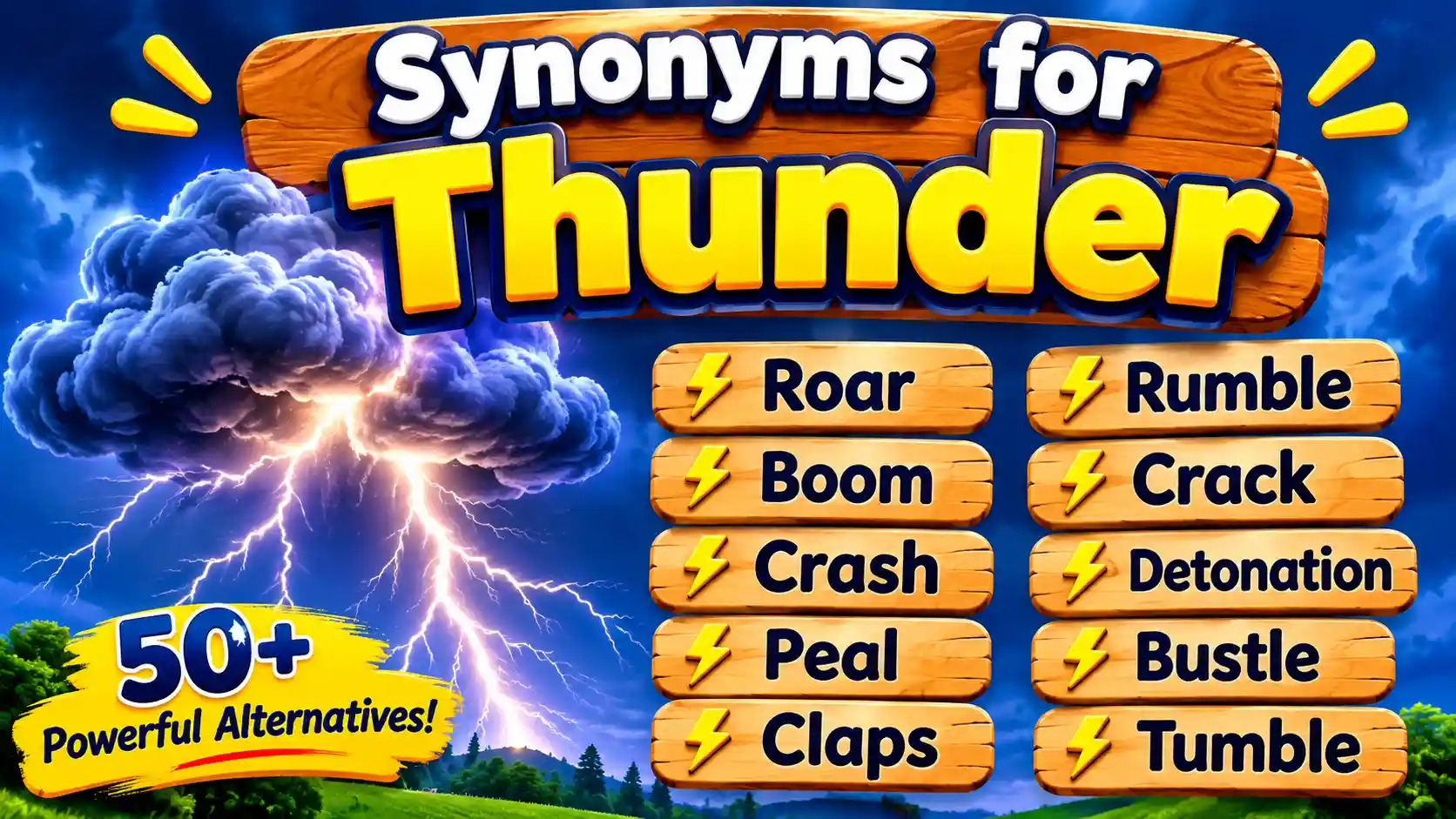
A flash of lightning, then a deep boom that shakes the windows. That sound is thunder, and it’s one of the most powerful words in English — it can describe a storm, a loud crowd, or even an angry voice. But thunder isn’t just one sound. Sometimes it’s a soft rumble far away, sometimes it’s a sharp clap right overhead, and sometimes it’s the roar of applause.
In this guide, you’ll learn what thunder really means, where the word comes from, and 40 synonyms grouped by sense — so you can pick the right word for a storm, a noise, a voice, or a story. Each word comes with a clear meaning, a best use, and a real example.
📖 Meaning of Thunder
Thunder is a noun, and it can also be a verb. As a noun, it is the loud sound that follows lightning. As a verb, it means to make that loud sound, or to speak very loudly.
- Definition: The loud, deep sound caused by lightning; a loud, explosive noise made when air expands suddenly after being heated by lightning.
- Part of speech: Noun and verb.
- Pronunciation: THUN-der /ˈθʌndər/
- Origin: From Old English thunor, from Proto-Germanic þunraz. It is related to Old Norse þórr — Thor, the Norse god of thunder — and to Latin tonāre, meaning “to thunder.” The word has been in English since before the year 900.
- Common usage: We use it for storms (“thunder and lightning”), loud noises (“the thunder of the crowd”), and loud speech (“he thundered at the team”). Writers also use it in the idiom “steal someone’s thunder,” meaning to take attention away from someone else’s news.
- Simple explanation: Lightning heats the air around it to about 30,000°C — five times hotter than the surface of the sun — in a tiny fraction of a second. The hot air expands so fast that it makes a huge sound wave. That sound wave is thunder.
📝 Top Synonyms of Thunder
The Sound After Lightning
| Word | Meaning | Best Use | Example |
| Rumble | A long, low, rolling sound | Distant thunder | A low rumble rolled across the hills. |
| Boom | A loud, deep, sudden sound | Close thunder | A boom shook the windows of the house. |
| Crash | A sudden, very loud noise | A thunderclap | A crash of thunder woke the baby. |
| Roar | A loud, deep, continuous sound | Storms and crowds | The roar of the storm filled the night. |
| Peal | A loud ringing sound that rises and falls | Thunder and bells | A peal of thunder echoed over the valley. |
| Clap | A short, sharp, loud sound | Close lightning | A clap of thunder came right after the flash. |
| Crack | A sudden sharp sound, like something breaking | Sharp thunder | A crack of thunder split the sky. |
| Roll | A long sound that moves and fades slowly | Rolling thunder | The roll of thunder lasted for a minute. |
| Growl | A low, deep, threatening sound | Storms and animals | The sky growled with distant thunder. |
| Blast | A sudden burst of loud sound | Explosions and storms | A blast of thunder hit the town. |
A Loud Noise in General
| Word | Meaning | Best Use | Example |
| Din | A loud, unpleasant, continuous noise | Crowds and streets | The din of the traffic never stopped. |
| Racket | A loud, noisy disturbance | Everyday speech | The kids made a racket in the garden. |
| Uproar | A loud noise from many people at once | Crowds and protests | The crowd broke into an uproar. |
| Tumult | A loud, confused noise | Formal writing | A tumult rose from the market square. |
| Clamour | A loud, demanding noise from a crowd | British formal use | A clamour went up from the fans. |
| Blare | A loud, harsh, trumpet-like sound | Music and horns | The blare of the horns filled the street. |
| Bang | A sudden, loud, sharp noise | Everyday speech | A bang from the kitchen scared us. |
| Thud | A dull, heavy sound of something falling | Falling objects | We heard a thud on the roof. |
| Reverberation | A sound that echoes and keeps going | Formal writing | The reverberation of the blast lasted long. |
| Hullabaloo | A loud, confused noise and fuss | Informal speech | What is all this hullabaloo about? |
Thunder as a Verb
| Word | Meaning | Best Use | Example |
| Bellow | To shout in a deep, loud voice | Angry speech | The coach bellowed at the players. |
| Shout | To speak very loudly | Everyday speech | She shouted my name across the street. |
| Yell | To cry out loudly | Everyday speech | The children yelled with joy. |
| Bark | To say something sharply and loudly | Orders and commands | The officer barked an order. |
| Resound | To fill a place with loud sound | Formal writing | Cheers resounded through the hall. |
| Reverberate | To echo loudly again and again | Formal writing | His voice reverberated in the cave. |
| Explode | To burst out suddenly with noise | Sudden sounds | The crowd exploded with cheers. |
| Burst | To break out suddenly and loudly | Sudden sounds | The band burst into a loud song. |
| Crackle | To make small, sharp, popping sounds | Fire and static | The fire crackled in the grate. |
| Howl | To make a long, loud, crying sound | Wind and voices | The wind howled through the trees. |
Thunderous and Powerful
| Word | Meaning | Best Use | Example |
| Thunderous | Very loud, like thunder | Applause and sounds | The singer got thunderous applause. |
| Deafening | So loud it is hard to hear anything else | Extreme noise | A deafening roar filled the stadium. |
| Stormy | Full of storms, or full of anger | Weather and moods | A stormy sky hung over the town. |
| Tempestuous | Wild and stormy, full of strong feelings | Formal writing | They had a tempestuous relationship. |
| Furious | Very angry and intense | People and storms | A furious wind tore at the roof. |
| Vehement | Showing strong feeling, forceful | Formal writing | He made a vehement protest. |
| Mighty | Very strong and powerful | Formal writing | A mighty wave crashed on the shore. |
| Powerful | Having great strength or force | Everyday and formal use | A powerful storm hit the coast. |
| Overwhelming | So strong it is hard to resist | Feelings and forces | An overwhelming noise filled the hall. |
| Earth-shaking | So strong it feels like the ground moves | Dramatic writing | An earth-shaking crash woke the town. |
Honest note: Thunder ke 4 alag senses hain — storm ki awaz, aam shor, verb (zor se bolna), aur thunderous jaisi sifat — koi aik lafz har jagah thunder ki jagah nahi le sakta. Isi liye groups alag rakhe gaye hain.
⚖️ Antonyms of Thunder
Thunder has no single perfect opposite, because it means a loud sound. These words are situational opposites — use the one that fits your sentence.
| Word | Meaning | Example |
| Silence | Complete quiet, no sound at all | After the storm, there was silence. |
| Quiet | Very little noise | The house was quiet at night. |
| Whisper | A very soft, low sound | She spoke in a whisper. |
| Calm | Peaceful and still, without noise | A calm evening followed the storm. |
| Stillness | The state of being still and quiet | The stillness of the forest was lovely. |
| Hush | A soft silence, often after noise | A hush fell over the crowd. |
| Murmur | A soft, low, continuous sound | A murmur ran through the room. |
| Peace | Quiet and freedom from disturbance | The valley was full of peace. |
| Softness | Gentle, quiet quality of sound | The softness of her voice calmed him. |
| Lull | A short period of quiet | A lull came between the storms. |
💬 Example Sentences
Daily Conversation
- The thunder woke me up last night.
- Did you hear that thunder? It was so loud!
- Thunder and lightning scared the dog.
- The storm passed, but the thunder kept going.
Academic English
- Thunder is caused by the rapid expansion of air heated by lightning.
- Sound travels at about 343 metres per second, so thunder comes after the flash.
- The study of thunder is called brontology.
- Claps of thunder last 0.2 to 2 seconds, while rumbles can last over 30 seconds.
Business English
- The new product launch made a thunderous impact on the market.
- The manager thundered about the missed deadline.
- The applause at the event was thunderous.
- Don’t let a rival steal your thunder with an early announcement.
Formal Writing
- The thunder of artillery echoed across the valley.
- A peal of thunder announced the coming storm.
- The speaker’s thunderous voice filled the great hall.
- The committee heard the tumult of the crowd outside.
Informal Writing
- That thunder was crazy loud last night!
- The kids made such a racket — it was like thunder in the house.
- My stomach rumbled like thunder before lunch.
- The fireworks went off with a huge boom.
Creative Writing
- Thunder rolled across the black sky like a drum.
- A crack of thunder split the night in two.
- The dragon’s roar was like thunder in the mountains.
- Rain fell, lightning flashed, and thunder growled overhead.
📚 Difference Between Similar Words
| Words | Meaning | When to Use | Example |
| Thunder vs Lightning | Thunder is the sound; lightning is the flash of light | Use lightning for the light, thunder for the sound | Lightning flashed, then thunder roared |
| Thunder vs Rumble | Rumble is a low, long sound; thunder is the whole sound of a storm | Use rumble for distant, low thunder | A distant rumble; a loud thunderclap |
| Thunder vs Roar | Roar is a continuous deep sound; thunder is a storm sound | Use roar for crowds, engines, and animals too | The roar of the crowd; the thunder of the storm |
| Thunder vs Boom | Boom is one sudden deep sound; thunder can be a whole series of sounds | Use boom for a single loud bang | A boom shook the house; thunder rolled on |
🎯 Best Alternative Words
- Professional Writing: rumble, roar, reverberation, tumult — formal words for loud sounds in reports.
- Essay Writing: thunder, peal, clap, reverberation — precise words that show you know the science.
- Email: boom, crash, loud noise — simple words that everyone understands fast.
- Business: thunderous, powerful, overwhelming — strong words for impact and applause.
- Conversation: boom, bang, rumble, racket — natural words for daily talk about storms and noise.
- Marketing: thunderous, earth-shaking, powerful — dramatic words that sell excitement.
- Creative Writing: growl, crack, roll, peal — vivid words that paint the storm in a story.
✍ Grammar Tips
- Part of speech: Thunder is both a noun and a verb. As a noun: “The thunder was loud.” As a verb: “It thundered all night.”
- Countable or uncountable: As a noun, thunder is usually uncountable: “I heard thunder.” The plural “thunders” is rare and poetic — don’t use it in everyday writing.
- Verb forms: thunder, thunders, thundered, thundering. Example: “It thunders every summer evening here.”
- Adjective forms: Thunderous means very loud, like thunder: “thunderous applause.” Thundery (British) describes weather: “a thundery afternoon.”
- Adverb form: Thunderously — “The crowd cheered thunderously.”
- Thunder vs lightning: Lightning is the light you see; thunder is the sound you hear. Don’t mix them up.
- Idiom: “Steal someone’s thunder” means to take attention away from someone else’s news or success.
- Spelling: T-H-U-N-D-E-R. Say it as THUN-der, with the “th” sound at the start.
- With nouns: It pairs with storm, lightning, applause, crowd, voice, and sky.
❌ Common Mistakes
| Wrong | Correct | Reason |
| The lightning was very loud. | The thunder was very loud. | Lightning is the flash of light; thunder is the sound you hear. |
| It thundered lightnings all night. | Lightning flashed all night. | Thunder is the sound, lightning is the light — don’t mix them. |
| The thunder was scary. | The thunder was scary. | Thunder is usually uncountable, so it has no -s plural. |
| He thundered quietly. | He thundered loudly. | A verb needs the adverb loudly, not the adjective quiet. |
| The applause was thunder. | The applause was thunderous. | Thunder is a noun; use the adjective thunderous to describe applause. |
| She stole his lightning. | She stole his thunder. | The idiom is “steal someone’s thunder,” not lightning. |
💡 Pro Writing Tips
- Match the sense: For a storm, pick rumble, boom, or peal. For a crowd, pick a roar or uproar. For a voice, pick below or thundered. The right sense matters more than a fancy word.
- Show the distance: A close strike is a clap or a boom. A far storm is a rumble or a roll. Distance changes the word.
- Use it as a verb in stories: “He thundered into the room” is stronger than “he came in angrily” — the verb carries the noise.
- Save “thunderous” for big moments: Thunderous applause, a thunderous ovation — if everything is thunderous, nothing feels big.
- Count the seconds: In real life, count the seconds between the flash and the sound, then divide by five for miles, or by three for kilometres. Writers can use this detail to make a storm scene feel real.
- Check your register: In science writing, use thunder, lightning, and sound waves. In stories, growl, crack, and roll paint a better picture.
📖 Related Words
- Associated words: lightning, storm, rain, cloud, flash, boom, rumble, applause, roar, crash
- Nearby words: thunderous, thundery, thunderously, thunderclap, thunderstorm, thunderbolt
- Contextual words: brontology, Thor, sound wave, shock wave, tempest, downpour
- Semantic variations: loud sound, deep boom, rolling noise, storm sound, angry voice
❓ FAQs
What does thunder mean?
Thunder is the loud, deep sound that follows lightning during a storm. Lightning heats the air to about 30,000°C in a fraction of a second, and the hot air expands so fast that it makes a huge sound wave. That sound wave is thunder. The word can also mean any very loud noise, like the thunder of a crowd.
What is the difference between thunder and lightning?
Lightning is the flash of light you see in the sky, and thunder is the sound you hear after it. Lightning heats the air, and the heated air expands fast to make thunder. Because light travels faster than sound, you see the flash first. Count the seconds between them to guess how far away the storm is.
What causes thunder?
Thunder is caused by lightning heating the air to about 30,000°C — five times hotter than the surface of the sun. The air expands so quickly that it creates a shock wave, and that shock wave is the sound we hear as thunder. A close strike sounds like a sharp clap, while a far one sounds like a low rumble.
What is the opposite of thunder?
There is no single opposite, because thunder means a loud sound. For quiet, use silence, quiet, or stillness. For a soft sound, use whisper or murmur. Pick the opposite that matches your sentence — silence fits a storm, while whisper fits a voice or a soft sound.
What does “steal someone’s thunder” mean?
“Steal someone’s thunder” means to take attention away from someone else’s news or success. It comes from the theatre in 1709, when playwright John Dennis invented a thunder sound for his play, and the theatre later used his sound for another play. Use it when someone shares your news first, or gets the praise you expected.
Is thunder a noun or a verb?
Thunder is both a noun and a verb. As a noun, it is the loud sound after lightning: “The thunder was loud.” As a verb, it means to make that sound: “It thundered all night.” It can also describe loud speech: “He thundered at the crowd.” Check the sentence to see which job the word is doing.
What is the adjective form of thunder?
The adjective form is thunderous, which means very loud, like thunder — for example, “thunderous applause.” Another adjective is thundery, used in British English for stormy weather, like “a thundery afternoon.” The adverb form is thunderously, as in “The crowd cheered thunderously after the final goal.”
Conclusion
Thunder is more than just a storm sound. It’s the deep rumble after lightning, the roar of a crowd, the boom of applause, and the voice of someone speaking with power. In this guide, you learned what thunder really means, where it comes from — Old English thunor, kin to Thor, the Norse god of thunder — and 40 synonyms grouped into four clear senses: storm sounds, loud noises, thunder as a verb, and thunderous words. You also saw antonyms, 24 example sentences, grammar tips, and the mistakes to avoid, like mixing up thunder and lightning. The next time you write about a storm, a crowd, or a loud voice, pick the synonym that matches your sound — rumble for far away, boom for close by, bellow for a voice — and your writing will sound clearer and stronger.