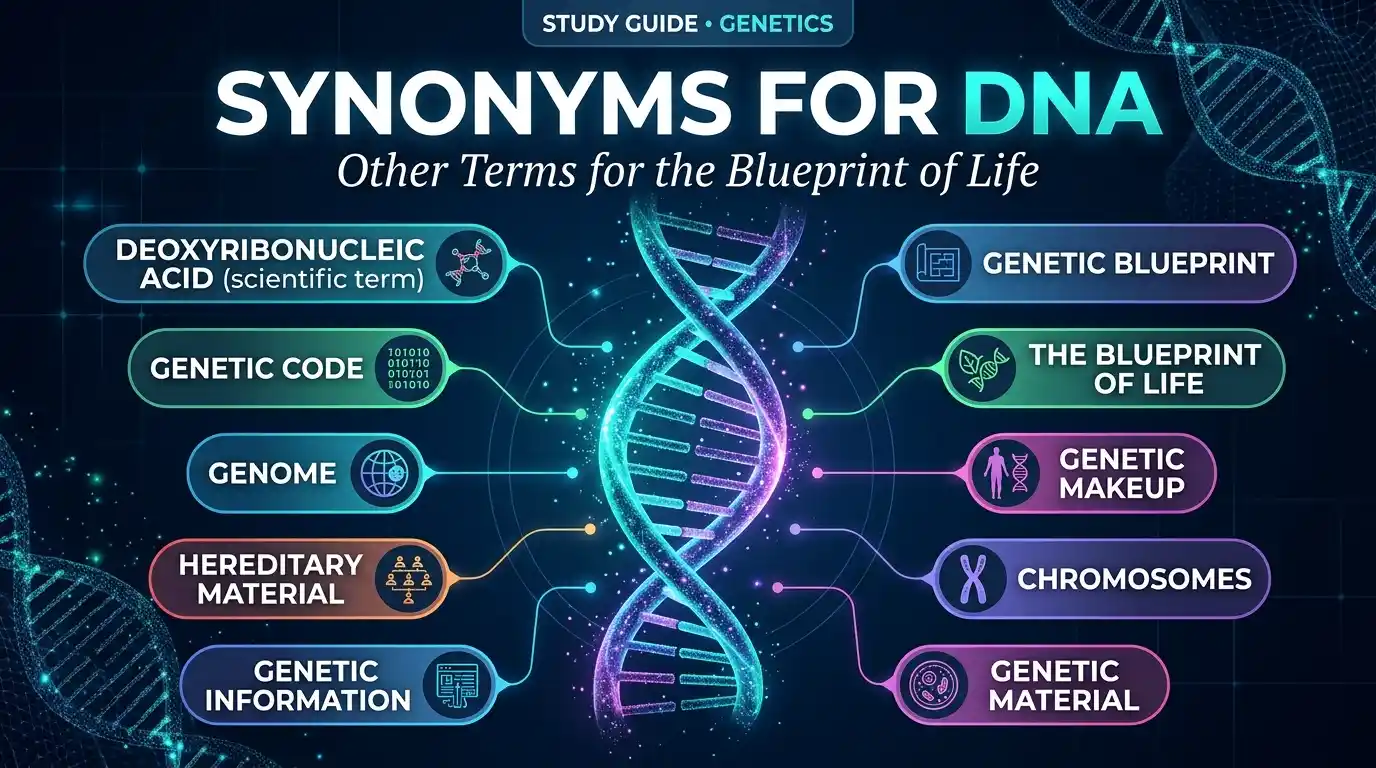
Looking for the best synonyms for DNA? Here’s the honest scientific truth: DNA is a specific molecule, so it has no exact synonym — the only true alternative name is its full form, deoxyribonucleic acid. But writers and students use many close terms: genetic material, genetic code, gene, genome, and double helix.
In this guide, you’ll learn 40 useful terms grouped by how they connect to DNA, plus the key differences between DNA, genes, chromosomes, and RNA. Every term is honestly labeled, so you’ll always know which words are true alternatives and which are related ideas. Let’s explore the language of life!
📖 Meaning of “DNA”
Definition: A molecule inside cells that carries the instructions for building and running a living thing. It passes traits from parents to children.
Part of Speech: Noun (usually uncountable).
Pronunciation: DNA is said letter by letter: “dee-en-AY.” The full name is “dee-OK-see-ry-boh-nyoo-KLEE-ik acid.”
Origin: Short for deoxyribonucleic acid — from deoxyribose (its sugar) + nucleic (found in the cell nucleus) + acid. DNA was first isolated by Friedrich Miescher in 1869; its double-helix structure was described by Watson and Crick in 1953, using Rosalind Franklin’s famous “Photo 51” data.
Common Usage: “DNA controls eye color.” “Police tested the DNA.”
Simple Explanation: DNA is your body’s instruction book — a long, twisted-ladder molecule that tells your cells how to build you.
📝 Top Synonyms of “DNA”
⚠️ Honesty note: Only the first group contains true ways to say DNA.
True Alternatives and Descriptions
| Word | Meaning | Best Use | Example |
| Deoxyribonucleic acid | The full scientific name of DNA | Science, formal | Deoxyribonucleic acid stores genetic data. |
| Genetic material | The material that carries genes | Biology | Genetic material passes to offspring. |
| Hereditary material | The material inherited from parents | Biology | Hereditary material shapes our traits. |
| Genetic code | The instructions written in DNA | Science, media | The genetic code builds proteins. |
| Genetic blueprint | A plan-like description of DNA | Simple explanations | DNA is the body’s genetic blueprint. |
| Genetic information | The data stored in DNA | Tech, science | Genetic information guides growth. |
| Genetic makeup | All the genes a person has | Health, identity | Your genetic makeup is unique. |
| Blueprint of life | A famous nickname for DNA | Writing, essays | DNA is called the blueprint of life. |
| Life’s instruction book | A simple metaphor for DNA | Kids, teaching | DNA is life’s instruction book. |
| Genetic fingerprint | A person’s unique DNA pattern | Forensics | The genetic fingerprint matched the suspect. |
Parts and Building Blocks
| Word | Meaning | Best Use | Example |
| Double helix | The twisted-ladder shape of DNA | Science | The double helix was discovered in 1953. |
| Gene | One section of DNA with one instruction | Biology | One gene controls blood type. |
| Chromosome | A long, coiled package of DNA | Cells, genetics | Humans have 46 chromosomes. |
| Genome | The complete set of DNA in a living thing | Research | The human genome was fully mapped in 2003. |
| Nucleotide | One building block of DNA | Chemistry | Each nucleotide has a base, sugar, and phosphate. |
| Base pair | Two matched DNA letters joined together | Genetics | Base pairs form the ladder’s rungs. |
| Strand | One side of the DNA ladder | Science | Each strand carries a copy of the code. |
| Codon | Three DNA letters that code for one amino acid | Advanced biology | A codon tells the cell what to build. |
| Helix | A spiral shape | General science | The helix twists like a staircase. |
| Genetic sequence | The order of letters in DNA | Testing, research | Scientists read the genetic sequence. |
Types and Forms of DNA
| Word | Meaning | Best Use | Example |
| Nuclear DNA | DNA inside the cell’s nucleus | Biology | Nuclear DNA comes from both parents. |
| Mitochondrial DNA (mtDNA) | DNA in the cell’s mitochondria — passed only from the mother | Ancestry, biology | Mitochondrial DNA traces the mother’s line. |
| Genomic DNA | DNA taken from the genome as a whole | Lab work | They extracted genomic DNA from the sample. |
| Chloroplast DNA | DNA inside plant chloroplasts | Botany | Chloroplast DNA helps plants make food. |
| Plasmid DNA | Small circular DNA in bacteria | Lab, medicine | Plasmid DNA carries extra traits in bacteria. |
| Viral DNA | DNA carried by a virus | Medicine | Some viruses inject viral DNA into cells. |
| Complementary DNA (cDNA) | Lab-made DNA copied from RNA | Research | cDNA is used to study active genes. |
| Recombinant DNA | DNA built by joining pieces from different sources | Biotech | Recombinant DNA produces insulin in labs. |
| Non-coding DNA | DNA that doesn’t build proteins (once called “junk DNA”) | Genetics | Non-coding DNA still has important jobs. |
| DNA profile | The result pattern from a DNA test | Forensics, ancestry | Her DNA profile confirmed her ancestry. |
Related Words Often Used Loosely
| Word | Meaning | Best Use | Example |
| RNA | DNA’s cousin molecule that carries messages | Biology | RNA carries DNA’s instructions to the cell. |
| Heredity | Passing traits from parents to children | General science | Heredity explains family likeness. |
| Inheritance | What is received from parents | Family, biology | Eye color is part of your inheritance. |
| Ancestry | Your family line through history | DNA testing | The test revealed her ancestry. |
| Trait | A feature like eye color or height | Everyday biology | Curly hair is a family trait. |
| Mutation | A small change in DNA | Evolution, health | A mutation changed the gene. |
| Bloodline | A family’s line of descent | Stories, history | The royal bloodline is ancient. |
| DNA test | A test that reads a person’s DNA | Health, ancestry | The DNA test showed his roots. |
| DNA sample | A small piece of material (blood, hair, saliva) used for testing | Forensics, labs | They collected a DNA sample. |
| Genetic testing | Checking DNA for health or ancestry answers | Medicine | Genetic testing found the risk early. |
⚖️ Antonyms
DNA has no true antonym — you can’t have an “opposite molecule.”
| Word | Meaning | Example |
| Nurture | Care and upbringing that shape a person | Nurture shapes habits and manners. |
| Environment | The world around a living thing | The environment affects plant growth. |
| Upbringing | The way a child is raised | His upbringing taught him kindness. |
| Learned behavior | Actions learned, not inherited | Table manners are learned behavior. |
| Experience | What a person lives through | Experience changes how we think. |
💬 Example Sentences
Daily Conversation
- My DNA test says I’m part Irish!
- Curly hair runs in our family’s DNA.
- The police found DNA on the jacket.
- Blue eyes are written in her DNA.
Academic English
- DNA stores genetic information in every cell.
- Scientists decoded the genome’s DNA sequence.
- A mutation is a permanent change in DNA.
- Mitochondrial DNA passes only from the mother.
Business English
- Our company culture is part of our brand DNA.
- The startup’s DNA is speed and bold ideas.
- Ancestry DNA kits are a booming business.
- Innovation is in this team’s DNA.
Formal Writing
- The report confirms the DNA profile matched the sample.
- Genetic material was extracted under strict conditions.
- The hereditary material determines inherited traits.
- Recombinant DNA technology transformed modern medicine.
Informal Writing
- Being clumsy is just in my DNA, lol.
- That plot twist? Totally in the show’s DNA.
- Got my DNA results — turns out I’m 100% snack-powered.
Creative Writing
- The double helix glowed like a staircase to the stars.
- The blueprint of life whispered inside every living cell.
- He inherited his father’s eyes and his mother’s stubborn trait.
- The ancient strand of DNA slept in the fossil for a million years.
📚 Difference Between Similar Words
| Word | What It Is | When to Use It |
| DNA | The molecule carrying all instructions | The molecule itself: “DNA controls traits.” |
| Gene | One section of DNA = one instruction | One trait: “A gene for eye color.” |
| Chromosome | A coiled package of DNA (humans have 46) | Cell structure: “Chromosomes sit in the nucleus.” |
| Genome | ALL the DNA of a living thing | The complete set: “The human genome.” |
| RNA | A working copy/messenger molecule | Protein building: “RNA carries the message.” |
Simple rule: Think of a library. DNA is all the books, the genome is the whole library, a chromosome is one shelf, a gene is one book, and RNA is a photocopy you take to the workshop. Size order: genome > chromosome > gene.
🎯 Best Alternative Words
- Professional Writing: DNA, genetic material — precise and clear.
- Email: DNA, genes — simple and friendly.
- Business: brand DNA, company DNA — the popular metaphor for core identity.
- Conversation: in my DNA, runs in the family — natural idioms.
- Marketing: blueprint of life, genetic fingerprint — vivid and memorable.
- Creative Writing: double helix, bloodline, life’s instruction book — poetic and visual.
✍ Grammar Tips
| Form | Word | Example |
| Noun | DNA | DNA is in every cell. |
| Plural | DNA (usually uncountable) | “DNAs” appears only in rare lab writing. |
| As adjective | DNA | DNA test, DNA sample, DNA profile. |
| Related adjective | genetic | Genetic traits, genetic testing. |
| Verb | — | No verb form exists. |
| Adverb | — | No adverb form exists. |
- Always capital letters: Write DNA, never “dna” — it’s an abbreviation of a long name.
- Singular verb: DNA is uncountable — “DNA is unique,” not “DNA are.”
- Who gives DNA: You inherit half your DNA from each parent — never from one parent only.
❌ Common Mistakes
| ❌ Wrong | ✅ Correct | 💡 Reason |
| DNAs is found in all cells. | DNA is found in all cells. | DNA is uncountable — singular verb, no -s. |
| I did a dna test yesterday. | I did a DNA test yesterday. | Abbreviations are written in capitals. |
| Deoxyribonucleic acid is short for DNA. | DNA is short for deoxyribonucleic acid. | DNA is the short form, not the long one. |
| DNA is a small part of a gene. | A gene is a small part of DNA. | The order is reversed — genes sit inside DNA. |
| He inherited all his DNA from his mother. | He inherited half his DNA from each parent. | Nuclear DNA comes from both parents. |
| Your DNAs are unique to you. | Your DNA is unique to you. | No plural in everyday English. |
💡 Pro Writing Tips
- Spell it out once. In formal writing, use “deoxyribonucleic acid (DNA)” the first time, then just DNA.
- Never force a fake synonym. Scientists respect honesty: if you mean DNA, write DNA. Use genetic material only when varying your words in a paragraph.
- Keep the hierarchy straight. Genome > chromosome > gene — mixing these up is the most common science-writing error.
- The business metaphor is fine — in business. “Brand DNA” is accepted in marketing, but keeps it out of biology essays.
📖 Related Words
- Associated words: deoxyribonucleic acid, double helix, gene, chromosome, genome, nucleotide
- Nearby words: RNA, protein, cell, nucleus, heredity, mutation
- Contextual words: DNA test, ancestry, forensics, paternity test, genetic engineering, cloning
- Semantic variations: genetic code, genetic makeup, hereditary material, bloodline
FAQs
1. What does DNA stand for?
DNA stands for deoxyribonucleic acid. The name comes from its parts: deoxyribose (its sugar), nucleic (it’s found in the cell nucleus), and acid. Say it as “dee-OK-see-ry-boh-nyoo-KLEE-ik acid.” Because the full name is so long, everyone — even scientists — just says DNA, letter by letter: “dee-en-AY.”
2. Does DNA have any real synonyms?
Honestly, almost none. DNA names one specific molecule, so the only true alternative is its full name, deoxyribonucleic acid. Descriptive phrases like genetic material, hereditary material, and genetic blueprint can stand in for it in sentences. Words like gene, genome, and RNA are related — but they are not synonyms, and scientists never swap them.
3. What is DNA in simple words?
DNA is your body’s instruction book. It’s a long molecule, shaped like a twisted ladder, that lives inside your cells. It tells your body how to grow, what color your eyes are, and how tall you’ll be. You received half of it from your mother and half from your father.
4. What is the difference between DNA and a gene?
DNA is the whole long molecule; a gene is just one short section of it — one instruction. A single human DNA set contains about 20,000 genes. Think of DNA as the whole cookbook and each gene as one recipe. Mixing them up is the most common mistake in school science writing.
5. What is the difference between DNA and RNA?
DNA is the master instruction book, stored safely in the cell nucleus, built as a double strand with the letter T (thymine). RNA is a single-strand working copy that carries instructions out to build proteins, and it uses U (uracil) instead of T. DNA stores; RNA delivers and helps build.
6. Where is DNA found in the body?
Almost every cell in your body holds DNA in its control center, the nucleus. You have about 2 meters of DNA packed into each cell! A small extra set lives in the mitochondria (the cell’s power stations) — that mitochondrial DNA comes only from your mother. Red blood cells are a rare exception: they have no nucleus and no DNA.
7. Who discovered the structure of DNA?
James Watson and Francis Crick described the double-helix structure in 1953. Their work depended on “Photo 51,” an X-ray image taken by Rosalind Franklin and her student Raymond Gosling. DNA itself had been discovered earlier — Friedrich Miescher first isolated it in 1869 and called it “nuclein.”
8. What is DNA made of?
DNA is built from smaller units called nucleotides. Each nucleotide has three parts: a sugar (deoxyribose), a phosphate, and one of four bases — adenine (A), thymine (T), cytosine (C), and guanine (G). The bases pair up, A with T and C with G, forming the rungs of the twisted ladder.
Conclusion
Now you know the honest answer about synonyms for DNA: the molecule has no exact synonym — only its full name, deoxyribonucleic acid, and descriptive phrases like genetic material and genetic blueprint. You’ve also learned 40 related terms, the library rule (genome > chromosome > gene), and the traps to avoid (DNA is uncountable, always capitalized, and half from each parent). Keep practicing with the example sentences, explore the related words, and check out more vocabulary guides on Synonymfy.com to keep building your English — and your science smarts!