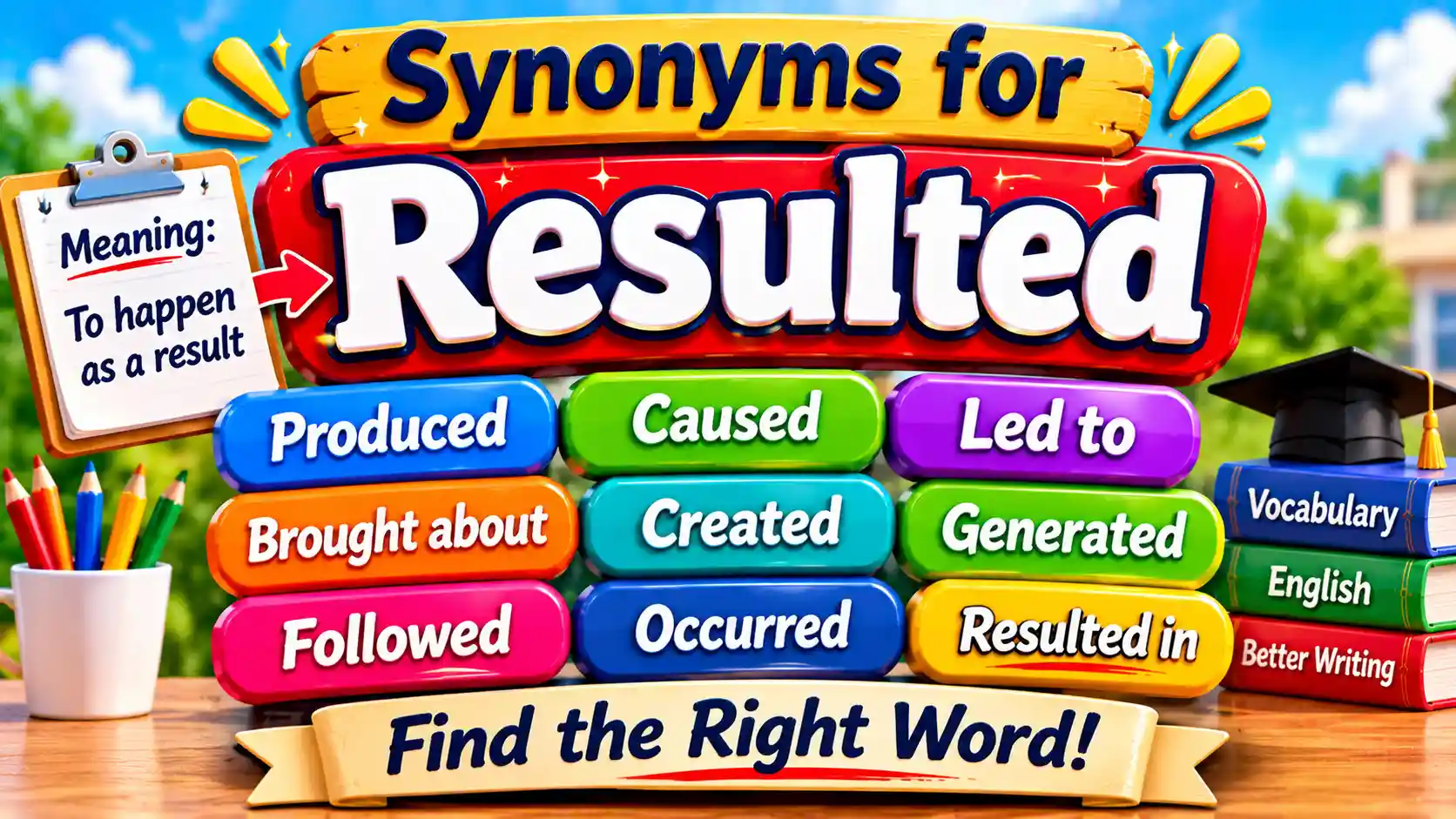
One small word — resulted — can mean two opposite directions, and that is what makes it tricky. “The rain resulted in a flood” and “The flood resulted from the rain” describe the same event, but the words point in different directions. That is why finding synonyms for results feels confusing: the right replacement depends on whether you mean “led to” or “came from.”
In this guide, you’ll learn 40 synonyms for results, grouped honestly by sense: caused something, ended with an outcome, came from something, and formal cause words. You’ll also get example sentences, grammar tips, and answers to common questions — so you’ll always pick the exact word for your sentence. Let’s get the direction right.
📖 Meaning of Resulted
Resulted is the past tense (and past participle) of the verb result. It means something happened as a consequence — one thing caused another, or one thing came from another.
- Pronunciation: rih-ZULT-id (three syllables, stress on ZULT)
- Part of speech: Verb — past tense and past participle of result
- Word family: result (base verb and noun), results (third person singular and plural noun), resulting (present participle), resultant (adjective — happening as a result)
- Origin: From Latin resultare, meaning “to spring back” (re- “back” + saltare “to leap, jump”)
- Two main directions: (1) result in — to cause: “The rain resulted in a flood”; (2) result from — to be caused by: “The flood resulted from the rain”
- Honest note: No single word replaces results everywhere. Each group below captures one sense only, so no word lands in the wrong meaning — “stemmed from” works for a cause, but never for an outcome.
📝 Top Synonyms for Resulted
Caused Something (Resulted In)
| Word | Meaning | Best Use | Example |
| Caused | Made something happen | Everyday, all writing | The storm caused a power cut. |
| Led to | Brought about as a consequence | Everyday, formal writing | Her practice led to a gold medal. |
| Brought about | Caused a change or event | Formal writing | The new law brought about safer roads. |
| Produced | Created an outcome | Academic, business | The experiment produced clear data. |
| Triggered | Started a chain of events | News, formal writing | The alarm triggered an evacuation. |
| Sparked | Started something suddenly | News, creative writing | The speech sparked a big debate. |
| Generated | Created or produced something | Business, academic | The sale generated strong profits. |
| Prompted | Caused someone to act | Formal writing | The letter prompted a quick reply. |
| Gave rise to | Caused something new to appear | Formal, academic | The discovery gave rise to new research. |
| Set off | Started something, often suddenly | Everyday, news | The rumor set off a panic. |
Ended With an Outcome (Resulted In)
| Word | Meaning | Best Use | Example |
| Ended in | Finished with a particular outcome | Everyday, stories | The match ended in a draw. |
| Culminated in | Reached a final, often grand result | Formal writing | Years of work culminated in a prize. |
| Concluded with | Finished with something | Formal, reports | The meeting concluded with an agreement. |
| Finished with | Ended with a result | Everyday writing | The day finished with a surprise party. |
| Wound up in | Ended up in a situation | Informal writing | He wound up in hospital after the fall. |
| Turned out as | Proved to be in the end | Everyday, stories | The trip turned out as a great adventure. |
| Amounted to | Added up to a final total | Formal writing | His savings amounted to a small fortune. |
| Came to | Reached a final point | Everyday writing | The talks came to a peaceful end. |
| Developed into | Grew gradually into something | Academic, stories | The idea developed into a real business. |
| Eventuated in | Happened as a final result | Formal, rare | The talks eventuated in a new treaty. |
Came From Something (Resulted From)
| Word | Meaning | Best Use | Example |
| Stemmed from | Grew out of a cause | Formal, academic | The problem stemmed from poor planning. |
| Arose from | Came into being because of something | Formal writing | The dispute arose from a misunderstanding. |
| Sprang from | Came suddenly from a source | Literary, formal | Her courage sprang from deep faith. |
| Flowed from | Came naturally as a consequence | Formal, literary | His calm flowed from years of practice. |
| Grew out of | Developed from an earlier cause | Everyday, stories | The club grew out of a school project. |
| Emerged from | Came out of a situation | News, formal writing | A new leader emerged from the crisis. |
| Derived from | Came originally from a source | Academic writing | The word derived from Latin. |
| Followed from | Happened as a consequence of something | Formal, logic | The conclusion followed from the facts. |
| Originated in | Began in a place or cause | Academic, history | The dance originated in Spain. |
| Came from | Had its source in something | Everyday writing | Her confidence came from hard work. |
Formal Cause Words (Resulted In)
| Word | Meaning | Best Use | Example |
| Occasioned | Caused something, formal | Legal, formal writing | The error occasioned a long delay. |
| Precipitated | Caused something suddenly | Formal, news | The crisis precipitated an election. |
| Engendered | Gave birth to a feeling or situation | Formal, academic | The speech engendered great hope. |
| Effected | Brought about a change | Formal, legal | The reform effected real change. |
| Induced | Caused something to happen | Academic, medical | The drug induced deep sleep. |
| Elicited | Drew out a response | Formal, academic | The question elicited a smile. |
| Evoked | Brought a feeling to mind | Literary, formal | The song evoked warm memories. |
| Begot | Gave rise to, old-fashioned | Literary, rare | Success begot more success. |
| Wrought | Caused or worked, literary | Literary, formal | The storm wrought great damage. |
| Spawned | Gave rise to many new things | News, business | The hit spawned a whole series. |
⚖️ Antonyms
Resulting has no single opposite, because its meaning changes with direction — but these words describe the reverse of a result: stopping an outcome instead of causing one.
| Word | Meaning | Example |
| Prevented | Stopped something from happening | Quick action prevented a disaster. |
| Averted | Turned away a bad outcome | The pilot averted a crash. |
| Stopped | Brought something to an end | The rain stopped the match. |
| Blocked | Got in the way of something | The wall blocked the floodwater. |
| Thwarted | Stopped a plan from working | Guards thwarted the escape plan. |
💬 Example Sentences
Daily Conversation
- The late bus resulted in a missed meeting.
- Too much rain resulted in a muddy garden.
- Her joke resulted in a room full of laughter.
- Skipping breakfast resulted in a grumpy morning.
Academic English
- The new policy resulted in higher attendance.
- Poor sampling resulted in weak evidence.
- The study resulted in three clear findings.
- Climate change resulted in rising sea levels.
Business English
- The campaign resulted in record sales.
- The merger resulted in two hundred new jobs.
- Cutting costs resulted in bigger profits.
- The launch resulted in worldwide press coverage.
Formal Writing
- The treaty resulted in lasting peace.
- The reform resulted in fairer elections.
- Negligence resulted in a heavy fine.
- The inquiry resulted in new safety rules.
Informal Writing
- The party resulted in a huge mess.
- His prank resulted in detention.
- The sale resulted in a shopping spree.
- One text resulted in a week of gossip.
Creative Writing
- The storm resulted in a flooded village.
- Her song resulted in tears and applause.
- The secret resulted in a broken friendship.
- Dawn resulted in golden light on the hills.
📚 Difference Between Similar Words
| Words | Difference | When to Use Each | Example |
| Resulted vs caused | Caused is direct; resulted often needs in or from | Caused for direct action; resulted for outcomes | The storm caused damage / The storm resulted in damage. |
| Resulted vs led to | Led to is smoother and more common | Led to for everyday writing; resulted for formal reports | Practice led to success / Practice resulted in success. |
| Resulted vs ended | Ended is about finishing; resulted is about consequence | Ended for final states; resulted for cause and effect | The game ended in a draw / The rain resulted in a delay. |
| Resulted vs followed | Followed is about order; resulted is about cause | Followed for sequence; resulted for consequences | The speech followed the news / Calm followed from the news. |
| Resulted vs happened | Happened is neutral; resulted shows a cause | Happened for any event; resulted when a cause matters | It happened yesterday / It resulted from the storm. |
🎯 Best Alternative Words
- Professional Writing: led to, stemmed from, culminated in, prompted
- Essay Writing: brought about, arose from, concluded with, derived from
- Email: led to, came from, ended in (keep it simple)
- Business: generated, produced, prompted, amounted to
- Conversation: led to, came from, ended in, turned out as
- Marketing: sparked, spawned, generated (for energy and growth)
- Creative Writing: sprang from, evoked, wrought, wound up in
✍️ Grammar Tips
- Regular verb: Result adds -ed: result → resulted. No spelling change, because result ends in a consonant, not a vowel + y (compare: try → tried).
- “Result in” vs “result from”: This is the key rule. “Result in” means to cause (“Rain resulted in floods”), while “result from” means to be caused by (“Floods resulted from rain”). Swapping them reverses the meaning.
- Past tense and past participle: Both forms are “resulted” — “It resulted in success” (past) and “It has resulted in success” (present perfect).
- Third person present: He/she/it results (not “result”). Present participle: resulting.
- Result as a noun: “A result” is a countable noun (“good results”), while “as a result” is a fixed phrase meaning “because of this.”
- “Resultant” as an adjective: In “the resultant damage,” resultant means happening as a result — formal, mostly in reports.
- Don’t confuse: Result (outcome) vs resort (a place to relax, or to turn to for help) — they sound alike but mean different things.
❌ Common Mistakes
| Wrong | Correct | Reason |
| The rain caused the flood. | The rain resulted in the flood. | Result needs in or from after it, never a direct object. |
| His hard work resulted from success. | His hard work resulted in success. | Result in means to cause; result from means to be caused by. |
| The plan failed. | The plan resulted in failure. | Result is followed by in or from, never by to. |
| The accident resulted in damage. | The accident resulted in damage. | Past events need the past form results. |
| It was caused by the storm. | It resulted from the storm. | Result is not used in the passive here; use resulted from. |
| The decision resulted in a new rule. | The decision resulted in a new rule. | The preposition is in, not on. |
💡 Pro Writing Tips
- Pick the direction first: Ask “did it cause, or was it caused?” before choosing a synonym — that one question prevents most mistakes.
- Use “led to” for everyday writing: It is clearer and more natural than “resulted in” in most sentences.
- Save formal verbs for formal writing: “Occasioned” and “precipitated” belong in reports, not in texts to friends.
- Vary, don’t repeat: In a report, rotate led to, prompted, and culminated in instead of writing “resulted in” ten times.
- Check the preposition: After any synonym, check whether your sentence needs in, from, or nothing at all — “caused” takes no preposition, “stemmed from” always takes from.
- Prefer strong verbs in stories: “Sparked” and “spawned” carry far more energy than plain “resulted.”
📖 Related Words
- Associated Words: result, outcome, consequence, effect, cause, aftermath, conclusion, product, upshot, sequel
- Nearby Words: result, results, resulting, resulted, resultant, result in, result from, as a result
- Contextual Words: resulted in success, resulted from rain, resulted in a delay, resulted in damage, resulted from poor planning, as a result
- Semantic Variations: led to, caused, stemmed from, culminated in, triggered, produced, ended in, arose from
FAQs
What is a synonym for results?
Common synonyms for results include led to, caused, triggered, stemmed from, and culminated in — but the right word depends on direction. Use led to or caused for “resulted in,” and stemmed from or arose from for “resulted from.” This guide lists 40 synonyms in total, grouped by meaning so you can pick accurately.
What is the past tense of result?
The past tense of the result is the result. It is a regular verb, so you simply add -ed to the base form, with no spelling change. For example: “Yesterday, the rain resulted in floods.” The past participle is also resulted, as in “The policy has resulted in higher attendance,” and the present participle is resulting.
What is the difference between result in and result from?
“Result in” means to cause something: “Rain resulted in floods.” “Result from” means to be caused by something: “Floods resulted from rain.” Swapping them reverses the meaning, so check the direction before you write. This in/from rule is the most common mistake learners make with this verb.
Is the result a verb or a noun?
Resulted is a verb — the past tense and past participle of result, as in “The plan resulted in success.” The noun form is result, as in “a good result,” and the adjective form is resultant, as in “the resultant damage.” In most sentences, though, you will see “resulted” working as a verb describing a consequence.
What is the opposite of the result?
The result has no single opposite because its meaning changes with direction. For “resulted in,” opposites include prevented, averted, and stopped — words for blocking an outcome. For example, “Quick action prevented a disaster” is the opposite of “The fault resulted in a disaster.” Choose the opposite that fits your sentence’s sense.
How do you use the result in a sentence?
Use resulted in or from: “The campaign resulted in record sales,” or “The delay resulted from bad weather.” Remember the direction rule: result in means to cause, result from means to be caused by. Never write “resulted” with a direct object or with to or on — “resulted the flood” and “resulted on a rule” are both wrong.
What does “as a result” mean?
“As a result” is a fixed phrase meaning “because of this” or “therefore.” For example: “It rained all night. As a result, the match was cancelled.” It connects a cause to its consequence without repeating the verb result, and it works at the start of a sentence or after a comma in formal and everyday writing alike.
What are some synonyms for results in business?
In business, good synonyms for results include generated, produced, prompted, and amounted to. For example, “The campaign generated record sales,” or “The merger amounted to two hundred new jobs.” These words sound professional and precise, and they avoid repeating “resulted in” in reports and emails.
Conclusion
Resulted is a small word with a surprisingly big job — it covers causes, outcomes, and origins, and it points in two directions at once. With these 40 synonyms for results, you can now choose the exact word for every sentence: led to for everyday causes, stemmed from for origins, culminated in for grand outcomes, and precipitated for formal reports. Remember the two traps from this guide: result in means to cause, while result from means to be caused by — and never write results with a direct object. Keep those rules in mind, and your English will sound sharper and more precise. Explore more words on Synonymfy.com, and keep your vocabulary growing — one well-chosen word at a time.