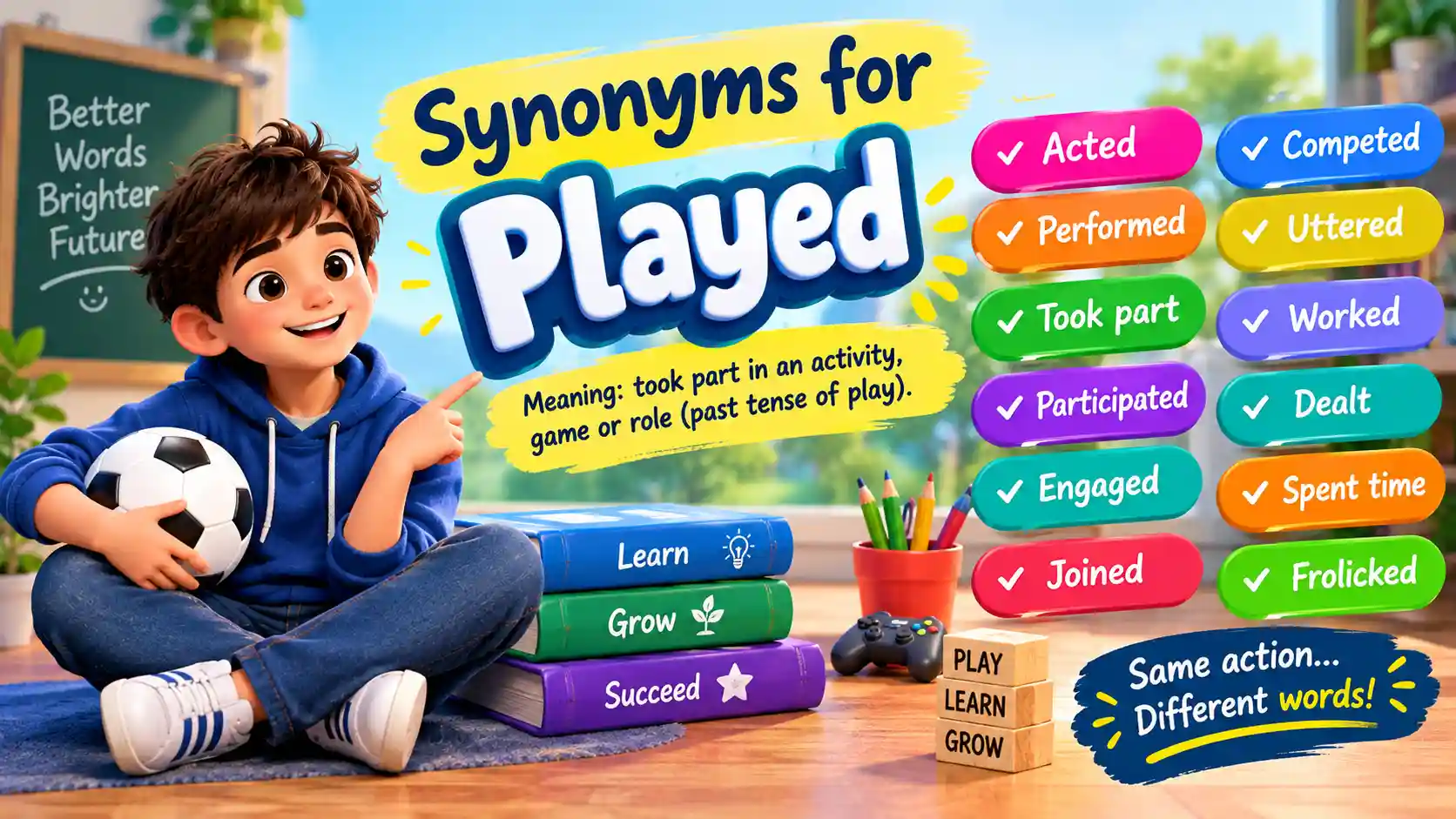
“She played the piano.” “He played football.” “They played a trick on him.” One little word — played — and three totally different meanings! That’s why finding synonyms for playing can feel tricky: the right replacement depends on what kind of playing you mean.
In this guide, you’ll learn 40 synonyms for played, grouped honestly by sense: games and sports, music, acting a role, and tricks. You’ll also get example sentences, grammar tips, and answers to common questions — so you’ll always pick the exact word for your sentence. Let’s play with words — the fun way.
📖 Meaning of Played
Played is the past tense (and past participle) of the verb play. It means someone took part in a game, made music, acted a part, or — in a sneaky sense — tricked someone.
- Pronunciation: PLAYD (one syllable, rhymes with “made”)
- Part of speech: Verb — past tense and past participle of play
- Word family: play (base verb), plays (third person singular), playing (present participle), played (past tense and past participle), player (noun — a person who plays), playful (adjective — fun-loving)
- Origin: From Old English plegian, meaning “to play, exercise, or frolic”
- Four main senses: (1) games and sports — “We played tennis”; (2) music — “She played the violin”; (3) acting — “He played Hamlet”; (4) tricks — “They played a trick on us”
- Honest note: No single word replaces played everywhere. Each group below captures one sense only, so no word lands in the wrong meaning — “portrayed” works for a role, but never for a football match.
📝 Top Synonyms for Played
Games and Sports
| Word | Meaning | Best Use | Example |
| Competed | Took part in a contest against others | Sports, competitions | She competed in the school tournament. |
| Participated | Took part in an activity | Formal writing, reports | He participated in the charity match. |
| Contended | Struggled to win against rivals | Formal, sports writing | They contended for the championship. |
| Vied | Competed eagerly for something | Formal writing | The two teams vied for first place. |
| Battled | Fought hard in a contest | Dramatic sports writing | The rivals battled until the final whistle. |
| Challenged | Faced someone in a contest | Sports, games | He challenged his friend to chess. |
| Opposed | Played against someone | Formal writing | Our team opposed the champions. |
| Engaged | Took part in an activity | Formal writing | The children engaged in a board game. |
| Scrimmaged | Played a practice game | Sports, team practice | The team scrimmaged before the season. |
| Matched | Competed evenly against someone | Sports writing | She matched her rival point for point. |
Music
| Word | Meaning | Best Use | Example |
| Performed | Played music for an audience | Concerts, shows | She performed the song beautifully. |
| Rendered | Played or sang a piece of music | Formal, classical music | He rendered the sonata with feeling. |
| Executed | Played a piece skillfully | Formal music writing | The pianist executed the piece flawlessly. |
| Strummed | Played a guitar by brushing the strings | Guitar, folk music | He strummed his guitar by the fire. |
| Drummed | Played drums with sticks or hands | Bands, rhythm | She drummed through the whole song. |
| Plucked | Played strings by pulling them | Guitar, harp | He plucked the harp strings gently. |
| Bowed | Played a violin with a bow | Violin, cello | She bowed the final note softly. |
| Piped | Played a pipe or flute | Folk, traditional music | He piped a tune on his flute. |
| Fiddled | Played the violin casually | Informal, folk music | Grandpa fiddled at the village dance. |
| Sounded | Made a musical sound | Instruments, bells | The trumpet sounded across the hall. |
Acting a Role
| Word | Meaning | Best Use | Example |
| Portrayed | Acted the part of a character | Films, theatre | She portrayed the queen in the play. |
| Enacted | Performed a role on stage | Theatre, formal writing | He enacted the hero’s journey. |
| Depicted | Showed a character through acting | Films, reviews | The actor depicted a brave soldier. |
| Impersonated | Acted as someone else | Comedy, mimicry | He impersonated the teacher perfectly. |
| Acted | Performed a role | Everyday, theatre | She acted in the school play. |
| Starred | Had the main role | Films, theatre | He starred as the detective. |
| Embodied | Fully became a character | Reviews, literary writing | She embodied the spirit of the role. |
| Personified | Gave human form to an idea | Literary writing | He personified courage on stage. |
| Mimicked | Copied someone’s acting style | Comedy, informal | She mimicked the singer’s moves. |
| Dubbed | Voiced a role in another language | Films, animation | He dubbed the hero’s voice. |
Tricks and Deception
| Word | Meaning | Best Use | Example |
| Tricked | Fooled someone with a trick | Everyday, stories | They tricked him with a fake letter. |
| Fooled | Deceived someone playfully or cruelly | Everyday, stories | She fooled us all with her disguise. |
| Deceived | Made someone believe something false | Formal writing | He deceived his rivals for years. |
| Duped | Tricked someone into believing a lie | News, formal writing | The buyers were duped by the scam. |
| Manipulated | Cleverly controlled someone | Formal, serious writing | He manipulated the whole committee. |
| Outwitted | Beat someone by being cleverer | Stories, games | She outwitted her opponent easily. |
| Cheated | Won unfairly by breaking rules | Games, exams | He cheated at cards and got caught. |
| Hoodwinked | Tricked someone completely | Informal, stories | They hoodwinked the guards with a costume. |
| Bamboozled | Confused and tricked someone | Informal, humorous | He bamboozled us with fast talk. |
| Toyed | Treated someone lightly, as a game | Relationships, stories | She toyed with his feelings all summer. |
⚖️ Antonyms
Play has no single opposite, because its meaning changes — but these words describe the reverse of playing: not taking part, stopping, or being serious.
| Word | Meaning | Example |
| Refrained | Held back from taking part | He refrained from the game entirely. |
| Abstained | Chose not to take part | She abstained from the match. |
| Skipped | Missed an activity on purpose | They skipped practice that day. |
| Quit | Stopped playing for good | He quit the team last year. |
| Watched | Observed instead of playing | She watched from the sidelines. |
💬 Example Sentences
Daily Conversation
- We played cards until midnight.
- She played the guitar at the party.
- He played the clown and made everyone laugh.
- Don’t let anyone play tricks on you like that.
Academic English
- The students participated in a group game during class.
- The orchestra performed Beethoven’s symphony last night.
- The actor portrayed a scientist in the school play.
- The study showed how children engaged in pretend play.
Business English
- Our team competed in the company sports day.
- She performed the presentation with great confidence.
- He starred in the company’s training video.
- The rivals outwitted us in the final round of talks.
Formal Writing
- The violinist rendered the concerto with great skill.
- The committee was manipulated by false promises.
- The two armies battled for control of the valley.
- The singer embodied the role of the tragic queen.
Informal Writing
- Grandpa fiddled a happy tune on his old violin.
- He bamboozled us all with his magic tricks.
- They scrimmaged on Saturday before the big game.
- She toyed with the idea of joining the band.
Creative Writing
- The children battled dragons in their backyard game.
- Moonlight fell as she bowed the last sad note.
- He impersonated the king so well that the guards bowed.
- The old fox hoodwinked the farmer with a clever plan.
📚 Difference Between Similar Words
| Words | Difference | When to Use Each | Example |
| Played vs competed | Competed means a contest; played is broader | Competed for contests; played for any game | They competed in the final / They played cards. |
| Played vs performed | Performed means for an audience; played can be casual | Performed for shows; played for fun too | She performed on stage / She played at home. |
| Played vs portrayed | Portrayed means acting a character; played covers more | Portrayed for roles; played for games and music | She portrayed the queen / She played tennis. |
| Played vs tricked | Tricked means deceived; played is neutral | Tricked for deception; played for games | They tricked him / They played chess. |
| Played vs practiced | Practiced means training; played means the real game | Practiced for rehearsal; played for the match | They practiced all week / They played on Sunday. |
🎯 Best Alternative Words
- Professional Writing: participated, rendered, portrayed, manipulated
- Essay Writing: competed, performed, enacted, depicted
- Email: participated, performed, acted (keep it simple)
- Business: competed, engaged, outwitted, performed
- Conversation: played, battled, strummed, fooled
- Marketing: starred, performed, embodied (for star power)
- Creative Writing: battled, bowed, impersonated, hoodwinked
✍️ Grammar Tips
- Regular verb: Play adds -ed: play → played. No spelling change, because play ends in a vowel + y (compare: try → tried).
- Past tense and past participle: Both forms are “played” — “She played yesterday” (past) and “She has played before” (present perfect).
- After “did,” use “play”: “Did you play?” is correct; “Did you played?” is wrong — did already carry the past tense.
- Third person present: He/she/it plays (not “play”). Present participle: playing.
- “Played” as an adjective: In “played out,” it means tired or overused — “a played-out joke.”
- Phrasal uses: “Played along” (pretended to agree), “played down” (made less important), “played up” (emphasized).
- Don’t confuse: Played (past of play) vs plaid (a checked fabric pattern) — they sound alike but mean different things.
❌ Common Mistakes
| Wrong | Correct | Reason |
| Did you play yesterday? | Did you play yesterday? | After “did,” use the base verb play. |
| He playd the piano. | He played the piano. | The spelling is played, not playd. |
| She has played tennis. | She has played tennis. | Present perfect needs the past participle played. |
| They played football. | They played football. | Plaid is a fabric; played is the verb. |
| He playsed the role well. | He played the role well. | No extra -s- in the past form. |
| We played chess. | We played chess. | Play is already past; don’t add “was” for a simple past action. |
💡 Pro Writing Tips
- Pick the sense first: Ask “game, music, role, or trick?” before choosing a synonym — that one question prevents most mistakes.
- Use strong verbs in sports writing: “Battled” and “vied” carry far more energy than plain “played.”
- Save “performed” for audiences: If nobody watched, “played” or “practiced” is more honest.
- Use trick words carefully: “Manipulated” and “deceived” are serious — don’t use them for harmless jokes.
- Vary, don’t repeat: In a match report, rotate, compete, battle, and face instead of writing “played” ten times.
📖 Related Words
- Associated Words: game, match, player, team, music, role, actor, trick, sport, concert
- Nearby Words: play, plays, playing, player, playful, playtime, playground, replay
- Contextual Words: played a game, played a song, played a part, played a trick, played along, played out
- Semantic Variations: competed, performed, portrayed, tricked, battled, rendered, enacted, fooled
FAQs
What is a synonym for played?
Common synonyms for played include competed, participated, performed, portrayed, and tricked — but the right word depends on the sense. Use competed for games, performed for music, portrayed for acting roles, and tricks for deception. This guide lists 40 synonyms in total, grouped by meaning so you can pick accurately.
What is the past tense of play?
The past tense of play is played. It is a regular verb, so you simply add -ed to the base form, with no spelling change. For example: “Yesterday, we played football.” The past participle is also played, as in “We have played this game before,” and the present participle is playing.
Is played a verb or an adjective?
Played is mainly a verb — the past tense and past participle of play, as in “She played the piano.” It can also work as an adjective in phrases like “a played-out joke,” meaning tired or overused. In most sentences, though, you will see “play” as a verb describing something someone did in the past.
What is the difference between played and performed?
Performed means playing music or acting for an audience, while played is broader and can be casual. “She performed on stage” suggests a show with watchers, while “She played at home” can mean practice or fun. Use performed when there is an audience, and played for games, practice, or casual music.
What is the opposite of playing?
Play has no single opposite because its meaning changes with context. For games, opposites include refrained, abstained, and skipped — words for not taking part. For example, “She watched from the sidelines” is the opposite of “She played the match.” Choose the opposite that fits your sentence’s sense.
How do you use played in a sentence?
Use played as the past form of play: “We played tennis yesterday,” “She played the violin,” or “He played the hero.” Remember the did rule: after “did,” use play, not played — “Did you play?” is correct, while “Did you played?” is a common mistake learners should avoid.
What does “played a trick” mean?
“Played a trick” means fooling or deceiving someone, usually as a joke or a scam. For example, “They played a trick on him” means they tricked him. Stronger synonyms for this sense include tricked, fooled, duped, and hoodwinked, while lighter jokes can use “played a prank” instead.
What is the difference between played and practiced?
Practising means training or rehearsing, while playing usually means taking part in the real game or performance. “They practiced all week” describes preparation, while “They played on Sunday” describes the actual match. In music, practice means rehearsal and play can mean either rehearsal or performance.
Conclusion
Play is a small word with a surprisingly big job — it covers games, music, acting, and even tricks. With these 40 synonyms for played, you can now choose the exact word for every sentence: competed for a match, performed for a concert, portrayed for a role, and tricked for a deception. Remember the two traps from this guide: after “did,” always use “play” (never “played”), and never spell it “plaid.” Keep those rules in mind, and your English will sound sharper and more precise.