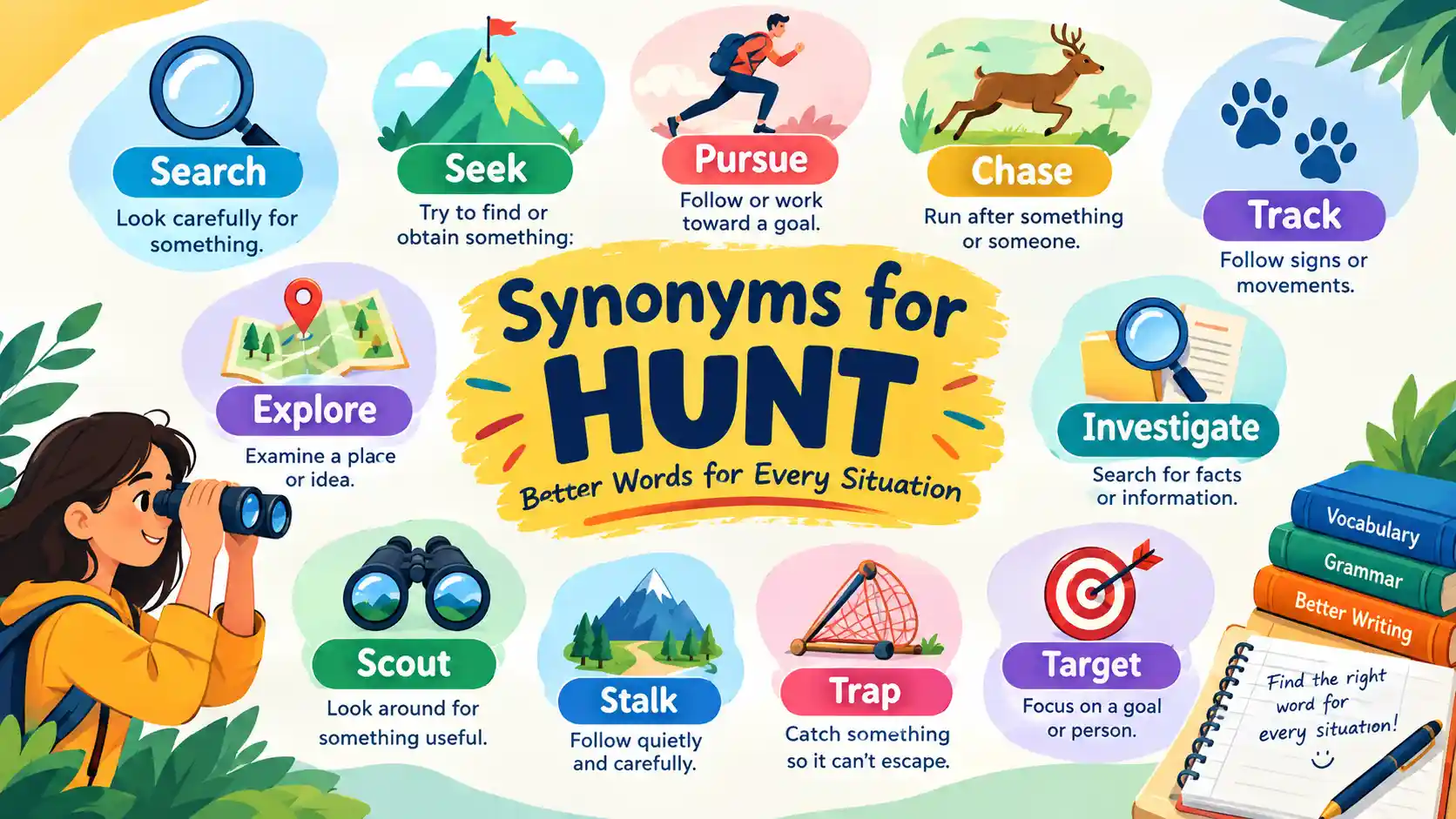
If you’re looking for synonyms for hunt, you have many useful choices depending on what you mean. Words like search, seek, chase, pursue, track, stalk, explore, and investigate can replace “hunt” in different situations.
The word hunt can mean looking for a person or thing, chasing an animal, searching for information, or trying hard to reach a goal. That’s why choosing the right synonym matters.
In this guide, you’ll learn the meaning of hunt, its best synonyms, antonyms, examples, common mistakes, and the best alternatives for writing and everyday English.
📖 Meaning of Hunt
Hunt is mainly used as a verb and noun.
As a verb, hunt means to search for, chase, or try to catch something or someone.
Example:
The dog hunted for the missing toy.
As a noun, hunt can mean an activity in which people search for or chase animals. It can also mean a search for something.
Example:
We went on a hunt for the missing keys.
Pronunciation
Hunt: /hʌnt/
It sounds like “hunt” with a short “u” sound.
Common Uses of Hunt
We commonly use hunt when talking about:
- Looking for something
- Searching for a person
- Chasing an animal
- Finding clues
- Looking for a job
- Searching for opportunities
- Trying to achieve a goal
The best synonym depends on the situation.
📝 Top Synonyms of Hunt
🔎 Search and Look For
Search — to look carefully for someone or something.
Example: The police searched the area.
Seek — to try to find or get something.
Example: She is seeking a better job.
Look for — to try to find someone or something.
Example: I’m looking for my keys.
Explore — to examine a place, subject, or idea to learn more about it.
Example: We explored several solutions.
Scout — to look around carefully for something suitable or useful.
Example: They scouted the area for a campsite.
Trace — to find someone or something by following clues or signs.
Example: The team traced the source of the problem.
Locate — to find the exact place of someone or something.
Example: We located the missing file.
🐾 Follow and Chase
Pursue — to follow or chase someone or something.
Example: The runner was pursued by a dog.
Chase — to run after someone or something to catch it.
Example: The children chased the ball.
Follow — to go after someone or something.
Example: The cat followed the mouse.
Trail — to follow someone or something by watching their path.
Example: The hikers trailed the guide.
Shadow — to follow someone closely.
Example: The reporter shadowed the politician.
Tail — to follow someone secretly.
Example: The detective tailed the suspect.
Run after — to chase someone or something.
Example: The boy ran after the bus.
Give chase — to begin chasing someone or something.
Example: The guard gave chase when the thief ran away.
🎯 Trying to Catch Something
Capture — to catch and take control of someone or something.
Example: The photographer captured a beautiful bird.
Catch — to stop and hold something that is moving.
Example: She caught the ball.
Snare — to catch something using a trap or other method.
Example: The animal was caught in a snare.
Trap — to catch something so that it cannot escape.
Example: The farmer trapped the animal safely.
Corner — to move someone or something into a place where escape is difficult.
Example: The police cornered the suspect.
Bag — an informal hunting term meaning to catch or kill an animal.
Example: The hunter bagged a rabbit.
🦌 Hunting and Tracking Animals
Stalk — to follow an animal quietly and carefully.
Example: The tiger stalked its prey.
Track down — to find someone or something after following clues or signs.
Example: The rangers tracked down the lost animal.
Flush out — to force an animal or person out of a hiding place.
Example: The dogs flushed the fox out of the bushes.
Drive — to force animals toward a particular place during a hunt.
Example: The hunters drove the deer toward the open field.
Pursue game — to follow and chase wild animals during hunting.
Example: The group pursued a game in the forest.
💼 Searching for Goals and Opportunities
The word hunt doesn’t always involve animals. It can also describe a strong search for something useful or important.
Seek out — to actively look for something or someone.
Example: Good writers seek out useful information.
Target — to focus on a particular person, group, or goal.
Example: The campaign targeted young readers.
Go after — to try hard to get or achieve something.
Example: She decided to go after her dream job.
Aim for — to try to achieve a particular result.
Example: We are aiming for better results.
Strive for — to work hard to reach a goal.
Example: Students should strive for success.
Chase — to strongly pursue something such as a dream or goal.
Example: He is chasing his dream of becoming a writer.
🕵️ Finding Information or Answers
Investigate — to search for facts and information.
Example: The team investigated the cause of the error.
Probe — to examine something closely to discover information.
Example: Reporters probed the issue carefully.
Uncover — to discover something hidden or unknown.
Example: The investigation uncovered new facts.
Discover — to find something that was not known before.
Example: Scientists discovered a new species.
Pursue a lead — to follow information that may help you find an answer.
Example: The detective pursued a new lead.
Scour — to search a place or source very carefully.
Example: We scoured the internet for reliable information.
⚖️ Antonyms of Hunt
An antonym is a word with an opposite or contrasting meaning.
| Word | Meaning | Example |
| Avoid | Stay away from something | She avoided the crowded street. |
| Ignore | Pay no attention to something | He ignored the warning. |
| Abandon | Leave something behind | They abandoned the search. |
| Surrender | Stop resisting or pursuing | The team surrendered its goal. |
| Release | Let someone or something go | They released the animal. |
| Stay | Remain in one place | The bird stayed in its nest. |
| Rest | Stop activity for a while | We rested after the long walk. |
| Withdraw | Move away from something | The group withdrew from the area. |
💬 Example Sentences With Hunt
Here are different ways to use hunt in everyday and formal English:
- The children hunted for seashells on the beach.
- We went on a hunt for the missing book.
- The dog hunted for its toy.
- The police hunted for the missing suspect.
- She is hunting for a new apartment.
- He is hunting for a better job.
- They hunted through the old boxes.
- The tiger hunted its prey at night.
- The researchers hunted for new evidence.
- We hunted for a quiet place to study.
- The detective hunted for clues.
- She hunted online for affordable shoes.
- The team hunted for the cause of the problem.
- The writer hunted for the right word.
- They hunted through the records for information.
- He is hunting for new business opportunities.
- The children hunted for hidden eggs.
- The explorers hunted for a safe route.
- She hunted for an answer to the difficult question.
- The photographer hunted for the perfect shot.
📚 Difference Between Similar Words
Several words can replace hunt, but they don’t always mean exactly the same thing.
| Word | Main Idea | Best Context |
| Hunt | Search, chase, or pursue | General use |
| Search | Look carefully | Objects and information |
| Seek | Try to find or obtain | Formal writing and goals |
| Chase | Run after | People, animals, and moving things |
| Pursue | Follow or work toward | Formal writing and goals |
| Track | Follow signs or movements | People, animals, and investigations |
| Stalk | Follow quietly | Animals or secret following |
| Investigate | Search for facts | Problems and research |
| Explore | Examine to learn more | Places, ideas, and options |
| Scour | Search very carefully | Large areas or sources |
Hunt vs. Search
Hunt often suggests an active or determined search.
Search simply means looking carefully for something.
Example:
- We searched the room for the keys.
- We hunted through every drawer for the missing document.
Hunt vs. Seek
Seek is more formal than hunt. It’s common when talking about goals, help, advice, knowledge, or opportunities.
Example:
- She is seeking professional advice.
- She is hunting for a new job.
Hunt vs. Chase
Chase focuses on following something that is moving.
Hunt can mean searching for something even when it isn’t moving.
Example:
- The dog chased the rabbit.
- The detective hunted for clues.
Hunt vs. Track
Track means following signs, footprints, movements, or evidence.
Example:
Rangers tracked the animal through the forest.
🎯 Best Alternative Words for Different Situations
Choosing a synonym depends on your purpose.
Professional Writing
Use:
- Seek
- Pursue
- Investigate
- Explore
- Identify
Example:
The company is seeking new business opportunities.
Academic Writing
Use:
- Investigate
- Explore
- Examine
- Seek
- Trace
Example:
The study investigates the causes of language change.
Business English
Use:
- Pursue
- Seek
- Target
- Explore
- Identify
Example:
The company is exploring new markets.
Everyday Conversation
Use:
- Look for
- Search
- Find
- Chase
- Go after
Example:
I’m looking for my phone.
Creative Writing
Use:
- Stalk
- Pursue
- Trail
- Chase
- Track
These words can make action scenes more vivid.
✍️ Grammar Tips for Hunt
Verb Forms
| Form | Example |
| Base form | They hunt for food. |
| Third-person | He hunts for clues. |
| Past | They hunted all day. |
| Past participle | They have hunted for hours. |
| -ing form | They are hunting for a solution. |
Noun Form
Hunt can also be a noun.
Example:
The search became a long hunt for the missing treasure.
Common Phrases With Hunt
- hunt for
- hunt down
- hunt around
- go hunting
- hunting ground
- treasure hunt
- job hunt
- manhunt
- witch hunt
- bargain hunt
❌ Common Mistakes
Mistake 1: Using “chase” for every meaning of hunt
Wrong:
I’m chasing for my keys.
Correct:
I’m looking for my keys.
Why?
Chase normally describes following something that is moving.
Mistake 2: Using “seek” in very casual situations
Less natural:
I’m seeking my phone.
More natural:
I’m looking for my phone.
Seek is often more formal.
Mistake 3: Confusing “hunt” and “track”
Hunt can mean searching or pursuing.
Track specifically focuses on following signs, movements, or evidence.
💡 Pro Writing Tips
Good writers don’t choose a synonym simply because it looks different from the original word. They choose a word that gives the sentence the exact meaning they want.
Before replacing hunt, ask:
- Is the person searching?
- Is someone being chased?
- Is the goal formal or informal?
- Is the subject an animal?
- Are clues involved?
- Is the sentence about a goal or opportunity?
- Does the sentence need a stronger or softer tone?
For example, search sounds neutral, pursue sounds more formal, chase feels more active, and stalk suggests quiet and careful following.
📖 Related Words
Here are some words connected with hunt:
- Hunter
- Hunting
- Hunting ground
- Search
- Searcher
- Pursuit
- Chase
- Tracker
- Tracking
- Prey
- Predator
- Trap
- Trail
- Clue
- Investigation
- Discovery
- Target
- Goal
- Opportunity
- Exploration
❓ Frequently Asked Questions
What is the best synonym for hunt?
The best synonym depends on the sentence. Search works well when you mean looking for something. Pursue fits formal writing or goals. Chase works when something is moving away. Track is useful when following signs or movements. For everyday English, look for is often the most natural choice.
What is a simple synonym for hunt?
A simple synonym for hunt is search. It means looking carefully for someone or something. In casual English, look for is also very common. For example, “I am hunting for my keys” can become “I am looking for my keys.”
What is a synonym for hunt in writing?
In writing, useful alternatives include search, seek, pursue, investigate, explore, track, and scour. The right word depends on the meaning. For example, investigate works well for research, while pursue works well when discussing a goal, career, or opportunity.
What is another word for hunting animals?
Words related to hunting animals include stalking, tracking, pursuing, chasing, and trapping. These words have different meanings. Stalking means following quietly, while tracking means following signs or footprints. Chasing focuses on running after an animal.
What is the difference between hunt and search?
Hunt can mean an active or determined search, while search simply means looking carefully for something. For example, “I searched the room for my phone” is neutral. “I hunted through every box for the missing letter” suggests a more determined search.
Is seek a synonym for hunt?
Yes, seek can be a synonym for hunt when both mean trying to find or obtain something. However, seek is usually more formal. You might say “seek advice,” “seek help,” or “seek employment.” In casual conversation, “look for” is often more natural.
Is pursue a synonym for hunt?
Yes. Pursuit can replace hunt when the meaning is to follow, chase, or work toward something. It is especially useful in formal writing. For example, “She pursued her goal” means that she actively worked toward achieving it.
What is a synonym for hunt for information?
Useful alternatives include search for, seek, investigate, explore, research, and look for. Search is common in everyday English, while investigate and research are more suitable for formal or academic contexts.
🏁 Conclusion
The word hunt has several meanings, so there isn’t one synonym that works in every sentence. Search, seek, pursue, chase, track, stalk, explore, and investigate each add a slightly different meaning.
For everyday English, look for and search are simple choices. For formal writing, seek, pursue, and investigate can work better. When describing animals or movement, track, stalk, and chase may be more precise.