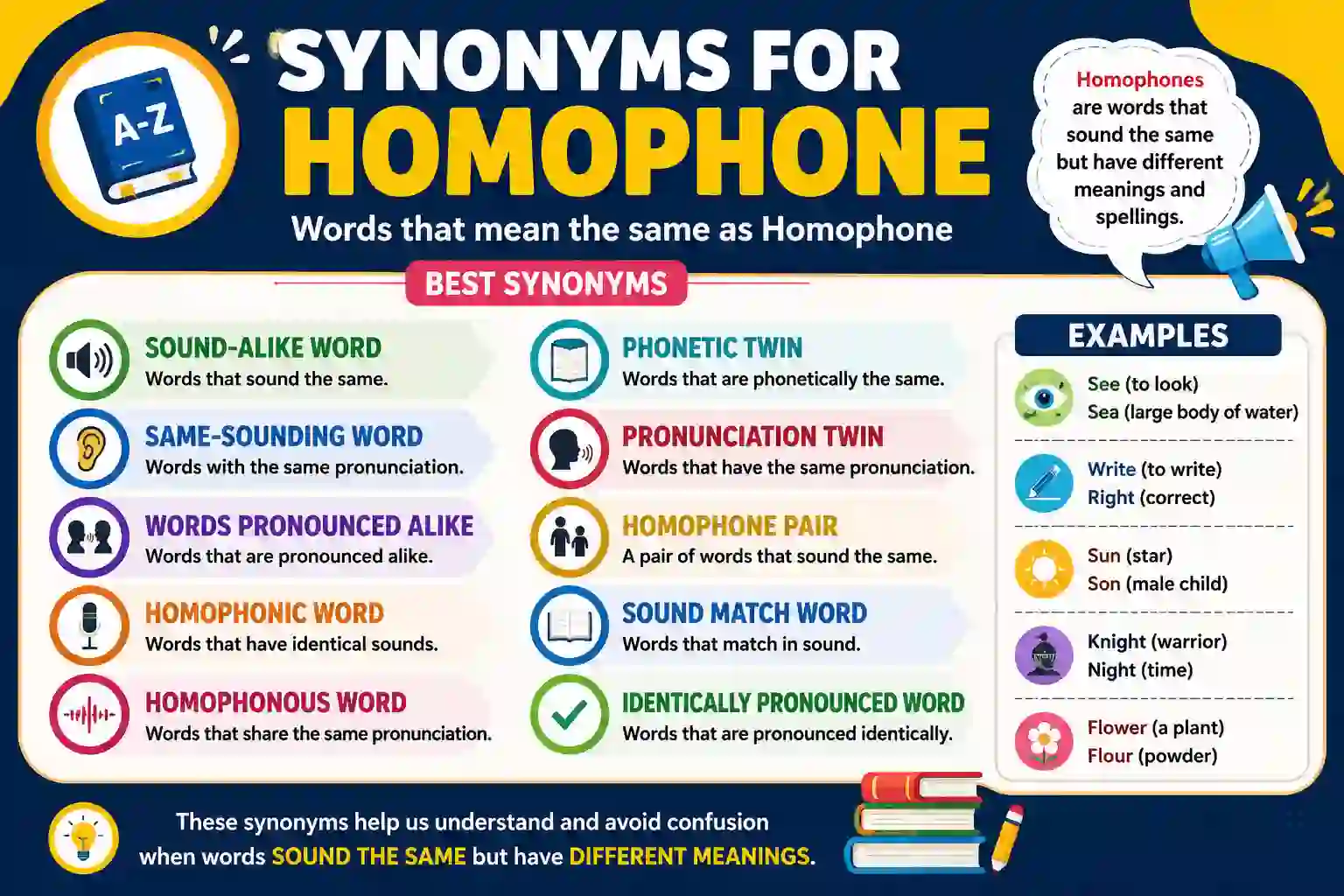
Looking for synonyms for homophone? The word homophone has a very specific meaning, so it doesn’t have many exact one-word synonyms. In simple terms, a homophone is a word that sounds the same as another word but has a different meaning or spelling. For example, see and sea are homophones.
If you’re writing for students, explaining English grammar, or looking for a simpler way to describe the idea, phrases such as sound-alike word, same-sounding word, and homophonic word can be useful. This guide explains accurate alternatives, related terms, examples, common mistakes, and the difference between homophones, homonyms, and homographs.
📖 Meaning of Homophone
Homophone is a noun used in linguistics and English grammar. It refers to one of two or more words that are pronounced alike but have different meanings, and often different spellings. Cambridge gives sea and sea as a simple example.
Simple definition
A homophone is a word that sounds like another word but means something different.
Examples:
- see / sea
- right / write
- flower / flour
- pair / pear
- to / too / two
- there / their / they’re
Part of speech
| Feature | Details |
| Word | Homophone |
| Part of speech | Noun |
| Plural | Homophones |
| Adjective | Homophonic / homophonous |
| Pronunciation | /ˈhɑː.mə.foʊn/ in American English |
| Main idea | Words with the same pronunciation but different meanings or spellings |
The term comes from Greek roots connected with same and sound. Merriam-Webster records the first known use of the homophone in 1843.
Best choices: For everyday readers, use sound-alike word, same-sounding word, or words pronounced alike. In academic writing, homophonic and homophonous are more precise.
📝 Synonyms for Homophone
Common Synonyms for Homophone
For simple English, the most useful alternatives to homophone are sound-alike word, same-sounding word, and words pronounced alike. These phrases are easy for students and English learners to understand.
| Word or Phrase | Meaning | Best Use | Example |
|---|---|---|---|
| Sound-alike word | A word that sounds like another word | Simple English | See and sea are sound-alike words. |
| Same-sounding word | A word with the same pronunciation | Beginners | Right and write are same-sounding words. |
| Words pronounced alike | Words with the same pronunciation | General explanation | Sea and see are words pronounced alike. |
| Homophonic word | A word with the same sound as another | Academic writing | The pair is homophonic. |
| Homophonous word | Having the same pronunciation | Formal writing | These forms are homophonous. |
Descriptive Alternatives
| Word or Phrase | Meaning | Best Use | Example |
|---|---|---|---|
| Sound-alike | Something that sounds like another | Informal English | These words are sound-alikes. |
| Homophone pair | Two words with the same pronunciation | Grammar lessons | See and sea are a homophone pair. |
| Homophone set | A group of words with the same sound | Teaching | To, too, and two form a homophone set. |
| Same-sound word | A word sharing the same sound | Beginner English | Pair and pear are same-sound words. |
| Pronunciation match | Words sharing pronunciation | Educational writing | The two words have a pronunciation match. |
| Phonetic match | Words with matching spoken forms | Linguistics | The pair has a phonetic match. |
Formal and Linguistic Terms
| Term | Meaning | Best Use | Example |
|---|---|---|---|
| Homophonic form | A form sharing pronunciation with another | Linguistics | The words have homophonic forms. |
| Homophonous form | A form pronounced like another | Formal writing | The forms are homophonous. |
| Phonetic twin | A word with the same spoken form | Educational explanation | The words can be viewed as phonetic twins. |
| Pronunciation twin | Words sharing pronunciation | Informal teaching | These words are pronunciation twins. |
| Identically pronounced word | A word pronounced the same way | Formal explanation | They are identically pronounced words. |
Important Note About “Synonyms for Homophone”
Not every phrase in a long synonym list is a perfect synonym for homophone.
⚖️ Antonyms and Contrasting Terms
| Contrasting Term | Meaning | Example |
| Non-homophone | A word that isn’t a homophone of another | cat and dog |
| Distinctly pronounced word | A word with a different pronunciation | cat and cut |
| Phonetically different word | A word with a different spoken form | ship and sheep |
| Different-sounding word | A word that sounds unlike another | book and back |
| Non-homophonous pair | A pair without identical pronunciation | pen and pin in accents where they differ |
| Unrelated word | A word with no relevant sound relationship | tree and yellow |
Be careful with heteronyms, homographs, and homonyms. These aren’t simple opposites of homophones. They describe different relationships between spelling, sound, and meaning.
💬 Example Sentences
Here are practical examples using homophone and its related terms:
- See and sea are common homophones,
- Right and write are pronounced alike.
- The teacher gave us a list of sound-alike words.
- Flower and flour form a homophone pair.
- I used the wrong homophone in my sentence.
- To, too, and two are a common homophone set.
- Good writers check confusing homophones carefully.
- Their and there are frequently confused in writing.
- The editor corrected the homophone mistake.
- Homophones can make English spelling difficult.
- The student identified the correct homophone.
- This exercise helps learners recognize sound-alike words.
- Peace and piece have different meanings.
- The writer chose the correct word from the homophone pair.
- Homophonic words can create interesting wordplay.
- The quiz tests knowledge of common homophones.
- Context helps readers understand which word is intended.
- The teacher explained why the two words sound alike.
📚 Difference Between Similar Words
The words homophone, homograph, and homonym are easy to mix up.
| Term | Main Feature | Example |
| Homophone | Same pronunciation; different meaning or spelling | see / sea |
| Homograph | Same spelling; meaning may differ, and pronunciation may differ | lead / lead |
| Homonym | A broader and sometimes differently defined category | bear / bear |
| Homophonic | Adjective describing the same-sound relationship | see and sea are homophonic |
| Homophonous | Another adjective meaning having the same pronunciation | The words are homophonous |
Merriam-Webster notes that homonyms can be used in different ways and may include homophones or homographs, which is why the terms can sometimes seem confusing.
Homophone vs. Homonym
A homophone focuses on sound.
A homonym is a broader term whose exact use varies by dictionary and linguistic tradition.
Homophone vs. Homograph
A homograph focuses on spelling.
- Homophone: sea / see
- Homograph: lead / lead
- Both: quail can refer to the bird or the act of shrinking from fear, depending on meaning and usage.
🎯 Best Alternative Words
Choose your wording based on your audience.
| Situation | Best Alternative |
| Beginner English | Sound-alike word |
| School lesson | Homophone pair |
| Simple explanation | Words pronounced alike |
| Academic writing | Homophonic |
| Linguistics | Homophonous |
| Blog writing | Sound-alike word |
| Grammar explanation | Homophone |
| Business communication | Homophone |
| Creative writing | Sound-alike |
| SEO content | Homophone + sound-alike word |
For SEO, don’t replace homophones everywhere. The primary term is the clearest and most accurate word. Use related phrases naturally to answer different search intents.
✍ Grammar Tips
Word forms
| Form | Example |
| Singular noun | A homophone |
| Plural noun | Several homophones |
| Adjective | Homophonic |
| Adjective | Homophonous |
There isn’t a common everyday verb or adverb form of homophone.
Common grammar patterns
- a homophone
- two homophones
- a pair of homophones
- homophone words
- homophone pairs
- homophonic words
- homophonous forms
❌ Common Mistakes
| Wrong or Unclear | Better | Reason |
| Homophone means same spelling | Homophone means same pronunciation | Sound is the key feature. |
| All homophones have different spelling | Many have different spelling, but not all | Some homophones can share spelling. |
| Homophone and synonym mean the same thing | They describe different relationships | Synonyms have similar meanings; homophones share pronunciation. |
| Homograph means same sound | Homograph focuses on spelling | The term relates to written form. |
| Homonym is always exactly the same as homophone | Homonym has broader usage | Dictionaries and linguists use the term differently. |
| Every sound-alike is a perfect synonym for homophone | Use sound-alike as a descriptive phrase | It isn’t a technical synonym in every context. |
| Homophone is a verb | Homophone is normally a noun | Use homophonic as an adjective. |
💡 Pro Writing Tips
For children: use sound-alike word.
For English learners: say words that sound the same but have different meanings.
Teachers: use homophone pair or homophone set.
📖 Related Words
These words are closely connected with the topic:
- Homonym
- Homograph
- Homophonic
- Homophonous
- Pronunciation
- Phonetics
- Phonology
- Spelling
- Meaning
- Word pair
- Sound
- Speech
- Vocabulary
- Grammar
- Linguistics
- Wordplay
- Confusable words
- Context
- Pronunciation pattern
- Language learning
Common homophone examples
| Homophone | Meaning 1 | Meaning 2 |
| See / sea | Look | Large body of salt water |
| Right / write | Correct | Put words on paper |
| Flower / flour | Plant bloom | Baking ingredient |
| Pair / pear | Two things | Fruit |
| Peace / piece | Calm | Part of something |
| Buy / by | Purchase | Near or through |
| Night / knight | Dark period | Medieval warrior |
| One / won | Number | Past of win |
| Hear / here | Perceive sound | In this place |
| Allowed / aloud | Permitted | Spoken out loud |
FAQs
What’s another word for homophones?
Another way to describe homophones is sound-alike words or same-sounding words. Homophones are words that have the same pronunciation but different meanings and often different spellings. For example, see and sea sound alike but have different meanings.
What are homophones, antonyms, and synonyms?
Homophones are words that sound the same but have different meanings, such as right and write. Synonyms are words with similar meanings, such as happy and joyful. Antonyms are words with opposite meanings, such as hot and cold. These are different word relationships.
What are homophones also called?
Homophones are also commonly called sound-alike words, same-sounding words, or words pronounced alike. In formal English and linguistics, homophone is the most accurate term. Examples include flower/flour, pair/pear, and night/knight, which share pronunciation but have different meanings.
What are 20 examples of homophones?
Here are 20 common homophone examples: see/sea, right/write, flower/flour, pair/pear, night/knight, one/won, buy/by, hear/here, peace/piece, sun/son, two/to/too, week/weak, knew/new, mail/male, blue/blew, allowed/aloud, ate/eight, brake/break, dear/deer, and whole/hole.
What is a synonym homonym?
The phrase “synonym homonym” isn’t a standard grammar term. A synonym is a word with a similar meaning, while a homonym refers to words that share a spelling or pronunciation relationship but have different meanings. For example, big and large are synonyms, while bat can be a homonym with different meanings.
How do homonyms differ from homophones?
Homophones are words that sound the same but have different meanings, such as see and sea. Homonyms is a broader term that can refer to words that share a spelling or pronunciation while having different meanings. Because dictionary and linguistic definitions vary, homophone is more precise when focusing specifically on sound.
What is a homophone in simple words?
A homophone is a word that sounds the same as another word but has a different meaning. The words may also have different spellings. For example, sun and son sound alike, but the sun is a star while a son is a male child. Homophones are common in English.
What is a homonym?
A homonym is a word that has the same spelling or pronunciation as another word but a different meaning, depending on the definition being used. For example, a bat can mean a flying animal or a piece of sports equipment. Homonyms can be confusing, so context helps readers understand the intended meaning.
Conclusion
The best synonyms for homophone depend on your audience and purpose. Sound-alike word, same-sounding word, and words pronounced alike are useful plain-English alternatives, while homophonic and homophonous work well in more formal contexts.