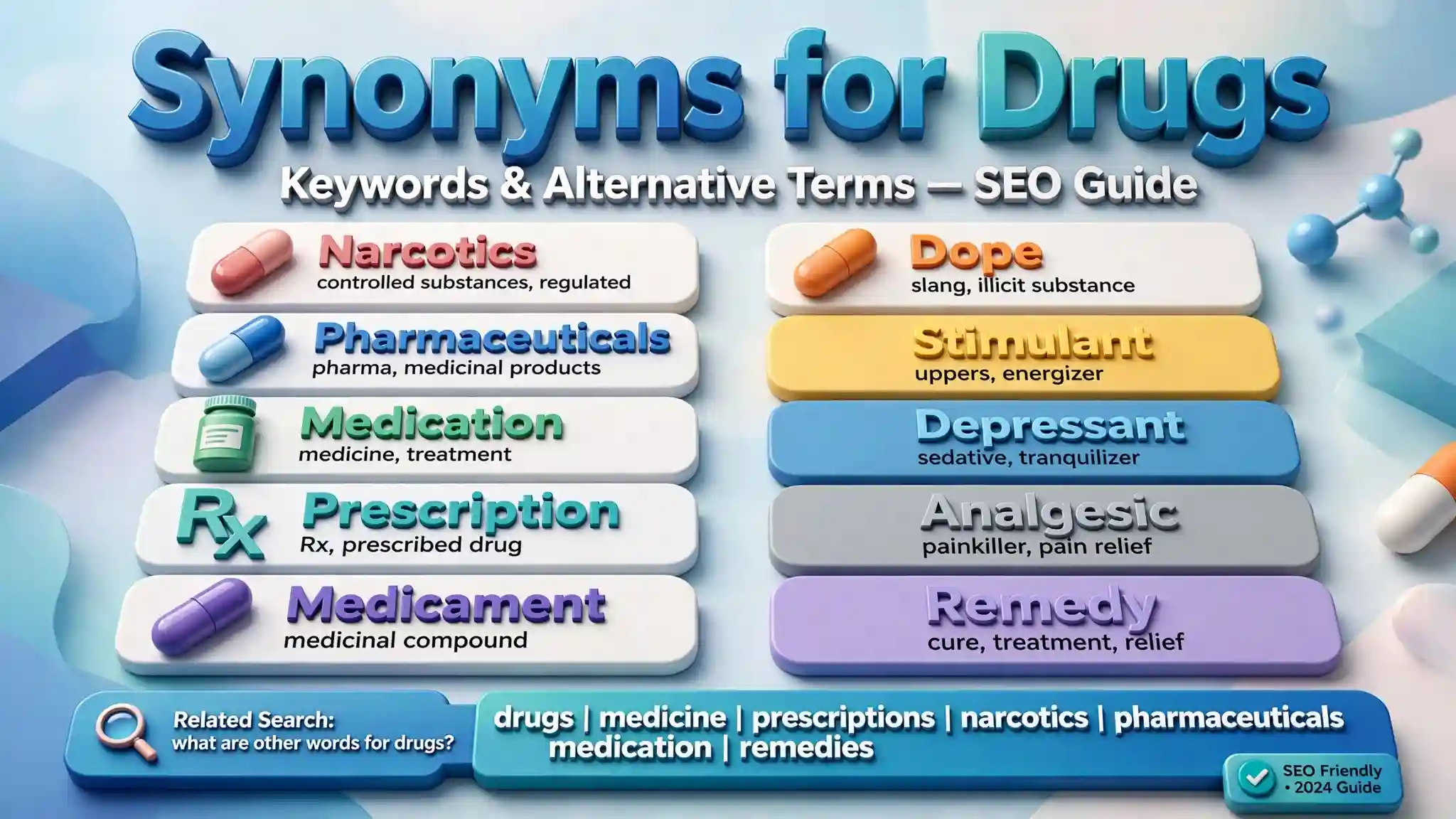
Choosing the right word for “drugs” isn’t always simple. Say “drugs” in a hospital, and people think of medicine. Say it in a news report, and they may think of illegal substances. That’s why learning synonyms for drugs matters. The right word makes your meaning clear, keeps your tone professional, and helps your reader understand you instantly.
In this guide, you’ll find 40 easy synonyms for drugs, grouped by formal, everyday, natural, scientific, and creative use. You’ll also learn the meaning of the word, opposite words, example sentences, grammar tips, and common mistakes to avoid. Whether you’re a student, teacher, or blogger, this page will help you pick the perfect word every time.
📖 Meaning of “Drugs”
- Definition: “Drugs” are substances people take to treat illness, ease pain, or change how the body works. The word can mean helpful medicine or harmful illegal substances — the context decides.
- Part of Speech: Noun (plural of “drug”). It can also work as a verb.
- Pronunciation: /drʌɡz/ — it rhymes with “hugs.”
- Origin: The word comes from Middle Dutch “droge” (meaning “dry”), through Old French “drogue.” Long ago, medicines were made from dried herbs and plants.
- Common Usage: You’ll see it in hospitals, pharmacies, news reports, school lessons, and everyday talk.
- Simple Explanation: Think of “drugs” as a big umbrella. Under it sit medicines that heal and substances that harm. Always check the sentence around it to know which meaning fits.
📝 Top Synonyms of “Drugs”
Learning synonyms is easier in small groups. Below, the 40 synonyms are divided into 5 clear categories, so you can quickly find the right word for any situation.
Formal and Medical Synonyms
Use these in reports, essays, hospitals, and professional writing.
| Word | Meaning | Best Use | Example |
|---|---|---|---|
| Medication | Medicine taken to treat illness | Formal / health writing | She takes her medication every morning. |
| Pharmaceutical | A manufactured medicinal product | Business / formal | The firm sells pharmaceuticals worldwide. |
| Prescription | Medicine ordered by a doctor | Medical | He picked up his prescription today. |
| Treatment | Medical care given for illness | Health | The new treatment worked very well. |
| Therapy | Treatment that heals illness | Health | Physical therapy helped her walk again. |
| Dose | A measured amount of medicine | Medical | Never exceed the daily dose. |
| Dosage | The amount and timing of doses | Medical | Follow the dosage on the label. |
| Injection | Medicine given with a needle | Medical | The nurse gave the injection gently. |
| Antibiotic | A drug that kills bacteria | Medical | The doctor gave her an antibiotic. |
| Vaccine | A substance that prevents disease | Health | The vaccine protects young children. |
Everyday Synonyms
These are the friendly words people use in daily conversation.
| Word | Meaning | Best Use | Example |
|---|---|---|---|
| Medicine | Substance used to heal the body | Daily talk | The medicine lowered his fever fast. |
| Pill | A small solid dose of medicine | Informal | Take one pill after breakfast. |
| Tablet | A flat, round dose of medicine | Medical | Swallow the tablet with water. |
| Capsule | Medicine inside a small shell | Medical | The capsule is easy to swallow. |
| Syrup | A sweet liquid medicine | General | This cough syrup tastes like cherry. |
| Shot | An informal word for injection | Informal | He got his flu shot yesterday. |
| Painkiller | A drug that reduces pain | General | He took a painkiller for his headache. |
Natural and Gentle Synonyms
Soft, nature-based words for healing products and remedies.
| Word | Meaning | Best Use | Example |
|---|---|---|---|
| Remedy | Something that cures or relieves | General | Rest is the best remedy for a cold. |
| Cure | Something that fully heals | General | There is no cure for the common cold. |
| Tonic | A health drink or liquid | General | She drinks a herbal tonic daily. |
| Herb | A plant used as medicine | Natural | The herb settled his stomach. |
| Botanical | A plant-based health product | Formal | The shop sells natural botanicals. |
| Supplement | An added health product | Health | She takes a vitamin supplement daily. |
| Vitamin | An essential body nutrient | General | Oranges are rich in vitamin C. |
| Homeopathic remedy | A gentle alternative treatment | Alternative | She prefers homeopathic remedies. |
Scientific and Strong Terms
Technical words used in labs, science, and legal contexts.
| Word | Meaning | Best Use | Example |
|---|---|---|---|
| Substance | A general word for a chemical | Formal | The substance is still under study. |
| Chemical | A natural or man-made compound | Scientific | Handle the chemical with care. |
| Compound | A mixture of chemicals | Scientific | Scientists tested the new compound. |
| Serum | A healing liquid used in treatment | Scientific | The serum was tested in the lab. |
| Sedative | A drug that calms or aids sleep | Medical | The sedative helped her rest well. |
| Stimulant | A drug that boosts energy | Medical | Coffee is a mild natural stimulant. |
| Antidote | A substance that fights poison | General | Doctors quickly found an antidote. |
| Narcotic | A strong pain-relieving drug | Legal / medical | Narcotics are strictly controlled by law. |
| Opiate | A drug made from opium | Medical | The opiate eased his severe pain. |
Creative and Literary Synonyms
Beautiful, old-style words perfect for stories and creative writing.
| Word | Meaning | Best Use | Example |
|---|---|---|---|
| Elixir | A sweet liquid cure; a magical remedy | Creative | The elixir promised perfect health. |
| Potion | A magical liquid in stories | Creative | The witch brewed a green potion. |
| Draught | An old word for a liquid dose | Literary | He drank the bitter draught slowly. |
| Ointment | A healing cream for skin | Medical | Apply the ointment twice a day. |
| Salve | A soothing healing cream | General | The salve cooled her sunburn. |
| Lotion | A liquid applied to skin | General | Use the lotion after your bath. |
⚖️ Antonyms
The word “drugs” has no perfect antonym because it names a thing, not an idea. Still, these words express opposite meanings in context:
| Word | Meaning | Example |
| Poison | A substance that harms the body | The poison made him seriously ill. |
| Toxin | A harmful natural chemical | The toxin damaged her liver. |
| Disease | An illness that drugs try to treat | The disease spread through the town. |
| Illness | A state of poor health | He missed work due to illness. |
| Ailment | A small health problem | The mild ailment lasted a week. |
| Contaminant | A harmful impurity | The water contained a contaminant. |
💬 Example Sentences
Daily Conversation
- I need to pick up my medicine from the store.
- Did you take your pills this morning?
- This syrup really helps my cough.
Academic English
4. Researchers tested the compound on small groups first.
5. The dosage must stay the same during the trial.
6. Antibiotics changed modern medicine forever.
Business English
7. Our company develops new pharmaceuticals each year.
8. The prescription market is growing very fast.
9. We must follow strict rules for every substance we sell.
Formal Writing
10. The patient received her medication on schedule.
11. The treatment showed strong positive results.
12. Doctors recorded no serious side effects from the serum.
Informal Writing
13. I grabbed some painkillers for my back.
14. She got her flu shot last week.
15. Just take the tablet with juice, not coffee.
Creative Writing
16. The old witch stirred her bubbling potion.
17. One sip of the elixir, and his strength returned.
18. He drank the bitter draught and closed his eyes.
19. The tonic glowed softly in the moonlight.
20. Legends spoke of a cure hidden in the forest.
📚 Difference Between Similar Words
| Word Pair | Difference | When to Use Each | Example |
| Drug vs Medicine | “Drug” is broad and neutral; “medicine” sounds healing and safe | Use “medicine” in daily talk; “drug” in science or news | She takes medicine for her heart. / The lab studied the drug. |
| Medicine vs Medication | “Medicine” is general; “medication” is more formal | Use “medication” in formal or medical writing | The nurse listed each medication. |
| Narcotic vs Drug | A narcotic is one strong type of drug | Use “narcotic” only for strong, controlled pain drugs | Narcotics need a special license. |
| Remedy vs Cure | A remedy relieves; a cure fully heals | Use “cure” only when the illness is gone for good | Honey is a remedy, not a cure. |
| Dose vs Dosage | A dose is one amount; dosage is the full plan | Use “dosage” for schedules on labels | Take one dose now. / Check the dosage chart. |
🎯 Best Alternative Words
- Professional Writing: medication, pharmaceutical, treatment
- Essay Writing: medicine, remedy, therapy
- Email: prescription, medication, dosage
- Business: pharmaceutical product, compound, substance
- Conversation: medicine, meds, pills, shot
- Marketing: remedy, solution, treatment, formula
- Creative Writing: elixir, potion, tonic, draught
✍️ Grammar Tips
- Singular and Plural: One “drug,” many “drugs.” The plural adds a simple “s.”
- As a Verb: “Drug” can be a verb meaning to give someone a drug. Forms: drug, drugged, drugging. Example: “They drugged the patient before surgery.”
- Adjective Forms: “Drugged” (affected by a drug), “druggy” (informal — sleepy or dulled by drugs), “drugless” (free from drugs).
- Adverb Form: There is no common adverb form. Say “with drugs” or “under the influence” instead.
- Common Mistake: Don’t confuse “drug” with the past tense of “drag.” The past tense of “drag” is “dragged,” never “drug.”
❌ Common Mistakes
| Wrong or Unclear | Correct | Reason |
|---|---|---|
| He drug the box across the floor. | He dragged the box across the floor. | In standard English, the past tense of “drag” is “dragged,” not “drug.” |
| The doctor gave me a drug for my headache. | The doctor gave me medicine for my headache. | In daily talk, “medicine” sounds clearer and more natural than “drug.” |
| She takes drugs every morning. | She takes her medication every morning. | “Drugs” alone can make readers think of illegal substances. |
| This drug has no side affects. | This drug has no side effects. | “Effect” is the noun, and “affect” is the verb. |
| The doctor will prescription a new drug. | The doctor will prescribe a new drug. | “Prescription” is the noun, and “prescribe” is the verb. |
| Take one dosage now. | Take one dose now. | A “dose” is one amount. “Dosage” means the full plan of amount and timing. |
| Honey is a cure for a cold. | Honey is a remedy for a cold. | A “remedy” relieves symptoms. A “cure” fully heals the illness. |
| The patient must take his meds twice daily. | The patient must take his medication twice daily. | “Meds” is informal. Use “medication” in reports and formal writing. |
| Vitamins are narcotics. | Vitamins are supplements. | A “narcotic” is a strong, controlled pain-relieving drug, not a general word for medicine. |
💡 Pro Writing Tips
- Pick your synonym before you write the sentence, not after.
- Match the word to your reader: “medication” for doctors, “medicine” for friends.
- In formal writing, avoid slang like “meds” unless you explain it first.
- One strong synonym beats three weak ones in the same paragraph.
- When in doubt, “medicine” is the safest everyday choice.
- Read your sentence aloud — the right word always sounds smooth.
- Keep a personal word list of synonyms you love and reuse them.
📖 Related Words
- Associated Words: pharmacy, pharmacist, prescription, dosage, side effect, treatment, therapy
- Nearby Words: drugstore, druggist, over-the-counter, refill, label, warning
- Contextual Words: hospital, clinic, doctor, nurse, patient, healing, recovery
- Semantic Variations: medicate, medicated, medicinal, pharmaceutical, therapeutic
❓ FAQs
1. What are synonyms for drugs?
Common synonyms for drugs include medication, medicine, pharmaceutical, prescription, remedy, treatment, pill, tablet, capsule, dose, vaccine, antibiotic, painkiller, and tonic. The best choice depends on your context — “medication” suits formal writing, while “medicine” works best in everyday conversation.
2. What is the difference between drugs and medicine?
“Drugs” is a broad word covering both helpful and harmful substances. “Medicine” almost always means something healing and safe. In daily talk, say “medicine” for prescriptions. In science or news, “drugs” fits better because it covers the full range of substances.
3. Is “medication” a synonym for “drugs”?
Yes. “Medication” is one of the best formal synonyms for “drugs.” It means medicine taken to treat illness. Doctors, nurses, and health writers prefer it because it sounds professional and clearly refers to healing substances, not illegal ones.
4. What is a formal synonym for drugs?
“Medication” and “pharmaceutical” are the most formal synonyms. Use them in reports, essays, and business writing. For example: “The pharmaceutical industry invests billions in research.” These words sound professional and precise to educated readers.
5. What do you call drugs in everyday conversation?
In daily talk, people say “medicine,” “pills,” “meds,” or “tablets.” For example: “Did you take your meds?” These words sound friendly and natural. Avoid saying just “drugs” for prescriptions, since listeners may misunderstand and think of illegal substances.
6. Are “narcotics” and “drugs” the same?
No. “Drugs” is the broad word for any substance that changes how the body works, from vitamins to vaccines. “Narcotics” usually means opioids, such as morphine, used to relieve severe pain. In law and news, the term can also cover other controlled substances. So all narcotics are drugs, but most drugs aren’t narcotics.
7. Can “drug” be used as a verb?
Yes. As a verb, “drug” means to give someone a drug, often to cause sleep. Example: “They drugged the patient before surgery.” Its forms are drug, drugged, and drugging. Don’t confuse it with “drag” — the past tense of “drag” is “dragged.”
8. What is the opposite of drugs?
“Drugs” has no perfect antonym, but contextual opposites include poison, toxin, disease, and illness. Drugs heal or treat, while poisons harm and diseases are what drugs fight. Writers use these opposite words to create clear contrast in sentences.
🏁 Conclusion
You now know 40 synonyms for drugs, from everyday words like “medicine” and “pills” to formal choices like “medication” and “pharmaceutical.” You also learned antonyms, grammar tips, common mistakes, and the best word for every situation. Great vocabulary is a superpower — it makes your writing clearer and your ideas stronger. Keep practicing, keep learning, and explore more simple word guides on Synonymfy.com. Your next favorite word is waiting!