Have you ever written “employment” three times in one paragraph? It happens to all of us! The word is useful, but it can sound stiff or repeat too much. In this guide, you’ll find over 30 synonyms for employment, sorted into easy groups.
You’ll learn what each word means, when to use it, and how it looks in a real sentence. We’ll also cover antonyms, grammar tips, common mistakes, and quick answers to popular questions. Ready to make your writing fresher and clearer? Let’s get started!
📖 Meaning of Employment
Employment means having a paid job. It can also mean the act of hiring someone to work for you.
- Part of speech: Noun (usually uncountable)
- Pronunciation: /ɪmˈplɔɪ.mənt/ (im-PLOY-ment)
- Origin: Most dictionaries trace “employ” to Old French employer, which comes from Latin implicare (“to enfold or involve”). Adding -ment turns the verb into a noun.
- Common usage: “full-time employment,” “employment contract,” “proof of employment,” “terms of employment”
Simple explanation: If you’re “in employment,” someone pays you for your work. If a company talks about “the employment of ten new workers,” it means they’re hiring them.
There’s one more meaning that many pages skip. In formal English, employment can also mean use, as in “the employment of new methods.” We’ll cover synonyms for that meaning too.
📝 Top Synonyms of Employment
Not every synonym fits every sentence. So we’ve sorted them by meaning, which makes it easier to pick the right one.
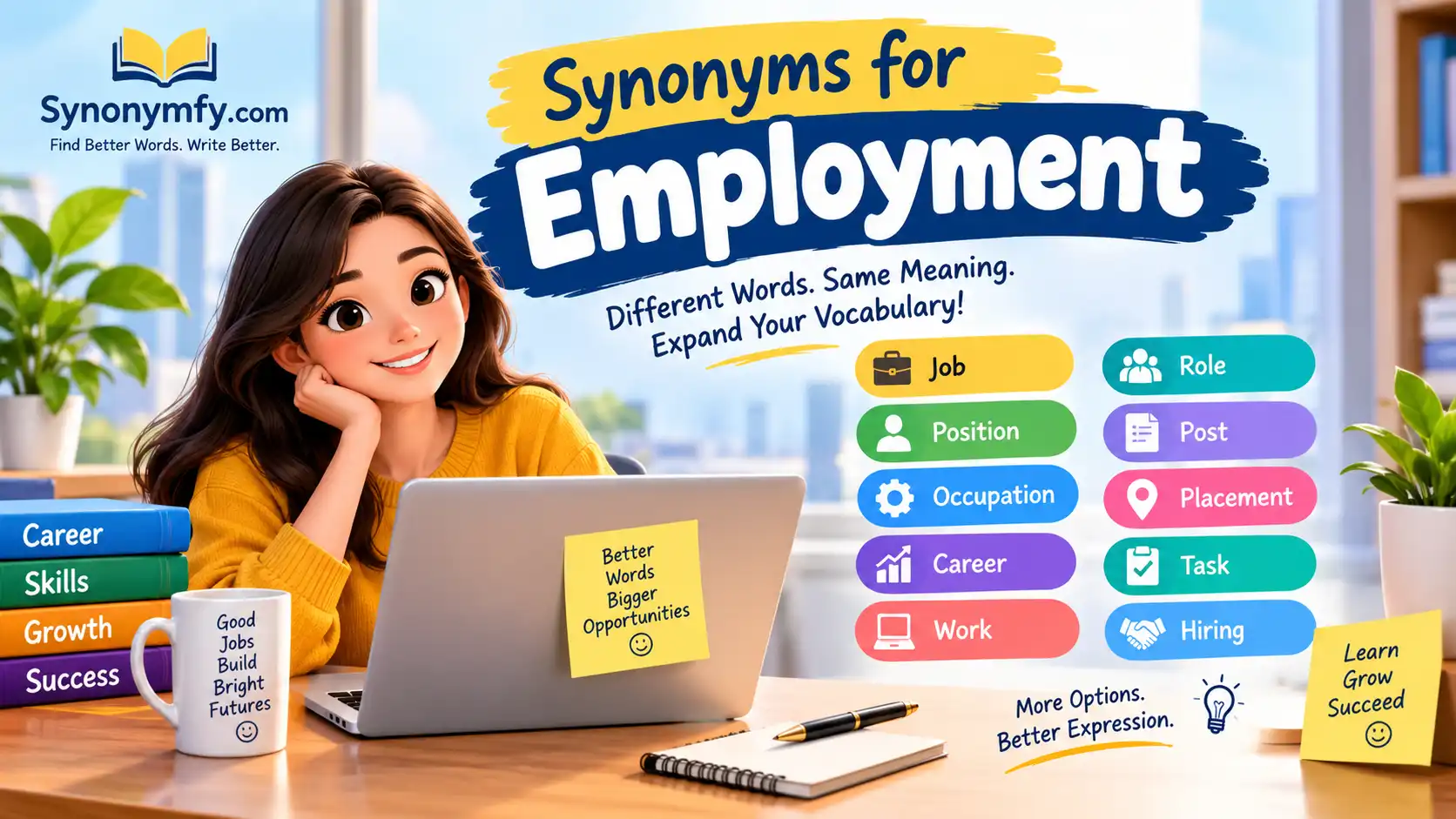
Everyday Words for Employment
| Word | Meaning | Best Use | Example |
| Job | A specific paid position | Daily talk | She loves her new job. |
| Work | Activity done to earn money | Casual and general | He’s looking for work. |
| Paid work | Work that earns a wage | Clear, plain writing | Paid work helped her save. |
| Position | A specific place in a company | Emails, job ads | The position is open. |
| Post | An official job, often in schools or government | Formal and British English | She took up a post abroad. |
| Role | The job someone has in a team | Team and project talk | His role is team leader. |
| Livelihood | The way a person earns money to live | Serious or thoughtful writing | Fishing is their livelihood. |
| Living | Money earned from work | Casual phrases | She makes a living as a tutor. |
| Labor | Work, especially hard physical work | Economics, law, history | Labor is needed at harvest time. |
Formal and Career Synonyms
| Word | Meaning | Best Use | Example |
| Occupation | The kind of work a person does | Forms, reports | Write your occupation here. |
| Profession | Work that needs special training | Law, medicine, teaching | Nursing is a caring profession. |
| Career | A long path of work over many years | Goals, resumes | He’s building a career in design. |
| Vocation | Work you feel suited for | Values and purpose | Teaching is her true vocation. |
| Calling | A strong pull toward a kind of work | Creative and emotional writing | Music became his calling. |
| Trade | Skilled hand work, like carpentry | Skilled jobs | He learned a trade at 18. |
| Craft | Work that needs artistic skill | Art and handmade goods | Pottery is a beautiful craft. |
| Line of work | The field someone works in | Friendly, natural talk | What’s your line of work? |
Words for the Act of Hiring
| Word | Meaning | Best Use | Example |
| Hiring | Giving someone a job | News, business | Hiring starts in March. |
| Recruitment | Finding and attracting job candidates | HR and business | Recruitment takes time. |
| Engagement | A formal agreement to work for someone | Formal or legal writing | His engagement began in June. |
| Appointment | Formal choice of someone for a post | Official announcements | Her appointment was welcomed. |
| Placement | Finding or assigning someone a job | Agencies, schools | The agency helped with her placement. |
Informal and Flexible Work Words
These describe kinds of employment. They’re near-synonyms, so use them when the work is casual or short-term.
| Word | Meaning | Best Use | Example |
| Gig | A short, informal job (informal) | Music, freelance | He plays a Friday gig. |
| Side hustle | Extra work beyond a main job | Casual blogs | Her side hustle grew fast. |
| Odd job | A small, one-time task for pay | Everyday talk | He did odd jobs for neighbors. |
| Temp work | Short-term work | Seasonal needs | Temp work fills busy months. |
| Freelance work | Work done for many clients | Writers, designers | Freelance work gives her freedom. |
| Part-time work | Work with fewer hours | Students | Part-time work suits students. |
Synonyms When Employment Means “Use”
| Word | Meaning | Best Use | Example |
| Use | Putting something to work | Everyday writing | The use of maps helped us. |
| Utilization | Making good use of something | Business, science | Better utilization saved money. |
| Application | Putting an idea into practice | Academic writing | The application of the rule is simple. |
| Exercise | Using a skill or power | Formal writing | She showed good exercise of care. |
⚖️ Antonyms
Antonyms show the opposite idea. Here are the closest ones.
| Word | Meaning | Example |
| Unemployment | Being without a paid job | Unemployment fell last year. |
| Joblessness | The state of having no job | Joblessness worried the family. |
| Layoff | Ending a worker’s job, often for business reasons | The layoff surprised everyone. |
| Dismissal | Being told to leave a job | His dismissal was unfair. |
| Termination | The formal end of a job | Termination came with a notice. |
| Retirement | Leaving work later in life | Retirement gave him time to travel. |
| Idleness | Not being busy or working | Idleness makes some people restless. |
| Leisure | Free time away from work | Weekends are for leisure. |
💬 Example Sentences
Daily conversation
- My cousin is still looking for employment after moving to a new town.
- Do you have a job lined up for the summer?
- Mom picked up some temp work at the post office during the holidays.
- He earns his living by fixing bikes.
Academic English
5. The study looked at employment rates among young adults.
6. School often shapes a person’s occupation later in life.
7. The essay explains how labor laws protect workers.
Business English
8. Please send proof of employment with your loan form.
9. The company announced the hiring of fifty new staff.
10. She accepted the position of marketing manager on Monday.
11. Our recruitment drive starts next week.
Formal writing
12. His appointment to the board was announced in May.
13. The contract lists the terms of employment clearly.
14. Teaching is a respected profession in many countries.
Informal writing
15. I got a weekend gig at a café.
16. She runs a side hustle selling handmade cards.
17. Summer odd jobs helped him pay for his first phone.
Creative writing
18. For Mia, painting wasn’t a job. It was her calling.
19. The old baker had practiced his craft for forty years.
20. Every trade in the village kept the little town alive.
“Use” meaning
21. The utilization of solar power cut the bills.
22. The application of this rule makes writing clearer.
📚 Difference Between Similar Words
Job vs. Career vs. Occupation vs. Profession vs. Vocation
| Word | Simple Meaning | Use It When | Example |
| Job | One specific position | You mean today’s work | I have a job at a bakery. |
| Career | A long work journey | You mean many years | She’s had a long career in nursing. |
| Occupation | The kind of work you do | You fill in a form | His occupation is farmer. |
| Profession | Work needing special training | Doctors, lawyers, teachers | Law is her profession. |
| Vocation | Work that feels like your purpose | You mean passion or skill training | Helping others is his vocation. |
Hiring vs. Recruitment vs. Appointment vs. Placement
| Word | Simple Meaning | Example |
| Hiring | Giving someone the job | The shop is hiring two cashiers. |
| Recruitment | Searching for the right people | Recruitment starts with a job ad. |
| Appointment | Officially choosing someone for a post | The mayor announced her appointment. |
| Placement | Matching someone with a job | The school offers job placement help. |
Quick tip: Recruitment finds people. Hiring gives them the job. That’s the easiest way to remember it.
🎯 Best Alternative Words
| Situation | Best Word | Why It Works |
| Professional writing | Occupation, position | Clear and formal |
| Essay writing | Employment, profession | Sounds academic |
| Role, position | Polite and simple | |
| Business | Hiring, appointment | Matches HR language |
| Conversation | Job, work | Natural and friendly |
| Marketing | Career | Feels hopeful and long-term |
| Creative writing | Calling, craft, livelihood | Adds feeling |
✍ Grammar Tips
| Form | Words |
| Noun | employment (uncountable) |
| Verb | employ, employs, employed, employing |
| Person nouns | employer (hires), employee (is hired) |
| Adjectives | employed, employable, unemployed |
| Adverb | No common adverb exists |
- Plural: “Employments” is very rare. Say “jobs” instead.
- Prepositions: Say “employment with a company” or “employment at a school.”
- Helpful phrase: “gainfully employed” means having a job that pays well.
- Compounds: self-employment, full-time employment, part-time employment.
❌ Common Mistakes
| Wrong | Correct | Reason |
| I have three jobs. | I have three jobs. | Employment is usually uncountable. |
| He got an employment at a bank. | He got a job at a bank. / He found employment at a bank. | “An employment” sounds unnatural. |
| The employee pays the workers. | The employer pays the workers. | The employer hires; the employee is hired. |
| Employement | Employment | No “e” after the “m.” |
| I’m looking for an occupation on Friday. | I’m looking for a job on Friday. | “Occupation” names a field, not one position. |
💡 Pro Writing Tips
- Match the reader. Use jobs for friends and occupation for forms.
- Check the meaning first. Profession needs training, so it won’t fit every job.
- Keep fixed phrases. “Proof of employment” and “terms of employment” stay as they are.
- Read it aloud. If it sounds stiff, try a simpler word.
- Don’t swap every time. Repeat the main word sometimes. Clear beats fancy.
- Check a dictionary. Cambridge Dictionary, Merriam-Webster, Oxford Languages, and Collins Dictionary all show real usage examples.
📖 Related Words
- People: employer, employee, staff, personnel, workforce
- Pay and papers: salary, wages, payroll, contract, resume
- Process: interview, application, onboarding, job market
- Status words: self-employment, underemployment, unemployment rate
- Places: workplace, office, company
❓ FAQs
1. What is another word for employment?
Job is the most common other word for employment. Work, occupation, position, and career are also good choices. The best word depends on your sentence. Use “job” for casual talk, “occupation” for forms, and “career” when you mean long-term work.
2. What is the meaning of employment?
Employment means the state of having a paid job. It also means the act of hiring someone to work for you. For example, “She found employment at a school” talks about having a job, while “the employment of new staff” talks about hiring.
3. Is employment a noun or a verb?
Employment is a noun. It’s usually uncountable, so we say “employment” rather than “employment.” The related verb is “employ,” which means to give someone a job or to use something. The person who hires is an employer, and the person hired is an employee.
4. What’s the difference between job and employment?
A job is one specific position, like “baker.” Employment is bigger. It describes the state of having paid work, or the act of hiring. You can say “I have a job,” but for the general idea, say “Employment is rising in our town.”
5. What is a formal synonym for employment?
Occupation, profession, and appointment are strong formal choices. Use “occupation” on forms, “profession” for jobs needing special training, and “appointment” for official selection to a post. These words usually fit reports, essays, and business letters better than casual words like “gig.”
6. What is the opposite of employment?
The most common opposite is unemployment, which means being without a paid job. Other opposites include joblessness, layoff, and dismissal. If you mean the opposite of working in general, leisure or idleness can also fit, depending on your sentence. Retirement also ends a person’s working life.
7. What’s a good synonym for employment on a resume?
Use “work history,” “professional experience,” or “career history” as section titles. Inside the section, list each role with its job title. Many resumes use “Employment History” too, and that’s perfectly fine. Choose clear, common words so hiring software and readers understand your resume quickly.
8. Can I use work instead of employment?
Yes, often you can. “Work” is simpler and friendlier, so it suits everyday writing. But “employment” sounds more official. In legal or business texts, like “terms of employment” or “proof of employment,” keep the exact word. Swapping it there can change the meaning.
Conclusion
“Employment” is a handy word, but you’ve now got plenty of choices. Use job and work for everyday talk, occupation and profession for formal writing, and hiring or appointment when you mean the act of giving someone a role. Remember the “use” meaning, too.