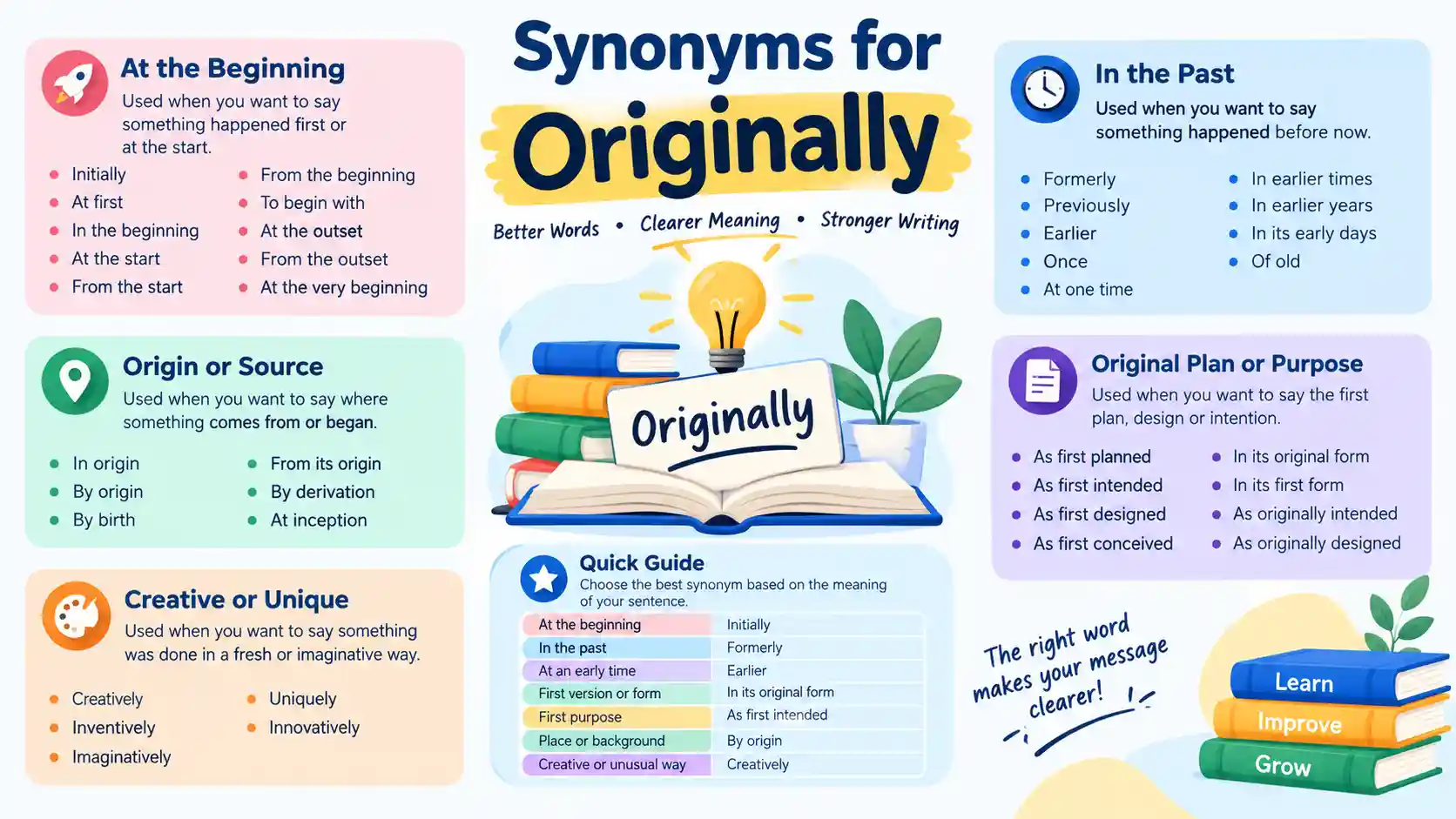
The best synonyms for originally are initially, at first, in the beginning, at the outset, formerly, and previously. Use initially or at first for a beginning, and formerly or previously for something that has changed.
Looking for synonyms for originally? You’re in the right place. This word can mean “at the beginning,” “before things changed,” or “where someone comes from,” so one replacement won’t fit every sentence.
Below, you’ll find simple alternatives sorted by meaning, each with a clear example. You’ll also get a quick comparison, grammar tips, and common mistakes to avoid. Let’s find the right word for your sentence.
📖 What Does “Originally” Mean?
Originally is an adverb. It has three main uses.
- At the beginning, before a change: The building was originally a school.
- By origin: She is originally from Canada.
- With a first plan or form: The bridge was originally designed for foot traffic.
There’s also a rare, less common sense: “in an original or creative way.” Most of the time, though, originally points back to a beginning.
Pronunciation: /əˈrɪdʒənəli/ (uh-RIJ-uh-nuh-lee)
⏳ Synonyms for “Originally” Meaning “At the Beginning”
Use these when you’re talking about the first stage of something.
| Word or phrase | Meaning | Example |
|---|---|---|
| Initially | At the first stage | Initially, the team struggled to work together. |
| At first | In the early part (most natural in speech) | At first, I didn’t like the idea. |
| In the beginning | At the earliest point | In the beginning, the shop had one employee. |
| At the outset | At the very start (formal) | At the outset, the goals were unclear. |
| At the start | When something began | At the start, the road was quiet. |
| From the start | Throughout, from the first moment | She was kind to us from the start. |
| To begin with | As a first point or stage | To begin with, we only sold books. |
| In the first place | At the very origin of a decision | Why did you choose this course in the first place? |
📜 Synonyms for “Originally” Meaning “Earlier or Before”
Use these when something was true in the past but isn’t true now.
| Word or phrase | Meaning | Example |
|---|---|---|
| Formerly | In the past, but no longer | The café was formerly a bank. |
| Previously | Before a particular time | He previously worked in sales. |
| Once | At some time in the past | This town was once a fishing port. |
| At one time | During an earlier period | At one time, the river was much wider. |
| Before | At an earlier time (simple, everyday) | I lived in Lahore before. |
🌍 Alternatives When “Originally” Means “By Origin”
Use these when you’re talking about where a person or thing comes from.
| Phrase | Example |
|---|---|
| By birth | She is Italian by birth. |
| By origin | The dish is Persian by origin. |
| A native of | He is a native of Karachi. |
| Hailing from (informal) | The band, hailing from Ireland, is touring now. |
📋 Alternatives When “Originally” Means “First Plan or Form”
| Phrase | Example |
|---|---|
| As first planned | The event went ahead as first planned. |
| As first intended | The tool works as first intended. |
| As first designed | The bridge is used as first designed. |
| In its original form | The recipe survives in its original form. |
| At inception | At inception, the project had only three members. |
🎨 Rare Sense: “Originally” Meaning “Creatively”
This use is uncommon. If you mean “in a fresh way,” these words are clearer: creatively, inventively, imaginatively, and innovatively.
Example: She solved the problem inventively.
⚖️ Words That Contrast With “Originally”
Originally has no single dictionary opposite. These words show what happened later.
| Word | Meaning | Example |
|---|---|---|
| Now | At the present time | It was originally a shop; now it’s a café. |
| Later | At a following time | The hall later became a museum. |
| Eventually | After a long time | The village was small but eventually became a city. |
| Finally | At the end, often after delay | The road was due in May and finally opened in July. |
| Ultimately | As the final result | The plan seemed risky but ultimately paid off. |
📚 Originally vs. Similar Words
| Word | Best used for | Example |
|---|---|---|
| Originally | First state, plan, or origin | The house was originally a shop. |
| Initially | First stage of a process | Initially, the machine worked well. |
| Formerly | A past status that has ended | The building is formerly a hotel. |
| Previously | Anything before a set time | She previously lived abroad. |
| At first | Casual, spoken English | At first, he was nervous. |
| Once | A simple past state | The lake was once frozen all winter. |
Correction to the row above: write it as “The building was formerly a hotel.” (Use “was,” not “is,” when the status has ended.)
Originally vs. Initially
They often overlap. Originally usually looks back at the first plan, state, or origin. Initially focuses on the first stage of an event.
- The hall was originally a church.
- Initially, the students found the lesson hard.
Originally vs. Formerly
Formerly stresses that something is no longer true. Originally stresses how it began. “The building was originally a school” tells us its first use. “The building was formerly a school” tells us it isn’t one now.
Originally vs. Previously
Previously only says “before a certain time.” Originally points back to the very beginning.
Originally vs. At First
At first sounds natural in conversation. Originally fits better when you explain an earlier plan, purpose, design, or origin.
🎯 Which Synonym Should You Use?
| Situation | Best choice | Example |
|---|---|---|
| First stage of a process | Initially | Initially, sales were slow. |
| Casual conversation | At first | At first, I thought it was too expensive. |
| Formal report or essay | At the outset | At the outset, the study had two aims. |
| Something that is no longer true | Formerly | The road was formerly a railway line. |
| Anything before a set time | Previously | The company previously used paper forms. |
| Emphasis on “all along” | From the start | We were clear about the goal from the start. |
| A person’s background | By birth or a native of | She is a native of Multan. |
| A first plan | As first planned | The meeting went ahead as first planned. |
Tip: Don’t swap words blindly. Check whether your sentence is about a beginning, a past status, an origin, or a plan, then choose from the matching group above.
💬 Example Sentences With “Originally”
- I originally planned to stay for one night.
- We originally wanted a smaller house.
- She is originally from Spain.
- The recipe is originally from Turkey.
- The study was originally designed for younger students.
- The book was originally published in another language.
- The company originally started with five employees.
- The meeting was originally scheduled for Friday.
- The town was originally called Newport.
- The tea is originally known as “red dust” in that region.
- Originally, we planned to travel by train.
- The old house was originally painted bright blue.
✍️ Grammar Tips
1. Position in a sentence. Originally can go at the start (with a comma), before the main verb, or after “be” or an auxiliary verb.
- Originally, we planned to travel by train.
- We originally planned to travel by train.
- The house was originally a shop.
2. Common patterns. Originally + planned, intended, designed, created, published, built, developed, called, or from.
3. “Originally from” describes origin. He is originally from Canada.
4. Word family:
| Word | Part of speech | Example |
|---|---|---|
| Origin | Noun | We studied the origin of the word. |
| Original | Adjective or noun | This is the original plan. |
| Originally | Adverb | It was originally a school. |
| Originality | Noun | Her writing shows originality. |
| Originate | Verb | The tradition originated in Europe. |
❌ Common Mistakes With “Originally”
| Wrong | Correct | Reason |
|---|---|---|
| He originally is from Italy. | He is originally from Italy. | The adverb usually comes after “be.” |
| The originally plan was simple. | The original plan was simple. | Use the adjective original before a noun. |
| Her work shows great originally. | Her work shows great originality. | Originality is the noun. |
| The meeting was formerly set for Friday. | The meeting was originally set for Friday. | Formerly means a past status, not a first plan. |
Don’t repeat it. Instead of “Originally, the shop was small. Originally, it had two workers,” write: “Originally, the shop was small. It had only two workers.”
💡 Quick Replacement Test
Before replacing originally, ask what you mean:
- The beginning? Try initially or at first.
- An earlier state that has ended? Try formerly or previously.
- A person’s background? Try by birth or a native of.
- A first plan? Try as first planned or as first intended.
- A fresh, creative way? Try creatively or inventively.
Sometimes originally is already the best word, so keep it.
🔗 Related Words
origin, original, originality, originate, inception, source, background, heritage, root, derivation, foundation, first, initial, former, previous, earlier
❓ Frequently Asked Questions
1. What is another word for originally?
Common alternatives are initially, at first, in the beginning, at the outset, from the start, formerly, and previously. Choose based on meaning: initially for a first stage, formerly for a past status, and by origin for background.
2. What is the simplest synonym for originally?
“At first” is the simplest and most natural in everyday English. “I originally thought it was easy” becomes “At first, I thought it was easy.” They aren’t identical in every sentence, especially when talking about origin.
3. Is initially the same as originally?
They often overlap, but not always. Initially focuses on the first stage of a situation. Originally can also describe a first plan, form, or place of origin, so “originally from Spain” can’t be replaced with “initially from Spain.”
4. What is the opposite of originally?
There’s no single opposite. Depending on the sentence, words like now, later, eventually, finally, or ultimately show a contrast. For example: “It was originally a school; now it’s a museum.”
5. How do you use originally in a sentence?
Use it for how something was at the start or where it came from. “The building was originally a library.” “She is originally from France.” It often suggests that things later changed.
6. Is originally formal or informal?
It works in both. You can use it in conversation, essays, and business writing. In very formal writing, “at the outset” or “initially” can sound slightly more precise.
7. What is the difference between originally and formerly?
Originally points to the beginning. Formerly says something was true before but no longer is. “Originally a school” stresses its first use; “formerly a school” stresses that it has stopped being one.
8. Can originally mean creatively?
Rarely. Dictionaries do list an “in an original way” sense, but it’s uncommon today. To avoid confusion, use “creatively” or “inventively” when you mean that.
✅ Conclusion
Originally helps you talk about a beginning, a first plan, or a place of origin. Depending on the sentence, you can use initially, at first, at the outset, formerly, previously, or by birth.
Ask what you really mean first, then pick the word that fits. For everyday English, “at first” is often best. For formal writing, “initially” or “at the outset” works well. For something that has ended, choose “formerly” or “previously.”