Every culture has myths — old stories about gods, heroes, and the birth of the world. But the word myth means more than one thing. It can be a sacred story, a popular tale, or a belief that is simply not true. That is why people search for synonyms for myths: they need the right word for the right sense.
In this guide, you will find 40 synonyms for myth in four clear groups, with simple meanings, the best use for each word, and real examples. You will also learn antonyms, grammar tips, and common mistakes, so you can use every word with confidence.
📖 Meaning of Myth
Myth is a noun. It means a traditional story, often about gods or heroes, that explains how the world began or why things are the way they are (Merriam-Webster). It can also mean a popular belief that is not true — for example, “the myth that money buys happiness”. We also use it for a person or thing that exists only in stories, like the unicorn.
- Part of Speech: Noun
- Pronunciation: MITH /mɪθ/
- Origin: Earlier mythos, mythus, borrowed from Greek mŷthos “utterance, speech, discourse, tale, narrative, fiction, legend”. The related words mythology and mythic are hundreds of years older than myth itself.
- First Known Use: 1830 (Merriam-Webster)
- Common Usage: We say “Greek myth”, “a creation myth”, “the myth of” plus a belief — “the myth of the perfect life”. In the plural, we say “myths” for many stories and “Greek myth” for the whole body of stories.
- Simple Explanation: A myth is an old story that people told to explain the world — and sometimes, it is a story that is not true at all.
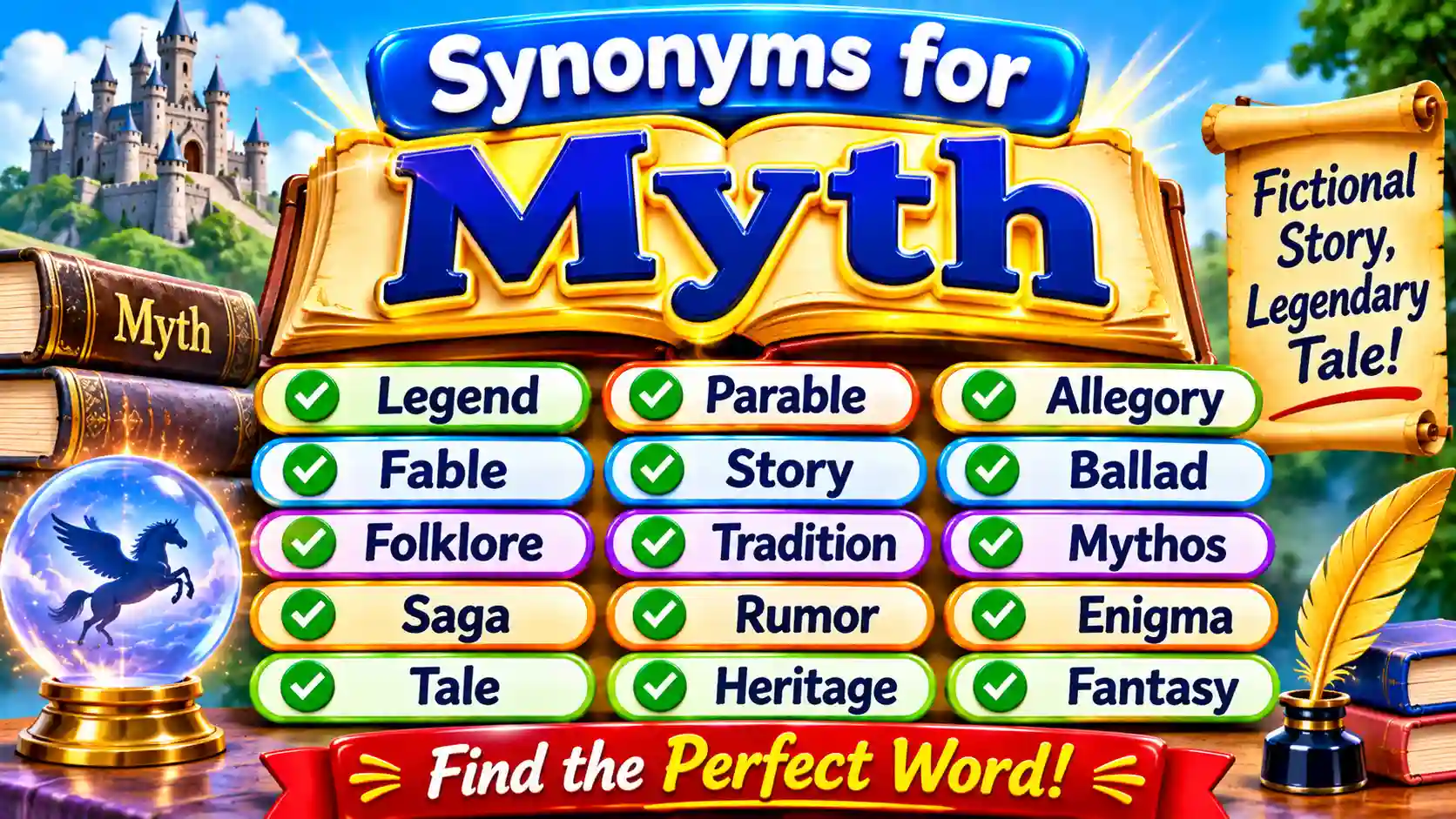
📝 Top Synonyms for Myth
A Traditional Story
| Word | Meaning | Best Use | Example |
| legend | An old story about a hero or an event | Stories and history | The legend of King Arthur lives on. |
| tale | A story, often told aloud | Daily and creative use | She told a tale of brave knights. |
| fable | A short story that teaches a moral | Lessons and children | The fable of the fox is famous. |
| folklore | The old stories and beliefs of a people | Culture and tradition | Irish folklore is full of magic. |
| saga | A long story of heroes and adventures | Books and history | The saga of the Vikings is long. |
| epic | A long poem or story about heroes | Literature and films | The epic tells of a great war. |
| story | An account of events, real or made up | Daily and general use | He loves a good story. |
| narrative | A spoken or written account of events | Formal and academic use | Her narrative moved the crowd. |
| lore | Old stories and knowledge passed down | Culture and fantasy | The lore of the forest is rich. |
| tradition | Beliefs and stories passed down over time | Culture and daily use | It is a tradition in our village. |
An Untrue Belief
| Word | Meaning | Best Use | Example |
| misconception | A wrong idea about something | Daily and formal use | It is a misconception that bats are blind. |
| fallacy | A false belief based on bad thinking | Formal and academic use | That claim is a fallacy. |
| falsehood | Something that is not true | Formal use | The report was full of falsehood. |
| illusion | Something that looks real but is not | Daily and creative use | The magic was just an illusion. |
| delusion | A false belief held with strong feeling | Formal and medical use | His delusion worried his friends. |
| fiction | Something made up, not real | Books and daily use | The tale is pure fiction. |
| fabrication | A lie made up to deceive | Formal use | The story was a fabrication. |
| invention | Something made up by the mind | Daily and formal use | The excuse was his invention. |
| untruth | Something that is not true | Formal use | He told an untruth. |
| fantasy | A dream or idea with no basis in fact | Daily and creative use | It was a pure fantasy. |
A Famous Person or Thing
| Word | Meaning | Best Use | Example |
| icon | A person famous for what they stand for | People and culture | She is an icon of fashion. |
| hero | A person admired for brave deeds | People and stories | He is a hero to his fans. |
| star | A famous person in film or music | People and media | The star filled the hall. |
| celebrity | A person famous in public life | People and media | The celebrity waved to fans. |
| idol | A person loved and admired by many | People and music | The idol sang to a huge crowd. |
| superstar | A person with very great fame | People and sports | The superstar scored the goal. |
| phenomenon | A person or thing that amazes people | People and events | The singer is a phenomenon. |
| wonder | A person or thing that fills people with awe | People and daily use | She is a wonder on the piano. |
| marvel | A person or thing that causes wonder | People and daily use | The bridge is a marvel. |
| titan | A person of very great power or fame | People and business | He is a titan of industry. |
A Sacred or Ancient Story
| Word | Meaning | Best Use | Example |
| mythology | The whole body of myths of a culture | Study and culture | Greek mythology is rich. |
| mythos | The set of beliefs and stories of a group | Formal and academic use | The Superman mythos is huge. |
| allegory | A story with a hidden moral meaning | Literature and study | The tale is an allegory. |
| parable | A short story that teaches a moral truth | Religion and lessons | Jesus told many parables. |
| creation story | A story of how the world began | Religion and culture | Every culture has a creation story. |
| origin story | A story of how something began | Daily and media use | The film tells his origin story. |
| fairy tale | A magical story, often for children | Children and stories | The fairy tale ends happily. |
| superstition | A belief in magic or luck with no proof | Culture and daily use | It is a superstition to fear black cats. |
| belief | Something a person holds to be true | Daily and formal use | It is a common belief. |
| cosmology | Ideas about how the universe began | Study and science | Ancient cosmology shaped myths. |
⚖️ Antonyms of Myth
Myth has no single exact opposite. These words are situational opposites — use the one that fits your sentence.
| Word | Meaning | Example |
| truth | What is real and true | She spoke the truth. |
| fact | Something known to be true | It is a fact, not a myth. |
| reality | The world as it really is | Reality is stranger than myth. |
| history | Real events of the past | History is based on proof. |
| evidence | Proof that shows something is true | The evidence was clear. |
| certainty | Being sure something is true | He spoke with certainty. |
| actuality | The state of being real | The actuality was plain. |
| verity | A true statement or fact | The verity of the claim was proved. |
| record | A written account of real events | The record shows the date. |
| nonfiction | Writing based on real facts | The book is nonfiction. |
💬 Example Sentences
Daily Conversation
- The myth that bats are blind is not true.
- We heard a myth about the old house.
- Everyone knows the myth of the perfect life.
- That story is just a myth, not a fact.
Academic English
- Greek myth explains the changing seasons.
- The myth of Persephone tells of winter and spring.
- Scholars study how myths shape a culture.
- Creation myths appear in every culture.
Business English
- The myth of overnight success misleads new firms.
- Smart leaders bust the myth that hard work alone wins.
- The myth of the perfect product costs firms money.
- We must break the myth that small teams cannot win.
Formal Writing
- The myth of racial superiority has no basis in fact.
- This paper tests the myth that money buys happiness.
- The author traces the myth to ancient Greece.
- Myths are sacred stories, not mere fiction.
Informal Writing
- Wow, the myth about the haunted school is wild!
- I love the myth of the unicorn and the rainbow.
- That old myth still gives me goosebumps.
- The myth of the lucky coin made us laugh.
Creative Writing
- The old myth woke when the moon rose full.
- Her tale wove myth and magic into one song.
- In the myth, the hero crossed a river of stars.
- The village kept its myth alive by the fire.
📚 Difference Between Similar Words
| Word | Meaning | Use It When | Example |
| myth | A sacred old story that explains the world | Talking about gods, origins, or false beliefs | Greek myth tells of Zeus. |
| legend | A story about a real person, made bigger over time | Talking about heroes from history | The legend of Robin Hood lives on. |
| fable | A short story with animals that teaches a moral | Talking about a lesson in a story | The fable of the tortoise teaches patience. |
| folklore | The old stories and beliefs of a whole people | Talking about a culture’s shared tales | Irish folklore is full of fairies. |
| history | Real events of the past, based on proof | Talking about what really happened | History records the war of 1947. |
🎯 Best Alternative Words
- Professional Writing: misconception, fallacy — “The claim is a common misconception.”
- Essay Writing: legend, folklore — “The legend of the hero shapes the essay.”
- Email: untruth, fiction — “That claim is fiction, not fact.”
- Business: misconception, fallacy — “Bust the fallacy that bigger is better.”
- Conversation: tale, story — “She told a tale of brave knights.”
- Marketing: legend, icon — “He is a legend in his field.”
- Creative Writing: saga, epic — “The saga of the Vikings is long.”
✍ Grammar Tips
- Word forms: Myth is a noun. Its plural is myths. The adjectives are mythical (relating to myths) and mythic (heroic, larger than life). The adverb is mythical.
- Mythical vs mythic: Mythical means “from myths” — “a mythical beast”. Mythic means “heroic and larger than life” — “a mythic hero”. Do not swap them carelessly.
- Myth vs mythology: A myth is one story. Mythology is the whole body of myths of a culture — “Greek mythology”, not “a Greek mythology”.
- Countable: Myth is countable — “one myth”, “many myths”. But in the sense of “the whole body of myths”, we use myth without an article — “a student of Greek myth”.
- Myth of: Use “the myth of” plus a belief — “the myth of the perfect life”, “the myth that money buys happiness”.
- No “mythness”: There is no noun “mythness”. Use myth or mythology instead.
- Myth as adjective: Myth never works as an adjective — say “a mythical creature”, not “a myth creature”.
❌ Common Mistakes
| Wrong | Correct | Reason |
| Many myths are false. | Many myths are false. | Myth is countable — add -s for the plural. |
| She told a mythical story about the gods. | She told a myth about the gods. | Mythical is an adjective — use the noun myth for the story. |
| The story is mythical. | The story is a myth. | After “a”, use the noun myth, not the adjective mythical. |
| Mythology is just one story. | A myth is just one story. | Mythology is the whole system of myths, not one single story. |
| The myths of Greece are famous. | The myths of Greece are famous. | Myths is plural — use are, not is. |
| He is a myth in his field. | He is a legend in his field. | A famous person is a legend or an icon — myth is for a story or a false belief. |
💡 Pro Writing Tips
- Name the sense: Always make clear which myth you mean — a sacred story, a popular tale, or a false belief.
- Save myth for stories: Use myth for old sacred stories and false beliefs, and legend for real heroes whose deeds grew over time.
- Don’t overuse myth: If every sentence says “myth”, the word loses power. Swap in legend, tale, or fable to keep readers awake.
- Use “the myth of”: Always name the belief — “the myth of the perfect life” is clearer than a bare “myth”.
- In formal writing, pick misconception: Myth is neutral, so in a formal report, use misconception or fallacy for a false belief instead.
- Show it with an example: Instead of “It is a myth”, write “The idea that bats are blind is a myth.” The picture is more than the label.
📖 Related Words
- mythology — the whole body of myths of a culture
- mythos — the set of beliefs and stories of a group
- legend — an old story about a hero or an event
- folklore — the old stories and beliefs of a people
- saga — a long story of heroes and adventures
- epic — a long poem or story about heroes
- fable — a short story that teaches a moral
- allegory — a story with a hidden moral meaning
- parable — a short story that teaches a moral truth
- creation story — a story of how the world began
- superstition — a belief in magic or luck with no proof
- tradition — beliefs and stories passed down over time
- narrative — a spoken or written account of events
- lore — old stories and knowledge passed down
- hero — a person admired for brave deeds
❓ FAQs
What does myth mean?
Myth means a traditional story, often about gods or heroes, that explains how the world began or why things are the way they are. It can also mean a popular belief that is not true, like the myth that money buys happiness. The word is a noun, and its plural is myths.
What is the difference between myth and legend?
A myth is a sacred old story that explains the world, often with gods and heroes, and it was believed to be true by the people who told it. A legend is a story about a real person or event, like Robin Hood, whose deeds grew bigger over time. Myths explain origins; legends celebrate heroes.
What is the difference between myth and fable?
Fables and myths are both old stories, but they work in different ways. A fable is a short tale that teaches a moral lesson, and its characters are usually animals, plants, or forces of nature that talk and act like people. A myth explains how the world began, with gods and heroes at its heart. Fables teach; myths explain origins.
What is the opposite of myth?
The opposite of myth depends on the sense you mean. When you mean a false belief, the opposite is truth or fact. When you mean a story that never really happened, the opposite is history. Pick the opposite that fits your sentence, because myth has more than one meaning.
Is myth singular or plural?
Myth is singular, and myths is its plural form. We say “one myth” and “many myths”. But in the sense of “the whole body of myths”, we use myth without an article — “a student of Greek myth”. In most sentences, use myths for more than one story.
What is the difference between myth and mythology?
A myth is one single story, like the myth of Icarus or the myth of King Midas. Mythology is the whole body of myths of a culture, like Greek mythology or Norse mythology. Use myth for one story, and mythology for the full set of stories a person tells.
What is a famous Greek myth?
A famous Greek myth is the story of Icarus, who flew too close to the sun on wings of feathers and wax. The wax melted, and he fell into the sea. Another famous myth is King Midas, whose touch turned everything to gold. Both stories still teach lessons today.
Can myth mean something false?
Yes, myth can mean a widely held idea that is false. For example, the idea that cracking your knuckles causes arthritis, or that goldfish have a three-second memory, is a myth. In this sense, close words are misconception, fallacy, and falsehood. Always check the context, because myth can also mean a sacred old story.
Conclusion
Myth is a small word with a big meaning — an old story that explains the world, a popular tale, or a belief that is simply not true. You now have 40 synonyms to say it better: legend for old hero stories, tale for simple stories, fable for lessons with talking animals, folklore for a people’s shared tales, and misconception for false beliefs. Remember: sacred story about gods, use myth; real hero, use legend; talking animals, use fable. Keep the grammar simple too — myths is plural, a myth is one story, and mythology is the whole body of myths. Pick the word that fits your sentence, and your writing will feel clear, natural, and strong. Share it with a friend who loves words, and keep it close when you write.