
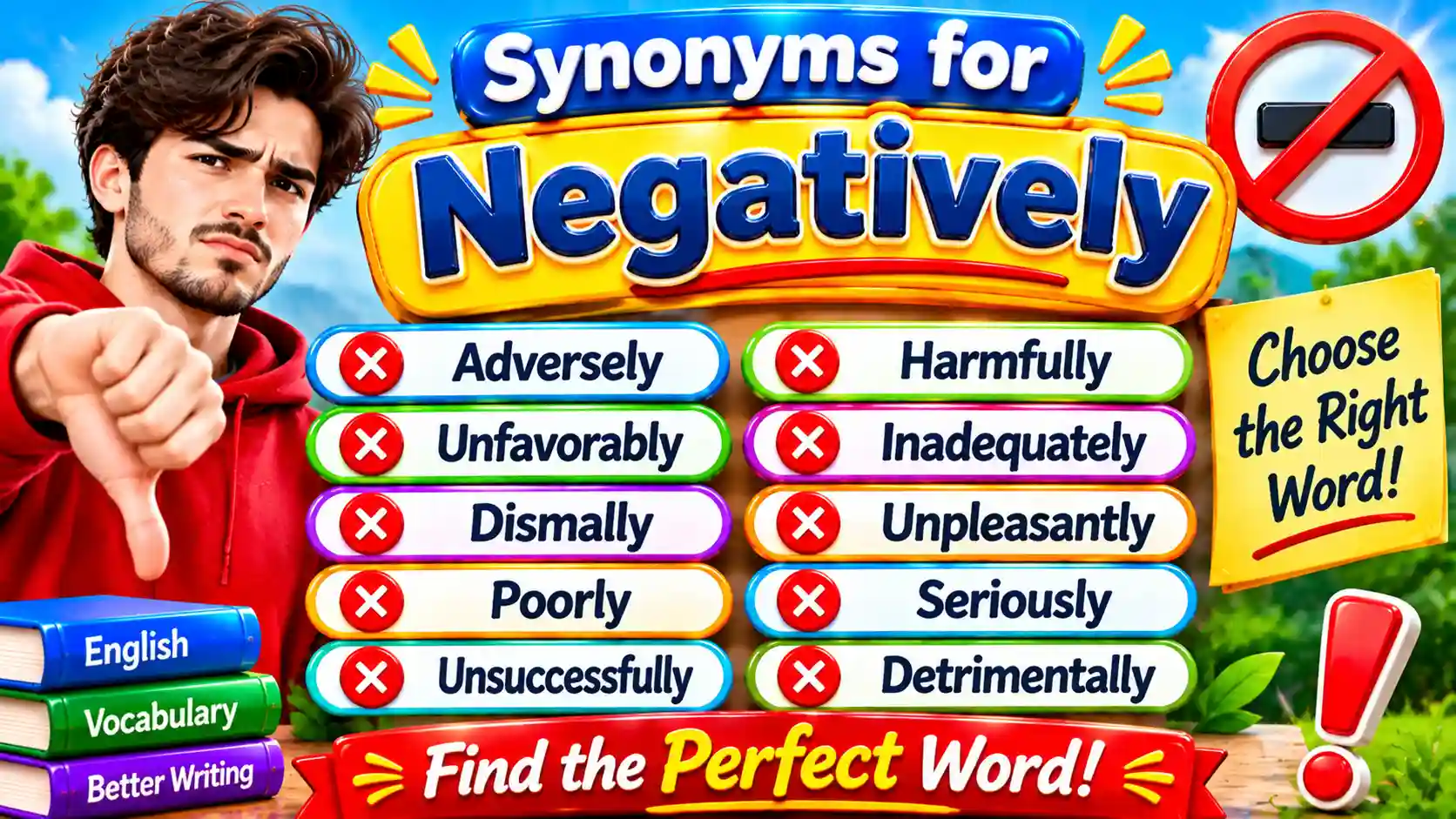
Some words are small but carry a lot of weight, and “negatively” is one of them. You hear it in news reports, school essays, business emails, and daily chats — “The plan affected sales negatively”, “She viewed the idea negatively”. But what does it really mean, and which word should you use instead?
In this guide, you will find 40 synonyms for negatively, sorted into four clear groups, with meanings, best uses, and real examples. You will also learn the difference between negatively, adversely, and pessimistically, plus grammar tips and common mistakes. By the end, you will know exactly which word fits your sentence — and your sentences will feel clearer and more confident.
📖 Meaning of Negatively
Definition: “Negatively” is an adverb. Merriam-Webster defines it as “by way of denial or contradiction”, “in the negative”, and “in such a way as to indicate refusal or lack of agreement or of sympathy” — for example, “viewed all their efforts negatively”. It can also mean “in a negative direction”, as in “a disk rotating negatively”, and “with negative electricity”, as in “negatively charged”.
Part of Speech: Adverb
Pronunciation: NEG-uh-tiv-lee /ˈneɡətɪvli/
Origin: “Negative” comes from around 1400, from Old French negatif and Latin negativus, meaning “that which denies”, from negare, “to deny, say no”. “Negatively” is also from around 1400, made by adding “-ly” to “negative”.
Common Usage: People use “negatively” to describe a bad reaction (“She reacted negatively”), a harmful effect (“Stress affects sleep negatively”), a bad opinion (“He views the plan negatively”), and in science, a negative electric charge (“negatively charged”).
Simple Explanation: If you do something negatively, you do it in a bad way — with a “no”, a frown, or a harmful result.
📝 Top Synonyms for Negatively
Unfavorably, With Disapproval
| Word | Meaning | Best Use | Example |
| Unfavorably | In a way that shows a bad opinion | Opinions and reviews | She viewed the plan unfavorably. |
| Disapprovingly | Showing that you do not approve | Reactions and looks | He shook his head disapprovingly. |
| Critically | In a way that finds faults | Reviews and feedback | The film was judged critically. |
| Harshly | In a rough and unkind way | Words and judgments | The teacher spoke harshly to the class. |
| Severely | In a very serious and strict way | Criticism and punishment | The plan was severely criticized. |
| Sternly | In a serious and strict way | Warnings and orders | “Sit down,” she said sternly. |
| Coldly | Without warmth or kindness | Greetings and replies | He answered her coldly. |
| Scornfully | With contempt and mockery | Reactions to ideas | She laughed scornfully at the idea. |
| Contemptuously | With deep disrespect | Attitudes and replies | He looked contemptuously at the mess. |
| Disparagingly | In a way that belittles something | Comments about people | He spoke disparagingly of his rival. |
Harmfully, In a Bad Way
| Word | Meaning | Best Use | Example |
| Adversely | In a way that causes harm | Effects and results | The drought affected crops adversely. |
| Harmfully | In a way that causes damage | Health and safety | Smoking affects health harmfully. |
| Detrimentally | In a way that causes harm or loss | Formal writing | The delay acted detrimentally on sales. |
| Badly | In a bad or poor way | Daily speech | The storm damaged the roof badly. |
| Destructively | In a way that destroys | Actions and habits | Anger can act destructively on trust. |
| Damagingly | In a way that causes damage | Reputation and health | The rumour spread damagingly fast. |
| Injuriously | In a way that injures | Formal and legal writing | The chemical acts injuriously on skin. |
| Dangerously | In a way that puts people at risk | Safety warnings | The road floods dangerously in rain. |
| Ruinously | In a way that ruins | Money and plans | The costs rose ruinously fast. |
| Disastrously | In a way that ends in disaster | Results and events | The launch went disastrously wrong. |
Pessimistically, With a Gloomy Outlook
| Word | Meaning | Best Use | Example |
| Pessimistically | Expecting the worst to happen | Outlook and forecasts | He viewed the future pessimistically. |
| Gloomily | In a sad and dark way | Moods and speech | She stared gloomily out of the window. |
| Cynically | Believing people act selfishly | Attitudes and comments | He smiled cynically at the promise. |
| Bleakly | Without hope or comfort | Descriptions and outlook | The report painted the future bleakly. |
| Darkly | In a gloomy or threatening way | Creative writing | He hinted darkly at trouble ahead. |
| Hopelessly | Without any hope | Feelings and situations | She felt hopelessly lost in the city. |
| Despairingly | With a loss of all hope | Emotional writing | He cried out despairingly for help. |
| Morosely | In a sullen and gloomy way | Moods and behaviour | He sat morosely in the corner. |
| Dourly | In a stern and gloomy way | Speech and looks | The guard nodded dourly at us. |
| Sullenly | In a bad-tempered, silent way | Reactions and moods | She stared sullenly at the floor. |
Hostilely, With Ill Will
| Word | Meaning | Best Use | Example |
| Hostilely | In an unfriendly, aggressive way | Conflicts and debates | The crowd reacted hostilely to the speaker. |
| Bitterly | With anger and resentment | Speech and feelings | She complained bitterly about the wait. |
| Resentfully | With a feeling of unfair treatment | Attitudes and replies | He glared resentfully at his brother. |
| Spitefully | With a wish to hurt or annoy | Actions and words | She spoke spitefully about her ex-friend. |
| Vindictively | With a wish for revenge | Behaviour and motives | He acted vindictively after the loss. |
| Maliciously | With a wish to cause harm | Intent and actions | The rumour was spread maliciously. |
| Angrily | With strong anger | Reactions and speech | He shouted angrily at the driver. |
| Hatefully | With hate and cruelty | Words and actions | They stared hatefully across the room. |
| Nastily | In a cruel and unpleasant way | Comments and behaviour | He laughed nastily at the mistake. |
| Unkindly | Without kindness | Words and treatment | She spoke unkindly to the new girl. |
⚖️ Antonyms of Negatively
| Word | Meaning | Example |
| Positively | In a good and hopeful way | She responded positively to the idea. |
| Favorably | In a way that shows approval | The plan was viewed favorably. |
| Approvingly | Showing that you approve | The teacher nodded approvingly. |
| Kindly | In a warm and gentle way | He spoke kindly to the child. |
| Warmly | With warmth and friendliness | She greeted us warmly. |
| Optimistically | Expecting the best to happen | He viewed the future optimistically. |
| Helpfully | In a way that helps | She explained the rules helpfully. |
| Beneficially | In a way that brings benefit | Exercise affects health beneficially. |
| Constructively | In a way that builds and improves | He criticized the plan constructively. |
| Cheerfully | In a happy and bright way | She answered cheerfully every time. |
💬 Example Sentences
Daily Conversation
- She shook her head negatively when I asked if she wanted more tea.
- He reacted negatively to the news, and the room went quiet.
- Don’t take it negatively — I only meant to help.
- My dad views tattoos negatively, so I never told him about mine.
Academic English
- The study found that stress affects memory negatively.
- The results show that noise affects learning negatively.
- Researchers observed that the drug influences mood negatively.
- The data suggest that screen time impacts attention negatively.
Business English
- The new tax will affect small shops negatively.
- Customers responded negatively to the price rise.
- The delay impacted our sales negatively this quarter.
- The board viewed the merger plan negatively.
Formal Writing
- The committee responded negatively to the proposal.
- Public opinion turned negatively after the report was published.
- The policy affects low-income families negatively.
- Critics judged the film negatively, yet audiences loved it.
Informal Writing
- He took my joke negatively, so I apologized right away.
- She always thinks negatively before a big test.
- I felt the comment was meant negatively, even if it was a joke.
- Don’t answer negatively — just say you need more time.
Creative Writing
- The old house seemed to glare negatively at the newcomers, its windows dark and cold.
- He shook his head negatively, and the whole room felt the refusal.
- The crowd murmured negatively as the singer walked off the stage.
- The storm answered negatively, drowning out every voice with thunder.
📚 Difference Between Similar Words
| Word | Meaning | When to Use It | Example |
| Negatively | In a bad, unfavourable, or harmful way | For a bad reaction, a bad opinion, or a bad effect | She reacted negatively to the news. |
| Adversely | In a way that causes harm or damage | When the focus is harm or damage | The drought affected crops adversely. |
| Pessimistically | Expecting the worst to happen | When the outlook or attitude is gloomy | He viewed the future pessimistically. |
| Unfavorably | In a way that shows disapproval | When someone judges or views something badly | She viewed the plan unfavorably. |
Simple rule: Use negatively for a bad reaction or a bad effect, adversely for harm, pessimistically for a gloomy outlook, and unfavorably for a bad opinion.
🎯 Best Alternative Words
- Professional Writing: Use “adversely” for harmful effects and “unfavorably” for bad opinions. Both sound formal and precise in reports and papers.
- Essay Writing: Use “unfavorably” for opinions and “pessimistically” for outlooks. They add variety and show a strong vocabulary.
- Email: Use “unfavorably” for a polite tone, as in “The client viewed the change unfavorably.” Keep it short and clear.
- Business: Use “adversely” for results and “unfavorably” for feedback, as in “The delay affected sales adversely.”
- Conversation: Use “badly” or “harshly” — they sound natural, as in “He took it badly” or “She spoke harshly.”
- Marketing: Avoid “negatively” and reframe the idea in positive words, as in “could be improved” instead of “viewed negatively”.
- Creative Writing: Use “darkly”, “coldly”, or “bitterly” to paint a mood, as in “He hinted darkly at trouble ahead.”
✍ Grammar Tips
- Word family: negative (adjective and noun), negatively (adverb), negativity (noun), negate (verb), negation (noun).
- “Negatively” is an adverb: It describes a verb (“reacted negatively”), an adjective (“negatively charged”), or another adverb. It never describes a noun.
- Form: Add “-ly” to “negative” — never add a second “-ly”. “Negativelyly” is wrong.
- After a linking verb, use the adjective: Say “The result was negative”, not “The result was negatively”. Verbs like “be”, “seem”, and “feel” need an adjective after them.
- “Negatively charged” is a fixed term: In science, it means carrying a negative electric charge — more electrons than protons.
- Avoid double negatives: In standard English, “I don’t have no time” is wrong. Say “I don’t have any time” or “I have no time.”
- Position: Put “negatively” after the verb it describes — “She reacted negatively”, “Stress affects sleep negatively”.
❌ Common Mistakes
| Wrong | Correct | Reason |
| He spoke negative about the plan. | He spoke negatively about the plan. | An adverb is needed to describe how he spoke; “negative” is an adjective. |
| The test was negatively. | The test result was negative. | After “was” we need an adjective, not an adverb. |
| She reacted negativelyly. | She reacted negatively. | “Negatively” already ends in “-ly”; do not add another one. |
| I don’t have no time. | I don’t have any time. | Two negatives cancel each other in standard English; use “any” with “not”. |
| The news affected us negative. | The news affected us negatively. | “Affected” is a verb, so it needs the adverb “negatively”. |
| He is a negatively person. | He is a negative person. | Before a noun we need the adjective “negative”, not the adverb “negatively”. |
💡 Pro Writing Tips
- Pick by meaning, not by habit: If the effect is harm, use “adversely”. If it is an opinion, use “unfavorably”. If it is a gloomy outlook, use “pessimistically”.
- Match the register: In formal writing, prefer “adversely” or “unfavorably”. In daily speech, “badly” or “harshly” sounds more natural.
- Keep the verb strong: “The delay affected sales negatively” is clear. Do not pile on extra adverbs — one is enough.
- Watch the linking verb: After “was”, “seemed”, or “felt”, use “negative”, never “negatively”.
- Use it sparingly: One “negatively” per paragraph is plenty. If you use it in every sentence, your writing sounds flat.
- In marketing, reframe: Instead of “customers viewed the change negatively”, try “customers wanted a simpler change”. Positive framing sells better.
📖 Related Words
- Negative — adjective and noun; the base word of “negatively”
- Negativity — noun; a negative attitude or state
- Negate — verb; to make something have no effect, or to deny it
- Negation — noun; the act of denying or saying no
- Denial — noun; saying that something is not true
- Refusal — noun; saying no to a request or offer
- Adverse — adjective; harmful or unfavourable
- Unfavorable — adjective; showing a bad opinion
- Pessimistic — adjective; expecting the worst to happen
- Hostile — adjective; unfriendly and aggressive
- Critical — adjective; finding faults
- Disapproval — noun; the feeling that something is wrong or bad
❓ FAQs
What is the best synonym for negatively?
“Adversely” is the best synonym when you mean a harmful effect, as in “The delay affected sales adversely.” “Unfavorably” is best for a bad opinion, and “pessimistically” is best for a gloomy outlook. The right choice depends on your meaning, so pick the word that matches the exact idea you want to share.
Is negatively an adverb?
Yes, “negatively” is an adverb. It comes from the adjective “negative” plus “-ly”, and it describes how an action happens. You can say “They answered negatively” or “The news affected us negatively.” It never describes a noun — for that, use “negative”.
What is the difference between negatively and adversely?
“Negatively” is a wide word for a bad reaction, a bad opinion, or a bad effect. “Adversely” is narrower and means in a way that causes harm or damage, as in “The drought affected crops adversely.” Use “adversely” when the focus is harm, and “negatively” for a general bad reaction.
How do I use negatively in a sentence?
Place “negatively” after the verb it describes, as in “He spoke negatively about the plan” or “Stress affects sleep negatively.” You can also use it before an adjective, as in “negatively charged”. Do not use it after a linking verb — say “The result was negative”, not “was negatively”.
What is the opposite of negatively?
The opposite of “negatively” is “positively”. Other antonyms are “favorably”, “approvingly”, “kindly”, “optimistically”, and “constructively”. For example, “She responded positively to the idea” is the opposite of “She responded negatively to the idea.” The best antonym depends on the sense you mean.
What does negatively charged mean?
“Negatively charged” means carrying a negative electric charge, which happens when an object has more electrons than protons. In science, a battery’s negative terminal is the side where electrons gather. The term comes from Benjamin Franklin, who named the two kinds of electric charge positive and negative.
Can I use negatively in formal writing?
Yes, you can use “negatively” in formal writing, and it is common in academic and business English. For example, “The policy affects low-income families negatively” is clear and correct. For a more formal tone, you can also use “adversely” for harm or “unfavorably” for a bad opinion.
What is the difference between negatively and pessimistically?
“Negatively” covers a hostile reply, a harmful outcome, or a flat refusal. “Pessimistically” is narrower and means expecting the worst to happen, as in “He viewed the future pessimistically.” Use “pessimistically” only for a gloomy outlook, and “negatively” for a wider range of bad reactions.
Conclusion
“Negatively” is a small word with a big job. It can show a cold reply, a harmful result, a refusal, or a dark mood — and now you know 40 words that can say the same thing more clearly. Use “adversely” when something causes harm, “unfavorably” when you mean a bad opinion, and “pessimistically” when you expect the worst. Keep the grammar simple: “negatively” is an adverb, so it describes a verb, not a noun. Pick the word that fits your exact meaning, and your writing will sound clearer, sharper, and more natural.


