
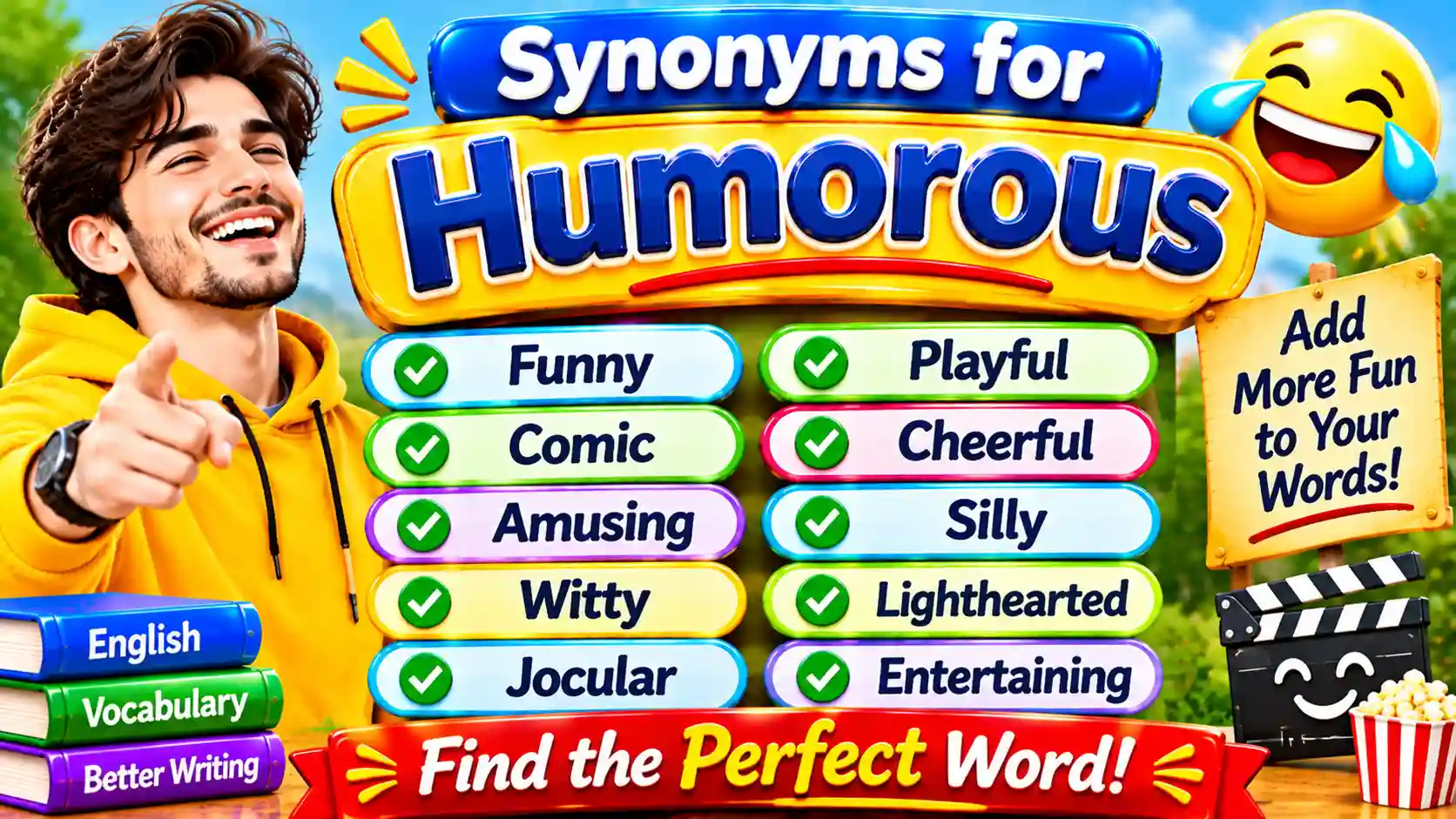
Laughter is one of the best parts of life, and “humorous” is the word we reach for when something makes us smile. You will find it in essays, speeches, and everyday chats — “a humorous story”, “a humorous teacher”, “a humorous twist”. But here is a surprise: “humorous” comes from the Latin word for “moisture”, because doctors once believed four body fluids decided your mood.
In this guide, you will find 40 synonyms for humorous, sorted into four clear groups, with meanings and real examples. You will also learn the difference between humorous, funny, and witty, plus grammar tips. By the end, you will know exactly which word fits your sentence — and your writing will feel lighter, warmer, and more fun.
📖 Meaning of Humorous
Definition: “Humorous” is an adjective. Merriam-Webster defines it as “full of or characterized by humor” — for example, “The book is very humorous” and “the humorous moments in an otherwise somber affair”. In simple words, something humorous makes people laugh or smile.
Part of Speech: Adjective
Pronunciation: HYOO-muh-rus /ˈhjuːmərəs/
Origin: “Humorous” comes from “humor”, which comes from Latin humor, meaning “moisture”. In the Middle Ages, doctors believed four fluids in the body — blood, phlegm, yellow bile, and black bile — decided a person’s health and mood. A cheerful person was said to have too much blood, a gloomy person too much black bile. Over time, “humor” came to mean mood, then a funny mood, and then the ability to make people laugh. Merriam-Webster records the first known use of “humorous” in the 15th century, while the modern “funny” sense is recorded from around 1705.
Common Usage: People use “humorous” for stories, speeches, teachers, books, films, and people — “a humorous story”, “a humorous speech”, “a humorous teacher”. It describes anything full of gentle, clever laughter.
Simple Explanation: If something is humorous, it makes you laugh or smile — a funny story, a witty remark, or a playful joke.
📝 Top Synonyms for Humorous
Funny, Makes You Laugh
| Word | Meaning | Best Use | Example |
| Funny | Makes people laugh | Daily speech and writing | Her story was so funny. |
| Amusing | Gently funny and pleasant | Stories and remarks | He told an amusing tale. |
| Hilarious | Extremely funny | Reactions and reviews | The show was hilarious. |
| Comical | Funny in a loud, silly way | Situations and scenes | It was a comical mix-up. |
| Laughable | So funny you cannot help laughing | Events and ideas | His excuse was laughable. |
| Sidesplitting | So funny it hurts to laugh | Jokes and shows | The act was sidesplitting. |
| Uproarious | Very loud and funny | Crowds and performances | The crowd gave uproarious laughter. |
| Riotous | Wildly funny and noisy | Parties and scenes | It was a riotous party. |
| Rib-tickling | Funny in a teasing way | Jokes and stories | She told a rib-tickling joke. |
| Knee-slapping | So funny you slap your knee | Old-fashioned jokes | It was a knee-slapping tale. |
Witty, With a Clever Edge
| Word | Meaning | Best Use | Example |
| Witty | Clever and quick with words | Speeches and writing | Her witty reply won the room. |
| Clever | Smart and quick-thinking | Remarks and ideas | That was a clever line. |
| Smart | Sharp and full of wit | Comments and comebacks | He gave a smart answer. |
| Droll | Dryly funny and odd | Characters and stories | He is a droll little man. |
| Wry | Funny with a dry twist | Remarks and smiles | She gave a wry smile. |
| Dry | Funny in a calm, quiet way | Humour and remarks | His dry humour made us laugh. |
| Ironic | Funny because it means the opposite | Comments and situations | It was an ironic twist. |
| Satirical | Funny by mocking faults | Writing and shows | The play was satirical. |
| Sarcastic | Funny with a sharp, biting edge | Remarks and replies | His sarcastic tone stung a little. |
| Facetious | Joking when you should be serious | Light remarks | Don’t be facetious right now. |
Light-Hearted, Playful
| Word | Meaning | Best Use | Example |
| Lighthearted | Cheerful and free of worry | Tone and mood | A lighthearted song lifted us. |
| Playful | Full of fun and games | People and writing | Her playful style charmed readers. |
| Jolly | Happy and full of laughter | People and parties | A jolly host kept us smiling. |
| Cheerful | Bright and happy | Moods and greetings | She gave a cheerful laugh. |
| Jovial | Friendly and full of good humour | People and gatherings | The jovial crowd sang along. |
| Merry | Happy and light | Celebrations and songs | We sang a merry tune. |
| Gleeful | Full of joyful delight | Reactions and laughter | The kids laughed gleefully. |
| Sprightly | Lively and full of energy | People and writing | Her sprightly wit kept us awake. |
| Buoyant | Cheerful and able to bounce back | Moods and spirits | His buoyant mood filled the room. |
| Carefree | Free of worry and full of fun | Attitudes and days | A carefree joke ended the meeting. |
Silly, Absurdly Funny
| Word | Meaning | Best Use | Example |
| Silly | Foolish in a funny way | Jokes and behaviour | He wore a silly hat. |
| Goofy | Silly and awkwardly funny | People and pets | Our goofy dog makes us laugh. |
| Zany | Wildly silly and odd | Comedy and characters | A zany clown stole the show. |
| Wacky | Strange and funny | Ideas and humour | It was a wacky plan. |
| Absurd | So silly it makes no sense | Situations and humour | The absurd plot made us laugh. |
| Ridiculous | So silly it seems unbelievable | Events and ideas | His ridiculous hat drew stares. |
| Ludicrous | Laughably absurd | Situations and claims | The ludicrous excuse failed. |
| Farcical | Like a wild, silly farce | Plays and events | The meeting turned farcical. |
| Slapstick | Physical, silly comedy | Comedy and films | The slapstick scene had us roaring. |
| Madcap | Wildly silly and reckless | Adventures and humour | A madcap chase ended the film. |
⚖️ Antonyms of Humorous
| Word | Meaning | Example |
| Serious | Not joking; grave and thoughtful | She gave a serious answer. |
| Solemn | Very serious and formal | The crowd fell solemn and quiet. |
| Grave | Deeply serious | His grave tone worried us. |
| Humorless | Without any sense of humour | The humorless boss never laughed. |
| Dull | Boring and not funny | The dull speech put us to sleep. |
| Boring | Not interesting or funny | The boring lecture dragged on. |
| Somber | Dark and serious in mood | A somber silence filled the room. |
| Grim | Stern and without laughter | He wore a grim expression. |
| Stern | Strict and serious | The stern teacher never smiled. |
| Joyless | Without joy or laughter | The joyless party ended early. |
💬 Example Sentences
Daily Conversation
- Her humorous story made the whole table laugh.
- He has a humorous way of telling even sad news.
- I love his humorous posts — they always cheer me up.
- The teacher’s humorous style makes class fun.
Academic English
- The study shows that humorous ads are remembered better than serious ones.
- Researchers found that humorous teaching improves student attention.
- The article uses humorous examples to explain a hard idea.
- A humorous tone can make academic writing easier to read.
Business English
- A humorous opening can relax the room before a big presentation.
- The brand used a humorous ad to win new customers.
- Keep the email humorous but polite — jokes should never offend a client.
- Our humorous slogan helped the product stand out.
Formal Writing
- The speech ended with a humorous story about the speaker’s first job.
- The report included a humorous note to lighten a serious topic.
- Her humorous essay won first prize in the writing contest.
- The novel’s humorous tone hides a serious message.
Informal Writing
- That was the most humorous text I got all week!
- His humorous captions always get the most likes.
- I tried to be humorous in my reply, but the joke fell flat.
- She sent me a humorous meme about Mondays.
Creative Writing
- The old clown’s humorous grin hid a hundred secrets.
- A humorous twist at the end turned the sad tale into a happy one.
- The cat gave a humorous little bow before stealing the fish.
- The wind played a humorous trick, blowing his hat straight into the pond.
📚 Difference Between Similar Words
| Word | Meaning | When to Use It | Example |
| Humorous | Full of humor; makes people laugh gently | For gentle, clever laughter | Her humorous story made us laugh. |
| Funny | Makes people laugh; also means strange | For any laugh, or something odd | That joke was funny. / That’s funny — the door was open. |
| Witty | Clever and quick with words | For smart wordplay and sharp replies | Her witty reply won the room. |
| Comical | Funny in a loud, silly way | For silly scenes that make you laugh out loud | It was a comical mix-up. |
Simple rule: Use humorous for gentle, clever laughter; funny for any laugh (or something strange); witty for clever wordplay; and comical for loud, silly laughter.
🎯 Best Alternative Words
- Professional Writing: Use “witty” for clever remarks and “lighthearted” for a warm tone, as in “a witty opening” or “a lighthearted note”.
- Essay Writing: Use “amusing” for gentle laughter and “witty” for clever points. They add variety and show a strong vocabulary.
- Email: Use “lighthearted” or “playful” for a friendly tone, as in “a lighthearted message to start the week”.
- Business: Use “witty” for speeches and “lighthearted” for team messages, as in “a witty slogan” or “a lighthearted team update”.
- Conversation: Use “funny” or “hilarious” — they sound natural, as in “That was so funny!” or “It was hilarious.”
- Marketing: Use “funny” or “playful” to catch attention, as in “a funny ad” or “a playful brand voice”.
- Creative Writing: Use “droll”, “wry”, or “zany” to paint a character, as in “his droll little smile” or “a zany clown”.
✍ Grammar Tips
- Word family: humor (noun and verb), humorous (adjective), humorously (adverb), humorist (noun), humorousness (noun), humorless (adjective).
- “Humorous” is an adjective: It describes a noun — “a humorous story”, “a humorous teacher”. It never stands alone as a noun.
- Comparative: Use “more humorous” and “most humorous”. Never say “humorouster” or “humorouser”.
- “A”, not “an”: “Humorous” starts with a pronounced H, so say “a humorous story”, never “an humorous story”.
- Spelling: American English writes “humor”, British English writes “humour” — but “humorous” is spelled the same in both. “Humourous” is always wrong.
- Adverb form: Add “-ly” to make “humorously” — “She spoke humorously about her first job.”
- “Funny” can also mean strange: “That’s funny — the door was open” does not mean the door made you laugh. “Humorous” never means strange.
❌ Common Mistakes
| Wrong | Correct | Reason |
| He told a humor story. | He told a humorous story. | Before a noun we need the adjective “humorous”, not the noun “humor”. |
| It was an humorous speech. | It was a humorous speech. | “Humorous” starts with a pronounced H, so use “a”, not “an”. |
| She is more humorouster than him. | She is more humorous than him. | Long adjectives use “more”, never “-er” on top of “-ous”. |
| The joke was humourous. | The joke was humorous. | The correct spelling is “humorous”, not “humourous”. |
| He is a humor person. | He is a humorous person. | “Humor” is a noun; use the adjective “humorous” before a person. |
| His humorous was great. | His humor was great. | “Humorous” is an adjective; the noun for the quality is “humor”. |
💡 Pro Writing Tips
- Pick by meaning, not by habit: If the laugh is clever, use “witty”. If it is loud and silly, use “comical” or “hilarious”. If it is gentle, use “amusing”.
- Match the register: In formal writing, prefer “humorous” or “witty”. In daily speech, “funny” or “hilarious” sounds more natural.
- Keep it light: One humorous line per paragraph is plenty. If every sentence tries to be funny, the joke wears thin.
- Avoid sarcasm in business: A sarcastic remark can sting. In emails and meetings, choose “lighthearted” over “sarcastic”.
- Show, don’t tell: Instead of saying “He was humorous”, show it — “He opened with a joke about his first job.”
- Know your audience: A joke that works with friends may fail at work. Pick a word — and a joke — that fits the room.
📖 Related Words
- Humor — noun and verb; the quality of being funny, or the ability to laugh
- Humour — noun; the British spelling of “humor”
- Humorously — adverb; in a funny way
- Humorist — noun; a person who writes or speaks in a funny way
- Humorousness — noun; the quality of being humorous
- Humorless — adjective; without any sense of humour
- Wit — noun; clever, quick humour with words
- Witty — adjective; full of clever wit
- Comedy — noun; a funny play, film, or show
- Comic — adjective and noun; funny, or a person who makes people laugh
- Laugh — verb and noun; to smile and make a happy sound
- Laughter — noun; the sound of laughing
- Joke — noun and verb; something said to make people laugh
- Amusement — noun; the feeling of being entertained and pleased
❓ FAQs
What does humorous mean?
“Humorous” is an adjective that means full of humor — something that makes people laugh or smile. A humorous story, speech, or person is funny in a gentle, clever way. For example, “The book is very humorous” means the book is full of jokes and funny moments.
What is the difference between humorous and funny?
“Funny” is a wider word — it can mean something that makes you laugh, or something strange, as in “That’s funny — the door was open.” “Humorous” is narrower and only means full of humor. Use “humorous” when the laugh is gentle and clever, and “funny” for any laugh.
Is humorous an adjective?
Yes, “humorous” is an adjective. It describes a noun, as in “a humorous story” or “a humorous teacher”. Its adverb form is “humorously”, as in “She spoke humorously about her first job”, and its noun form is “humorousness”, which means the quality of being humorous.
How do I use humorous in a sentence?
Put “humorous” before the noun it describes, as in “He told a humorous story” or “She gave a humorous speech.” You can also use it after a linking verb, as in “The story was humorous” or “The film was very humorous.” Never use it as a noun — say “his humor”, not “his humorous”.
What is the opposite of humorous?
The opposite of “humorous” is “serious”. Other antonyms are “solemn”, “grave”, “humorless”, “dull”, and “boring”. For example, “a serious speech” is the opposite of “a humorous speech”. The best antonym depends on the sense — “humorless” fits a person with no sense of humour.
What is the difference between humorous and witty?
“Humorous” is a wide word for anything that makes people laugh. “Witty” is narrower and means clever and quick with words, as in “a witty reply”. A witty remark is always humorous, but a humorous story is not always witty — it can be silly, gentle, or absurd instead.
What is humorous writing?
Humorous writing is writing that makes readers laugh or smile. It uses jokes, funny stories, clever wordplay, and silly situations to entertain. A humorous essay, novel, or speech mixes laughter with a real message, so readers enjoy the words and still remember the point.
Does humorous mean the same as funny?
Almost, but not exactly. “Humorous” and “funny” both mean something that makes people laugh. The difference is that “funny” can also mean strange or odd, as in “a funny smell”, while “humorous” only means full of humor. So every humorous thing is funny, but not every funny thing is humorous.
Conclusion
“Humorous” is a small word with a joyful job — it turns plain words into laughter. Now you know 40 words that can do the same job more clearly: “funny” for any laugh, “witty” for clever wordplay, “hilarious” for the loudest laugh, and “amusing” for gentle laughter. Keep the grammar simple: “humorous” is an adjective, so it describes a noun, and its adverb is “humorously”. Pick the word that fits your exact meaning, and your writing will sound lighter, warmer, and more fun.


