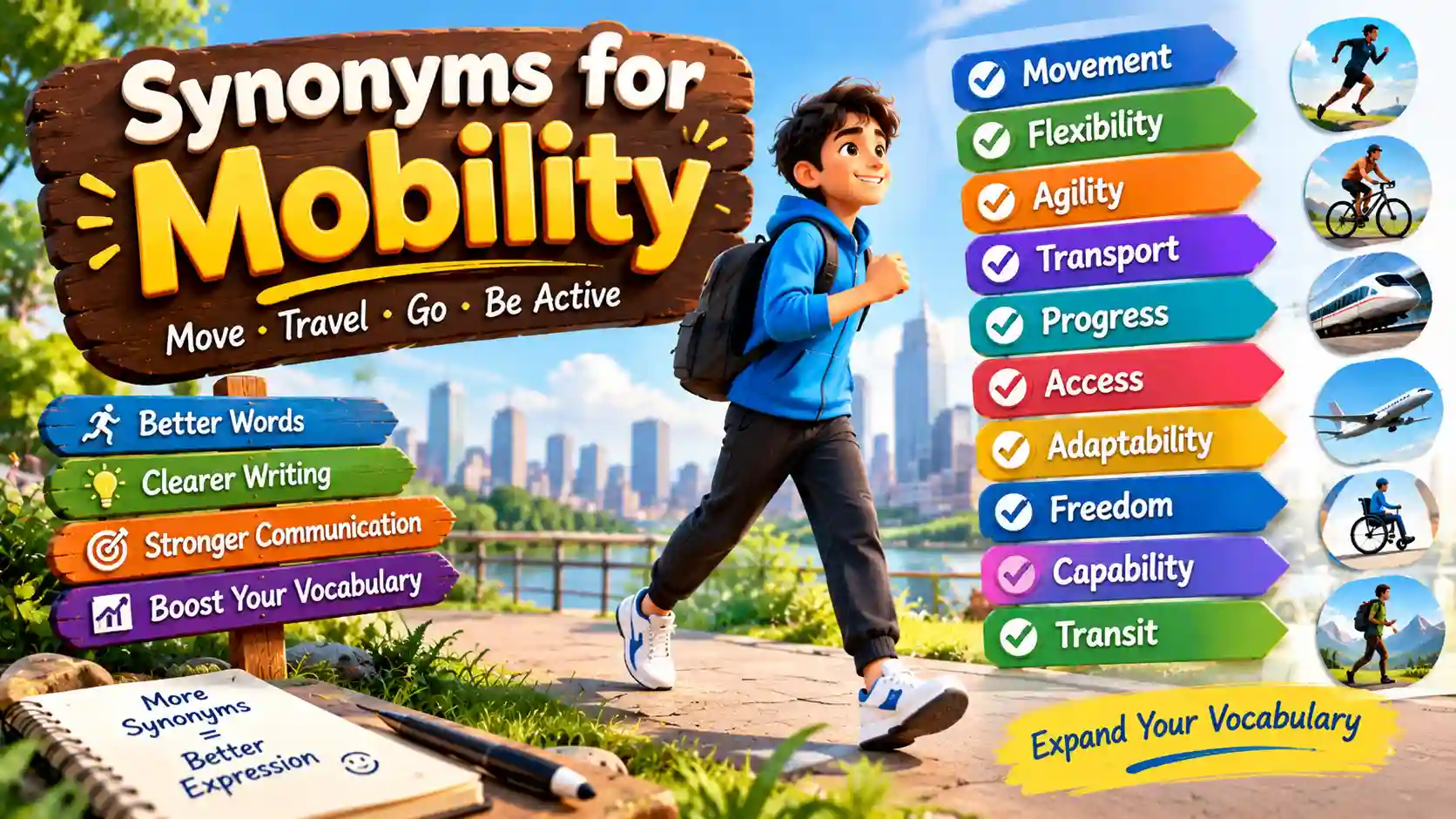
Looking for the best synonyms for mobility? The word mobility means the ability to move freely and easily. Common alternatives include movement, agility, flexibility, and motion. But these words aren’t always interchangeable — agility highlights speed and balance, while flexibility focuses on bending and adapting.
In this guide, you’ll learn 40 useful alternatives grouped by meaning, plus antonyms, example sentences, grammar tips, and answers to the most asked questions. Whether you’re a student, teacher, writer, or health professional, these examples will help you pick the perfect word every time.
📖 Meaning of “Mobility”
Definition: The ability to move or be moved freely and easily. It can describe a person’s body, a social position, or travel.
Part of Speech: Noun.
Pronunciation: /məʊˈbɪləti/ — say “moh-BIL-ih-tee.”
Origin: From Latin mobilitas (movability), from mobilis (movable, swift) — the same root that gives us mobile and move.
Common Usage: “Yoga improves mobility.” “Social mobility is rising.” “The army needs mobility.”
Simple Explanation: Mobility means how freely something can move — a body, a person in society, or a traveler on the road.
📝 Top Synonyms of “Mobility”
Physical Movement and the Body
| Word | Meaning | Best Use | Example |
| Movement | The act of moving | General | Movement heals stiff joints. |
| Motion | Moving from one place to another | Science, formal | Motion keeps the body young. |
| Locomotion | The ability to move from place to place | Biology, technical | Walking is a form of locomotion. |
| Agility | Quick, balanced movement | Sports, fitness | Agility helps players dodge. |
| Flexibility | The ability to bend and stretch | Health, yoga | Flexibility prevents injuries. |
| Dexterity | Skilled, precise movement | Hands, crafts | Her dexterity amazed the surgeon. |
| Maneuverability | Easy turning and direction changes | Vehicles, sports | The bike has great maneuverability. |
| Motility | The ability to move spontaneously | Biology, medical | Gut motility aids digestion. |
| Nimbleness | Light, quick movement | Informal, graceful | The dancer’s nimbleness wowed us. |
| Spryness | Lively, energetic movement (often older people) | Warm, descriptive | His spryness at 80 is amazing. |
Freedom and Ease of Movement
| Word | Meaning | Best Use | Example |
| Freedom | The state of being free to move | General, inspiring | A bike gives children freedom. |
| Liberty | Freedom from restriction | Formal, legal | Liberty of movement is a right. |
| Fluidity | Smooth, flowing movement | Dance, writing | Her fluidity on stage is stunning. |
| Ease | Moving without difficulty | Everyday | He moves with ease. |
| Smoothness | Even, effortless motion | Descriptive | The smoothness of her stride impressed us. |
| Grace | Elegant, controlled movement | Arts, praise | She walks with grace. |
| Portability | How easily something is carried | Products, tech | The laptop’s portability is great. |
| Adaptability | Adjusting easily to change | Work, life | Adaptability helps in new cities. |
| Versatility | Being useful in many ways | Skills, products | His versatility makes him valuable. |
| Range | How far something can move | Joints, technical | The shoulder has a wide range of motion. |
Social and Economic Mobility
| Word | Meaning | Best Use | Example |
| Advancement | Moving forward or upward | Careers | Education leads to advancement. |
| Progress | Moving toward a better state | General | Progress takes patience. |
| Promotion | A step up in rank or job | Workplace | She earned a promotion. |
| Ascent | A rise to a higher position | Formal | His ascent was rapid. |
| Rise | An increase in status or power | News, general | The rise of the middle class. |
| Betterment | Making something better | Formal | They work for society’s betterment. |
| Improvement | Becoming better | Everyday | Improvement is visible already. |
| Opportunity | A chance to advance | Inspiring | Education creates opportunity. |
| Elevation | Being raised to a higher level | Formal | His elevation surprised everyone. |
| Uplift | An improvement in conditions | Community | The program brought uplift. |
Travel and Getting Around
| Word | Meaning | Best Use | Example |
| Travel | Going from place to place | General | Travel broadens the mind. |
| Transit | Being carried across a place | Transport systems | The goods are in transit. |
| Transport | Carrying people or goods | Logistics | Transport links the cities. |
| Commuting | Traveling regularly to work | Daily life | Commuting takes an hour. |
| Navigation | Finding your way around | Ships, apps | Good navigation prevents delays. |
| Migration | Moving to live elsewhere | People, animals | Migration peaks in spring. |
| Relocation | Moving home or office | Business | Relocation costs are rising. |
| Wandering | Moving aimlessly, exploring | Creative, relaxed | Wandering through town is fun. |
| Roaming | Moving freely over an area | Animals, phones | Cattle roam the fields. |
| Touring | Traveling for pleasure | Travel writing | Touring Italy was magical. |
⚖️ Antonyms
| Word | Meaning | Example |
| Immobility | The state of not moving | Immobility harms recovery. |
| Stillness | No movement at all | Stillness filled the room. |
| Stiffness | Hard, difficult movement | Stiffness slows him down. |
| Rigidity | Being stiff and unbending | Rigidity limits the joint. |
| Stagnation | No progress or movement | Stagnation hurt the economy. |
| Paralysis | Complete loss of movement | The injury caused paralysis. |
| Confinement | Being kept in a small space | Confinement frustrated the patient. |
| Fixity | Staying fixed in one state | Fixity prevents change. |
💬 Example Sentences
Daily Conversation
- Yoga has really improved my mobility.
- Grandma’s mobility has improved since her surgery.
- This bike gives me freedom to go anywhere.
- He moves with such ease at his age!
Academic English
- Researchers studied mobility in older adults.
- Social mobility shapes life chances in cities.
- The study measured joint mobility after therapy.
- Data shows mobility declines without daily activity.
Business English
- Our app improves workforce mobility across regions.
- The company supports employee mobility and remote work.
- Market mobility helps small firms grow faster.
- We invested in mobility solutions for field staff.
Formal Writing
- Freedom of mobility is protected by law.
- The treaty guarantees mobility across borders.
- Urban mobility plans reduce city traffic.
- The patient’s mobility improved after rehabilitation.
Informal Writing
- My new scooter = total mobility upgrade!
- No car, no problem — bikes mean mobility for days.
- Stretching daily keeps my mobility on point.
Creative Writing
- The old dancer moved with a grace that defied her years.
- Freedom tasted like open roads and endless wandering.
- His ascent through the company was quiet but unstoppable.
- She roamed the coastline, collecting shells and stories.
- In the stillness after the storm, nothing moved at all — not even the trees.
📚 Difference Between Similar Words
| Word | Core Meaning | When to Use It |
| Mobility | The ability to move freely (body, society, travel) | General: “Mobility improves with exercise.” |
| Movement | The act of moving itself | Action-focused: “Her movement was graceful.” |
| Agility | Quick, balanced, skillful movement | Sports: “Agility wins games.” |
| Flexibility | How much something can bend or adapt | Body and plans: “Flexibility prevents injuries.” |
| Motion | Movement, often scientific or mechanical | Science: “Motion is energy in action.” |
Simple rule: Mobility is about ability. Movement and motion are about the act. Agility adds speed and skill, while flexibility adds bending and adapting.
🎯 Best Alternative Words
- Professional Writing: mobility, advancement, progress — precise and formal.
- Essay Writing: mobility, motion, migration — clear and academic.
- Email: movement, flexibility — natural and friendly.
- Business: mobility, relocation, commuting — everyday corporate terms.
- Conversation: freedom, movement, ease — warm and human.
- Marketing: freedom, flexibility, agility — positive and active.
- Creative Writing: wandering, roaming, grace — vivid and poetic.
✍ Grammar Tips
| Form | Word | Example |
| Noun | mobility | Mobility matters at every age. |
| Plural | mobilities (rare, academic) | Different mobilities were studied. |
| Adjective | mobile | The clinic is fully mobile. |
| Adverb | mobilely (rare) | Rarely used — rephrase instead. |
| Related verb | mobilize | They mobilized the team quickly. |
- Usually uncountable: Mobility is normally used without a plural. Say “mobility is growing,” not “mobilities are.” The plural mobilities appear only in academic writing comparing different kinds of movement.
- Don’t add -s casually: “less mobility,” not “less mobilitys.”
- Adjective vs noun: Mobile describes (a mobile clinic); mobility is the thing itself (clinic mobility).
❌ Common Mistakes
| ❌ Wrong | ✅ Correct | 💡 Reason |
| The mobility of people is growing. | The mobility of people is growing. | Mobility is usually uncountable. |
| He has good mobilty now. | He has good mobility now. | Spelling: mo-bil-i-ty. |
| Mobility is a verb. | Mobility is a noun; mobile is the adjective. | Keep word classes straight. |
| She has less mobilitys than before. | She has less mobility than before. | No -s on uncountable nouns. |
| The car has great mobility. | The car has great mobility. | Mobilize is a verb, not a noun. |
| He is mobile to work every day. | He is mobile enough to walk to work. | Mobile is an adjective — it needs a verb like is. |
💡 Pro Writing Tips
- Name the type. “Social mobility,” “joint mobility,” and “urban mobility” are three different topics — always specify which one you mean.
- Pick the active word. For bodies in motion, agility and movement feel alive; mobility feels clinical.
- Avoid repeating “mobility” in health writing. Alternate with movement, flexibility, and range of motion to keep readers engaged.
- Use mobile for tech and clinics. “Mobile app,” “mobile unit” — the adjective form is standard in these fields.
- Keep it human. In stories, choose wandering or roaming over mobility — they paint a picture.
📖 Related Words
- Associated words: mobile, mobilize, immobilize, immobilized, mobility aid, mobility scooter
- Nearby words: movement, motion, travel, transport, migration, commute
- Contextual words: wheelchair, rehabilitation, physiotherapy, accessibility, active transport
- Semantic variations: agility, flexibility, locomotion, maneuverability, fluidity
FAQs
1. What does mobility mean?
Mobility means the ability to move freely and easily. It can describe a person’s body (“joint mobility”), a person’s place in society (“social mobility”), or travel (“urban mobility”). It’s a noun, from Latin mobilitas meaning movability. Simple example: “Yoga improves mobility.” The adjective form is mobile, as in “a mobile phone.”
2. What is a good synonym for mobility?
Good synonyms include movement, agility, flexibility, and motion. Movement is the most general. Agility fits sports and quick, skillful motion. Flexibility focuses on bending and adapting, and motion suits science writing. Choose based on context — for health topics, mobility itself or movement usually works best.
3. What is the difference between mobility and movement?
Mobility is the ability to move; movement is the act of moving. A doctor checks your mobility (ability) before watching your movement (action). Think of it this way: good mobility makes smooth movement possible. Both are nouns, but mobility also works for society and travel, while movement stays physical or artistic.
4. What is the plural of mobility?
Mobility is usually uncountable, so it normally has no plural — say “mobility is important,” not “mobilities are.” In rare academic writing, mobilities is used to compare different kinds of movement, as in “urban and rural mobilities were studied.” For everyday writing, always use the singular form mobility.
5. What is the adjective form of mobility?
The adjective is mobile — as in “a mobile clinic,” “a mobile phone,” or “she is fully mobile after surgery.” It comes from the same Latin root (mobilis, movable). The adverb mobilely exists but is very rare; good writers rephrase instead. Example: instead of “he moved mobilely,” write “he moved freely.”
6. What is social mobility?
Social mobility is the ability to move up (or down) in society — in income, job status, or class. Education is the most famous driver: a student from a poor family who becomes a doctor shows upward social mobility. Governments and researchers track it because it measures how fair a society’s opportunities really are.
7. What are mobility aids?
Mobility aids are tools that help people move more freely. Common examples include wheelchairs, walking sticks (canes), walkers, crutches, and mobility scooters. They support independence after injury, illness, or with age. Other aids include stairlifts and grab rails at home. The goal is always the same: safer, easier, more confident movement every day.
8. Is mobility a formal word?
Yes, mobility is a medium-formal word. It’s standard in healthcare, social science, business, and transport planning: “urban mobility,” “workforce mobility.” With friends, simpler words like movement or getting around sound more natural. Neither is wrong — mobility simply adds a professional, precise tone, which is why reports and essays use it so often.
Conclusion
Now you know 40 synonyms for mobility — from everyday words like movement and freedom to precise terms like agility and locomotion. Remember the golden rules: mobility is about the ability to move, it’s normally uncountable (no plural in daily English), and its adjective form is mobile. Watch the common traps: spelling (mobility, not mobilty), word class (mobilize is a verb), and register (wandering belongs in stories, not reports). Keep practicing with the example sentences, explore the related words, and check out more vocabulary guides on Synonymfy.com to keep building your English!