
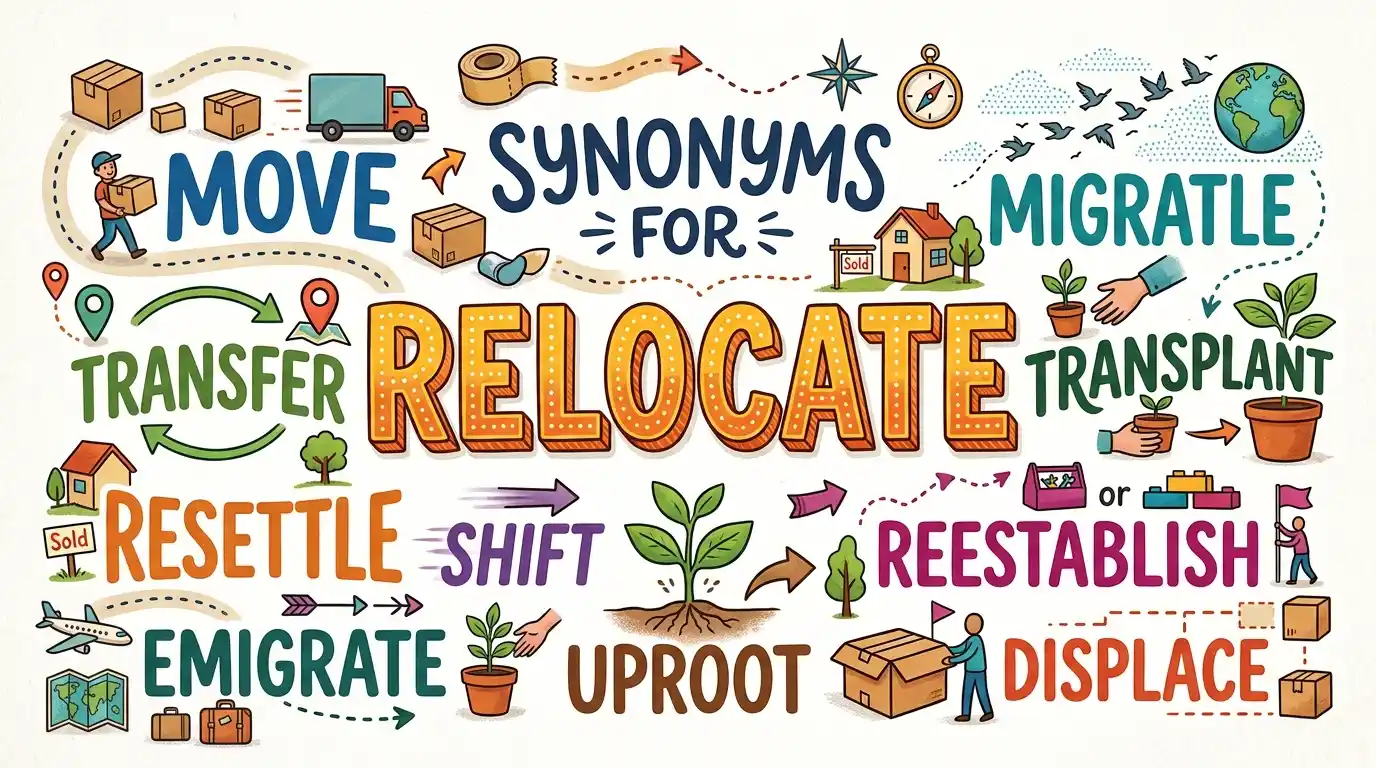
Looking for the best synonyms for relocate? The word relocate usually means to move to a new place — a new home, city, or office. Common alternatives include move, shift, transfer, and migrate. But these words aren’t always interchangeable — migrate suggests a big journey, while shift can mean moving just a chair.
In this guide, you’ll learn 40 useful alternatives grouped by meaning, plus antonyms, example sentences, grammar tips, and answers to the most asked questions. Whether you’re a student, teacher, writer, or professional writing a business email, these examples will help you pick the perfect word every time.
📖 Meaning of “Relocate”
Definition: To move to a new place, or to move something to a new position. It can describe people, businesses, or objects.
Part of Speech: Verb (can be transitive or intransitive). “We relocated” / “We relocated the office.”
Pronunciation: /ˌriː.ləʊˈkeɪt/ — say “ree-luh-KAYT.”
Origin: From re- (again) + locate, which comes from Latin locare (to place), from locus (place).
Common Usage: “The company relocated to Texas.” “They relocated the meeting to Room B.”
Simple Explanation: Relocate means to pick up and move — yourself, your business, or a thing — to a different place.
📝 Top Synonyms of “Relocate”
Moving Homes and Lives
| Word | Meaning | Best Use | Example |
| Move | To change where you live | Everyday | We move to a new flat next month. |
| Shift | To change position or place | Everyday, British English | They shifted to a bigger house. |
| Migrate | To move over a long distance | Big moves, formal | Birds migrate south in winter. |
| Emigrate | To leave your country to live elsewhere | Leaving a country | She emigrated to Canada in 2020. |
| Immigrate | To arrive in a new country to live | Entering a country | They immigrated to Australia. |
| Resettle | To settle again in a new place | Formal, refugees | The family resettled in a quiet town. |
| Rehouse | To give someone a new home | Official, housing | The council rehoused the families. |
| Uproot | To pull up and move completely | Emotional, dramatic | Moving abroad uprooted their lives. |
| Transplant | To move and settle somewhere new | People, plants | He transplanted his life to Tokyo. |
| Decamp | To leave a place suddenly | Informal, quick moves | They decamped to the countryside. |
| Pull up stakes | To leave everything and move (idiom) | Informal, brave moves | They pulled up stakes and moved west. |
| Start over | To begin again in a new place | Fresh starts | She started over in a new city. |
Work and Business Moves
| Word | Meaning | Best Use | Example |
| Transfer | To move someone to a new role or place | HR, official | He transferred to the London office. |
| Reassign | To give someone a new task or place | Business, formal | She was reassigned to Berlin. |
| Redeploy | To move staff or resources elsewhere | Military, corporate | Troops were redeployed to the border. |
| Re-site | To move a business to a new site | Business property | They re-sited the factory up north. |
| Reposition | To move to a better position | Strategy | The firm repositioned its headquarters. |
| Second | To send staff to work elsewhere temporarily (UK) | British business | He was seconded to the Paris team. |
| Post | To assign to a new location | Military, diplomats | She was posted to New Delhi. |
| Assign | To give someone a new place of work | Formal | They assigned him to the Tokyo branch. |
| Move offices | To change office location | Everyday business | We move offices in June. |
| Change base | To switch your main location | Informal business | The startup changed base to Austin. |
Moving Objects
| Word | Meaning | Best Use | Example |
| Budge | To move slightly | Small movements | The box won’t budge. |
| Dislodge | To force out of position | Stuck objects | He dislodged the stone. |
| Rearrange | To move into a new order | Furniture, plans | They rearranged the classroom. |
| Transport | To carry across a distance | Logistics | Trucks transport the goods. |
| Haul | To pull or carry heavily | Informal, heavy loads | They hauled the sofa upstairs. |
| Carry | To take from one place to another | Everyday | She carried the bags inside. |
| Lug | To drag something heavy (informal) | Casual | He lugged the suitcase upstairs. |
| Ferry | To carry back and forth | Repeated trips | Boats ferry passengers daily. |
| Shift around | To move things here and there | Informal | They shifted the desks around. |
| Displace | To move from its usual place | Formal | The flood displaced the fence. |
Urgent or Forced Moves
| Word | Meaning | Best Use | Example |
| Evacuate | To leave quickly for safety | Emergencies | They evacuated the building. |
| Clear | To empty a place | Orders | Police cleared the street. |
| Remove | To take away | Formal | They removed the old sign. |
| Eject | To force out | Forceful | He was ejected from the club. |
| Expel | To drive out officially | Schools, countries | The school expelled the student. |
| Exile | To force someone to leave a country | Politics, history | The king exiled his rival. |
| Deport | To send out of a country officially | Law | They deported the criminal. |
| Drive out | To force to leave | Strong, dramatic | Fear drove them out of town. |
⚖️ Antonyms
| Word | Meaning | Example |
| Stay | To remain where you are | We decided to stay. |
| Remain | To continue in a place | She remained in Paris. |
| Stay put | To not move (informal) | Stay put until I return. |
| Settle down | To stop moving and live somewhere | They settled down in Ohio. |
| Put down roots | To establish a permanent home (idiom) | They put down roots in the village. |
| Dwell | To live in a place (formal) | They dwell in the old house. |
| Reside | To live officially somewhere | She resides in Boston. |
| Linger | To stay longer than expected | He lingered after the meeting. |
💬 Example Sentences
Daily Conversation
- We’re relocating to Chicago next summer.
- They moved into a bigger apartment last week.
- I can’t budge this heavy table alone.
- She shifted all her furniture yesterday.
Academic English
- Researchers studied why families relocate to cities.
- Migration patterns show people relocate for jobs.
- The study tracked workers who transferred abroad.
- Data reveals most graduates relocate within five years.
Business English
- Our company is relocating its headquarters to Austin.
- She was transferred to the Singapore office.
- We need to re-site the warehouse closer to the port.
- He was seconded to our Berlin team for six months.
Formal Writing
- The embassy relocated after the security alert.
- Residents were evacuated before the storm arrived.
- The council voted to rehouse the affected families.
- The firm repositioned its European base.
Informal Writing
- We’re pulling up stakes and moving to the coast!
- He lugged all his stuff to the new place himself.
- They decamped to a cabin for the whole summer.
Creative Writing
- She uprooted her quiet life and transplanted it to the city.
- The old lighthouse keeper refused to budge from his rock.
- Fear drove them out, but hope led them somewhere new.
- They carried their dreams across the border in battered suitcases.
- The wind dislodged the sign, sending it clattering down the street.
📚 Difference Between Similar Words
| Word | Core Meaning | When to Use It |
| Relocate | To move to a new place (home, office, city) | Formal moves: “The firm relocated to Denver.” |
| Move | The general word for changing place | Everyday: “We move next week.” |
| Migrate | To move over a long distance, often seasonally | Big journeys: “They migrated west.” |
| Transfer | To move someone officially to a new role/place | Workplaces: “She transferred departments.” |
| Shift | To change position slightly or informally | Small or casual: “Shift the chair left.” |
Simple rule: Relocate is the formal all-rounder for homes and businesses. Moving is your everyday default. Migrate implies distance, transfer implies official process, and shift is the lightest of them all.
🎯 Best Alternative Words
- Professional Writing: relocate, transfer, reassign — precise and formal.
- Essay Writing: migrate, resettle, relocate — clear for readers.
- Email: move, shift, transfer — natural and friendly.
- Business: relocate, redeploy, re-site — industry-standard terms.
- Conversation: move, shift, pull up stakes — warm and human.
- Marketing: start fresh, new beginnings — positive and inviting.
- Creative Writing: uproot, transplant, decamp — vivid and dramatic.
✍ Grammar Tips
| Form | Word | Example |
| Base verb | relocate | We plan to relocate. |
| Third person | relocates | She relocates every two years. |
| Past tense | relocated | They relocated in June. |
| Present participle | relocating | We are relocating soon. |
| Past participle | relocated | They have relocated twice. |
| Noun | relocation | The relocation went smoothly. |
| Adjective | relocatable | The office is fully relocatable. |
| Adverb | — | No standard adverb exists. |
- Preposition: Use to — “relocate to London,” not “relocate at London.”
- After “to”: Use the base form — “need to relocate,” not “to relocation.”
- Noun vs verb: Relocate is the action; relocation is the thing. “The relocation (noun) was easy” vs “We relocated (verb) easily.”
❌ Common Mistakes
| ❌ Wrong | ✅ Correct | 💡 Reason |
| They relocated to a new city last year. | They relocated to a new city last year. | Past time needs the past tense. |
| She is relocating to New York. | She is relocating to New York. | Use to for destination, not at. |
| The company relocationed its office. | The company relocated its office. | The verb is relocate — just add -d. |
| We need to relocate soon. | We need to relocate soon. | After to, use the base verb form. |
| Relocate is a noun. | Relocation is a noun; relocate is a verb. | Don’t mix up the word forms. |
| He relocated very quickly. | He relocated very quickly. | Adverbs describe verbs — and use past tense here. |
💡 Pro Writing Tips
- Match the scale. Use relocate for homes and offices, migrate for long journeys, and shift for small adjustments.
- Mind the formality. Business emails love to relocate and transfer; friends prefer to move.
- Watch your prepositions. It’s always relocating to a place — at, in, and on sound wrong here.
- Don’t stack synonyms. “Relocate and move” in one sentence is redundant — pick one.
- Use the noun wisely. Relocation works great in HR and business writing: “relocation package,” “relocation costs.”
📖 Related Words
- Associated words: relocation, migrant, migration, emigration, immigration, transfer, displacement
- Nearby words: move, journey, travel, voyage, commute, resettlement
- Contextual words: headquarters, branch office, expat, refugee, evacuee, newcomer
- Semantic variations: rehouse, re-site, redeploy, reassign, uproot, transplant
FAQs
1. What does relocate mean?
Relocate means to move to a new place — a new home, city, or office — or to move something to a new position. Example: “The company relocated to Texas.” It comes from re- (again) plus locate (to place). It’s a verb, more formal than move, and it’s commonly used in business, HR, and everyday conversation about moving.
2. What is a good synonym for relocate?
Good synonyms include move, shift, transfer, and migrate. Move is the everyday default, transfer fits official work moves, and migration suggests a long-distance journey. For objects, try reposition or rearrange. Choose based on what’s moving and how formal the situation is — relocate itself is the safest all-rounder.
3. What is the difference between relocate and move?
Relocating is more formal and usually means changing your home, office, or city. Move is the general everyday word — it can mean changing houses or just shifting a chair. In business writing, relocate sounds professional (“the firm relocated”), while friends say move (“we’re moving next week”). Both are correct; tone decides.
4. What is the difference between relocate and migrate?
Relocating means moving to a new home or office, usually once and deliberately. Migrate suggests a longer journey, often across regions or countries — and it’s also used for animals and birds moving seasonally. People relocate for a new job; populations migrate for better opportunities. Migrate carries a bigger sense of distance.
5. What is the past tense of relocate?
The past tense is relocated — just add -d. Example: “They relocated to Denver last year.” The past participle is also relocated: “They have relocated twice.” A common mistake is writing relocationed, which is wrong. Remember: the verb is relocate, the noun is relocation — keep the two forms separate.
6. What is the noun form of relocate?
The noun is relocation — as in “The relocation went smoothly” or “relocation costs.” It’s very common in business and HR writing: “relocation package,” “relocation allowance.” Don’t confuse it with the verb: you relocate (action), but you plan a relocation (thing). After “to,” always use the verb: “need to relocate.”
7. How do you pronounce relocate?
Say “ree-luh-KAYT” — the stress falls on the last syllable: /ˌriː.ləʊˈkeɪt/. Break it into three parts: re (like “reef” without the f), lo (soft, quick), cate (rhymes with “late”). A common mistake is stressing the first syllable. Practice with the sentence: “We plan to reloCATE in June.”
8. Is relocate a formal word?
Yes, relocate is more formal than move. You’ll see it in business emails, HR documents, and news reports: “The company relocated its headquarters.” With friends, “move” sounds more natural: “We’re moving next month.” Neither is wrong — relocate simply adds a professional tone, which is why companies prefer it in official announcements.
Conclusion
Now you know 40 synonyms for relocate — from everyday words like move and shift to formal terms like transfer and migrate. Remember the golden rules: relocate is your professional all-rounder, move is the everyday default, and it’s always “relocate to” a place. Watch the common traps: the past tense is relocated, the noun is relocation, and there’s no adverb form. Keep practicing with the example sentences, explore the related words, and check out more vocabulary guides on Synonymfy.com to keep building your English!