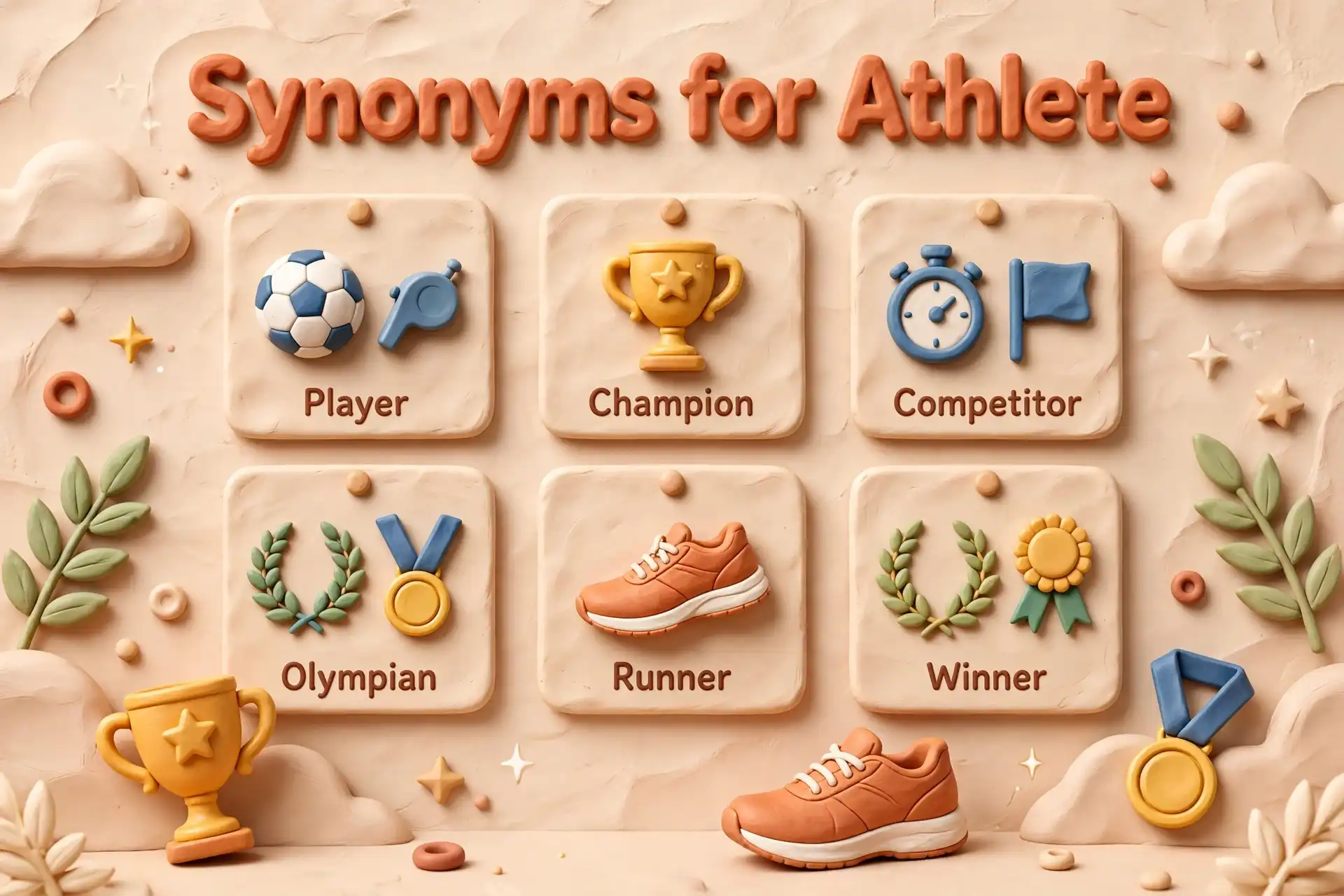
Looking for the best synonyms for athletes? The word athlete usually means a person who plays sports or competes in physical games. Common alternatives include player, sportsperson, competitor, and champion. But these words aren’t always interchangeable — a champion has won something, while a player might just enjoy the game.
In this guide, you’ll learn 40 useful alternatives grouped by meaning, plus antonyms, example sentences, grammar tips, and answers to the most asked questions. Whether you’re a student, teacher, writer, or sports fan, these examples will help you pick the perfect word every time.
📖 Meaning of “Athlete”
Definition: A person who is trained in sports, games, or physical exercises — especially someone who competes.
Part of Speech: Noun (countable). You can say “one athlete” or “ten athletes.”
Pronunciation: /ˈæθ.liːt/ — say “ATH-leet.”
Origin: From the Greek word athletes (contestant), which comes from athlon meaning “contest” or “prize.” It traveled through Latin (athleta) into English.
Common Usage: “The young athlete trains every morning.” “Olympic athletes inspire millions.”
Simple Explanation: An athlete is someone who plays sports seriously — running, swimming, football, or any physical competition.
US vs UK Note: In American English, athlete means any sportsperson. In British English, it often means a track-and-field competitor specifically (running, jumping, throwing). For other sports, British speakers often say player or sportsman/sportswoman.
📝 Top Synonyms of “Athlete”
General Words for Sports Players
| Word | Meaning | Best Use | Example |
| Player | Someone who takes part in a game or sport | Everyday, all sports | She’s a talented tennis player. |
| Sportsperson | A gender-neutral word for someone in sports | Formal, inclusive writing | The award honors the year’s best sportsperson. |
| Sportsman | A man who plays sports (traditional) | British English, traditional | He’s a true sportsman on and off the field. |
| Sportswoman | A woman who plays sports (traditional) | British English, traditional | She became a famous sportswoman in the 1990s. |
| Competitor | Someone who takes part in a contest | Competitions, races | Each competitor ran the full marathon. |
| Contestant | Someone who competes for a prize | Contests, tournaments | The contestants warmed up before the final. |
| Contender | Someone with a real chance of winning | Sports news | He’s a strong contender for the gold medal. |
| Participant | Someone who takes part in an event | Formal, events | All participants received a medal. |
| Professional | An athlete paid to play | Paid sports | She turned professional at eighteen. |
| Pro | Short, casual form of professional | Informal, conversation | He’s a golf pro from Florida. |
| Amateur | An athlete who plays for love, not pay | Non-professional sports | The tournament is open to amateurs. |
| Challenger | Someone who fights for a title | Title matches | The young challenger faced the champion. |
| Rival | A competing athlete or team | Sports stories | The two rivals met in the final. |
| Finalist | An athlete who reaches the final round | Tournaments | Both finalists played brilliantly. |
Elite and Winning Athletes
| Word | Meaning | Best Use | Example |
| Champion | The winner of a competition | Winners | She is the world champion. |
| Winner | Someone who wins | Everyday | The winner lifted the trophy high. |
| Victor | A literary word for winner | Formal, dramatic writing | The victor waved to the cheering crowd. |
| Star | A famous, outstanding athlete | Media, fans | He’s the star of the team. |
| Superstar | An extremely famous athlete | Celebrity sports | The superstar signed a huge contract. |
| Ace | A top performer | Informal, praise | Our ace scored three goals. |
| Medalist | An athlete who wins a medal | Olympics | She is a two-time Olympic medalist. |
| Record-holder | An athlete holding a best record | Sports history | The record-holder broke her own time. |
| Titleholder | The current holder of a title | Boxing, championships | The titleholder defended his belt. |
| Olympian | An athlete at the Olympic Games | Olympics | The young Olympian won bronze. |
| Paralympian | An athlete at the Paralympic Games | Paralympics | The Paralympian set a new record. |
| All-star | A player chosen as one of the best | US sports | He was voted an all-star five times. |
Sport-Specific Terms (Use Only in Context)
These are not universal synonyms — use them only when the sport is clear:
| Word | Meaning | Best Use | Example |
| Runner | An athlete who runs | Running | The runner finished first. |
| Sprinter | A short-distance runner | Track | The sprinter exploded from the blocks. |
| Swimmer | An athlete who swims | Swimming | The swimmer broke the record. |
| Gymnast | An athlete in gymnastics | Gymnastics | The gymnast scored a perfect ten. |
| Boxer | An athlete who boxes | Boxing | The boxer trained for months. |
| Wrestler | An athlete who wrestles | Wrestling | The wrestler won by pinfall. |
| Cyclist | An athlete who cycles | Cycling | The cyclist climbed the mountain stage. |
| Skier | An athlete who skis | Winter sports | The skier flew down the slope. |
| Footballer | A football/soccer player | British English | The footballer signed a new deal. |
| Cricketer | A cricket player | Cricket countries | The cricketer scored a century. |
| Tennis player | Someone who plays tennis | Tennis | The tennis player served an ace. |
| Jockey | A horse-racing rider | Horse racing | The jockey won by a nose. |
| Pugilist | A literary word for boxer | Formal, old-fashioned | The young pugilist entered the ring. |
| Triathlete | A three-sport endurance athlete | Triathlon | The triathlete swam, cycled, and ran. |
⚖️ Antonyms
Athlete has no single perfect opposite, but these words describe people who don’t compete in sports:
| Word | Meaning | Example |
| Nonathlete | A person who is not an athlete | The club welcomes athletes and nonathletes. |
| Spectator | Someone who watches instead of playing | Spectators filled the stadium. |
| Onlooker | A person watching an event | Onlookers cheered from the sidelines. |
| Viewer | Someone watching on TV or online | Millions of viewers watched the final. |
| Bystander | A person standing near, not taking part | Bystanders watched the street race. |
| Non-competitor | Someone not competing | The award is open to non-competitors too. |
| Couch potato | A lazy person (informal, humorous) | Don’t be a couch potato — go play! |
| Armchair fan | A fan who only watches (informal) | He’s an armchair fan of football. |
💬 Example Sentences
Daily Conversation
- The young athlete trains before school every day.
- She’s the best athlete on our basketball team.
- My brother wants to become a professional athlete.
- That athlete runs faster than anyone I know.
Academic English
- Researchers studied how athletes recover from injuries.
- The study compared diets of endurance athletes.
- Student athletes must balance sports and schoolwork.
- Data shows athletes peak in their late twenties.
Business English
- Our company sponsors three Olympic athletes.
- The brand signed the athlete for a new campaign.
- Athletes make excellent motivational speakers.
- We invited a famous athlete to the product launch.
Formal Writing
- The athlete received the national sports award.
- Each athlete must pass a medical examination.
- The committee honored the retired athlete.
- Athletes from forty countries took part.
Informal Writing
- He’s such a natural athlete — good at everything!
- That was an insane performance by the young athlete.
- She trains like a beast — total athlete mindset.
Creative Writing
- The tired athlete crossed the line and collapsed, smiling.
- Rain hammered the track, but the athlete kept running.
- Under stadium lights, the young athlete became a legend.
- Every scar told a story on the veteran athlete’s hands.
- The crowd held its breath as the athlete took the final shot.
📚 Difference Between Similar Words
| Word | Core Meaning | When to Use It |
| Athlete | A person trained in sports or physical competition | General: “She’s a talented athlete.” |
| Player | Someone taking part in a game | Games with teams or opponents: “a football player” |
| Sportsman / Sportswoman | Traditional word for a male/female in sports | British English, traditional tone |
| Sportsperson | Gender-neutral modern alternative | Formal, inclusive writing |
Simple rule: Athlete is the broadest word. Players fit games and team sports best. In the UK, athlete often means track and field only — so player or sportsperson may sound more natural there.
🎯 Best Alternative Words
- Professional Writing: sportsperson, competitor, professional — neutral and precise.
- Essay Writing: athlete, competitor, participant — clear for readers.
- Email: player, team member — natural and friendly.
- Business: professional athlete, brand ambassador — industry-standard terms.
- Conversation: player, pro, star — warm and human.
- Marketing: champion, superstar, Olympian — exciting and aspirational.
- Creative Writing: victor, contender, challenger — vivid and dramatic.
✍ Grammar Tips
| Form | Word | Example |
| Singular noun | athlete | The athlete is warming up. |
| Plural noun | athletes | The athletes are warming up. |
| Adjective | athletic | She has an athletic build. |
| Adverb | athletically | He moves athletically for his age. |
| Verb | — | No verb form exists. Don’t invent one. |
- Plural rule: Just add -s — athletes. No apostrophe needed.
- Adjective vs noun: Athlete is a person; athletic describes a quality. “He is athletic” (not “he is an athlete”).
- No verb: There is no verb “to athlete.” Say “to compete” or “to play sports” instead.
- US/UK reminder: In British English, athlete alone often suggests track and field.
❌ Common Mistakes
| ❌ Wrong | ✅ Correct | 💡 Reason |
| She is a good athlete. | She is a good athlete. | Don’t stack two synonyms together. |
| He is very athletic. | He is very athletic. | Use the adjective athletic after “very.” |
| The athlete’s are tired. | The athletes are tired. | Plurals don’t need an apostrophe. |
| An athlete must train daily. | An athlete must train daily. | Never put “to” after “must. |
| He is an athlete of football. | He is a football player. | Football player is the natural phrase. |
| The athlets won the game. | The athletes won the game. | Spelling: a-t-h-l-e-t-e-s. |
💡 Pro Writing Tips
- Match the sport. Use a player for team games, runner or swimmer when the sport is known, and athlete as your safe all-rounder.
- Mind your audience. American readers accept athletes for all sports; British readers may expect track and field — adjust accordingly.
- Don’t overuse “sportsman.” It’s traditional and gendered; sportsperson or athlete is safer in modern writing.
- Use elite words sparingly. Champions and superstars lose power if every athlete gets one.
- Check the context. Competitor and rival imply a contest — don’t use them for casual weekend players.
📖 Related Words
- Associated words: athletics, athleticism, sportsmanship, training, fitness, competition, tournament, championship
- Nearby words: player, team, coach, referee, fan, stadium, medal, trophy
- Contextual words: endurance, stamina, agility, strength, speed, teamwork, victory, defeat
- Semantic variations: Olympian, Paralympian, professional, amateur, all-star, MVP (most valuable player)
FAQs
1. What does athlete mean?
An athlete is a person trained in sports, games, or physical exercise — especially someone who competes. In American English it covers all sports, while in British English it often means a track-and-field competitor. The word comes from Greek athletes, meaning “contestant.” Example: “The young athlete trains every morning before school.”
2. What is a good synonym for athlete?
Good synonyms include player, sportsperson, competitor, and champion. Player works for most games, competitor fits contests and races, and champion means a winner. Choose based on context: a casual weekend footballer is a player, while an Olympic gold medalist is a champion or Olympian.
3. Is player a synonym for athlete?
Yes, but with a difference. Player usually means someone taking part in a game — especially team sports like football or basketball. Athlete is broader and covers all physical sports, including running and swimming. In American English they’re often interchangeable; in British English, player is preferred for non-track sports.
4. What is the difference between athlete and sportsman?
Athlete is modern and gender-neutral, used worldwide for anyone in competitive sports. Sportsman is traditional British English for a man in sports, and sportswoman for a woman. Many style guides now prefer athletes or sportspeople because they’re inclusive. In the UK, sportsmen can also describe someone with a fair, sporting attitude.
5. What is the plural of athlete?
The plural is athletes — just add -s. Example: “The athletes warmed up before the race.” Never write athlete’s for the plural; the apostrophe is only for possession, as in “the athlete’s medal.” This is a regular plural with no spelling changes, unlike words like curriculum → curricula.
6. What is the adjective form of athlete?
The adjective is athletic — as in “an athletic teenager” or “athletic shoes.” A common mistake is saying “he is very athletic,” which is wrong; say “he is very athletic.” The adverb form is athletically: “She moves athletically.” Remember: athlete is the person, athletic describes the quality.
7. What is the opposite of an athlete?
There is no single perfect antonym, but nonathlete is the most direct opposite. Others include spectator (one who watches), onlooker, and viewer. Informally, people say couch potato for someone lazy and inactive. Choose based on tone — nonathlete is neutral, while couch potato is humorous and slightly rude.
8. Can athlete be used as a verb?
No — athlete has no verb form in standard English. Don’t write “he athletes every day.” Instead say “he competes,” “he trains,” or “he plays sports.” Dictionaries like Merriam-Webster and Collins list athlete only as a noun. If you need a verb for sports action, compete and train are your best choices.
Conclusion
Now you know 40 synonyms for athlete — from everyday words like player and competitor to elite terms like champion and Olympian. Remember the golden rules: athlete is your safe all-rounder, player fits team games best, and in British English athlete often means track and field. Watch the common traps: the plural is athletes, the adjective is athletic, and there’s no verb form. Keep practicing with the example sentences, explore the related words, and check out more vocabulary guides on Synonymfy.com to keep building your English!