
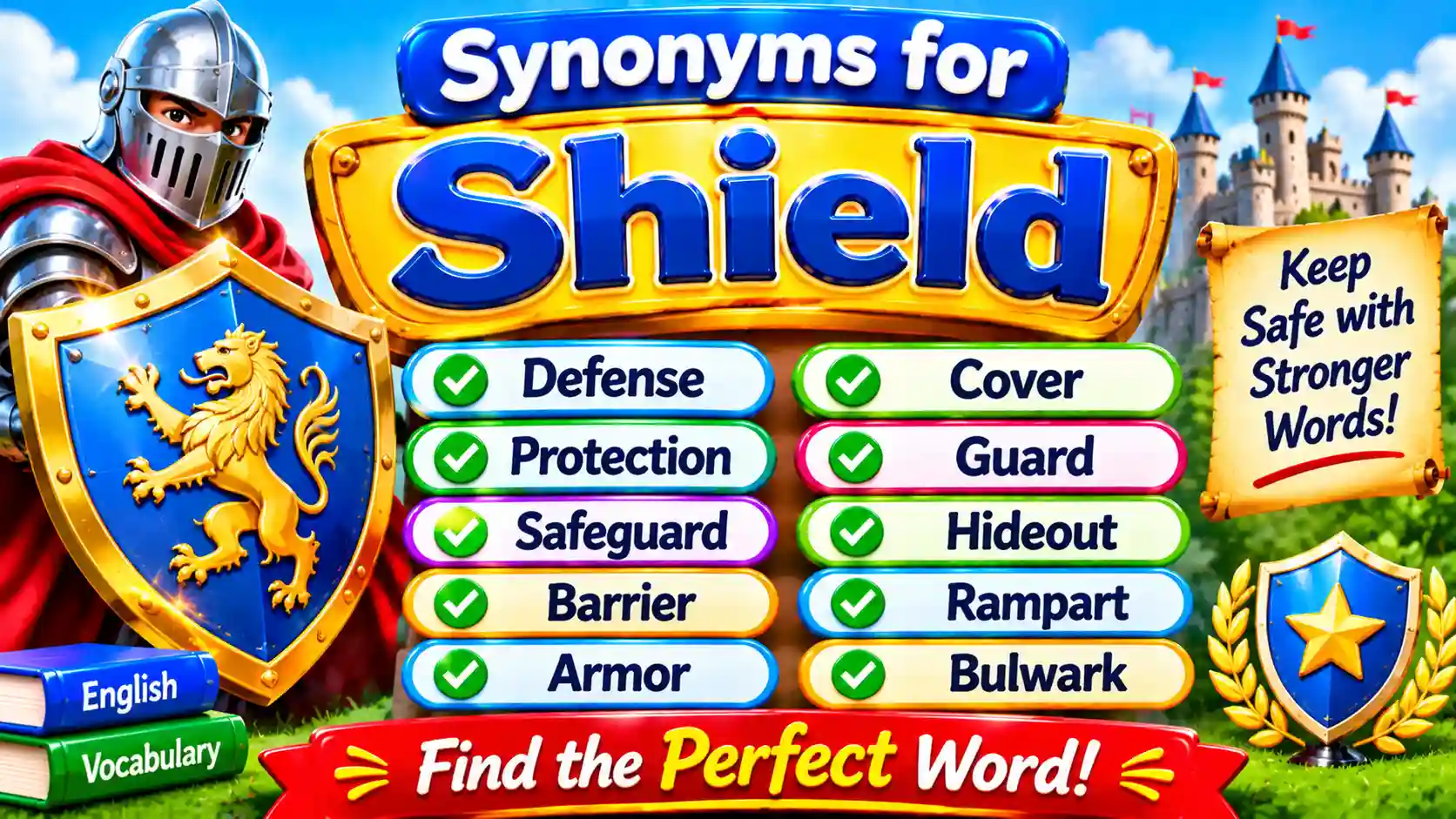
A shield is one of the oldest words in English — knights carried one into battle, and today we use the same word for anything that keeps us safe. But shield means more than one thing. It can be a piece of armour, an action, a person who protects you, or the safety itself. That is why people search for synonyms for shields: they need the right word for the right sense.
In this guide, you will find 40 synonyms for shield in four clear groups, with simple meanings, the best use for each word, and real examples. You will also learn antonyms, grammar tips, and common mistakes, so you can use every word with confidence.
📖 Meaning of Shield
Shield is both a noun and a verb. As a noun, it means a broad piece of defensive armour carried on the arm (Merriam-Webster). It can also mean anything or anyone that protects or defends — for example, “a healthy lifestyle may act as a shield against preventable diseases”. As a verb, it means to protect with or as if with a shield — “she shielded her eyes from the sun with her hand”.
- Part of Speech: Noun and Verb
- Pronunciation: SHEELD /ʃiːld/
- Origin: Middle English sheld, from Old English scield; akin to Old High German scilt shield, and probably to Old English sciell shell.
- First Known Use: Before the 12th century, for both the noun and the verb (Merriam-Webster)
- Common Usage: We say “a shield against” plus a danger — “a shield against the rain”. As a verb, we say “shield from” or “shield against” — “shield your eyes from the sun”. In heraldry, a shield is the escutcheon that carries a coat of arms.
- Simple Explanation: A shield is anything that stands between you and harm — a piece of armour, a person, or an action that protects.
📝 Top Synonyms for Shield
A Protective Object
| Word | Meaning | Best Use | Example |
| barrier | Something that blocks or stops harm | Daily and formal use | The wall is a barrier. |
| buckler | A small round shield held in the hand | History and stories | The knight raised his buckler. |
| escutcheon | A shield that carries a coat of arms | Heraldry and history | The escutcheon bore a lion. |
| bulwark | A strong wall or defence against attack | Formal use | The fort is a bulwark. |
| rampart | A wide wall around a castle or town | History and formal use | The rampart kept foes out. |
| armour | Metal clothing worn to protect the body | History and stories | The knight wore shining armour. |
| cover | Something that lies over and protects | Daily and general use | The cover kept the rain off. |
| screen | Something that hides or blocks a view | Daily and formal use | The screen hid the stage. |
| wall | A solid structure that blocks or guards | Daily and general use | The wall kept the wind out. |
| aegis | The protection or support of a person or group | Formal use | Under the aegis of the law. |
To Protect
| Word | Meaning | Best Use | Example |
| protect | To keep safe from harm or danger | Daily and general use | The helmet protects the head. |
| defend | To fight back against an attack | Daily and formal use | The army defended the town. |
| guard | To watch over and keep safe | Daily and formal use | The dog guards the house. |
| shelter | To give cover from danger or bad weather | Daily and formal use | The roof sheltered them. |
| safeguard | To protect with care against danger | Formal use | We must safeguard the children. |
| secure | To make safe and free from danger | Formal and business use | They secured the building. |
| preserve | To keep safe from harm or decay | Formal use | We preserve old books. |
| save | To keep from harm or loss | Daily and general use | He saved the child. |
| fend | To push away an attack or danger | Daily and formal use | She fended off the blows. |
| harbour | To give shelter or a safe place | Formal use | The port harboured the ship. |
A Person Who Protects
| Word | Meaning | Best Use | Example |
| protector | A person who keeps others safe | People and daily use | He is her protector. |
| guardian | A person who guards and cares for others | People and formal use | She is the child’s guardian. |
| defender | A person who fights to protect someone | People and sports | The defender blocked the ball. |
| champion | A person who fights for a cause or person | People and formal use | She is a champion of the poor. |
| keeper | A person who looks after something | People and daily use | The keeper guards the gate. |
| custodian | A person who takes care of a place or person | Formal use | The custodian locked the hall. |
| sentinel | A soldier who stands guard and watches | Formal and military use | The sentinel stood at the gate. |
| watchman | A person who watches over a place at night | Daily and formal use | The watchman patrolled the yard. |
| bodyguard | A person hired to protect someone | People and media | The star has a bodyguard. |
| saviour | A person who saves others from danger | People and formal use | He was their saviour. |
Protection or Cover
| Word | Meaning | Best Use | Example |
| defence | The act of protecting against attack | Formal use | The defence held strong. |
| protection | The state of being kept safe | Daily and formal use | Sunscreen gives protection. |
| safety | The state of being free from danger | Daily and general use | Safety comes first. |
| refuge | A safe place to hide from danger | Daily and formal use | The cave was a refuge. |
| haven | A place of safety and peace | Daily and formal use | The inn was a haven. |
| security | The state of being safe and free from fear | Formal and business use | Security guards the bank. |
| immunity | Freedom from harm, duty, or disease | Formal and medical use | The vaccine gives immunity. |
| asylum | Protection given by a country to people in danger | Formal use | They sought asylum. |
| sanctuary | A safe place, often a holy place | Formal use | The church is a sanctuary. |
| fortification | A wall or building made to defend a place | History and formal use | The fortification stood tall. |
⚖️ Antonyms of Shield
Shield has no single exact opposite. These words are situational opposites — use the one that fits your sentence.
| Word | Meaning | Example |
| attack | To strike or harm someone | They attacked the fort. |
| harm | To hurt or damage someone | The storm caused harm. |
| expose | To leave unprotected or open to danger | He exposed his face to the sun. |
| endanger | To put someone in danger | Smoking endangers health. |
| vulnerability | The state of being open to harm | The gap was a vulnerability. |
| threat | A danger that may cause harm | The threat was real. |
| danger | The chance of harm or loss | Danger is near. |
| weakness | A point where something can be harmed | The wall had a weakness. |
| assault | A violent attack on a person | The assault was stopped. |
| offence | An attack or a wrong act | The offence was punished. |
💬 Example Sentences
Daily Conversation
- The umbrella was a shield against the rain.
- She used her hand as a shield from the sun.
- A good coat is a shield in winter.
- His smile was a shield against his fear.
Academic English
- In medieval times, knights carried a shield into battle.
- The shield was a key part of a soldier’s armour.
- Scholars study how shields changed over time.
- The Roman testudo used shields as a roof.
Business English
- A strong brand is a shield against rivals.
- Good contracts shield a firm from risk.
- The firm built a shield of patents.
- We must shield our data from hackers.
Formal Writing
- The law acts as a shield for the poor.
- This policy shields workers from harm.
- The treaty was a shield against war.
- A free press is a shield for truth.
Informal Writing
- Wow, that hat is a great shield from the sun!
- I used my bag as a shield in the rain.
- That old jacket is my shield on cold days.
- His jokes are a shield when he feels shy.
Creative Writing
- The knight raised his shield as the arrows fell.
- Her courage was a shield no sword could pierce.
- In the storm, the cave was their shield.
- The moon rose like a silver shield in the sky.
📚 Difference Between Similar Words
| Word | Meaning | Use It When | Example |
| shield | A thing or action that blocks danger in the moment | Talking about protection in an attack | He raised his shield. |
| guard | A person or thing that watches over with care | Talking about watching and keeping safe | The guard watched the gate. |
| protect | To keep safe from harm, in a general way | Talking about keeping something safe | The helmet protects the head. |
| defend | To fight back against an attack | Talking about fighting off danger | The army defended the town. |
| shelter | A place or cover that gives safety from weather or danger | Talking about a safe place | The roof sheltered them. |
🎯 Best Alternative Words
- Professional Writing: safeguard, secure — “We must safeguard the data.”
- Essay Writing: defence, bulwark — “The fort was a bulwark.”
- Email: protect, secure — “Please protect the files.”
- Business: safeguard, security — “We safeguard our clients’ data.”
- Conversation: guard, cover — “The roof is a good cover.”
- Marketing: protection, safety — “Safety comes first with us.”
- Creative Writing: buckler, aegis — “Under the aegis of the king.”
✍ Grammar Tips
- Word forms: Shield is both a noun and a verb. Its plural is shields. The past is shielded. The present participle is shielding. The adjective is shielded. The noun for a person who shields is shielder.
- Shield from vs shield against: Use “shield from” for the danger itself — “shield your eyes from the sun”. Use “shield against” for what you stand against — “a shield against the rain”.
- Shield needs an object: Shield is a transitive verb — say “shield your eyes”, not “shield from the sun” with no object.
- Shield as a noun: Use “a shield” for one object — “He raised a shield”. Use “shields” for more than one — “The knights raised their shields”.
- No “shieldness”: There is no noun “shieldness”. Use shield, protection, or defence instead.
- Shield in compounds: Shield joins other words — heat shield, face shield, windshield, dress shield, shield law (a law that protects journalists’ sources).
- Shielded as an adjective: Shielded means protected — “a shielded wire”, “a shielded child”. Do not write “shielded” when you mean “shielding” — the first is done, the second is doing.
❌ Common Mistakes
| Wrong | Correct | Reason |
| Many shields protect us. | Many shields protect us. | Shield is countable — add -s for the plural. |
| He shields his face. | He shielded his face. | Shield needs the past form shielded for the past. |
| She is a shield from the rain. | She is shielded from the rain. | After “is”, use the past participle shielded. |
| The shield protects the city. | The shield protects the city. | Shield is singular — use protects, not protect. |
| He shielded from the sun. | He shielded himself from the sun. | Shield is transitive — it needs an object. |
| He is a shield in the team. | He is a protector in the team. | A person is a protector — a shield is the object or the action. |
💡 Pro Writing Tips
- Name the sense: Always make clear which shield you mean — a piece of armour, an action, a person, or the safety itself.
- Save shield for the moment: Use shield when danger is close or real, and safeguard when danger is only possible.
- Don’t overuse shield: If every sentence says “shield”, the word loses power. Swap in guard, cover, or defence to keep readers awake.
- Use “shield against”: Always name the danger — “a shield against the rain” is clearer than a bare “shield”.
- In formal writing, pick safeguard: Shield is vivid, so in a formal report, use safeguard or protection for a planned defence instead.
- Show it with an example: Instead of “It is a shield”, write “The umbrella was a shield against the rain.” The picture is more than the label.
📖 Related Words
- guard — a person or thing that watches over and keeps safe
- defence — the act of protecting against attack
- protection — the state of being kept safe
- safeguard — to protect with care against danger
- armour — metal clothing worn to protect the body
- buckler — a small round shield held in the hand
- escutcheon — a shield that carries a coat of arms
- bulwark — a strong wall or defence against attack
- cover — something that lies over and protects
- screen — something that hides or blocks a view
- shelter — to give cover from danger or bad weather
- protector — a person who keeps others safe
- sentinel — a soldier who stands guard and watches
- aegis — the protection or support of a person or group
- fortification — a wall or building made to defend a place
❓ FAQs
What does shield mean?
Shield means a broad piece of defensive armour carried on the arm, or anything that protects or defends. As a verb, it means to protect with or as if with a shield — for example, “she shielded her eyes from the sun”. The word is both a noun and a verb, and its plural is shields.
What is the difference between shield and guard?
A shield is a thing or an action that blocks danger in the moment, like a piece of armour or a hand raised against the sun. A guard is a person or thing that watches over something with care, like a guard at a gate. Shield is the block; guard is the watch.
What is the difference between shield and protect?
Shield suggests protective action in the face of danger that is already here, like an umbrella raised against the rain. Protect is the wider word — it means keeping something safe in a general way, like a helmet that protects the head. Shield is the moment; protection is the whole job.
What is the opposite of shield?
The opposite of shield depends on the sense you mean. When you mean the action of protecting, the opposite is attack or exposure. When you mean the state of being safe, the opposite is danger or vulnerability. Pick the opposite that fits your sentence, because shield has more than one meaning.
How do you use shields in a sentence?
Use shield as a noun for a thing that protects, or as a verb for the act of protecting. For example: “The knight raised his shield.” Or say “She used a hat to shield her face.” Always name what the shield blocks, so the reader knows what the danger is.
Is shield a noun or a verb?
Shield works as two parts of speech. As a noun, it means a piece of defensive armour or anything that protects — “He raised a shield.” As a verb, it means keeping safe — “She shielded her eyes.” The stress stays on the same syllable in both forms, so the word sounds the same either way.
What is the plural of shield?
The plural of shield is shields. We say “one shield” and “many shields”. For example: “The knights raised their shields.” The verb form also adds -s in the third person — “The shield protects the city.” Remember to add -s for the plural, never -es.
What is a shield in history?
In history, a shield was a wide piece of defensive armour worn on the arm, made of wood, metal, or leather. Knights and soldiers used shields to block swords and arrows, and Roman soldiers joined their shields into a roof called a testudo. Shields also carried coats of arms in heraldry, showing a knight’s family and rank.
Conclusion
Shield is a small word with a big meaning — a piece of armour, an action, a person who protects, or the safety itself. You now have 40 synonyms to say it better: guard for a watcher, barrier for a thing that blocks, protect for the general act of keeping safe, defend for fighting back, and shelter for a safe place. Remember: a thing that blocks danger, use shield; a person who watches, use guard; keeping safe in general, use protection. Keep the grammar simple too — shield is plural, shielded is the past, and shield needs an object. Pick the word that fits your sentence, and your writing will feel clear, natural, and strong. Share it with a friend who loves words, and keep it close when you write.


