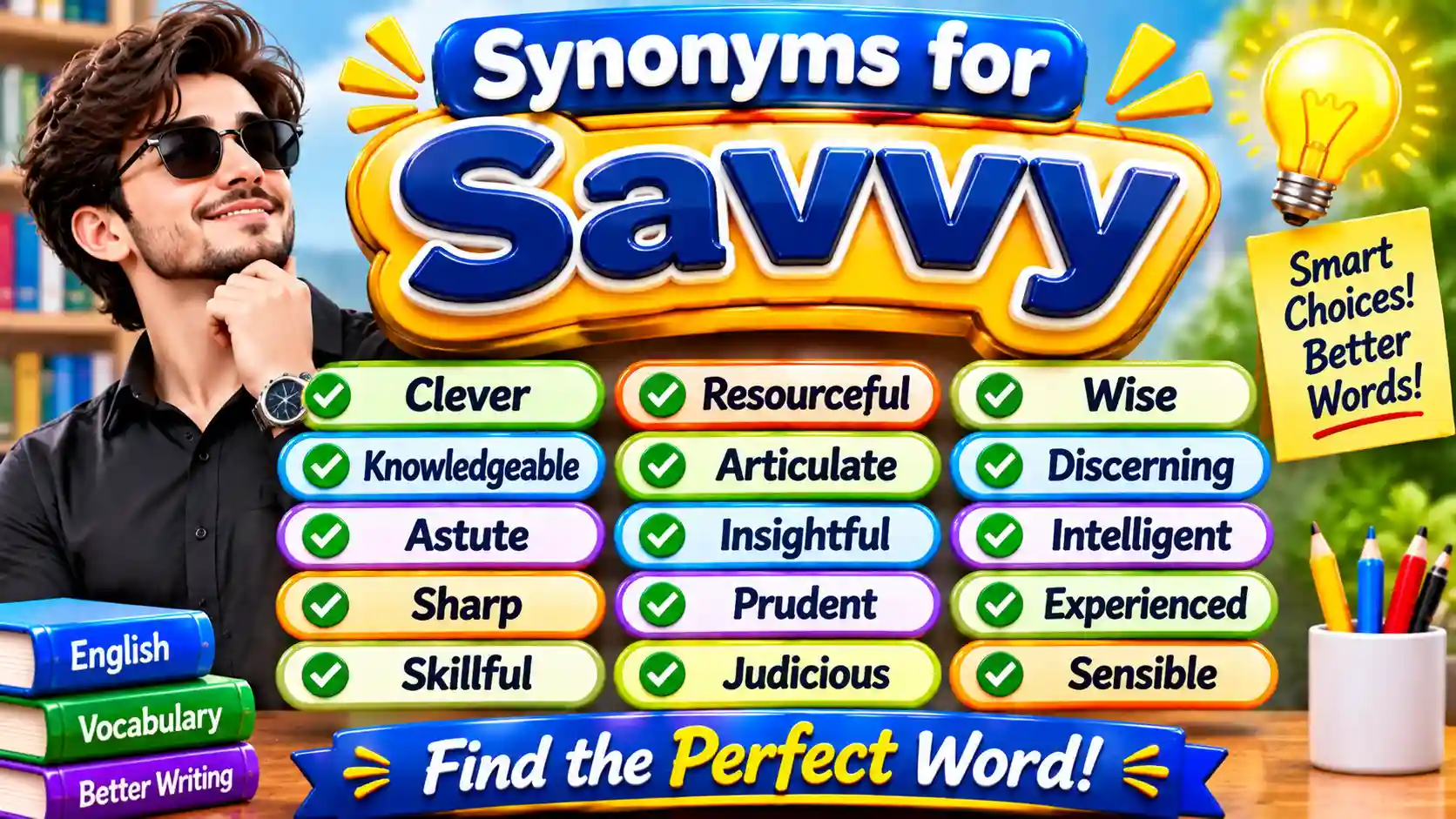
Some people just seem to know how the world works. They read a room fast, spot a good deal, avoid a bad risk, and make smart choices without a fuss. That practical cleverness has a name: savvy. People search for synonyms for savvy when they write about business, tech, money, or everyday life and want a word that fits the moment just right.
In this guide, you will find 40 synonyms for savvy in four clear groups, with simple meanings, the best use for each word, and real examples. You will also learn antonyms, grammar tips, and common mistakes, so you can use every word with confidence.
📖 Meaning of Savvy
Savvy is an adjective. It means having or showing perception, comprehension, or shrewdness, especially in practical matters (Merriam-Webster). As a noun, it means practical sense and knowledge of the world. As a verb, it means to know or to understand, though that use is now old slang.
- Part of Speech: Adjective (also a noun; verb in old slang)
- Pronunciation: SAV-ee /ˈsævi/
- Origin: A West Indies pidgin borrowing of French savez(-vous)? “do you know?” or Spanish sabe (usted) “you know”, from Latin sapere “to be wise, be knowing” — the same root as sapient and sage.
- First Known Use: Verb 1686, noun circa 1785, adjective 1826 (Merriam-Webster).
- Common Usage: We say “savvy about” plus a topic — “savvy about money”, “savvy about tech”. Common compounds: tech-savvy, business-savvy, media-savvy, street-savvy.
- Simple Explanation: A savvy person knows how things work in real life and makes good choices. It is cleverness you learn by doing, not just from books.
📝 Top Synonyms for Savvy
Smart and Shrewd
| Word | Meaning | Best Use | Example |
| shrewd | Clever and sharp in judgment | Business and deals | She made a shrewd deal. |
| clever | Quick to learn and understand | Daily and creative use | He found a clever fix. |
| smart | Quick-thinking and bright | Daily and formal use | She is smart with numbers. |
| bright | Quick to learn, full of ideas | People and students | A bright young manager. |
| sharp | Quick to notice and understand | Minds and eyes | He has a sharp eye. |
| astute | Very clever in judging people | Business and politics | An astute leader. |
| canny | Careful and clever with money | Scots and business use | A canny investor. |
| brainy | Very clever, full of brains | Informal and daily use | My brainy sister. |
| wily | Clever in a sly, tricky way | Stories and rivals | A wily old fox. |
| crafty | Clever at getting what you want | Stories and plans | A crafty trader. |
Experienced and Well-Informed
| Word | Meaning | Best Use | Example |
| experienced | Having done it for a long time | Work and life | An experienced teacher. |
| knowledgeable | Knowing a lot about a topic | Formal and daily use | A knowledgeable guide. |
| well-informed | Up to date with the facts | News and formal use | A well-informed voter. |
| worldly | Knowing how the world works | People and travel | A worldly traveller. |
| seasoned | Made wise by long experience | Work and cooking | A seasoned sailor. |
| skilled | Trained and able to do it well | Work and crafts | A skilled mechanic. |
| streetwise | Smart about real city life | Informal and daily use | A streetwise kid. |
| clued-up | Well informed, in the know | British informal use | She is clued-up on tech. |
| practiced | Done often, so done well | Skills and habits | A practiced speaker. |
| informed | Having the facts you need | Formal and daily use | An informed choice. |
Practical and Sensible
| Word | Meaning | Best Use | Example |
| practical | Useful in real life, not just theory | Daily and work use | A practical plan. |
| pragmatic | Sensible and focused on results | Formal and business use | A pragmatic leader. |
| sensible | Showing good, calm judgment | Daily and formal use | A sensible choice. |
| realistic | Seeing things as they really are | Plans and goals | A realistic budget. |
| level-headed | Calm and sensible in a crisis | People and leaders | A level-headed nurse. |
| down-to-earth | Practical and easy to talk to | People and daily use | A down-to-earth boss. |
| clear-headed | Thinking clearly, not confused | Minds and decisions | A clear-headed judge. |
| resourceful | Good at solving hard problems | People and work | A resourceful mum. |
| hands-on | Learned by doing, not just reading | Work and skills | Hands-on training. |
| matter-of-fact | Plain, direct, and practical | Tone and style | A matter-of-fact reply. |
Quick to Understand
| Word | Meaning | Best Use | Example |
| perceptive | Quick to notice small details | People and minds | A perceptive friend. |
| discerning | Good at judging quality | Taste and choices | A discerning buyer. |
| observant | Watching closely and noticing | People and detectives | An observant child. |
| quick-witted | Fast with clever answers | Humour and talk | A quick-witted host. |
| alert | Awake and ready to notice | Minds and guards | Stay alert at night. |
| aware | Knowing what is going on | Daily and formal use | Be aware of the risks. |
| insightful | Showing deep understanding | Writing and thinking | An insightful book. |
| intuitive | Knowing without long thought | Feelings and choices | An intuitive designer. |
| judicious | Showing wise, careful judgment | Formal and legal use | A judicious decision. |
| penetrating | Deep and sharp in thought | Minds and questions | A penetrating question. |
⚖️ Antonyms of Savvy
Savvy has no single exact opposite. These words are situational opposites — use the one that fits your sentence.
| Word | Meaning | Example |
| naive | Too trusting, lacking real-life experience | A naive tourist paid too much. |
| clueless | Having no idea what is going on | He is clueless about money. |
| ignorant | Lacking knowledge about a topic | She is ignorant of the rules. |
| inexperienced | New to something, with little practice | An inexperienced driver. |
| gullible | Too ready to believe anything | A gullible buyer fell for the scam. |
| foolish | Lacking good sense or judgment | A foolish bet lost his money. |
| unwise | Not showing good judgment | An unwise move cost the team. |
| unaware | Not knowing what is happening | She was unaware of the danger. |
| unsophisticated | Simple, without worldly knowledge | An unsophisticated village boy. |
| green | Very new and untested | A green recruit made mistakes. |
💬 Example Sentences
Daily Conversation
- She is so savvy about money — she never overspends.
- Ask him; he is savvy with phones and apps.
- That was a savvy move, buying tickets early.
- You need to be savvy when you shop online.
Academic English
- The study links media savvy to better news habits.
- Students showed business savvy in the group project.
- Her paper explores how street savvy shapes city life.
- Researchers measured financial savvy among young adults.
Business English
- Our new manager is savvy about markets and clients.
- A savvy negotiator knows when to walk away.
- The firm hired a tech-savvy team to fix the system.
- Good business savvy saved the company from a bad deal.
Formal Writing
- The committee praised her savvy handling of the crisis.
- His savvy approach to trade won wide respect.
- The report notes a savvy use of public funds.
- Leaders need political savvy to pass new laws.
Informal Writing
- Wow, you are really savvy with that old car!
- He is street savvy — nobody fools him twice.
- My gran is surprisingly tech-savvy for her age.
- That was savvy, mate — well played!
Creative Writing
- The savvy fox slipped past the farmer’s dogs.
- Her savvy smile told him she knew the secret.
- In the old port town, only the savvy survived.
- The young detective’s savvy mind solved the case.
📚 Difference Between Similar Words
| Word | Meaning | Use It When | Example |
| savvy | Practical know-how from real life | Real-life skill and judgment | A savvy trader reads people well. |
| smart | Quick thinking or book knowledge | Brains, school, fast learning | A smart student tops the class. |
| wise | Deep, long-term good judgment | Life advice and big choices | A wise elder gave counsel. |
| shrewd | Clever, often with a sly edge | Deals and business moves | A shrewd buyer got a low price. |
| streetwise | Smart about real city life | Streets, safety, daily survival | A streetwise teen avoided the scam. |
🎯 Best Alternative Words
- Professional Writing: astute, knowledgeable — “An astute manager reads the market well.”
- Essay Writing: discerning, judicious — “A discerning reader sees the writer’s aim.”
- Email: sensible, practical — “A sensible plan will save us time.”
- Business: shrewd, worldly — “A worldly trader knows every market.”
- Conversation: smart, streetwise — “He is streetwise and nobody fools him.”
- Marketing: sharp, clever — “A sharp slogan sells the product.”
- Creative Writing: cunning, wily — “The wily fox outran the dogs.”
✍ Grammar Tips
- Word forms: Savvy is mostly an adjective — “a savvy investor”. As a noun, it is uncountable — “business savvy”, “street savvy”. As a verb, it means “to know” — “Do you savvy?” — but that use is old slang now.
- Comparative and superlative: Use savvier and savviest. You can also say “more savvy” and “most savvy”. Never write “more savvier”.
- Compounds: Tech-savvy, business-savvy, media-savvy, money-savvy, street-savvy. Keep the hyphen, before a noun and after “be” — “She is tech-savvy.”
- Savvy about: Always use “savvy about” plus a topic — “savvy about money”, “savvy about tech”. Do not write “savvy in computers”.
- Noun and adverb: The noun form is savviness — “Her savviness won the deal.” The adverb is savvily — “She handled it savvily.” Both are rare; “savvy” itself is more common.
- No plural: Savvy has no plural “savvies”. As an adjective, it never changes — “savvy people”, never “savvies people”.
- Countable or not: As a noun, savvy is uncountable — say “a lot of savvy”, never “a savvy” or “two savvies”.
❌ Common Mistakes
| Wrong | Correct | Reason |
| He is savvy. | He is savvy. | As an adjective, savvy needs no “a”. As a noun, say “He is savvy.” |
| She is more savvier than her brother. | She is savvier than her brother. | Savvier is already the comparative — do not add “more”. |
| They are savvies in business. | They are savvy in business. | Savvy has no plural “savvies” — the adjective never changes. |
| I don’t know your plan. | I don’t understand your plan. | Savvy as a verb is old slang — use understood in modern English. |
| She is tech-savvy. | She is tech-savvy. | Tech-savvy is an adjective — it needs a noun after it, like “a tech-savvy person”. |
| He is savvy in computers. | He is savvy about computers. | Use “savvy about” plus a topic, not “savvy in”. |
💡 Pro Writing Tips
- Match the area: Name the field — tech-savvy for gadgets, money-savvy for finance, streetwise for city life. The area makes the word clear.
- Save shrewd for business: Use shrewd for deals and money, wise for life advice, and savvy for hands-on know-how.
- Don’t overuse savvy: If every sentence says “savvy”, the word loses power. Swap in clever, sharp, or sensible to keep readers awake.
- Use “savvy about”: Always name the topic — “savvy about money” beats a bare “savvy” every time.
- In formal writing, pick astute: Savvy is informal to neutral, so in a formal report, use astute or knowledgeable instead.
- Show it with an example: Instead of “He is savvy”, write “He spotted the bad deal in five minutes.” The picture is more than the label.
📖 Related Words
- know-how — practical skill from doing
- acumen — sharp judgment in business
- shrewdness — clever, careful thinking
- street smarts — practical city sense
- common sense — sound everyday judgment
- nous — practical intelligence (British informal)
- gumption — courage and common sense
- wisdom — deep, long-term good judgment
- discernment — the skill of judging well
- perception — the way you notice things
- insight — deep understanding of a problem
- expertise — expert skill from long practice
- experience — knowledge from living and doing
- astuteness — sharp, clever judgment
- practicality — being useful in real life
❓ FAQs
What does savvy mean?
Savvy means having practical knowledge and good judgment, especially in real-life situations. A savvy person understands how things work and makes smart choices. For example, a savvy shopper finds good deals, and a savvy investor avoids bad risks. It describes clever, real-world sense, not just book learning.
What is the difference between savvy and smart?
Savvy and smart are close, but they are not the same. Smart usually means quick thinking or book knowledge, like a smart student. Savvy means practical know-how from real life, like a savvy trader who reads people well. A person can be smart in class yet still lack the savvy to run a business.
What is the difference between savvy and wise?
Savvy and wise both describe good judgment, but wise is deeper and slower. A wise person thinks about long-term truth and right choices. A savvy person acts fast with practical sense in the moment. Wisdom grows over a lifetime, while savvy grows from hands-on experience in one area of life.
How do you use savvy in a sentence?
Use savvy as an adjective before or after a noun. For example: “She is a savvy businesswoman.” Or say “He is savvy about money.” As a noun, say “He has good business savvy.” Always name the area — money, tech, or people — so the sentence stays clear.
What does “tech-savvy” mean?
Tech-savvy means knowing how to use technology well. A tech-savvy person handles phones, apps, and computers with ease and learns new tools fast. It does not mean being a programmer. It means practical comfort with tech in daily life and at work.
What does “street savvy” mean?
Street savvy means knowing how to stay safe and smart in real-life city situations. A street-savvy person reads people quickly, avoids trouble, and handles surprises calmly. It comes from real experience on the streets, not from books or school lessons.
Is savvy a formal word?
Savvy is informal to neutral, so it fits daily talk, blogs, and business writing, but not the most formal legal text. You can write “a savvy manager” in an email or article. In a very formal report, choose “astute” or “knowledgeable” instead for a safer tone.
Conclusion
Savvy is a small word with a big meaning — practical cleverness that you learn by living and doing. You now have 40 synonyms to say it better: shrewd for business, streetwise for city life, worldly for wide experience, sensible for calm judgment, and perceptive for quick understanding. Remember the simple rule: if you mean book smarts, use smart; if you mean deep wisdom, use wise; if you mean hands-on know-how, use savvy. Keep the grammar simple too — savvy is mostly an adjective, “savvy about” names the topic, and savvier is the comparative. Pick the word that fits your sentence, and your writing will feel clear, natural, and strong.