
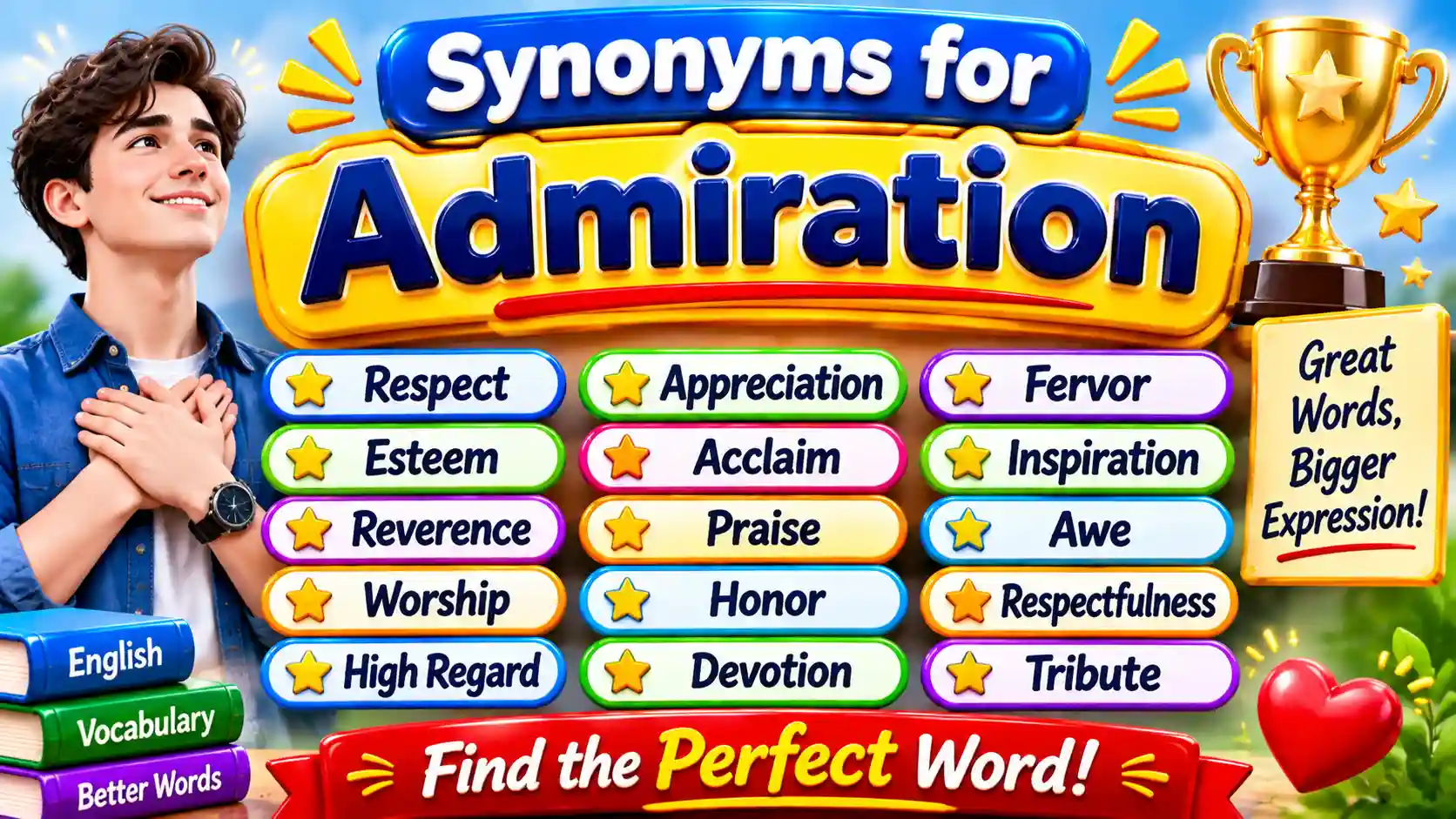
Admiration is a warm feeling of respect and wonder — and it is a word English learners meet every day. You feel admiration for a brave teacher, a talented singer, or a friend who never gives up. But which word should you use when you write? Respect, esteem, awe, adoration — each one fits a different moment.
In this guide, you will learn 40 synonyms for admiration, grouped by meaning, with clear examples, antonyms, grammar tips, and common mistakes. By the end, you will know exactly which word to pick, and your English will sound richer and more natural.
📖 Meaning of Admiration
Admiration is a noun. It means a warm feeling of respect and wonder for a person or thing you think is good, brave, or skilled.
- Part of Speech: Noun
- Pronunciation: ad-muh-RAY-shun /ˌædməˈreɪʃn/
- Origin: From Middle English admiracion, borrowed from Latin admīrātiō, from admīrārī “to admire”, from ad- + mīrārī “to be surprised, look with wonder at”, from mīrus “remarkable, amazing”.
- First Known Use: 15th century (Merriam-Webster)
- Common Usage: We say “admiration for” plus a person or thing — “I have great admiration for my teacher.”
- Simple Explanation: Admiration is the warm feeling you get when someone does something great, brave, or beautiful.
📝 Top Synonyms for Admiration
Respect and High Regard
| Word | Meaning | Best Use | Example |
| Respect | Deep regard for a person | Formal and daily use | I have great respect for my teacher. |
| Esteem | High respect and good opinion | Formal writing | She is held in high esteem by her students. |
| Regard | A good opinion of someone | Formal and polite use | I hold him in high regard. |
| Honor | Great respect and praise | Formal and ceremonial use | It is an honor to meet you. |
| Reverence | Deep respect, almost holy | Formal and serious use | They showed reverence for the old temple. |
| Veneration | Great respect for someone holy or old | Formal and literary use | The saint received veneration from the town. |
| Deference | Respect shown by listening and yielding | Formal and polite use | He spoke with deference to the judge. |
| Appreciation | Thankfulness for value or help | Daily and business use | I want to show my appreciation for your help. |
| Approval | A good opinion of something | Daily and formal use | Her work won the approval of the team. |
| Praise | Words that say someone did well | Daily and public use | The singer received high praise. |
Wonder and Awe
| Word | Meaning | Best Use | Example |
| Awe | Wonder mixed with a little fear | Strong and emotional use | We watched the mountains in awe. |
| Wonder | A feeling of surprise and delight | Daily and creative use | The child looked at the stars in wonder. |
| Amazement | Great surprise and wonder | Daily and spoken use | To my amazement, she finished first. |
| Marvel | Something that fills you with wonder | Literary and daily use | The new bridge is a marvel of design. |
| Astonishment | Great surprise | Formal and daily use | His speed filled us with astonishment. |
| Fascination | Strong interest and wonder | Daily and creative use | She watched the dancer with fascination. |
| Enchantment | A magical feeling of delight | Creative and literary use | The garden held a quiet enchantment. |
| Delight | Great pleasure and joy | Daily and warm use | The baby’s smile was a delight. |
| Wonderment | A state of wonder | Literary use | He stared in wonderment at the sky. |
| Captivation | Being held by wonder | Creative and literary use | The story held us in captivation. |
Love and Devotion
| Word | Meaning | Best Use | Example |
| Adoration | Deep love and admiration | Warm and emotional use | The fans showed adoration for the singer. |
| Devotion | Deep love and loyalty | Warm and serious use | Her devotion to her family is clear. |
| Love | A deep, warm feeling | Daily and warm use | I have great love for my grandmother. |
| Fondness | A warm, gentle liking | Daily and soft use | He has a fondness for old books. |
| Affection | A warm feeling of love | Daily and gentle use | She showed affection for her dog. |
| Attachment | A strong feeling of closeness | Daily and formal use | He has a strong attachment to his home. |
| Idolatry | Worship of a person like a god | Strong and literary use | His idolatry of the star worried his friends. |
| Worship | Deep love and honour, like for a god | Religious and strong use | The crowd’s worship of the hero grew. |
| Cherishing | Loving and caring deeply | Warm and literary use | She keeps a cherishing love for her mother. |
| Hero worship | Admiration of a hero, sometimes too much | Daily and informal use | His hero worship of the captain is clear. |
Public Praise and Honour
| Word | Meaning | Best Use | Example |
| Acclaim | Loud public praise | Formal and media use | The film won wide acclaim. |
| Applause | Clapping that shows praise | Public and daily use | The speech received warm applause. |
| Plaudits | Public praise and applause | Formal and literary use | The young writer earned plaudits. |
| Tribute | An act that shows respect | Formal and public use | The concert was a tribute to the singer. |
| Homage | Public respect for a great person | Formal and literary use | The book pays homage to the old master. |
| Commendation | Formal praise for good work | Business and official use | She received a commendation for bravery. |
| Recognition | Public notice of good work | Business and formal use | His work finally won recognition. |
| Kudos | Praise for a job well done | Informal and daily use | Kudos to the team for a great job. |
| Adulation | Extreme, sometimes too much praise | Strong and formal use | The star grew tired of adulation. |
| Glorification | Praising someone as great or holy | Formal and literary use | The song is a glorification of the hero. |
⚖️ Antonyms of Admiration
| Word | Meaning | Example |
| Contempt | A feeling that someone is worthless | He looked at the cheat with contempt. |
| Disdain | A feeling of scorn and dislike | She spoke of the liar with disdain. |
| Scorn | Open contempt and mockery | The crowd met his words with scorn. |
| Disgust | A strong feeling of dislike | The smell filled her with disgust. |
| Hatred | A very strong dislike | Hatred filled his heart. |
| Dislike | A feeling of not liking someone | I have a dislike for cold weather. |
| Disrespect | A lack of respect | His rude words showed disrespect. |
| Indifference | A lack of interest or feeling | She met the news with indifference. |
| Mockery | Making fun of someone | His mockery hurt her feelings. |
| Condemnation | Strong public disapproval | The crime met with condemnation. |
💬 Example Sentences
Daily Conversation:
- I have great admiration for my teacher.
- She looked at the singer with admiration.
- His hard work earned my admiration.
- We all admire her courage.
Academic English:
- The study shows admiration for local leaders.
- Students expressed admiration for the author’s style.
- Her paper won the admiration of the judges.
- The class discussed admiration in poetry.
Business English:
- The team showed admiration for the new manager.
- Our clients admire the company’s honesty.
- The award brought admiration from the whole industry.
- He earned admiration for his fair leadership.
Formal Writing:
- We express our admiration for the winners.
- The speech received great admiration.
- The crowd showed admiration for the hero.
- Her courage won universal admiration.
Informal Writing:
- Wow, I really admire your cooking!
- I admire how you stay calm.
- He admires his big brother a lot.
- We admire that singer so much.
Creative Writing:
- Her eyes held admiration for the old painter.
- The town sang with admiration for the young star.
- His heart filled with admiration for the sea.
- The story ends with admiration for the brave girl.
📚 Difference Between Similar Words
| Word Pair | Admiration | Other Word | When to Use Each |
| Admiration vs Respect | Warm feeling of wonder for skill or courage | Deep regard for rights, rank, or character | Use admiration when you feel wonder; use respect when you honour a person’s position. |
| Admiration vs Awe | Warm and positive wonder | Stronger wonder, mixed with a little fear | Use admiration for a person you respect; use awe for something huge, like a mountain. |
| Admiration vs Adoration | Respect mixed with wonder | Deep love, often for a person or a god | Use admiration for talent and work; use adoration for deep, lasting love. |
| Admiration vs Appreciation | Respect for qualities or achievements | Thankfulness for help or value | Use admiration for what someone is; use appreciation for what someone did for you. |
🎯 Best Alternative Words
| Situation | Best Word | Example |
| Professional Writing | Esteem, regard | She is held in high esteem by her peers. |
| Essay Writing | Admiration, reverence | The essay shows reverence for the old poet. |
| Appreciation, admiration | I want to express my appreciation for your help. | |
| Business | Respect, recognition | His work finally won recognition. |
| Conversation | Admire, love, respect | I really admire your cooking. |
| Marketing | Acclaim, praise, applause | The film won wide acclaim. |
| Creative Writing | Awe, wonder, adoration | The town sang with adoration for the young star. |
✍ Grammar Tips
- Word Form: Admiration is a noun. It is usually uncountable — say “great admiration”, never “an admiration”.
- Admiration for: Always use “admiration for” plus a person or thing — “admiration for her courage”.
- Verb Form: Admire, admires, admired, admiring — “I admire her. She admires her teacher. They admired the show.”
- Adjective Form: Admirable means worthy of admiration — “an admirable teacher”. Admiring means showing admiration — “an admiring look”.
- Adverb Form: Admiringly — “She looked at him admiringly.” Never “admirely”.
- In Admiration Of: The phrase “in admiration of” means you feel admiration — “The crowd stood in admiration of the singer.”
- Plural Form: The plural “admirations” is rare and technical — use the singular in daily English.
- British vs American: The synonym “honor” is American; British English writes “honour”. Both are correct.
❌ Common Mistakes
| Wrong | Correct | Reason |
| I have an admiration for her. | I have great admiration for her. | Admiration is usually uncountable — use “great admiration”, not “an admiration”. |
| She admires her teacher. | She admires her teacher. | Admire takes a direct object — no “to” after it. |
| He looked at her with admiration. | He looked at her with admiration. | After “with”, use the noun admiration, not the verb admire. |
| They have admiration for the singer. | They have admiration for the singer. | Use “admiration for”, not “admiration to”. |
| Her work is great. | Her admirable work is great. | Before a noun, use the adjective admirable, not the verb admire. |
| We admirely watched the show. | We watched the show admiringly. | The adverb form is admiringly, never “admirely”. |
💡 Pro Writing Tips
- Pick by strength: Respect is the lightest, admiration is warm, awe is strong, and adoration is the deepest — match the word to the feeling.
- Save adulation for excess: Adulation means extreme praise, sometimes too much — use it only when you mean over-the-top admiration.
- Use “admiration for” with people and work: The phrase works for a person, a skill, or a piece of work — always name what you admire.
- In formal writing, use esteem and reverence: These words sound serious and polite in essays, speeches, and letters.
- In daily talk, use admiration and love: Simple words sound natural — “I admire her courage” beats a long, fancy sentence.
- Show, don’t just tell: Instead of “I admire him”, write “I admire how he stays calm when the day goes wrong” — the detail makes it real.
📖 Related Words
- Admire: The verb form — to feel respect and wonder
- Admirable: Worthy of admiration
- Admiring: Showing admiration
- Admiringly: In a way that shows admiration
- Adorer: A person who admires deeply
- Hero: A person others admire for courage
- Idol: A person or thing greatly admired
- Role Model: A person others look up to and copy
- Inspiration: Something that fills you with admiration and ideas
- Wonder: A feeling of surprise and delight
- Respect: Deep regard for a person
- Esteem: High respect and good opinion
- Praise: Words that say someone did well
- Honor: Great respect and praise
- Glory: Great praise and fame
- Fame: Being known and admired by many people
- Recognition: Public notice of good work
❓ FAQs
What does admiration mean?
Admiration is a warm feeling of respect and wonder for someone or something. You feel admiration when a person does great work, shows courage, or has a skill you love. For example, you may feel admiration for a brave firefighter or a talented singer. It is a noun, and the verb form is admire.
What is the difference between admiration and respect?
Admiration and respect are close, but they are not the same. It is a warm feeling of wonder for a person’s skill or courage. Respect is a deep regard for a person’s rights, rank, or character. You can respect a person you do not admire, and admire a person you do not know well.
What is the difference between admiration and adoration?
Admiration and adoration are close, but adoration is stronger. Admiration is respect mixed with wonder for a skill or achievement. Adoration is deep love, often for a person, a hero, or a god. Use admiration for talent and work, and adoration for love that is deep and lasting.
Is admiration a noun or a verb?
Admiration is a noun. It names that warm feeling you get when someone does something great. The verb form is admire — “I admire her courage.” The adjective form is admirable — “an admirable teacher.” The adverb form is admiringly — “She looked at him admiringly.” Use the right form for your sentence.
What does “in admiration of” mean?
The phrase “in admiration of” means you feel admiration for a person or thing. For example: “The crowd stood in admiration of the singer.” It is a formal, warm way to show respect. You can also say “in admiration for”, but “in admiration of” is the common form in books and speeches.
What is the adjective form of admiration?
The adjective form of admiration is admirable. It means worthy of admiration. For example: “She is an admirable teacher.” You can also use admiring, which means showing admiration: “He gave her an admiring look.” Use admirable for the person or thing, and admiring for the look or the feeling.
What is the verb form of admiration?
The verb form of admiration is admire. It means to feel respect and wonder when someone does something great. For example: “I admire her courage.” The past form is admired, and the -ing form is admiring. Use admire with a direct object — “admire her”, never “admire to her”.
Conclusion
Admiration is a warm, positive feeling — and now you have 40 words to say it better. You learned respect and esteem for deep regard, awe and wonder for amazement, adoration and devotion for deep love, and acclaim and applause for public praise. You also learned the opposites, the grammar, and the mistakes to avoid. The best synonym is the one that fits your sentence: use respect in formal writing, awe for something huge, adoration for deep love, and appreciation when you feel thankful. Keep practising these words in your own sentences, and your English will grow stronger every day.