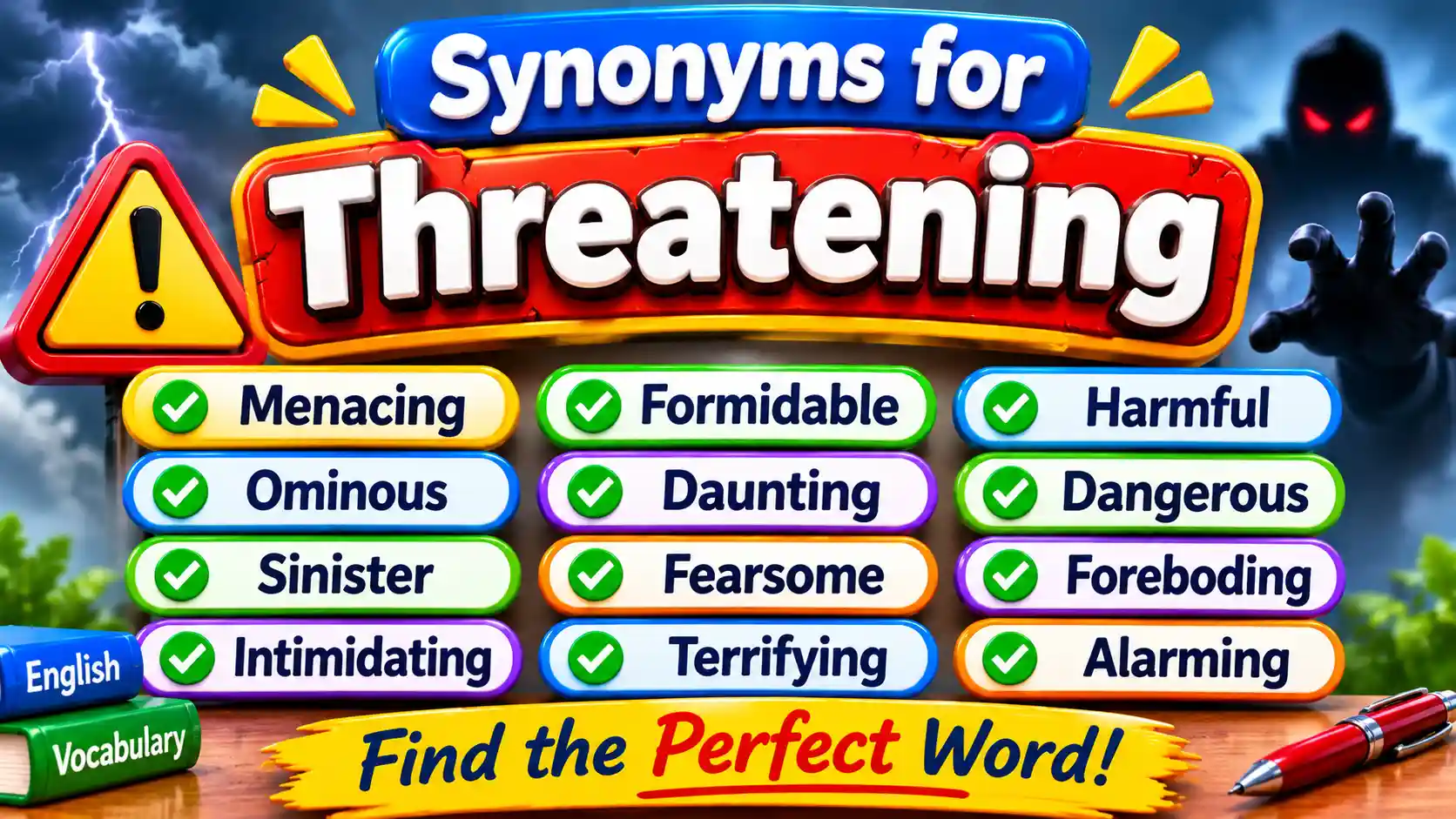
Some words make your heart beat faster the moment you hear them. Threatening is one of them. It describes a look, a voice, a message, or even a dark sky that hints at harm or trouble ahead. People search for synonyms for threatening when they write stories, essays, emails, or reports and want a word that fits the mood just right.
In this guide, you will find 40 synonyms for threatening in four clear groups, with simple meanings, the best use for each word, and real examples. You will also learn antonyms, grammar tips, and common mistakes, so you can use every word with confidence.
📖 Meaning of Threatening
Threatening is an adjective. It means expressing or suggesting a threat of harm or danger. It can also mean showing that trouble or danger is coming soon.
- Part of Speech: Adjective (also the present participle of the verb threaten)
- Pronunciation: THRET-ning /ˈθretnɪŋ/
- Origin: From the verb threaten, which comes from Old English thrēatnian, “to urge or induce, especially by using threats,” from thrēat, “coercion, oppression.” The noun threat was first used before the 12th century, the verb threaten in the 13th century, and the adjective threatening in 1530 (Merriam-Webster).
- Simple Explanation: When something is threatening, it makes you feel unsafe. A threatening letter promises harm. A threatening sky warns of a storm. A threatening look tells you trouble may follow.
Word Family: threat (noun) — threaten (verb) — threatening (adjective) — threatened (adjective) — threateningly (adverb).
📝 Top Synonyms for Threatening
Scary and Menacing
| Word | Meaning | Best Use | Example |
| menacing | Scary in a way that promises harm | A look or voice | He gave me a menacing look. |
| intimidating | Making you feel small or afraid | A person or place | The big guard was intimidating. |
| frightening | Making you feel afraid | A sound or sight | A frightening noise came from the dark. |
| scary | Causing fear | Everyday talk | That dark alley looks scary at night. |
| alarming | Making you worry that something bad will happen | News or signs | The alarming news worried the whole town. |
| ominous | Warning that something bad will happen | Clouds or silence | Ominous clouds covered the sky. |
| sinister | Evil and scary | A smile or plan | He gave a sinister smile. |
| foreboding | A strong feeling that trouble is coming | A mood or place | A sense of foreboding filled the old house. |
| chilling | So scary it makes you feel cold | A story or warning | Her chilling words stayed in my mind. |
| dreadful | Very bad and frightening | An event or sight | The dreadful storm broke the windows. |
Dangerous and Harmful
| Word | Meaning | Best Use | Example |
| dangerous | Able to hurt you | A road or animal | That road is dangerous at night. |
| hazardous | Full of risk | Work or chemicals | The factory stores hazardous waste. |
| perilous | Very dangerous | A journey or climb | The climbers faced a perilous path. |
| deadly | Able to kill | A poison or disease | Some snakes carry deadly venom. |
| lethal | Able to cause death | A dose or weapon | A lethal dose can kill in minutes. |
| harmful | Causing damage | Smoke or habits | Smoking is harmful to your health. |
| destructive | Causing great damage | A storm or fire | The destructive fire burned the forest. |
| unsafe | Not safe | A bridge or place | The old bridge is unsafe to cross. |
| risky | Full of danger | A plan or bet | It is risky to drive in the fog. |
| treacherous | Dangerously unstable | Ice or seas | The treacherous ice cracked under his feet. |
Aggressive and Hostile
| Word | Meaning | Best Use | Example |
| hostile | Unfriendly and ready to fight | A crowd or tone | The hostile crowd shouted at the team. |
| aggressive | Ready to attack | A dog or driver | The aggressive dog barked at the postman. |
| belligerent | Eager to fight | A nation or speaker | His belligerent tone started an argument. |
| antagonistic | Showing hate or opposition | A rival or remark | Her antagonistic words hurt the team. |
| confrontational | Ready for a fight | A style or question | His confrontational manner scared the class. |
| combative | Keen to fight | A player or lawyer | The combative lawyer attacked every point. |
| fierce | Wild and strong | An animal or storm | A fierce wind shook the trees. |
| savage | Cruel and violent | An attack or beast | The savage attack shocked the village. |
| brutal | Cruel and harsh | A crime or winter | The brutal winter froze the pipes. |
| vicious | Cruel and violent | A dog or rumour | A vicious dog guarded the yard. |
Warning of Trouble Ahead
| Word | Meaning | Best Use | Example |
| looming | Big and scary, coming closer | A threat or deadline | A looming deadline worried the team. |
| impending | About to happen | Doom or flood | The town feared an impending flood. |
| approaching | Coming nearer | A storm or exam | The approaching storm darkened the sky. |
| imminent | About to happen very soon | Danger or rain | Rain is imminent, so take an umbrella. |
| brewing | Slowly building up | Trouble or a storm | Trouble was brewing in the office. |
| gathering | Slowly growing | Clouds or anger | Dark clouds were gathering fast. |
| portending | Warning that something bad will come | A sign or dream | The black birds were portending bad luck. |
| oncoming | Coming toward you | Traffic or a storm | The oncoming storm filled the sky. |
| nearing | Getting close | A deadline or danger | The nearing exam made her nervous. |
| foreshadowing | Hinting at trouble to come | A story or sign | The quiet music was foreshadowing trouble. |
⚖️ Antonyms of Threatening
Threatening has no single exact opposite. These words are situational opposites — use the one that fits your sentence.
| Word | Meaning | Example |
| reassuring | Making you feel safe and calm | Her reassuring smile calmed the child. |
| comforting | Giving warmth and peace | He spoke in a comforting voice. |
| friendly | Kind and welcoming | The friendly guard waved us through. |
| harmless | Unable to hurt anyone | The small spider is harmless. |
| safe | Free from danger | The park is safe for children. |
| peaceful | Calm and quiet | We spent a peaceful evening at home. |
| gentle | Soft and kind | She has a gentle way of speaking. |
| welcoming | Warm and inviting | The welcoming lights made us smile. |
| kind | Good and caring | A kind word can change a day. |
| calm | Quiet and free from fear | Stay calm and breathe slowly. |
💬 Example Sentences
Daily Conversation
- The sky looks threatening — let’s go inside before it rains.
- His voice sounded threatening, so I stepped back.
- Don’t send threatening messages; talk calmly instead.
- The dog’s growl was threatening, and the children ran away.
Academic English
5. The study links threatening behaviour to stress in schools.
6. A threatening climate can harm students’ learning.
7. Researchers found that threatening words raise fear in listeners.
8. The report calls the storm a threatening risk to the coast.
Business English
9. We received a threatening email from a fake supplier.
10. The manager warned us about the threatening tone of the letter.
11. A threatening market can push small firms to close.
12. The firm took legal steps after the threatening calls.
Formal Writing
13. The council called the letter threatening and passed it to the police.
14. A threatening note was found on the office door.
15. The court heard that the calls were threatening in nature.
16. The letter carried a threatening demand for money.
Informal Writing
17. That guy’s stare was so threatening, I left the park.
18. The clouds are looking threatening — grab your jacket!
19. She sent a threatening text, and I blocked her number.
20. The film’s villain has a threatening laugh.
Creative Writing
21. A threatening shadow crept across the old castle wall.
22. The sea turned dark and threatening before the storm.
23. His threatening whisper made the whole room fall silent.
24. A threatening silence hung over the village that night.
📚 Difference Between Similar Words
| Word | Meaning | Use It When | Example |
| threatening | Shows harm or trouble may come | Any sign of danger or trouble | A threatening letter arrived today. |
| menacing | Deliberately scary, aimed at you | A look, voice, or person feels evil | His menacing stare froze the room. |
| intimidating | Makes you feel small or nervous | A person or place makes you afraid to act | The tall building felt intimidating. |
| dangerous | Able to cause harm | A thing or place can hurt you | The icy road is dangerous. |
| ominous | A sign that bad news is coming | A sign points to trouble ahead | An ominous silence filled the hall. |
🎯 Best Alternative Words
- Professional Writing: menacing, ominous, hostile — “The report noted a menacing tone in the letter.”
- Essay Writing: alarming, foreboding, impending — “The alarming rise in crime worried the town.”
- Email: intimidating, concerning — “His intimidating reply made the team nervous.”
- Business: hazardous, risky, perilous — “The risky plan could harm the firm.”
- Conversation: scary, frightening — “That dark street looks scary at night.”
- Marketing: alarming, urgent — “The alarming facts need your attention now.”
- Creative Writing: sinister, chilling, looming — “A sinister figure stood in the fog.”
✍ Grammar Tips
- Part of speech: Threatening is an adjective. It describes a noun — “a threatening letter,” “a threatening sky.”
- Comparative and superlative: Use more threatening and most threatening. Never write “threateninger” or “threateningest.”
- Adverb: Add -ly to get threateningly — “He spoke threateningly.” Use it after a verb, never before a noun.
- Noun: The noun is threat — “It was an empty threat.” The plural is threats.
- Verb: The verb is threaten — threaten, threatens, threatened, threatening. “He threatened to call the police.”
- Threatening vs threatened: Threatening describes the thing that makes the threat. Threatened describes the person or thing under the threat. The dog is threatening; the postman is threatened.
- Spelling: Threatening is spelled T-H-R-E-A-T-E-N-I-N-G. Keep the “e” after “threat” — “threatening” is wrong.
- Common confusion: Don’t mix up threatening with threatened. A “threatened species” is a species in danger of dying out, not a species that scares you.
❌ Common Mistakes
| Wrong | Correct | Reason |
| He gave me a threatening look. | He gave me a threatening look. | Before a noun, use the adjective threatening, not the verb threaten. |
| The sky looks very threatening. | The sky looks very threatening. | After “very,” use the adjective threatening, not the noun threat. |
| She felt threatened by his words. | She felt threatened by his words. | The person who receives the threat is threatened, not threatened. |
| The dog barked threateningly. | The dog barked threateningly. | To describe how an action is done, use the adverb threateningly. |
| It was a more threateninger storm. | It was a more threatening storm. | Threatening has no -er form — use more threatening. |
| They made a threatening call. | They made a threatening call. | The spelling is threatening — keep the “e” after “threat.” |
💡 Pro Writing Tips
- Match the fear to the word: Use menacing for a person, dangerous for a thing, and ominous for a sign. The right match makes your writing feel natural.
- Don’t overuse threatening: If every sentence says “threatening,” the word loses power. Swap in alarming, looming, or sinister to keep readers awake.
- Show, don’t just tell: Instead of “He was threatening,” write “He leaned close and spoke in a low, slow voice.” The picture is more than the label.
- Save threatening for real danger: In a light story, “scary” or “frightening” fits better. Keep threatening for moments when harm or trouble truly feels near.
- Pair it with a clear noun: “A threatening letter,” “a threatening sky,” and “a threatening silence” all work because the noun tells the reader what kind of danger it is.
- Use threateningly for actions: When someone does something in a scary way, the adverb does the work — “She smiled threateningly.”
📖 Related Words
- threat — a warning that harm will come
- threaten — to say you will cause harm
- threatened — under a threat; also, a species in danger of dying out
- threateningly — in a threatening way
- menace — a threat or danger; also, to threaten someone
- intimidation — the act of making someone feel afraid
- danger — the chance of harm
- warning — a sign that trouble is coming
- fear — the feeling of being afraid
- harm — damage or injury
- risk — the chance of something bad happening
- doom — a bad fate that feels certain
- hostility — unfriendly and aggressive feelings
- aggression — angry, forceful behaviour
- peril — serious danger
❓ FAQs
What does threatening mean?
Threatening means showing that harm or trouble may come. A threatening look, message, or sky makes you feel unsafe, because it hints that something bad could happen soon. For example, dark clouds look threatening before a storm. The word is an adjective, and it describes a person, a thing, or a situation that feels dangerous.
What is the difference between threatening and menacing?
Threatening and menacing are close, but they are not the same. Threatening is the wider word — it covers any sign of harm, danger, or trouble ahead, like a storm or a warning. Menacing is stronger and more personal — it describes a look, voice, or person that feels deliberately scary. Use menacing when the fear feels aimed at you.
What is the difference between threatening and intimidating?
Threatening warns that harm or danger could follow, while intimidating means making someone feel small, nervous, or afraid. A threatening letter promises harm. An intimidating teacher does not promise harm — the teacher’s strict look and strong voice simply make students feel too nervous to speak. So threatening points to danger, and intimidating points to fear.
How do you use threatening in a sentence?
Use threatening before a noun or after a linking verb. Before a noun, say “a threatening message” or “a threatening sky.” After a linking verb, say “The sky looks threatening.” Do not use threatening as a verb — for the action, use threaten, as in “He threatened to leave.” Keep the adjective for the thing that gives the threat.
Is threatening an adjective or a verb?
Threatening is an adjective, and it comes from the verb threaten. As an adjective, it describes a noun — “a threatening letter,” “a threatening storm.” The verb is threaten — “He threatened the shopkeeper.” The noun is threat — “It was an empty threat.” The adverb is threateningly — “He spoke threateningly.” So one word family gives you four forms.
What does “threateningly” mean?
Threateningly is the adverb form of threatening. It tells how someone does something — in a way that shows a threat. For example, “He looked at me threateningly” means his look warned me that trouble could follow. Use threateningly after a verb, never before a noun. For a noun, use threatening — “a threatening look,” not “a threatening look.”
What is the difference between threatening and threatened?
Threatening and threatened look alike, but they point in opposite directions. Threatening describes the thing that makes the threat — “a threatening dog,” “a threatening letter.” Threatened describes the person or thing under the threat — “a threatened village,” “a threatened species.” So the dog is threatening, and the postman is threatened.
Can threatening describe weather or a situation?
Yes, threatening often describes weather or a situation, not just people. Grey clouds hang threatening over a town before rain, and a rising river looks threatening before a flood. A threatening silence in a meeting can mean trouble is coming. Here, threatening means a warning sign — something bad may happen soon, even though no person has made a threat.
Conclusion
Threatening is a strong word, and now you have 40 friends to stand beside it. Use menacing for a scary look, intimidating for a person who makes you feel small, ominous for a sign of trouble, and dangerous for a real risk of harm. Remember the simple rule: if someone means to harm you, use threatening or menacing; if a thing can hurt you, use dangerous; if a sign points to bad news ahead, use ominous. Keep the grammar simple too — threatening is an adjective, threateningly is the adverb, and the person under the threat is threatened. Pick the word that fits your sentence, and your writing will feel clear, natural, and strong.