Have you ever needed a better way to say that something is everywhere? The word ubiquity describes the state of being present or found in many places at the same time. It’s a useful word in academic, business, and everyday writing, but it can sound quite formal.
That’s why knowing the right synonyms for ubiquity can make your writing clearer and more natural. In this guide, you’ll discover simple alternatives such as omnipresence, prevalence, pervasiveness, commonness, and widespread presence, along with easy examples to help you choose the best word for your sentence.
📖 Meaning of Synonyms for Ubiquity
Ubiquity is a noun that means the state of being everywhere or seeming to be everywhere at the same time. It is a formal word often used in academic, business, technology, and formal writing. Cambridge defines it as the fact that someone or something seems to be everywhere.
Pronunciation: /juːˈbɪk.wə.ti/
Part of speech: Noun
Simple meaning: Being everywhere or being found in many places.
For example:
The ubiquity of smartphones has changed how people communicate.
Here, ubiquity means that smartphones are found almost everywhere.
The word comes from Latin ubique, meaning “everywhere.” Merriam-Webster records the first known use of ubiquity in English in 1572.
Because ubiquity is a noun, the best replacement depends on what you want to emphasize. Sometimes you mean being everywhere, while in another sentence you may mean being very common, widespread, or present throughout an area.
📝 Top Synonyms of Ubiquity
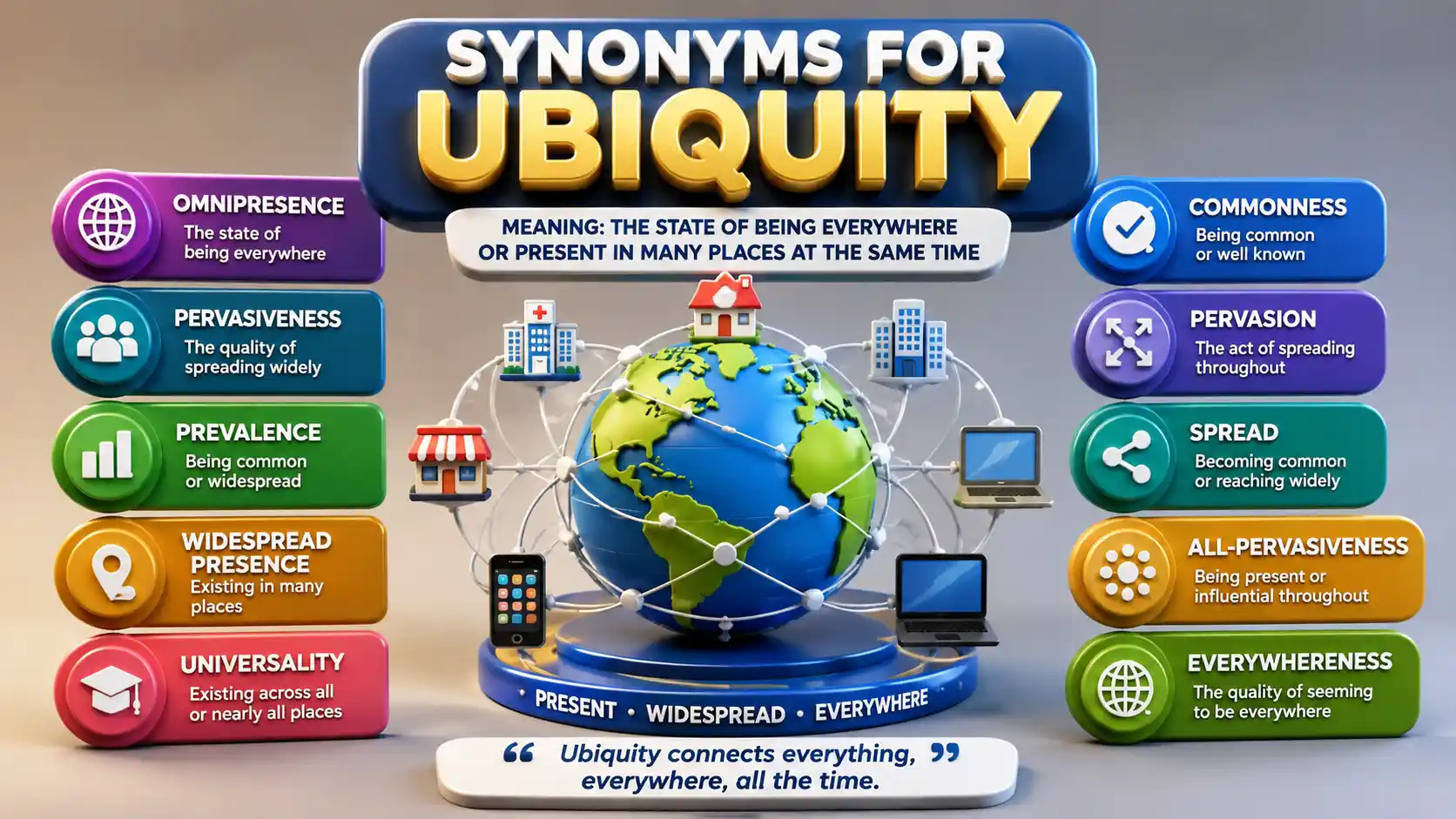
There is no single synonym for ubiquity that works perfectly in every sentence. Ubiquity means the state of being present, found, or noticed everywhere or almost everywhere. Depending on the context, you can use words such as omnipresence, pervasiveness, prevalence, widespread presence, and universality.
| Word | Meaning | Best Use | Example |
|---|---|---|---|
| Omnipresence | The state of being present everywhere | Formal and academic writing | The omnipresence of digital media is clear. |
| Pervasiveness | The quality of spreading widely throughout an area, group, or activity | Ideas, technology, trends, and systems | The pervasiveness of social media is growing. |
| Prevalence | The fact of being common or widespread | Research, statistics, and formal writing | The prevalence of online learning has increased. |
| Widespread presence | Being present in many places or among many people | Clear everyday English | The widespread presence of smartphones has changed communication. |
| Universality | The quality of existing or applying everywhere or to everyone | Academic and formal writing | The universality of the problem surprised researchers. |
| Commonness | The quality of being common or frequently found | General English | The commonness of smartphones is easy to see. |
| Pervasion | The act or process of spreading throughout something | Formal writing | The pervasion of technology into daily life is difficult to ignore. |
| Spread | The process of becoming common or reaching many places or people | Everyday English | The spread of social media has been rapid. |
| Prevalency | The state or condition of being prevalent | Technical or formal contexts | The prevalency of the issue remains high. |
| All-pervasiveness | The quality of being present or influential throughout everything or nearly everything | Strong formal description | The all-pervasiveness of technology is remarkable. |
| Everywhereness | The quality of seeming to be everywhere | Creative or informal writing | The everywhereness of the brand was striking. |
| Ubiquitariness | The quality or state of being ubiquitous | Rare or specialized vocabulary | The ubiquitariness of digital devices is evident. |
Related Words That Are Not Exact Synonyms
Some words are associated with ubiquity but should not be presented as direct synonyms because their meanings are different.
- Frequency — describes how often something happens, not how widely it is present.
- Regularity — describes repeated or consistent occurrence.
- Popularity — describes how widely something is liked or accepted.
- Reach — describes the number or area of people or places affected.
- Coverage — describes the area, subjects, or people included.
- Distribution — describes how something is spread across locations or groups.
- Occurrence — refers to the fact that something happens or appears.
- Presence — simply means being in a particular place; it does not necessarily mean being everywhere.
- Abundance — means a large quantity, not widespread presence.
- Profusion — means a large or excessive amount.
- Multiplicity — means a large number or variety.
- Proliferation — means rapid increase or spread, rather than the state of being everywhere.
- Expansion — means growth in size, range, or reach.
- Penetration — refers to the extent to which something enters or becomes established in a market or group.
- Saturation — means a state of being completely or almost completely filled or supplied.
- Inescapability — means being difficult or impossible to avoid, which is related to ubiquity but not identical to it.
- Dissemination — means spreading information or knowledge widely.
- Diffusion — means the spreading of something from one place, group, or area to another.
- Preponderance — means a greater amount or number, not presence everywhere.
- Currency — can mean widespread acceptance or current use of an idea or term, but it is not a direct synonym for ubiquity.
- Generality — refers to broadness or lack of specificity, not being everywhere.
- Extensiveness — refers to covering a large area or range, but does not necessarily mean being ubiquitous.
- Incidence — refers to the occurrence or rate of occurrence of something, especially in statistics or health contexts.
Best Direct Synonyms of Ubiquity
If you need the closest and safest alternatives, use these first:
- Omnipresence
- Pervasiveness
- Widespread presence
- Prevalence
- Universality
These choices preserve the central idea of being widespread or present in many or all places better than words such as frequency, popularity, abundance, or expansion.
⚖️ Antonyms of Ubiquity
The opposite of ubiquity is the idea that something is rare, limited, localized, or absent.
| Antonym | Meaning | Example |
| Scarcity | Being in short supply | The scarcity of clean water is serious. |
| Rarity | Being uncommon | The rarity of the bird makes it special. |
| Absence | Not being present | The absence of internet access created problems. |
| Localization | Being limited to a particular place | The localization of the service reduced its reach. |
| Limitation | A restriction in size or range | The limitation of the system affects users. |
| Exclusivity | Being limited to selected people or places | The exclusivity of the club attracts members. |
| Isolation | Being separated from others | The village’s isolation makes travel difficult. |
| Infrequency | Happening rarely | The infrequency of updates frustrated users. |
| Concentration | Being gathered in one area | The concentration of stores is highest downtown. |
| Absence of presence | Lack of something in a place | The absence of technology was noticeable. |
💬 Example Sentences Using Ubiquity and Its Alternatives
Daily Conversation
- The ubiquity of smartphones makes them hard to avoid.
- The widespread presence of cafés has changed the neighborhood.
- Social media has become almost ubiquitous among young adults.
- The popularity of streaming services continues to grow.
- The commonness of online shopping is easy to see.
- The presence of advertisements is everywhere.
Academic English
- Researchers examined the ubiquity of digital communication.
- The prevalence of the practice varies between countries.
- The pervasiveness of technology has changed education.
- The universality of language learning is difficult to measure.
- The diffusion of new ideas can take many years.
Business English
- The ubiquity of mobile devices creates new marketing opportunities.
- The company’s global reach has expanded rapidly.
- Internet penetration has influenced consumer behavior.
- Market saturation can make further growth difficult.
- The proliferation of online businesses has increased competition.
Formal Writing
- The omnipresence of technology has transformed modern life.
- The pervasiveness of advertising deserves careful study.
- The prevalence of digital payments continues to rise.
- The extensive distribution of the product improved access.
- The ubiquity of information presents both benefits and challenges.
Creative Writing
- The city seemed filled with the ubiquity of bright screens.
- Music followed her everywhere, creating a sense of omnipresence.
- The brand’s signs appeared with almost inescapable regularity.
- Everywhere he looked, the familiar logo appeared.
📚 Difference Between Similar Words
Several words look like perfect replacements for ubiquity, but their meanings are slightly different.
| Word | Main Focus | Example |
| Ubiquity | Being everywhere | The ubiquity of smartphones is clear. |
| Omnipresence | Being present everywhere | The omnipresence of advertising is striking. |
| Pervasiveness | Spreading throughout something | The pervasiveness of the trend is growing. |
| Prevalence | Being common or widespread | The prevalence of the issue is high. |
| Frequency | How often something happens | The frequency of updates increased. |
| Popularity | Being liked or used by many | The popularity of the app grew. |
| Reach | How far something extends | The campaign has international reach. |
| Diffusion | Spreading from one area to another | The diffusion of the idea was gradual. |
| Saturation | Being filled to a high level | The market reached saturation. |
Ubiquity vs. Omnipresence
These are the closest choices. Omnipresence strongly suggests presence everywhere, while ubiquity can also describe something that seems to be everywhere or is found in many places. Cambridge lists omnipresent as a synonym for ubiquitous.
Ubiquity vs. Prevalence
Prevalence means how common something is. Ubiquity puts more emphasis on its broad presence.
- The prevalence of remote work is increasing.
- The ubiquity of remote-work tools is obvious.
Ubiquity vs. Pervasiveness
Pervasiveness suggests that something spreads throughout an environment, group, or system.
- The ubiquity of smartphones = smartphones are found almost everywhere.
- The pervasiveness of smartphone technology = smartphone technology has spread deeply through society.
Ubiquity vs. Frequency
These words shouldn’t normally replace each other.
- Ubiquity: found in many places.
- Frequency: happens many times.
A product can have high frequency of use without having true ubiquity.
🎯 Best Alternative Words for Different Situations
| Situation | Best Alternative | Why |
| Professional writing | Prevalence | Clear and formal |
| Academic essay | Pervasiveness | Good for broad social effects |
| Formal report | Prevalence | Works well with measurable trends |
| Business | Reach | Focuses on market or audience |
| Marketing | Penetration | Useful for market coverage |
| Conversation | Commonness | Simple and easy to understand |
| Creative writing | Omnipresence | Strong and vivid |
| Technology | Ubiquity | Natural for widespread technology |
| Research | Prevalence | Useful for measurable occurrence |
| Formal analysis | Universality | Useful for broad patterns |
A good synonym isn’t simply a word with a similar dictionary definition. It should also fit the grammar, tone, subject, and meaning of your sentence.
✍️ Grammar Tips
Ubiquity is a noun that is normally used as an uncountable noun. It describes the state or quality of being present or found everywhere or almost everywhere.
| Form | Word | Example |
|---|---|---|
| Noun | ubiquity | The ubiquity of smartphones is clear. |
| Adjective | ubiquitous | Smartphones are ubiquitous. |
| Adverb | ubiquitously | Digital technology is ubiquitously available in modern life. |
| Related noun | ubiquitousness | The ubiquitousness of smartphones is difficult to ignore. |
The adjective ubiquitous means present, found, or seeming to be everywhere. The adverb ubiquitously means in a way that is present or found everywhere. Ubiquitousness is a related noun meaning the state or quality of being ubiquitous, although ubiquity is the more common noun.
Useful Word Forms
- Ubiquity — noun
- Ubiquitous — adjective
- Ubiquitously — adverb
- Ubiquitousness — related noun
Common Grammar Pattern
One of the most common structures is:
the ubiquity of + noun
Examples:
- the ubiquity of smartphones
- the ubiquity of social media
- the ubiquity of advertising
- the ubiquity of digital technology
How to Use Ubiquity Correctly
Use ubiquity when you are talking about the widespread or nearly universal presence of something.
Correct:
- The ubiquity of smartphones has changed communication.
- The ubiquity of social media is difficult to ignore.
- Researchers studied the ubiquity of digital technology.
Because ubiquity is normally uncountable, avoid using it as a plural noun such as “ubiquities” in ordinary English.
Simple rule:
Ubiquity = noun → ubiquitous = adjective → ubiquitously = adverb.
❌ Common Mistakes
| Wrong | Correct | Reason |
| The ubiquity is increasing. | The ubiquity is increasing. | Ubiquity is singular. |
| The ubiquity of phones are obvious. | The ubiquity of phones is obvious. | The subject is ubiquity, not phones. |
| Smartphones are ubiquitous. | Smartphones are ubiquitous. | Ubiquitous is the adjective. |
| The ubiquity is everywhere. | The product is ubiquitous. | Ubiquity is the state of being everywhere. |
| The frequency of phones is everywhere. | The ubiquity of phones is obvious. | Frequency and ubiquity have different meanings. |
| It has many ubiquities. | It has a widespread presence. | Ubiquity is normally used as an uncountable noun. |
💡 Pro Writing Tips
Choosing the right alternative to ubiquity depends on the exact idea you’re trying to express.
Use omnipresence when you want to emphasize presence everywhere.
The Use prevalence when you want to say something is common or widespread.
Use pervasiveness when something has spread throughout a system, culture, or environment.
The Use frequency when the important point is how often something happens.
Use reach when you’re discussing a business, campaign, product, audience, or organization.
Use saturation when something has reached a very high level, especially in a market.
For simple readers, don’t choose a difficult word just because it sounds impressive. Widespread presence or commonness may communicate your idea more clearly than ubiquity.
Professional writing is strongest when the word is both accurate and easy to understand.
📖 Related Words
Here are useful words connected with ubiquity:
Associated Words
- ubiquitous
- ubiquitousness
- omnipresent
- omnipresence
- widespread
- pervasive
- prevalence
- common
- frequent
- universal
Contextual Words
- presence
- spread
- distribution
- occurrence
- reach
- coverage
- expansion
- diffusion
- proliferation
- saturation
Semantic Variations
- Ubiquity — being everywhere
- Ubiquitous — existing everywhere
- Omnipresence — presence everywhere
- Prevalence — being common
- Pervasiveness — spreading throughout
- Proliferation — rapid growth or spread
- Diffusion — spreading across places or groups
❓ FAQs
1. What is the best synonym for ubiquity?
The best direct synonym for ubiquity is omnipresence. Both describe the idea of being present everywhere. However, prevalence, pervasiveness, or widespread presence may be better when the sentence focuses on something being common rather than literally present everywhere.
2. What does ubiquity mean in simple English?
Ubiquity means that something is found everywhere or seems to be everywhere. For example, if smartphones are present in almost every home, workplace, and school, you can talk about the ubiquity of smartphones.
3. Is omnipresence a synonym for ubiquity?
Yes. Omnipresence is one of the closest synonyms for ubiquity because both words describe being present everywhere. Omnipresence can sound especially formal or philosophical, while ubiquity is commonly used in discussions of technology, society, business, and culture.
4. What is the opposite of ubiquity?
Common opposites of ubiquity include rarity, scarcity, absence, localization, limitation, and isolation. The best antonym depends on the sentence. If something is found in only one small area, localization or limited presence may be more accurate than rarity.
5. Is ubiquitous an adjective or noun?
Ubiquitous is an adjective. It describes something that exists or seems to exist everywhere. The related noun is ubiquity. For example, “Social media is ubiquitous” uses the adjective, while “The ubiquity of social media is clear” uses the noun.
6. What is a simple synonym for ubiquity?
A simple synonym for ubiquity is widespread presence. Depending on context, you can also use commonness, presence, or being everywhere. These alternatives are easier for English learners than the more formal word omnipresence.
7. Is prevalence the same as ubiquity?
Not exactly. Prevalence describes how common something is, while ubiquity emphasizes its presence in many places or everywhere. A problem can have high prevalence without being truly ubiquitous. Choosing between the two depends on whether you want to stress commonness or widespread presence.
🏁 Conclusion
Ubiquity is a useful formal noun for describing something that is everywhere or seems to be everywhere. Its closest alternative is omnipresence, but words such as prevalence, pervasiveness, widespread presence, commonness, reach, and diffusion can work better in specific situations.
The key is to choose a synonym based on the meaning you want to highlight. If you’re writing an essay, report, article, email, or business document, don’t simply replace ubiquity with the first similar word you find. Check whether you mean being everywhere, being common, spreading widely, or reaching many people.