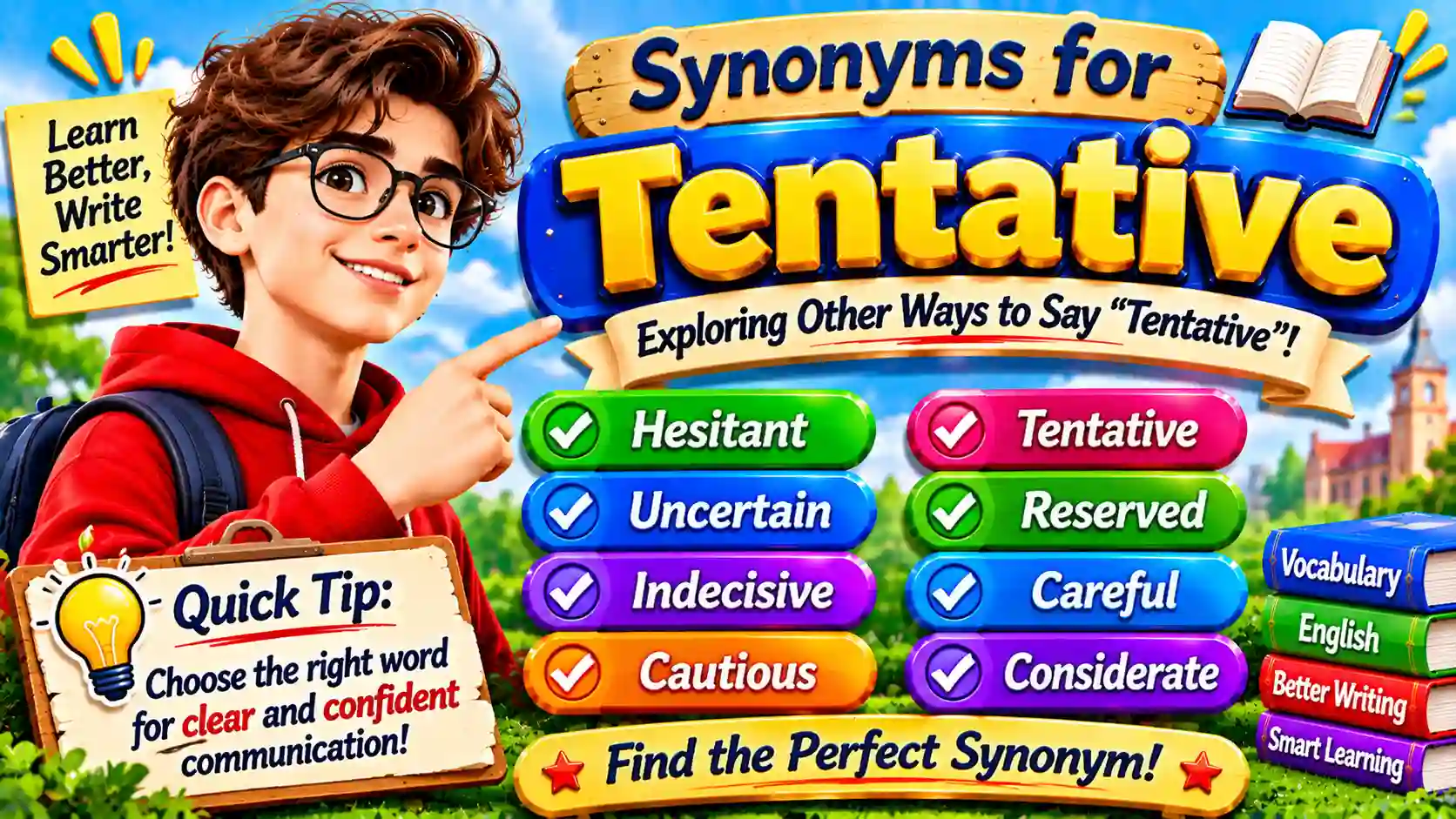
Have you ever made a plan that wasn’t final yet, or smiled at someone new without feeling sure? That’s exactly what tentative means. It’s one of those useful English words that covers both uncertain plans and shy, careful feelings, so learners search for it all the time.
In this guide, you’ll learn what tentative really means, where it comes from, and 40 synonyms grouped by sense — so you can pick the right word for a plan, an agreement, or a feeling. Each word comes with a clear meaning, a best use, and a real example sentence. By the end, you’ll never pause over this word again.
📖 Meaning of Tentative
Tentative is an adjective. It describes something that is not fully decided, not final, or done in a careful, unsure way.
- Definition: Not fully worked out or developed; not definite or certain; hesitant or unsure.
- Part of speech: Adjective (it can also be a noun in rare uses, meaning a trial or an attempt).
- Pronunciation: TEN-tuh-tiv /ˈtɛntətɪv/
- Origin: From Medieval Latin tentātīvus, meaning “as a trial, experimental, provisional,” from Latin tentāre (a form of temptāre), meaning “to feel, test, examine.” Its first known use as an adjective was in 1825, according to Merriam-Webster.
- Common usage: We use it for plans (“a tentative date”), agreements (“a tentative deal”), steps (“tentative steps”), and feelings (“a tentative smile”). In every case, something is not final yet — it may change, or the person is not fully sure.
- Simple explanation: Think of tentative as “trying it out first.” A tentative plan is a first draft of a plan. A tentative smile is a smile that is still testing the water.
📝 Top Synonyms of Tentative
Not Sure and Uncertain
| Word | Meaning | Best Use | Example |
| Hesitant | Slow to act because you are unsure | Feelings and decisions | She was hesitant to speak first in the meeting. |
| Unsure | Not certain about something | Everyday speech | I’m unsure about the new date for the trip. |
| Doubtful | Feeling doubt; not believing fully | Opinions and predictions | He was doubtful that the rain would stop. |
| Uncertain | Not known or not decided | Formal and everyday use | The future of the project is still uncertain. |
| Undecided | Not yet having made a choice | Decisions and votes | They are undecided about which school to pick. |
| Wavering | Moving back and forth between choices | Decisions and loyalty | Her support for the plan was wavering. |
| Indecisive | Finding it hard to make decisions | People and choices | He is indecisive about what to study. |
| Ambivalent | Having mixed feelings at the same time | Feelings and relationships | She felt ambivalent about moving abroad. |
| Skeptical | Doubting that something is true | Claims and promises | I’m skeptical about the quick-fix diet. |
| Dubious | Doubting or suspicious | Formal writing | The report’s dubious claims need checking. |
Not Final and Provisional
| Word | Meaning | Best Use | Example |
| Provisional | Arranged for now, but may change | Plans and agreements | We have a provisional booking for Friday. |
| Preliminary | Done first, before the final version | Reports and results | The preliminary results look promising. |
| Conditional | Depending on something else happening | Offers and agreements | The job offer is conditional on a reference. |
| Unconfirmed | Not yet checked or made certain | News and bookings | The flight time is still unconfirmed. |
| Unsettled | Not decided or not fixed | Plans and questions | The meeting date remains unsettled. |
| Draft | A first version, not the final one | Writing and plans | This is only a draft of the contract. |
| Interim | Temporary, until something final comes | Roles and reports | She is the interim manager this month. |
| Pending | Waiting to be decided or done | Official and business use | The decision is pending approval. |
| Nonbinding | Not legally forcing you to act | Agreements and offers | The letter is a nonbinding offer. |
| Flexible | Able to change easily | Plans and schedules | Keep the schedule flexible this week. |
Hesitant and Shy
| Word | Meaning | Best Use | Example |
| Timid | Shy and easily frightened | People and animals | The timid child hid behind her mother. |
| Shy | Nervous around people you don’t know | People and behaviour | He gave a shy smile and looked down. |
| Cautious | Careful to avoid danger or mistakes | Actions and decisions | Be cautious when you cross the road. |
| Wary | Careful because you expect trouble | Trust and safety | She was wary of strangers online. |
| Diffident | Lacking confidence in yourself | Formal writing | He gave a diffident answer in class. |
| Reserved | Quiet and not showing feelings easily | Personality | My neighbour is reserved but kind. |
| Reluctant | Not willing to do something | Decisions and actions | She was reluctant to leave her job. |
| Nervous | Worried and not calm | Feelings before events | I felt nervous before my first speech. |
| Sheepish | Embarrassed and a little shy | After a mistake | He gave a sheepish grin after the joke. |
| Bashful | Shy in a sweet, gentle way | People and smiles | The bashful boy thanked her softly. |
Trial and Experimental
| Word | Meaning | Best Use | Example |
| Experimental | Done as a test to see what happens | Science and new ideas | This is an experimental teaching method. |
| Exploratory | Done to explore or find out more | Research and talks | We held exploratory talks with the team. |
| Trial | Done as a test before a final choice | Products and plans | The trial period lasts for one month. |
| Pilot | A small test before a big launch | Projects and programmes | The pilot project starts in two schools. |
| Speculative | Based on guesses, not facts | Ideas and markets | His speculative plan had no real data. |
| Conjectural | Based on guessing, not proof | Academic writing | Her conjectural view needs more evidence. |
| Hypothetical | Imagined, not real or proven | Examples and questions | Take a hypothetical case: what if it rains? |
| Rough | Not finished or not exact | Drafts and estimates | Here is a rough plan for the event. |
| Untested | Not tried yet | Ideas and products | This untested method may fail. |
| Probationary | A trial period before a final decision | Jobs and memberships | He is on a probationary contract. |
⚖️ Antonyms of Tentative
Tentative has no single perfect opposite, because its meaning changes with sense. These words are situational opposites — use the one that fits your sentence.
| Word | Meaning | Example |
| Definite | Fixed and certain | We have a definite date now: May 5. |
| Certain | Sure, without doubt | I am certain she will come. |
| Confident | Sure of yourself | He gave a confident smile. |
| Firm | Strong and not changing | She made a firm decision. |
| Settled | Decided and fixed | The plan is settled at last. |
| Confirmed | Checked and made certain | Your booking is confirmed. |
| Decided | Already chosen | The date is decided. |
| Assured | Promised and certain | Success is not assured. |
| Resolute | Determined and firm | She stayed resolute under pressure. |
| Conclusive | Proving something clearly | The test gave conclusive results. |
💬 Example Sentences
Daily Conversation
- We have a tentative plan to visit the park on Sunday.
- I’m tentative about joining the gym this month.
- She gave a tentative smile when she met the new teacher.
- Let’s keep our weekend plans tentative for now.
Academic English
- The study offers tentative conclusions about sleep and memory.
- Tentative results suggest the new method may work better.
- The essay presents a tentative view of the writer’s argument.
- Researchers made tentative steps toward a cure.
Business English
- We reached a tentative agreement with the supplier.
- The tentative budget will change after the review.
- Please treat this schedule as tentative until Monday.
- The team set a tentative launch date for June.
Formal Writing
- The committee made a tentative decision, subject to review.
- A tentative draft of the report was shared with members.
- The treaty remains tentative until both sides sign it.
- Tentative findings must be checked before publication.
Informal Writing
- I sent a tentative text: “Maybe coffee on Saturday?”
- Our holiday plans are still pretty tentative.
- He gave a tentative knock before coming in.
- I’m tentative about the new haircut, but I’ll try it.
Creative Writing
- Her tentative steps echoed down the dark hallway.
- He reached out a tentative hand toward the light.
- A tentative hope grew in her heart that morning.
- The tentative rain began to fall on the old roof.
📚 Difference Between Similar Words
| Words | Meaning | When to Use | Example |
| Tentative vs Provisional | Tentative is wider — plans and feelings; provisional is only about plans or decisions not yet final | Use provisional for official plans; tentative for feelings too | A tentative smile; a provisional booking |
| Tentative vs Hesitant | Hesitant describes a person’s feeling of doubt; tentative can also describe plans and things | Use hesitant for people; tentative for plans and people | A hesitant speaker; a tentative plan |
| Tentative vs Uncertain | Uncertain means not knowing; tentative means not decided or not final | Use uncertain for facts; tentative for plans and attempts | An uncertain future; a tentative date |
| Tentative vs Conditional | Conditional means depending on a condition; tentative means not final, with no condition needed | Use conditional when something must happen first | A conditional offer; a tentative agreement |
Simple rule: If a person feels unsure, use hesitant or tentative. If a plan may change, use tentative or provisional. If something depends on another event, use conditional.
🎯 Best Alternative Words
- Professional Writing: provisional, preliminary, conditional, pending — these sound formal and clear in reports and contracts.
- Essay Writing: tentative, uncertain, speculative, conjectural — these fit academic arguments that are still open.
- Email: tentative, flexible, draft, unconfirmed — polite words that show a plan may change.
- Business: provisional, interim, conditional, nonbinding — safe words for deals, budgets, and offers.
- Conversation: unsure, hesitant, not sure yet, up in the air — natural words for daily talk.
- Marketing: trial, pilot, exploratory — these sound positive, like a test, not a weakness.
- Creative Writing: timid, bashful, sheepish, wary — these paint a picture of a shy or careful person.
✍ Grammar Tips
- Part of speech: Tentative is an adjective. It describes a noun: a tentative plan, a tentative smile, a tentative step.
- Comparative and superlative: Tentative is a long adjective, so use more tentative and most tentative. Never write “tentativer” or “tentativest.”
- Adverb form: Add -ly to get tentatively: “She knocked tentatively on the door.”
- Noun form: Tentativeness is the noun, and it is uncountable: “His tentativeness surprised us.”
- Common pattern: Use tentative about + -ing form: “I’m tentative about joining the club.”
- Spelling: The correct spelling is T-E-N-T-A-T-I-V-E. A common mistake is writing “tentitive” with an “i” — remember the “a” after “tent.”
- No verb form: There is no verb “to tentative.” To say the action, use “try tentatively” or “make a tentative attempt.”
- With nouns: It pairs with plan, agreement, date, decision, step, smile, and conclusion.
❌ Common Mistakes
| Wrong | Correct | Reason |
| We made a tentatively plan. | We made a tentative plan. | Use the adjective tentative before a noun, not the adverb tentatively. |
| She smiled tentative. | She smiled tentatively. | A verb needs the adverb tentatively, not the adjective. |
| The date is tentatived for Friday. | The date is tentatively set for Friday. | There is no verb form “tentatived”; use the adverb with a verb. |
| He is more tentativer than me. | He is more tentative than me. | The comparative is more tentative, never tentativer. |
| They reached a tentatively agreement. | They reached a tentative agreement. | Use the adjective tentative before the noun agreement. |
| I am tentative about to go. | I am tentative about going. | After about, use the -ing form of the verb. |
💡 Pro Writing Tips
- Match the sense: For a plan, pick provisional or preliminary. For a shy person, pick timid or bashful. The right sense matters more than a fancy word.
- Don’t overuse it: If every plan is tentative, your writing sounds unsure. Use it only when something is truly not final.
- Pair it with a date: “A tentative date of May 5” is clearer than just “a tentative date,” because readers know when to expect news.
- In business, add the condition: “Tentative, subject to approval” tells the reader exactly what must happen next.
- In stories, show it: Instead of writing “she was tentative,” show a tentative smile or a tentative step — readers feel it more.
- Check your register: In formal writing, prefer provisional or conditional. In daily talk, unsure or hesitant sounds more natural.
📖 Related Words
- Associated words: trial, experiment, test, draft, plan, agreement, decision, step, smile, hope
- Nearby words: tentatively, tentativeness, tentative plans, tentative steps, tentative agreement
- Contextual words: provisional, preliminary, conditional, hesitant, uncertain, cautious, exploratory
- Semantic variations: not final, not certain, subject to change, up in the air, in the works, on trial
❓ FAQs
What does tentative mean?
Tentative means not fully decided, not final, or done in a careful, unsure way. It can describe a plan that may change, like a tentative date, or a person who feels unsure, like a tentative smile. The word comes from Latin tentare, meaning “to try or test.” Use it when something is still a first try, not the final version.
What is the best synonym for tentative?
The best synonym depends on what you mean. For a person who feels unsure, use hesitant or unsure. For something done as a test, use experimental or trial. Always match the synonym to the sense — a plan, a feeling, or a test — before you pick one.
What is the difference between tentative and provisional?
Tentative is the wider word: it covers uncertain plans and shy, unsure feelings. Provisional is narrower and only describes plans, decisions, or arrangements that are not yet final. You can say “a tentative smile,” but you would not say “a provisional smile.” For official plans, both work, but provisional sounds more formal.
Is tentative a positive or negative word?
Tentative is neutral, not good or bad. It simply means something is not final yet. In business, a tentative plan can be smart and careful. In a story, a tentative smile can feel sweet and honest. The feeling around it comes from the context, not from the word itself, so use it freely.
What is the opposite of tentative?
There is no single opposite, because tentative has more than one sense. For plans, the opposite is definite or confirmed. For decisions, the opposite is firm or settled. Pick the opposite that matches your sentence’s sense, just as you pick the synonym.
How do you use tentative in a sentence?
Use tentative before a noun, like “a tentative plan” or “a tentative agreement.” You can also use it after a linking verb: “The plan is tentative.” For feelings, try “She gave a tentative smile.” Remember it is an adjective, so it describes a thing or a person, and it often pairs with plan, date, step, or smile.
What is the noun form of tentative?
The noun form is tentativeness, and it is uncountable. For example: “His tentativeness surprised the team.” It means the quality of being tentative — unsure or not final. In everyday writing, people more often rephrase it, saying “the plan is tentative” instead of using the noun, because the noun sounds formal and heavy.
What is the adverb form of tentative?
The adverb form is tentatively. Use it to describe how an action is done: “She knocked tentatively on the door.” It means in a careful, unsure way. Remember the difference: tentative describes a noun, like a plan, while tentatively describes a verb, like knocked, smiled, or reached out to someone.
Conclusion
Tentative is a small word with a useful job: it tells us something is not final yet. It can describe a plan that may change, an agreement waiting for a signature, or a person who is still finding courage. In this guide, you learned its meaning, its Latin origin in tentare — to try or test — and 40 synonyms grouped into four clear senses: not sure, not final, hesitant and shy, and trial and experimental. You also saw antonyms, 24 example sentences, grammar tips, and the mistakes to avoid. The next time you write a plan, an email, or a story, pick the synonym that matches your sense — provisional for a plan, hesitant for a feeling, experimental for a test — and your writing will sound clearer and more confident.