However, it is one of the most useful words in English, and it is also one of the most repeated. You use it to add a contrast, to say “in any way,” or to talk about how much something matters. The trouble is that many writers use it in almost every paragraph, and the writing starts to feel flat.
This guide fixes that. You will learn 40 synonyms for however, grouped by meaning, with clear examples for each one. You will also learn when however is the best choice and when another word sounds better. A quick spelling note: “howver” is a common misspelling. The correct spelling is however, with an e after w — h-o-w-e-v-e-r.
📖 Meaning of However
Definition: However means “in spite of that” or “nevertheless” when you add a contrast. It also means “in whatever way” and “to whatever degree.”
Part of Speech: Adverb / conjunctive adverb. It is not a conjunction, so it cannot join two sentences with only a comma.
Pronunciation: HOW-ev-er — /haʊˈɛvər/.
Origin: Middle English, from how + ever, late 14th century.
Common Usage: You will see this in essays, emails, stories, and talks. It often starts with a sentence — “However, we kept going” — or sits in the middle — “The plan was good; however, it cost too much.” It also appears before an adjective — “However hard it was, she finished” — and in phrases like “however you like,” which means “in any way you like.”
📝 Top Synonyms of However
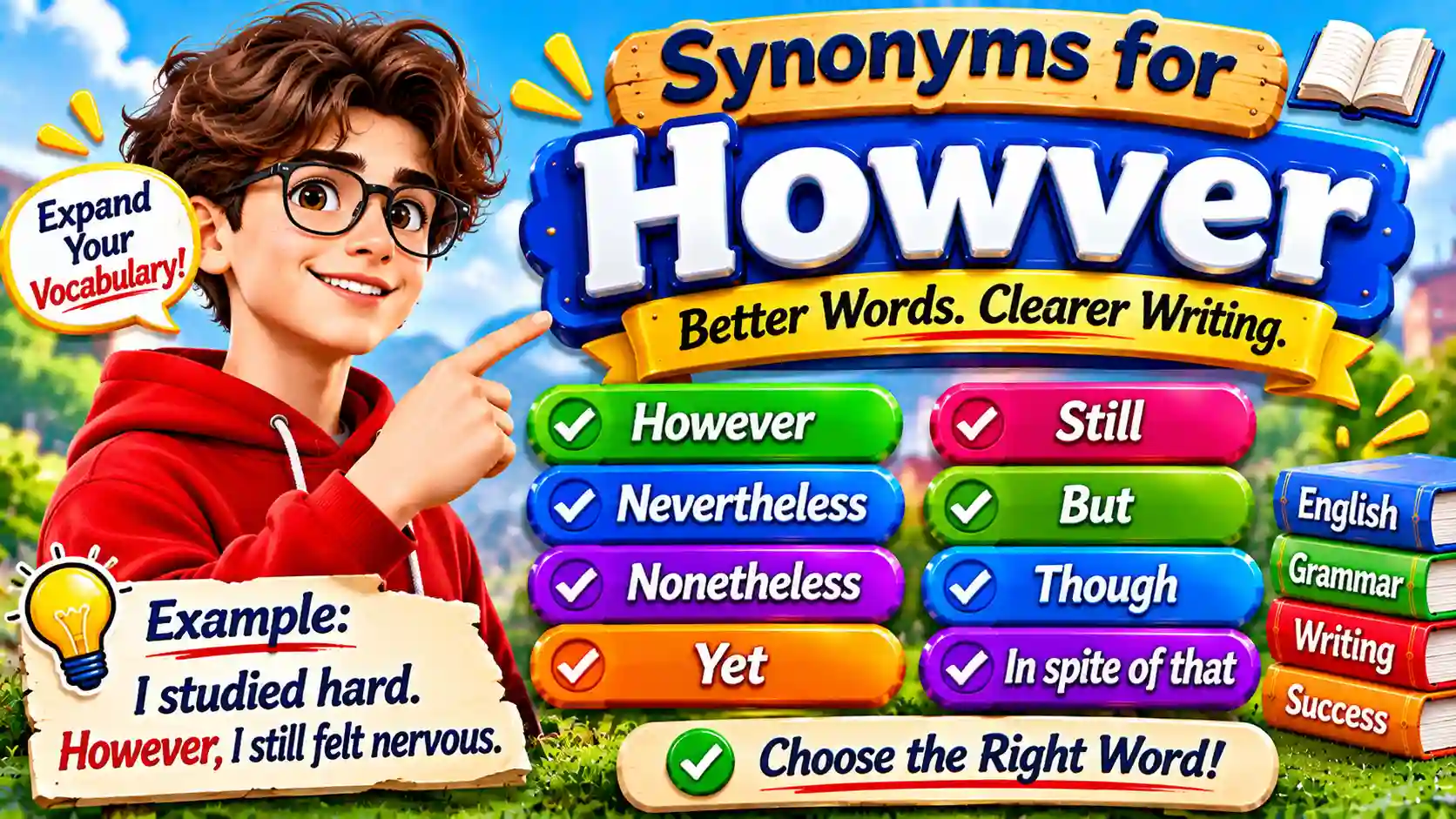
Nevertheless / In Spite of That
| Word | Meaning | Best Use | Example |
| nevertheless | in spite of that; even though something is true | formal writing and essays | It rained all day; nevertheless, we enjoyed the trip. |
| nonetheless | in spite of that; still true | formal and business writing | The test was hard; nonetheless, she passed with a smile. |
| even so | despite what was just said | everyday and formal writing | He was tired; even so, he helped his friend move. |
| still | despite that; in spite of it | everyday speech and writing | The shop was closed, but we still found a gift. |
| yet | but at the same time; despite that | short, clear sentences | She was ill, yet she came to class. |
| though | despite the fact that; however | everyday speech, often at the end | It was cold, though, and we stayed inside. |
| all the same | in spite of that; anyway | friendly, everyday writing | It was late; all the same, we waited for him. |
| despite that | in spite of what was said | clear, plain writing | The price was high; despite that, they bought the book. |
| in spite of that | even though that is true | clear, plain writing | He had little time; in spite of that, he finished the work. |
| regardless | in spite of everything; anyway | strong, firm statements | It rained; regardless, the game went on. |
But / Contrast
| Word | Meaning | Best Use | Example |
| but | introduces a contrast | everyday speech and writing | I like tea, but I love coffee more. |
| then again | on second thought; on the other hand | everyday speech and writing | It is costly; then again, it lasts for years. |
| on the other hand | looking at the opposite side | essays and talks | It is fast; on the other hand, it uses more fuel. |
| in contrast | showing a clear difference | academic and formal writing | The north is cold; in contrast, the south is warm. |
| by contrast | compared with something else | academic and formal writing | He is quiet; by contrast, his sister talks all day. |
| conversely | in the opposite way | formal and academic writing | She loves rain; conversely, her brother loves sun. |
| on the flip side | the other side of the idea | informal talks and blogs | The job pays well; on the flip side, the hours are long. |
| having said that | after what I just said, here is a contrast | talks and essays | It is a great plan; having said that, it needs more time. |
| at the same time | while also thinking of the other side | everyday and business writing | It is fun; at the same time, it takes hard work. |
| mind you | please note this contrast too | informal, friendly speech | He is young; mind you, he is very wise. |
No Matter How / In Whatever Way
| Word | Meaning | Best Use | Example |
| no matter how | regardless of the way or amount | everyday and formal writing | No matter how hard it gets, keep going. |
| in whatever way | in any way you choose | everyday speech and writing | You can learn in whatever way suits you best. |
| in whichever way | in any one of the ways | clear, careful writing | Cut the cake in whichever way you like. |
| by whatever means | using any method that works | formal writing | Finish the task by whatever means are fair. |
| in any way | in whatever manner | everyday speech and writing | Help me in any way you can. |
| in any manner | in whatever style or method | formal writing | Please send the form in any manner you like. |
| by any means | using any method | everyday and formal writing | Get home by any means you can. |
| whatever way | any way at all | everyday speech | Cook it whatever way you enjoy most. |
| howsoever | in whatever way; to whatever degree | old, formal, literary writing | Howsoever you look at it, the truth stays the same. |
| in whatever manner | in any way at all | formal writing | Speak in whatever manner feels natural to you. |
In What Way / Question Sense
| Word | Meaning | Best Use | Example |
| in what way | by which method or manner | questions and clear writing | In what way can I help you today? |
| by what means | using which method | formal questions | By what means did they reach the island? |
| how on earth | in what possible way (surprised) | informal, surprised speech | How on earth did you finish so fast? |
| how in the world | in what possible way (surprised) | informal, surprised speech | How in the world did she find the key? |
| in what manner | in which style or way | formal questions | In what manner should we greet the guests? |
| by what method | using which steps | academic and formal writing | By what method did you solve this sum? |
| how exactly | in precisely what way | everyday questions | How exactly does this machine work? |
| in which way | by which path or method | clear, careful writing | In which way do we go to the park? |
| by which means | using which method | formal writing | By which means will you send the parcel? |
| what way | in which manner (short question form) | everyday, informal questions | What way do you want to play this game? |
⚖️ Antonyms of However
However it has no single direct opposite, because it shows a contrast or “any way” — not a thing you can reverse. The words below work as situational opposites: they show a result, not a contrast.
| Word | Meaning | Example |
| therefore | for that reason; as a result | It rained, therefore we stayed home. |
| consequently | as a result of that | He trained hard; consequently, he won. |
| accordingly | in line with that; as a result | Prices rose; accordingly, sales fell. |
| as a result | because of that | She studied daily; as a result, she passed. |
| hence | for this reason | It is late; hence we must go now. |
| thus | in this way; therefore | He saved money; thus he could travel. |
| so | for that reason | I was tired, so I went to bed. |
| for that reason | because of that fact | It was cold; for that reason, we wore coats. |
💬 Example Sentences
Daily Conversation
- It rained all morning; however, we still went for a walk.
- I wanted cake, but my sister wanted ice cream instead.
- The film was long, yet we loved every minute of it.
- Do the puzzle however you like — there is no wrong way.
Academic English
- The data was limited; nevertheless, the results were clear.
- The first group scored high; in contrast, the second group scored low.
- However much the cost rises, the study must go on.
- By what method did the team test the new idea?
Business English
- Sales fell last month; however, this month looks much better.
- The plan is strong; having said that, we need a bigger budget.
- The client was unhappy; nonetheless, we kept the contract.
- Please send the report in whatever way is fastest for you.
Formal Writing
- The law was old; even so, it still shaped the case.
- The work was hard; notwithstanding the cold, they finished on time.
- In whatever manner you write, keep your facts clear and true.
- The team was small; regardless, it met every goal.
Informal Writing
- It was late, though, and we were all so sleepy.
- The pizza was cold; on the flip side, it still tasted great.
- How on earth did you learn to cook so well?
- It costs a lot; then again, it will last for years.
Creative Writing
- The road was dark; still, she walked on with a brave heart.
- No matter how far he ran, the song followed him home.
- The old house was quiet; mind you, its walls held many stories.
- How exactly did the little bird find its way back home?
📚 Difference Between Similar Words
| Word Pair | Difference | Simple Rule | Example |
| however vs nevertheless | However is common and flexible; nevertheless is more formal and firm. | Use nevertheless in formal writing. | It rained; however, we played. / It rained; nevertheless, we played. |
| however vs but | But is a conjunction that joins two parts; however is an adverb that needs a semicolon or a full stop. | Use but to join; use however with a semicolon or a new sentence. | I like tea, but I love coffee. / I like tea; however, I love coffee. |
| however vs still | Still is short and everyday; however, it is more formal and can start a sentence. | Use still in speech; use however in essays. | It was cold, but we still went out. / It was cold; however, we went out. |
| however vs yet | Yet is short and joins ideas like but; however adds a pause and a stronger contrast. | Use yet for a quick contrast; use however for a clear break. | She was ill, yet she came. / She was ill; however, she came. |
| however vs nonetheless | Nonetheless is formal and means “in spite of that”; however can also mean “in any way.” | Use nonetheless only for contrast, not for “any way.” | He was tired; nonetheless, he worked. / Do it however you like. |
🎯 Best Alternative Words
- Professional Writing: Use nevertheless, nonetheless, or having said that for a calm, formal contrast.
- Essay Writing: Use however, in contrast, or conversely to show a clear change in your argument.
- Email: Use still, yet, or at the same time for a short, polite contrast.
- Business: Use nonetheless, even so, or in contrast when you report results and plans.
- Conversation: Use but, still, though, or then again — they sound natural and friendly.
- Marketing: Use on the other hand or on the flip side to show both sides of an offer.
- Creative Writing: Use still, no matter how, or how on earth for feeling, wonder, and surprise.
✍️ Grammar Tips
- However, it is a conjunctive adverb, not a conjunction. Do not join two sentences with only a comma before it.
- Use a semicolon before however and a comma after it: “It rained; however, we played.”
- You can also start a new sentence: “It rained. However, we played.”
- Put a comma after “however at the start of a sentence: “However, we kept going.”
- However, I can sit in the middle: “The plan was good; it was, however, too costly.”
- “However” is one word. “How ever” is two words, used in questions like “How ever did you do that?”
- Use however before an adjective to mean “no matter how”: “However hard it was, she finished.”
- However, it has no comparative form. Do not write “more however” or “howeverer.”
- Do not use “however and but together: “But however, we went” is wrong. Pick one.
- “Howver” is a misspelling. Always write however, with an e after w.
❌ Common Mistakes
| Wrong | Correct | Reason |
| I like tea, however I prefer coffee. | I like tea; however, I prefer coffee. | However is not a conjunction, so it needs a semicolon or a full stop, not only a comma. |
| Howver is the correct spelling. | However, it is the correct spelling. | The word is spelled h-o-w-e-v-e-r, with an e after w. |
| He is however smart. | He is, however, smart. | However, the middle of a sentence needs commas on both sides. |
| She was tired, however she kept working. | She was tired; however, she kept working. | Two full sentences need a semicolon before however, not only a comma. |
| I will go regardless of the weather. | I will go no matter what the weather is like. | However, it needs a full phrase after it, such as “however bad the weather is.” |
| However, he tried his best. | Despite that, he tried his best. / However, he tried his best. | However, I cannot follow “despite” like that; use “despite that” or start with however. |
💡 Pro Writing Tips
- Do not start every paragraph with however. Mix in still, yet, but, and nonetheless.
- Read your sentence aloud. If however feels heavy, try but or still instead.
- Use however for a big turn in your idea, not for every small change.
- In essays, put however after a semicolon to show a strong, clear contrast.
- In stories, use no matter how and still to keep the feeling warm and alive.
- Keep a short list of your favourite however synonyms on your desk, and pick a new one each day.
- Check your spelling: however, not howver, and never “however” unless you are asking a question.
📖 Related Words
- nevertheless, nonetheless, still, yet, though, even so, regardless, notwithstanding
- but, in contrast, conversely, on the other hand, then again, having said that
- no matter how, in whatever way, in any way, by whatever means, howsoever
- therefore, consequently, accordingly, as a result, hence, thus, so
- contrast, result, degree, manner, method, way, extent, however much
- transition words, connectors, linking words, conjunctions, adverbs
❓ Frequently Asked Questions
What does this mean?
However, it means “in spite of that” when you add a contrast, “in whatever way” when you talk about a method, and “to whatever degree” when you talk about amount. For example, “It rained; however, we played outside” shows a contrast. “Do it however you like” means “in any way you like.” Context shows which meaning fits best.
What is the best synonym for however?
The best synonym depends on your sentence. Use nevertheless or nonetheless in formal writing, but or still in everyday talk, and in contrast in essays. For “in any way,” use no matter how or in whatever way. Pick the word that fits the tone and the meaning, not just the first word you find.
Is it correct to start a sentence with however?
Yes, it is correct to start a sentence with however. Put a comma right after it, like this: “However, we kept going.” Some old guides said no, but modern dictionaries and style guides accept it. Just do not use it at the start of every sentence, or your writing will feel dull.
What is the difference between however and but?
But is a conjunction, so it joins two parts with only a comma: “I like tea, but I love coffee.” However is an adverb, so it needs a semicolon or a full stop: “I like tea; however, I love coffee.” Use but for a quick link and however for a clear, strong break between ideas.
What is the difference between however and nevertheless?
However and nevertheless both mean “in spite of that,” but nevertheless sounds more formal and firm. However is more common and can also mean “in any way,” while nevertheless only shows a contrast. Use nevertheless in essays and reports, and however in most other writing when you want a natural, clear contrast.
How do you use it in a sentence?
Use however with a semicolon before it and a comma after it: “It rained; however, we played.” You can also start a new sentence: “It rained. However, we played.” Put however in the middle with commas too: “The plan was good; it was, however, too costly.” Never join two sentences with only a comma before however.
Is “howver” the correct spelling?
No, “howver” is not the correct spelling. It is a common misspelling however. The correct spelling is h-o-w-e-v-e-r, with an e after the w. If you see “howver” in a search box, it usually means the writer wants the word however. Always check the spelling before you publish your work.
What is the opposite of however?
However, it has no single direct opposite. Words like therefore, consequently, accordingly, and as a result show a result, not a contrast, so they work as situational opposites. For example, “It rained, therefore we stayed home” shows a result, while “It rained; however, we went out” shows a contrast. Pick the result word that fits your sentence.
Conclusion
However, it is a small word with big jobs. It can show a contrast, it can mean “in any way,” and it can talk about how much something matters. Now you have 40 synonyms to use instead, grouped by meaning, so you can pick the right word for each sentence. Remember the key rules: however is an adverb, not a conjunction, so use a semicolon or a full stop before it; put a comma after it at the start of a sentence; and spell it however, not “howver.” Mix nevertheless, but, still, yet, in contrast, and no matter how into your writing, and your words will sound fresh, clear, and confident. Try one new word in your next email or essay, and notice how much fresher your writing feels. Keep practising one new synonym each day, and explore more words on Synonymfy.com to keep your vocabulary growing — one well-chosen word at a time.