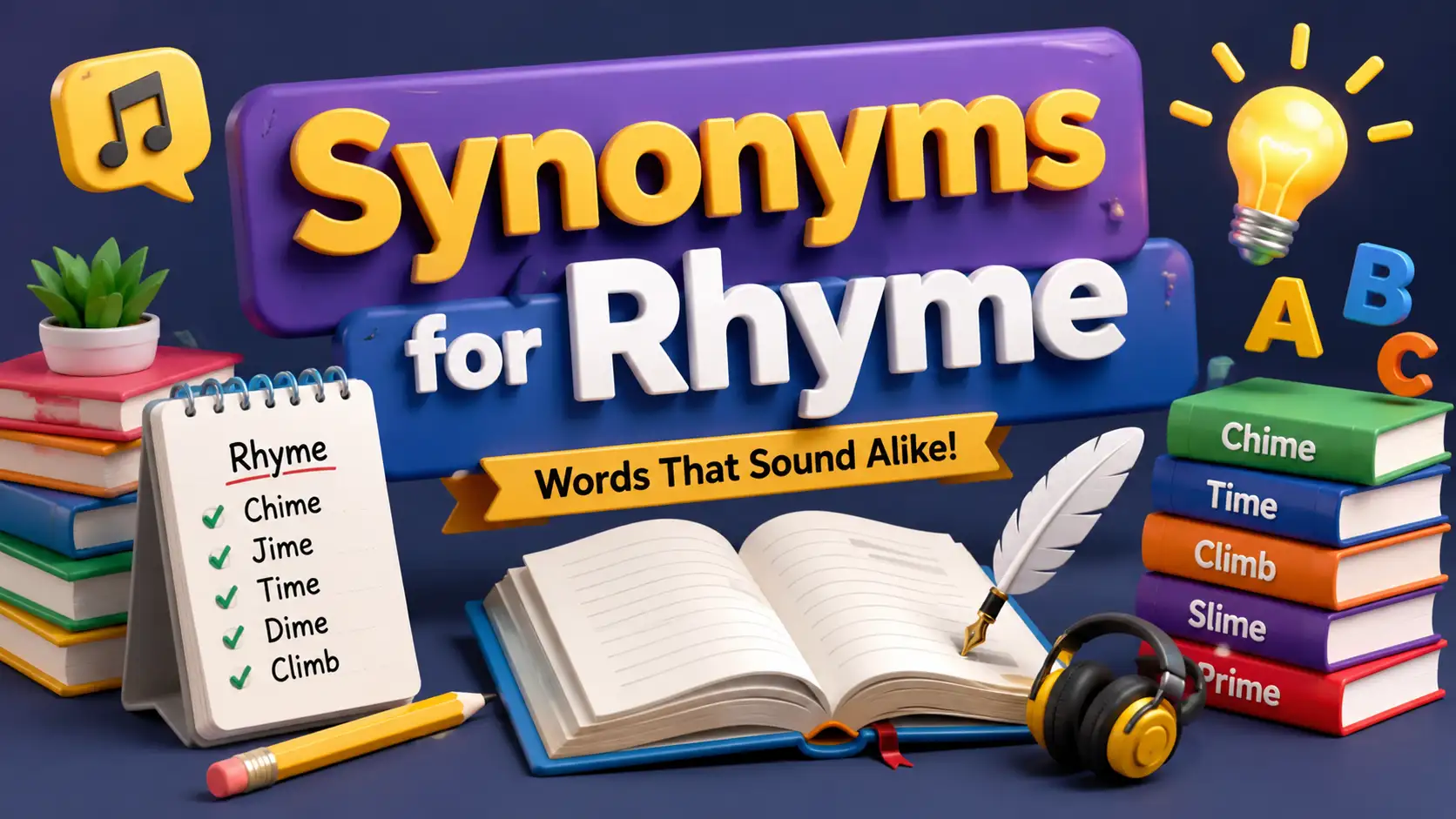
Finding the right synonyms for rhyme can make your writing more varied, creative, and precise. The word rhyme can refer to matching sounds, a short poem, a poetic technique, or the act of using matching sounds. Because its meaning changes with context, there isn’t always one perfect replacement.
Words such as verse, poem, song, chime, harmonize, cadence, rhythm, and rhyme scheme may work in different situations, but they don’t all mean exactly the same thing. In this guide, you’ll learn the closest alternatives, related literary terms, examples, common mistakes, and practical tips for choosing the right word.
📖 What Does Rhyme Mean?
Rhyme means a similarity between sounds, usually at the ends of words or lines. It is common in poetry, songs, nursery rhymes, rap, and creative writing.
For example:
- Light rhymes with night.
- Play rhymes with day.
- Moon rhymes with tune.
The word rhyme can work as both a noun and a verb.
| Form | Meaning | Example |
| Noun | A matching sound or a piece of verse | The poem has a simple rhyme. |
| Verb | To have matching sounds | “Blue” rhymes with “true.” |
Pronunciation: /raɪm/
Rhyme in simple English
Think of rhyme as a sound connection between words. The spelling doesn’t have to be the same. What matters is how the words sound.
For example, “blue” and “through” look different but rhyme because their ending sounds match.
Rhyme can make language easier to remember and more enjoyable to read or hear. That’s why it appears so often in songs, children’s books, poems, advertising slogans, and spoken-word writing.
📝 Direct Synonyms and Alternatives for Rhyme
There are only a few close substitutes for rhyme because it has a specific meaning. Some alternatives work better for the verb sense, while others describe a similar sound relationship.
| Alternative | Meaning | Example |
| Chime | To sound alike or pleasantly together | The final words chime together. |
| Harmonize | To sound well together | The sounds harmonize nicely. |
| Sound alike | To have similar sounds | These two words sound alike. |
| Sound similar | To have partly matching sounds | The endings sound similar. |
| Correspond in sound | To have a sound relationship | The two endings correspond in sound. |
Which alternative should you choose?
- Use chime when you want a literary or expressive tone.
- Use sound alike in simple everyday English.
- Use sounds similar when the sounds are close but not identical.
- Use harmonize when talking about sounds working well together.
- Use corresponds to sound in technical or academic discussion.
Important: Words such as poem, verse, rhythm, and meter are related to rhyme, but they aren’t direct synonyms.
📖 Synonyms for Rhythm
Rhythm describes a regular pattern of beats, stresses, movements, or sounds. Its best alternatives depend on whether you’re talking about music, speech, poetry, movement, or writing.
| Word | Best Meaning | Example |
| Beat | A repeated musical pulse | The song has a strong beat. |
| Tempo | The speed of music or movement | The tempo becomes faster. |
| Cadence | The flow or rise and fall of sound | Her speech has a calm cadence. |
| Meter | A structured pattern in poetry | The poem uses regular meter. |
| Pulse | A steady repeated beat | The music follows a steady pulse. |
| Flow | The smooth movement of words or ideas | The paragraph has a natural flow. |
| Pace | The speed at which something progresses | The story has a quick pace. |
| Timing | The placement of actions or sounds | Good timing improves the performance. |
| Groove | A strong, repeated musical feel | The band found a great groove. |
| Pattern | A repeated arrangement | The sounds create a clear pattern. |
Rhyme vs. rhythm
These terms are easy to confuse:
- Rhyme = matching or similar sounds.
- Rhythm = a pattern of beats, stresses, or timing.
A poem can have rhythm without rhyme. It can also use both at the same time.
🔤 Synonyms That Rhyme With Each Other
Finding two words that are both synonyms and rhymes can be difficult. Most synonyms don’t share the same ending sound.
For example:
| Word | Related Word | Do They Rhyme? | Note |
| sad | unhappy | No | Related meaning, different sounds |
| quick | fast | No | Similar meaning, different sounds |
| large | big | No | Similar meaning, different sounds |
| smart | clever | No | Similar meaning, different sounds |
| small | tiny | No | Similar meaning, different sounds |
| glad | happy | No | Similar meaning, different sounds |
This shows an important vocabulary rule: being synonyms and being rhyming words are two different relationships.
Why is this useful?
Writers, poets, and songwriters sometimes need a word that:
- Keeps the original meaning.
- Fits naturally into the sentence.
- Matches a particular sound.
That can be challenging because changing a word for its rhyme may change its meaning.
Best practice: Choose meaning first, then look for a suitable rhyming word.
📝 Other Terms for Rhyme Scheme
A rhyme scheme is the pattern that shows which lines in a poem rhyme with one another. Writers often represent the pattern with letters such as ABAB or AABB.
The most useful alternative expression is rhyme pattern.
| Term | Use | Example |
| Rhyme pattern | Common alternative to rhyme scheme | The poem follows an ABAB rhyme pattern. |
| Rhyming pattern | Describes the arrangement of rhymes | The rhyming pattern changes in the final stanza. |
| Rhyme structure | Describes how rhyme is organized | The rhyme structure is simple. |
| Poetic rhyme pattern | Makes the poetry context clear | The poetic rhyme pattern repeats throughout. |
| End-rhyme pattern | Specifically focuses on line-ending rhymes | The end-rhyme pattern is AABB. |
Example
Suppose a four-line poem follows this pattern:
- Line 1 → A
- Line 2 → B
- Line 3 → A
- Line 4 → B
Its rhyme scheme is ABAB.
⚖️ Antonyms and Contrasts of Rhyme
There isn’t one exact antonym for rhyme. The best contrast depends on what aspect of rhyme you’re discussing.
| Contrast | Meaning | Example |
| Non-rhyming verse | Poetry that doesn’t use rhyme | The poet chose a non-rhyming verse. |
| Free verse | Poetry without a fixed rhyme or meter | She writes in free verse. |
| Prose | Ordinary written language rather than verse | The novel is written in prose. |
| Dissonance | Harsh or clashing sound | The writer uses dissonance for effect. |
| Discord | A lack of harmony | The sounds create discord. |
| Irregular pattern | A pattern without regular repetition | The poem has an irregular sound pattern. |
Rhyme and free verse
Free verse doesn’t have to follow a fixed rhyme scheme or meter. However, free verse can still contain occasional rhyme.
So, free verse isn’t a strict antonym of rhyme. It’s better described as a contrasting poetic form.
💬 Example Sentences With Rhyme and Related Words
These examples show how different vocabulary words work in real sentences.
Everyday English
- The words cake and lake rhyme.
- Can you find a rhyme for star?
- Those two words sound similar.
- The children enjoyed the nursery rhyme.
- This song has a catchy beat.
Academic English
- The poem follows an ABAB rhyme scheme.
- The writer uses internal rhyme in several lines.
- The poem’s meter creates a steady rhythm.
- The repeated vowel sounds create assonance.
- The poet uses consonance to strengthen the sound pattern.
Creative Writing
- The final words chime beautifully.
- Her verse has a gentle cadence.
- The poem has a musical quality.
- The writer carefully controls the rhythm.
- The repeated sounds create a memorable effect.
Songwriting and Performance
- The lyrics use end rhymes.
- The chorus has a strong rhythmic pattern.
- The rapper uses internal rhyme to build momentum.
- The melody works well with the lyrics.
- The words fit naturally with the beat.
📚 Difference Between Rhyme, Rhythm, and Rhyme Scheme
These three terms are connected, but they describe different things.
| Term | What It Describes | Simple Example |
| Rhyme | Similar or matching sounds | Night / light |
| Rhythm | Pattern of beats or stresses | A steady beat in a poem |
| Rhyme scheme | Arrangement of rhymes across lines | ABAB |
Rhyme
Rhyme focuses on sound similarity between words.
The words rain and train rhyme.
Rhythm
Rhythm focuses on the movement and timing of sounds.
The poem has a fast rhythm.
Rhyme scheme
A rhyme scheme shows how the rhyming lines are arranged.
The poem follows an AABB rhyme scheme.
Easy way to remember
Rhyme = sound match
Rhythm = beat pattern
Rhyme scheme = rhyme arrangement
🎯 Best Alternatives to Rhyme for Different Contexts
The right replacement depends on the sentence. Don’t change rhyme simply because you want to avoid repeating it.
| Context | Recommended Word | Why It Works |
| Poetry | Verse | Refers to poetic writing or a section of it |
| Matching sounds | Chime | Can suggest sounds fitting together |
| Simple conversation | Sound alike | Easy for everyday readers |
| Poetry structure | Rhyme pattern | Describes the arrangement of rhymes |
| Beat or movement | Rhythm | Focuses on timing and stresses |
| Poetic meter | Meter | Describes structured syllable patterns |
| Speech flow | Cadence | Describes the rise, fall, and flow of language |
| Children’s literature | Nursery rhyme | Fits traditional children’s verse |
| Music | Harmony | Useful when discussing combined musical sounds |
| Academic poetry study | Prosody | Covers rhythm, meter, and sound features |
Quick tip
If your sentence means “these words have matching sounds,” keep rhyme.
If it means “the poem has a repeated beat,” use rhythm.
✍️ Grammar Tips for Rhyme
Rhyme can function as a noun and a verb, so its form changes depending on the sentence.
| Grammar Form | Word | Example |
| Noun | rhyme | The poem contains rhyme. |
| Plural noun | rhymes | The writer uses several rhymes. |
| Base verb | rhyme | These words rhyme. |
| Third-person verb | rhymes | “Day” rhymes with “play.” |
| Past tense | rhymed | The poet rhymed the final words. |
| Present participle | rhyming | She is rhyming two words. |
| Adjective | rhyming | They read a rhyming story. |
Useful sentence patterns
Rhyme with
“Tree” rhymes with “free.”
A rhyme for
“Light” is a rhyme for “night.”
Rhyming words
Find five rhyming words for “day.”
Rhyme scheme
The poem uses an ABAB rhyme scheme.
A useful grammar point
When rhyme is used as a verb with a singular subject, use rhymes:
The word cat rhymes with hat.
With a plural subject, use rhyme:
The words cat and hat rhyme.
❌ Common Mistakes With Rhyme and Related Words
| Common Mistake | Better Version | Why |
| The word cat rhymes with hat. | The word cat rhymes with hat. | Singular subjects need rhymes. |
| These words rhyme together. | These words rhyme together. | Plural subject takes rhyme. |
| Rhythm means matching sounds. | Rhyme means matching sounds. | Rhythm and rhyme have different meanings. |
| A rhyme scheme is one rhyming word. | A rhyme scheme is a pattern of rhymes. | A scheme describes the overall arrangement. |
| Verse always means rhyme. | Verses may be rhymed or unrhymed. | Verse refers to poetry, not necessarily rhyme. |
| Alliteration is the same as rhyme. | Alliteration and rhyme are different devices. | Alliteration focuses on repeated initial sounds. |
| Free verse can never contain rhyme. | Free verse can contain occasional rhyme. | Free verse isn’t required to avoid all rhymes. |
Remember
A related literary term isn’t automatically a synonym. Rhyme, rhythm, meter, verse, and alliteration describe different features of language.
💡 Pro Writing Tips for Choosing the Right Word
Good writers choose words according to meaning, tone, and context.
1. Check the exact meaning
Before replacing rhyme, ask what you’re describing:
- A matching sound?
- A beat?
- A poem?
- A poetic structure?
- A sound effect?
Your answer will guide your word choice.
2. Don’t use rhythm when you mean rhyme
These words are related, but they aren’t interchangeable.
The words blue and true rhyme.
Changing rhyme to rhythm would change the meaning.
3. Use rhyme pattern for structure
When explaining how rhymes are organized across lines, the rhyme pattern is clearer than using a general word such as sound.
4. Think about your audience
For young learners, sounding alike is easier than technical terms such as prosody.
For academic writing, terms such as meter, assonance, consonance, and rhyme scheme can give your explanation greater precision.
5. Choose meaning before sound
Poets and songwriters often need both meaning and sound to work together. Don’t select a word only because it rhymes if it makes the sentence confusing.
6. Read your sentence aloud
Rhyme and rhythm are sound-based features. Reading your writing aloud can help you notice awkward word choices that aren’t obvious on the page.
📖 Related Poetry and Sound Words
Learning related vocabulary makes it easier to talk about poems, songs, and creative writing.
| Word | Simple Meaning |
| Verse | A line or section of poetry |
| Stanza | A grouped section of poem lines |
| Couplet | Two lines of poetry |
| Meter | A pattern of stressed and unstressed syllables |
| Rhythm | A pattern of beats or stresses |
| Cadence | The flow or rise and fall of language |
| Rhyme scheme | The arrangement of rhymes in a poem |
| End rhyme | Rhyme at the ends of lines |
| Internal rhyme | Rhyme within a line |
| Perfect rhyme | A close match in ending sounds |
| Slant rhyme | A partial or approximate sound match |
| Assonance | Repetition of vowel sounds |
| Consonance | Repetition of consonant sounds |
| Alliteration | Repetition of beginning consonant sounds |
| Prosody | The study of poetic rhythm and sound |
| Free verse | Poetry without a fixed traditional pattern |
| Lyrics | Words written for a song |
| Melody | A sequence of musical notes |
| Harmony | Different musical sounds used together |
| Stanza | A group of lines forming a section of a poem |
These words aren’t all synonyms for rhyme. Instead, they’re part of the wider vocabulary used to describe poetry, sound, rhythm, and literary technique.
❓ Frequently Asked Questions
1. What is another word for rhyme?
The closest alternative depends on the meaning. Chime, harmonize, sound alike, and sound similar can work when discussing matching or related sounds. For poetry, verse and poem are related terms, but they aren’t exact synonyms. Always choose the word that preserves the original meaning.
2. What is a synonym for rhythm?
Common alternatives or closely related words for rhythm include beat, tempo, cadence, pulse, flow, pace, and meter. They aren’t interchangeable in every sentence. For example, tempo usually describes speed, while meter refers to a structured pattern of stresses and syllables in poetry.
3. What is another name for a rhyme scheme?
The most natural alternative is rhyme pattern. You may also see expressions such as rhyming pattern or rhyme structure. A rhyme scheme shows how the lines of a poem rhyme with one another, often using letters such as ABAB or AABB.
4. Can synonyms rhyme with each other?
Yes, but it is uncommon. Synonyms are words with similar meanings, while rhyming words share similar sounds. These are separate relationships, so two synonyms don’t normally rhyme. Writers may need to search carefully for a word that preserves the intended meaning while also fitting a desired rhyme.
5. What is the difference between rhyme and rhythm?
Rhyme refers to matching or similar sounds, often at the ends of words or lines. Rhythm refers to the pattern of beats, stresses, or timing. A poem may use rhythm without rhyme, or it may use both. They work together but describe different features.
6. Is verse a synonym for rhyme?
No. Verse refers to poetry or a section of a poem, while rhyme refers to matching sounds or the use of those sounds. Verses can be rhymed or unrhymed. Therefore, verse is a related literary term rather than a direct synonym for rhyme.
7. What are examples of words that rhyme?
Examples include cat/hat, light/night, day/play, blue/true, and moon/tune. Rhyming words usually share an important part of their ending sound, although their spellings can be different. Some forms of rhyme are exact, while others use approximate or partial sound matches.
8. What are the main types of rhyme?
Common types include perfect rhyme, slant rhyme, half-rhyme, end rhyme, and internal rhyme. Perfect rhyme has a close matching sound, while slant rhyme uses a less exact match. End rhyme occurs at line endings, whereas internal rhyme appears within a line.
🎯 Conclusion
The best synonyms for rhyme depend on what you mean. If you’re talking about matching sounds, rhyme is usually the clearest word. For poetry, verse and poem may fit better. For sound and flow, consider rhythm, cadence, harmony, or chime. When discussing poetic techniques, terms such as rhyme scheme, internal rhyme, end rhyme, alliteration, assonance, and consonance provide greater precision.