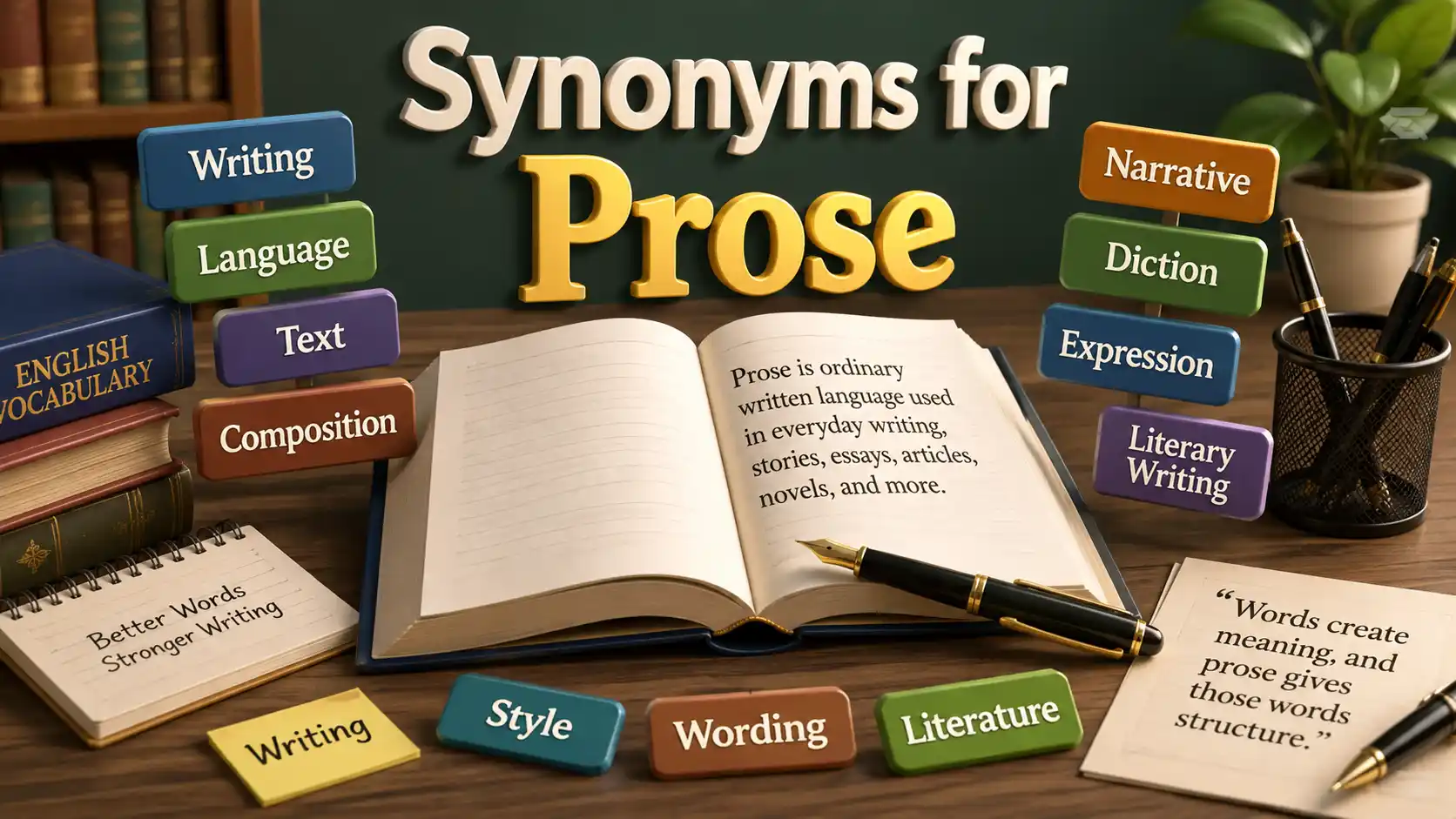
Finding the right synonyms for prose can make your writing clearer, more precise, and more engaging. Prose refers to ordinary written or spoken language, especially the kind used in novels, essays, articles, stories, and everyday writing.
Depending on the context, useful alternatives include writing, language, text, composition, narrative, diction, expression, and literary writing. In this guide, you’ll discover the best synonyms for prose, their simple meanings, and practical examples. Whether you’re a student, teacher, writer, blogger, or English learner, these alternatives will help you choose the right word for your sentence and improve your vocabulary.
📖 Meaning of Prose
Prose is language written or spoken in its normal form rather than in the structured form of poetry. It is the kind of language we usually see in novels, essays, articles, stories, reports, emails, and everyday writing.
Cambridge Dictionary defines prose as written language in its ordinary form rather than poetry. Merriam-Webster also describes it as ordinary language used in speaking or writing and as a literary form distinguished from poetry.
Prose is usually a noun, but it can also be used as an adjective and verb in less common contexts.
Pronunciation
Prose: /proʊz/
It sounds like “prohz”, not “pro-see.”
Simple Example
The author is known for her clear and beautiful prose.
Here, prose means the author’s style of written language.
The word has a long history. Merriam-Webster traces it through Middle English and Anglo-French to the Latin prosa, connected with the idea of straightforward or direct expression.
Where Is Prose Used?
You may see the word in:
- Novels
- Short stories
- Essays
- Articles
- Academic writing
- Business writing
- Biographies
- Speeches
- Reports
- Creative writing
- Nonfiction
- Literary criticism
📝 Top Synonyms for Prose
Not every word related to prose is a direct synonym. Some words describe the writing itself, while others refer to its style, language, structure, or type. Choosing the right alternative depends on what you mean by prose in your sentence.
Direct and Close Alternatives to Prose
These words are the most useful alternatives when you are talking about written language or writing in general.
| Word | Meaning | Best Use | Example |
|---|---|---|---|
| Writing | Words expressed in written form | General | Her writing is clear and engaging. |
| Language | Words used to communicate ideas | General | The author’s language is simple. |
| Written language | Language expressed in written form | Educational | Written language can be formal or informal. |
| Written work | Something produced through writing | General | The student submitted a written work. |
| Text | Written material | Academic/Digital | The text contains useful examples. |
| Composition | A piece of writing created for a purpose | Academic | Her composition was well organized. |
| Expression | A way of communicating an idea or feeling | General | His expression is clear and direct. |
| Wording | The particular words used to express something | Editing | The wording could be clearer. |
| Diction | A writer’s choice and use of words | Literary | The author’s diction is formal. |
| Phraseology | The way words and phrases are arranged or expressed | Formal | The phraseology sounds technical. |
| Style | A particular way of writing | Literary | Her writing style is distinctive. |
| Voice | A writer’s recognizable way of expressing ideas | Creative | The writer has a strong voice. |
Literary and Storytelling Terms
These aren’t exact synonyms for prose, but they’re closely connected with prose and can work as alternatives in specific contexts.
| Word | Meaning | Best Use | Example |
|---|---|---|---|
| Narrative | A story or account of connected events | Storytelling | The narrative follows a young writer. |
| Narration | The act or method of telling a story | Storytelling | The narration moves smoothly. |
| Story | An account of real or imagined events | General | The story was easy to follow. |
| Literary writing | Writing with a literary or artistic purpose | Literature | She enjoys literary writing. |
| Creative writing | Imaginative writing such as stories and poems | Education | Creative writing encourages imagination. |
| Fiction | Writing that presents invented events or characters | Literature | The novel is a work of fiction. |
| Nonfiction | Writing based mainly on real people, facts, or events | Informational | The book is nonfiction. |
| Literature | Written works valued for artistic or intellectual qualities | Literary | He studies English literature. |
| Description | Writing that explains what something looks, feels, or seems like | Creative | The description creates a vivid image. |
| Exposition | Writing or speech that explains an idea or subject | Academic | The exposition explains the theory clearly. |
Words Related to Prose Style
These terms are especially useful when you’re discussing how prose sounds or how an author writes.
| Word | Meaning | Best Use | Example |
|---|---|---|---|
| Prose style | The particular way an author writes prose | Literary | Her prose style is simple and elegant. |
| Word choice | The selection of particular words | Writing/Editing | Strong word choice improves the passage. |
| Expression | The way an idea is communicated | General | The expression feels natural. |
| Diction | Specific choice and use of words | Literary | The writer uses formal diction. |
| Wording | The exact language used | Editing | The wording needs improvement. |
| Tone | The attitude or feeling conveyed by writing | Writing | The tone is friendly and positive. |
| Voice | The distinctive character of a writer’s expression | Creative | Her voice is easy to recognize. |
| Rhetoric | Language designed to influence, persuade, or impress | Persuasive | The speech uses strong rhetoric. |
| Verbiage | Words used to express something, often with a suggestion of excess | Formal/Critical | The report contains unnecessary verbiage. |
| Parlance | Language commonly used by a particular group | Professional | In legal parlance, the term has a special meaning. |
Types and Forms of Prose Writing
The following words are forms or examples of prose, rather than synonyms for the word itself.
| Term | What It Means | Example |
|---|---|---|
| Essay | A short piece of writing about a particular subject | She wrote an essay about education. |
| Article | A piece of writing published in a newspaper, magazine, or website | I read an article about language. |
| Report | A structured account of information or findings | The team prepared a report. |
| Novel | A long fictional work | The novel is written in prose. |
| Short story | A brief work of fiction | He published a short story. |
| Manuscript | An author’s original or unpublished written work | The author submitted the manuscript. |
| Treatise | A formal, detailed written discussion of a subject | The scholar wrote a treatise on grammar. |
| Passage | A section of a written work | Read the passage carefully. |
| Paragraph | A group of sentences forming a section of writing | The paragraph explains the main point. |
| Script | Written material prepared for a performance | The actor studied the script. |
Words That Contrast With Prose
Poetry and verse are better described as contrasts to prose rather than synonyms.
| Word | Meaning | Example |
|---|---|---|
| Poetry | Literary writing that often uses lines, rhythm, imagery, or other poetic features | She enjoys poetry and prose. |
| Verse | Writing arranged in lines, especially poetry | The story was written in verse. |
| Poem | An individual work of poetry | He wrote a short poem. |
| Poetic language | Language with qualities associated with poetry | The passage uses poetic language. |
Quick Guide: Which Word Should You Use?
If you want to replace prose, choose a word based on your meaning:
- Writing — when you mean written work in general
- Language — when focusing on the words used
- Text — when referring to written material
- Composition — when referring to a completed piece of writing
- Diction — when discussing word choice
- Wording — when discussing the exact words used
- Style — when discussing the way someone writes
- Voice — when discussing a writer’s unique expression
- Narrative — when focusing on storytelling
- Literary writing — when discussing artistic writing
- Fiction — when referring to invented stories
- Nonfiction — when referring to fact-based writing
- Passage — when referring to part of a written work
Important: Not All Related Words Are True Synonyms
It’s important not to treat every related writing term as a direct synonym for prose.
For example:
The novel is written in prose.
Here, novel cannot simply replace prose. A novel is a type of literary work, while prose describes the form of language used to write it.
Similarly:
The author’s diction is formal.
Here, diction refers specifically to word choice, not to prose as a whole.
And:
The passage is written in clear prose.
Here, passage means a section of text, not a synonym for prose.
This distinction helps you choose words accurately and makes your writing sound more natural and professional.
⚖️ Antonyms of Prose
The strongest contrast to prose is usually poetry or verse, although the exact opposite depends on the meaning being discussed.
| Word | Meaning | Example |
| Poetry | Literary writing often organized through rhythm, lines, and other poetic features | She enjoys poetry more than prose. |
| Verse | Writing arranged in lines with poetic form or rhythm | The story was written in verse. |
| Poem | A specific work of poetry | He wrote a short poem. |
| Poetic language | Language with qualities associated with poetry | The description uses poetic language. |
| Rhythmic writing | Writing with a noticeable rhythm | The passage has a rhythmic quality. |
| Lyric | A short poetic work expressing feelings or thoughts | The lyrics express deep sadness. |
| Rhyming verse | Verse that uses rhyme | The children performed a rhyming verse. |
However, poetry is not simply the “opposite” of every meaning of prose. Prose and poetry are mainly different literary forms. Merriam-Webster’s thesaurus lists poetic, poetical, lyrical, rhythmic, and related terms as dissimilar words to prose in its adjective sense.
💬 Example Sentences With Prose
Here are 20 natural examples showing how prose works in different contexts.
- The author’s prose is clear and easy to follow.
- I prefer the novel’s prose to its movie adaptation.
- Her prose creates a strong sense of place.
- The book is written in simple prose.
- His prose style is formal but readable.
- The writer uses short sentences in his prose.
- The student’s prose became stronger after editing.
- Good prose doesn’t need complicated words.
- The novel contains beautiful descriptive prose.
- The professor asked students to analyze the author’s prose.
- Her academic prose is precise and organized.
- The journalist writes direct, factual prose.
- The report uses professional prose throughout.
- The email would be stronger with clearer prose.
- The novelist’s prose gives the characters a distinct voice.
- The editor removed unnecessary words from the prose.
- His prose sounds natural and conversational.
- The translation preserves much of the original prose.
- The writer combines simple prose with vivid descriptions.
- Readers often praise the author’s smooth prose.
Prose in Different Contexts
Academic:
The essay uses clear academic prose to explain the theory.
Business:
The report should use concise and professional prose.
Creative:
The author’s prose makes the forest feel alive.
Conversation:
I really like the prose in this book.
Marketing:
The landing page needs stronger, clearer prose.
📚 Difference Between Similar Words
Several words can look like synonyms for prose, but they don’t always mean the same thing.
| Word | How It Differs From Prose | Example |
| Writing | A broad term for anything written | Her writing is excellent. |
| Poetry | A literary form different from ordinary prose | He writes poetry. |
| Verse | Usually refers to lines arranged in poetic form | The tale was told in verse. |
| Diction | Focuses on word choice | His diction is formal. |
| Style | Covers the overall way someone writes | Her style is friendly. |
| Narrative | Focuses on telling a story | The narrative is easy to follow. |
| Text | Refers broadly to written material | Read the text carefully. |
| Composition | A created piece of writing | Submit your composition tomorrow. |
| Literature | A broad field or body of written works | She studies literature. |
| Language | The words and system used to communicate | The language is simple. |
Prose vs. Writing
Prose is a type or form of language, while writing is a much broader term.
The novel is written in prose.
Her writing has improved.
The first sentence refers to literary form. The second refers more generally to the person’s written work or ability.
Prose vs. Poetry
This is one of the most important distinctions.
Prose normally follows ordinary sentence and paragraph structure. Poetry often uses lines, rhythm, sound patterns, imagery, and other poetic techniques.
The story was written in prose.
The same story was later adapted into verse.
🎯 Best Alternative Words for Different Situations
The best synonym isn’t always the fanciest word. Choose one that matches your purpose.
| Situation | Best Alternative | Why |
| General writing | Writing | Simple and natural |
| Academic work | Academic writing | Clear and specific |
| Literary discussion | Prose style | Focuses on writing style |
| Word choice | Diction | More precise |
| Storytelling | Narrative | Highlights the story |
| Web content | Content | Common digital term |
| Formal document | Written work | Neutral and professional |
| Creative work | Creative writing | Highlights imagination |
| Business | Professional writing | Fits workplace communication |
| Description | Language | Focuses on expression |
| Author’s style | Voice | Shows personal identity |
| Word selection | Wording | Useful for editing |
| Persuasion | Rhetoric | Focuses on persuasive language |
Best Synonyms for Professional Writing
For business and professional writing, use:
- Writing
- Professional writing
- Language
- Wording
- Expression
- Communication
- Written communication
- Text
Avoid replacing prose with highly literary words when you’re writing for a general audience. Simple words are often clearer.
✍ Grammar Tips for Prose
Is Prose Countable?
In its main literary sense, prose is generally an uncountable noun.
Correct:
The author’s prose is beautiful.
Less natural:
The author’s prose is beautiful.
When talking about separate pieces, use phrases such as:
- pieces of prose
- passages of prose
- works of prose
- examples of prose
- prose works
Related Word Forms
| Word | Part of Speech | Meaning |
| prose | Noun | Ordinary written or spoken language |
| prose | Adjective | Related to prose |
| prose | Verb | To write or speak in prose |
| prosaic | Adjective | Ordinary, or sometimes dull |
| prosy/prose-like | Adjective | Resembling prose or lacking poetic quality |
Merriam-Webster records prose as a noun, adjective, and verb. As a verb, prosed and prosing are the forms used.
Common Word Combinations
Some useful collocations include:
- academic prose
- literary prose
- clear prose
- simple prose
- elegant prose
- descriptive prose
- formal prose
- narrative prose
- prose style
- prose writing
- prose fiction
- prose passage
Cambridge specifically gives academic prose, prose fiction, and prose style among common collocations.
❌ Common Mistakes With Prose
| Wrong or Weak Usage | Better Usage | Reason |
| Her prose is beautiful. | Her prose is beautiful. | Prose is normally uncountable. |
| Prose means poetry. | Prose differs from poetry. | They are different literary forms. |
| His prose is a poem. | His prose is written in ordinary form. | Prose and poetry have different forms. |
| I like this prose writing style language. | I like this author’s prose style. | The shorter phrase is clearer. |
| The poem is prose. | The passage is prose. | A poem is normally poetry. |
| Use “diction” for every use of prose. | Use “diction” when discussing word choice. | Diction has a narrower meaning. |
A Key Tip
Don’t replace prose just because a thesaurus lists a word. Check what you actually mean.
If you’re talking about:
- the whole written work → writing
- word choice → diction
- a story → narrative
- a section of writing → passage
- a general written message → text
- artistic written works → literature
- poetic form → verse or poetry
This gives your writing much more precision.
💡 Pro Writing Tips
Professional writers don’t choose synonyms only to avoid repetition. They choose words that make the meaning clearer and more exact.
1. Think about the context
Ask yourself what you mean by prose.
Are you talking about:
- the writer’s style?
- the actual text?
- the story?
- the word choice?
- the literary form?
Your answer determines the best alternative.
2. Don’t choose a difficult word just to sound smart
For example:
The author’s diction is excellent.
This is useful when you specifically mean word choice.
But:
The author’s prose is excellent.
This can refer more broadly to the quality and character of the writing.
3. Use precise words
Instead of repeatedly writing prose, try:
The author’s prose is simple. The writing is easy to understand, and the diction is carefully chosen.
Each word now adds a slightly different idea.
4. Read the sentence aloud
If a synonym sounds strange when you read it aloud, it may not fit the context.
Natural writing usually sounds clear, direct, and purposeful.
5. Check a trusted dictionary
When you’re unsure whether two words are true synonyms, compare their definitions and examples in a reliable dictionary or thesaurus.
📖 Related Words to Prose
Here are useful words connected with prose, writing, and literary language:
Writing Terms
- Writing
- Text
- Composition
- Manuscript
- Paragraph
- Passage
- Article
- Essay
- Report
- Document
Literary Terms
- Literature
- Fiction
- Nonfiction
- Narrative
- Story
- Novel
- Short story
- Description
- Exposition
- Characterization
Language Terms
- Language
- Vocabulary
- Wording
- Diction
- Expression
- Phraseology
- Rhetoric
- Parlance
- Idiom
- Voice
Style Terms
- Writing style
- Prose style
- Literary style
- Narrative style
- Tone
- Voice
- Expression
- Word choice
- Sentence structure
- Clarity
These related words are useful for students, teachers, writers, editors, bloggers, and content creators who want to describe writing more precisely.
❓ Frequently Asked Questions
What is the best synonym for prose?
The best general synonym for prose is writing or written language. However, the correct alternative depends on context. Use diction when you mean word choice, narrative when you mean storytelling, and text when referring to written material. There is no single replacement that works perfectly in every sentence.
What is another word for prose writing?
Another word for prose writing is simply writing, although literary writing, written language, composition, and narrative may work in specific contexts. Prose writing normally refers to ordinary written language arranged in sentences and paragraphs rather than the structured lines commonly associated with poetry.
What is the opposite of prose?
The most common contrast to prose is poetry or verse. Prose normally uses ordinary sentence and paragraph structures, while poetry often uses lines, rhythm, sound patterns, and other poetic features. However, prose and poetry are better understood as different literary forms rather than perfect opposites.
Is writing a synonym for prose?
Writing can be a close alternative to prose, but it is broader. Writing includes prose, poetry, scripts, lists, notes, and many other forms. Prose specifically refers to ordinary language that is not written in poetic form. Therefore, “writing” works in general contexts but may lose some precision.
What is a synonym for prose in literature?
In literary contexts, useful alternatives include literary writing, narrative, written language, composition, text, and prose style. However, each term has a slightly different meaning. For example, narrative focuses on storytelling, while prose style focuses on how an author uses language, sentences, rhythm, and structure.
What is the synonym of prose in an essay?
Depending on the sentence, useful alternatives include writing, composition, text, academic writing, and language. If you are describing the writer’s choice of words, diction is more accurate. If you’re describing the whole essay, writing or composition may be the better choice.
What are examples of prose?
Common examples of prose include novels, short stories, essays, articles, reports, biographies, letters, speeches, and ordinary written communication. Prose generally follows normal sentence and paragraph structure instead of the line-based structure often used in poetry. Both fiction and nonfiction can be written in prose.
What is the difference between prose and poetry?
Prose is ordinary written or spoken language arranged in a natural sentence structure. Poetry is a literary form that may use lines, rhythm, meter, rhyme, repetition, and concentrated imagery. Some modern poetry can look similar to prose, so the difference is sometimes based on form, convention, and artistic purpose.
📝 Conclusion
Finding a synonym for prose isn’t simply about replacing one word with another. The best choice depends on what you mean.
Use writing for a broad meaning, diction for word choice, narrative for storytelling, text for written material, composition for a piece of writing, and style or voice when discussing how an author writes.