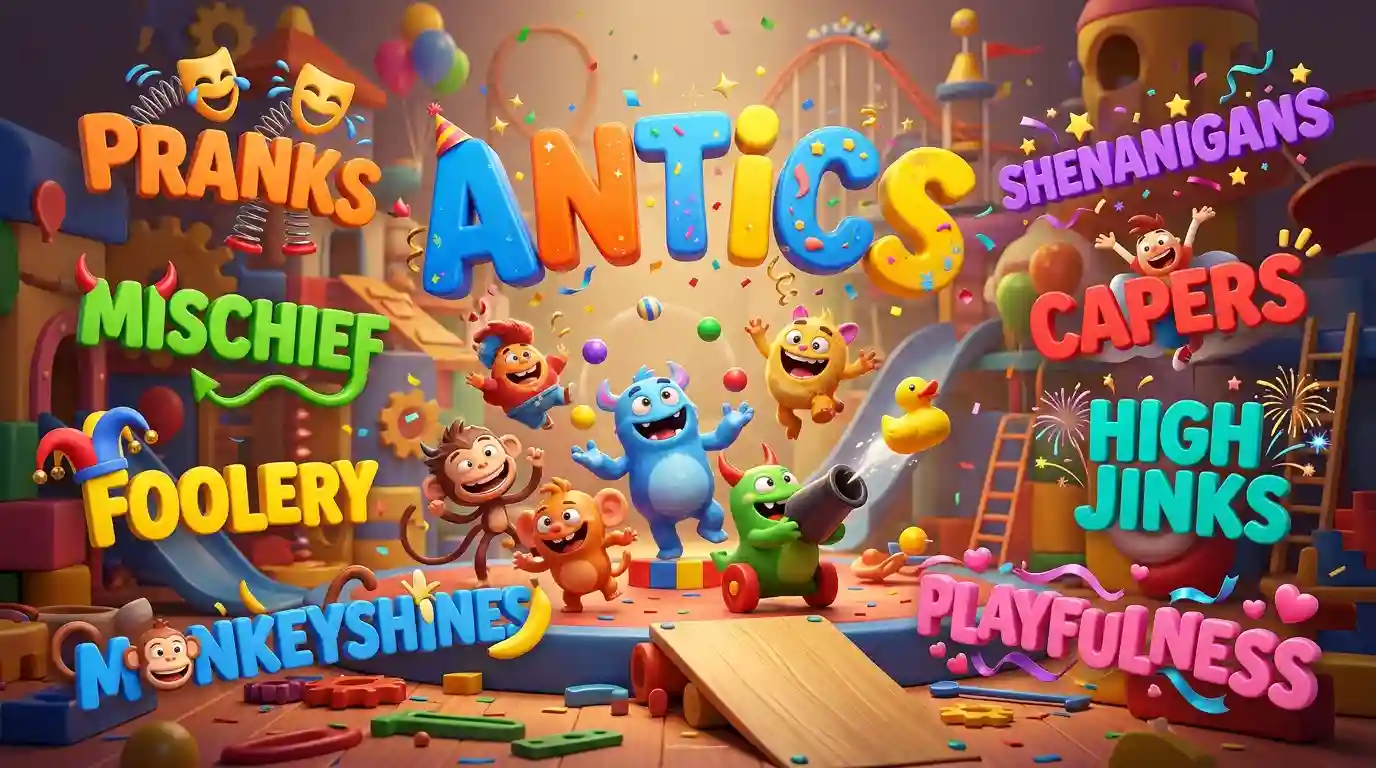
Finding the right words to describe funny, playful, or unusual behavior can make your writing more lively and precise. Antics refers to silly, amusing, or sometimes troublesome actions, but it isn’t always the best word for every situation. Depending on the context, you might use words like pranks, mischief, capers, tricks, shenanigans, or horseplay.
In this guide to synonyms for antics, you’ll learn the meanings, differences, examples, and best uses of useful alternatives. Whether you’re a student, writer, teacher, or English learner, these words can help you express ideas naturally and choose the right term with confidence.
📖 What Does Antics Mean?
Antics is a plural noun used for funny, silly, playful, strange, or sometimes troublesome actions. It often describes behavior that attracts attention or makes people laugh.
Simple meaning:
Antics = unusual or amusing actions or behavior
Quick Facts
| Feature | Details |
| Word | Antics |
| Part of Speech | Plural noun |
| Singular Form | Antic |
| Pronunciation | AN-tiks |
| Basic Meaning | Funny, silly, playful, or unusual behavior |
| Common Contexts | People, children, animals, comedy, stories |
| Tone | Usually informal or expressive |
Simple Examples
- The puppy’s antics made everyone laugh.
- His strange antics surprised the audience.
- We enjoyed watching the children’s antics.
The meaning changes slightly with context. Antics can describe harmless fun, but it can also suggest annoying or foolish behavior.
📝 Top Synonyms for Antics
There isn’t one perfect replacement for antics. Each synonym adds a slightly different meaning or tone.
| Synonym | Simple Meaning | Best Context | Example |
| Pranks | Tricks played for fun | Practical jokes | The students played harmless pranks. |
| Mischief | Playful trouble | Children or pets | The puppy was always getting into mischief. |
| Capers | Playful or unusual adventures | Stories | Their weekend capers became a funny story. |
| Escapades | Exciting unusual experiences | Travel or stories | Their holiday escapades were memorable. |
| Shenanigans | Silly or questionable actions | Informal speech | We don’t need any more shenanigans. |
| Horseplay | Rough physical play | Children or groups | The teacher stopped the horseplay. |
| Tomfoolery | Foolish behavior | Humorous writing | The movie is full of tomfoolery. |
| Frolics | Energetic playful activity | People or animals | The puppies’ frolics were adorable. |
| Larks | Fun activities or adventures | Casual English | They went out for a lark. |
| Buffoonery | Ridiculous comic behavior | Humor or criticism | His buffoonery entertained the crowd. |
| Silliness | Lack of seriousness | General use | Her silliness made everyone smile. |
| Playfulness | A cheerful desire to play | Positive contexts | The child’s playfulness was charming. |
Quick choice guide
- Funny tricks → pranks
- Minor trouble → mischief
- Fun adventures → escapades
- Casual questionable behavior → shenanigans
- Rough play → horseplay
- Foolish comic behavior → tomfoolery
- Positive playful behavior → playfulness
🔴 Antics Negative Synonyms
When antics has a negative meaning, choose a word that clearly shows why the behavior is unwanted or inappropriate.
| Word | Meaning | Strength | Example |
| Misbehavior | Behavior that breaks rules | Clear negative | The teacher addressed his misbehavior. |
| Foolishness | Lack of good judgment | Mild–moderate | His foolishness caused problems. |
| Nonsense | Foolish or unreasonable behavior | Moderate | We have no time for this nonsense. |
| Disruption | Behavior that interrupts something | Formal | The disruption delayed the meeting. |
| Impropriety | Improper or unacceptable conduct | Formal | The report mentioned an impropriety. |
| Indiscipline | Lack of control or discipline | Formal | The coach criticized the team’s indiscipline. |
| Irresponsibility | Failure to act responsibly | Strong | His irresponsibility affected the project. |
| Inappropriate behavior | Conduct unsuitable for the situation | Formal/neutral | The school investigated the inappropriate behavior. |
Which one fits best?
Misbehavior works well for rule-breaking.
Disruption fits behavior that interrupts others.
Impropriety is useful in formal writing.
Foolishness focuses on poor judgment.
Don’t automatically replace antics with a negative synonym. If the behavior is harmless and funny, a positive or neutral word may be more accurate.
👤 Synonyms for Antics Person
Antics describe actions, not a person. So instead of saying “antics person,” use a noun that describes someone who behaves in a playful, funny, mischievous, or troublesome way.
| Word for a Person | Meaning | Tone | Example |
| Prankster | Someone who plays practical jokes | Playful | My brother is a natural prankster. |
| Mischief-maker | Someone who causes playful trouble | Playful | The child is a little mischief-maker. |
| Joker | Someone who enjoys making jokes | Casual | He’s always been the office joker. |
| Rascal | A playful, mischievous person | Affectionate | That little rascal hid my shoes. |
| Scamp | A mischievous but often likable person | Affectionate | The young scamp kept everyone laughing. |
| Goofball | A silly or eccentric person | Casual | He’s a lovable goofball. |
| Jester | A person who entertains with jokes | Literary | The jester entertained the royal court. |
| Buffoon | A foolish or ridiculous person | Negative | The character behaves like a buffoon. |
| Troublemaker | Someone who causes problems | Negative | The school identified him as a troublemaker. |
| Comedian | Someone who performs comedy | Neutral/positive | The comedian entertained the audience. |
Best choice
- Playful joker → prankster
- Mischievous child → rascal / scamp
- Funny casual person → goofball / joker
- Professional entertainer → comedian
- Person who causes problems → troublemaker
- Foolish person → buffoon
😄 Synonyms for Antics Slang
For casual speech, texting, social media, and humorous conversations, informal expressions can make the sentence sound more natural.
| Slang / Informal Expression | Meaning | Example |
| Goofing around | Acting silly instead of being serious | Stop goofing around and study. |
| Messing around | Playing or wasting time | We were just messing around. |
| Fooling around | Behaving playfully or wasting time | They were fooling around outside. |
| Monkeying around | Acting foolishly | The kids were monkeying around. |
| Clowning around | Acting silly for fun | He was clowning around during lunch. |
| Getting up to mischief | Doing playful or troublesome things | The children were getting up to mischief. |
| High jinks | Lively and playful activity | The party was full of high jinks. |
| Tomfoolery | Silly or foolish behavior | Enough with the tomfoolery! |
| Shenanigans | Silly or questionable activity | What are these shenanigans? |
| Fooling about | Playing or wasting time | They were fooling about in the garden. |
⚖️ Antonyms and Contrasting Words for Antics
Because antics can mean different types of behavior, it doesn’t have one exact antonym. These words express opposite qualities.
| Word | Meaning | Example |
| Seriousness | A serious attitude | Her seriousness changed the mood. |
| Composure | Calm self-control | He maintained his composure. |
| Restraint | Controlled behavior | She showed remarkable restraint. |
| Discipline | Controlled and orderly behavior | The team showed discipline. |
| Decorum | Proper social behavior | The ceremony required decorum. |
| Dignity | Calm and respectable behavior | She handled the criticism with dignity. |
| Maturity | Responsible behavior | He responded with maturity. |
| Sobriety | Serious and controlled behavior | The occasion called for sobriety. |
| Orderliness | Organized and controlled conduct | The classroom was known for its orderliness. |
| Self-control | Ability to control one’s actions | He showed excellent self-control. |
💬 Example Sentences With Antics and Its Synonyms
Everyday English
- The baby’s antics made everyone smile.
- We watched the dog’s funny behavior.
- His latest prank surprised his friends.
- The children were full of mischief.
- Their playful capers kept us entertained.
Academic English
- The author’s use of comic behavior adds humor to the novel.
- The character’s foolish actions reveal his immaturity.
- The children’s behavior provides comic relief in the story.
- The poem presents playful actions through its main character.
Business English
- The manager asked employees to avoid disruptive behavior.
- The executive’s unusual actions attracted attention.
- Professional settings require appropriate conduct.
- The company investigated the employee’s inappropriate behavior.
Formal Writing
- His unusual behavior disrupted the ceremony.
- The character’s buffoonery creates comic relief.
- The report describes repeated incidents of misbehavior.
- Her conduct was unsuitable for the formal event.
Creative Writing
- The monkey’s antics delighted the visitors.
- Their escapades became legendary in the village.
- The little rascal caused laughter wherever he went.
- The hero’s comic behavior added warmth to the story.
📚 Difference Between Antics and Similar Words
| Word | What It Mainly Means | Key Difference |
| Antics | Funny or unusual behavior | Broad term |
| Prank | A trick played on someone | Usually involves another person |
| Mischief | Playful trouble | Suggests minor wrongdoing |
| Escapade | Unusual adventure | Focuses on an experience |
| Shenanigans | Silly or questionable actions | More informal |
| Horseplay | Rough physical play | Focuses on physical activity |
| Buffoonery | Ridiculous behavior | Strong comic meaning |
| Stunt | Attention-grabbing action | Often planned for effect |
| Frolic | Playful energetic activity | More positive |
| Foolishness | Unwise behavior | Focuses on poor judgment |
A simple way to remember
Antics = broad funny or unusual actions
Prank = a trick
Mischief = minor trouble
Escapade = an adventure
Horseplay = rough play
Buffoonery = ridiculous behavior
🎯 Best Alternatives to Antics for Different Contexts
The most useful synonym depends on your audience and purpose.
| Situation | Recommended Word | Why |
| Children’s playful behavior | Mischief | Natural and familiar |
| Practical jokes | Pranks | Very specific |
| Travel stories | Escapades | Highlights adventure |
| Casual conversation | Shenanigans | Friendly and informal |
| Physical play | Horseplay | More precise |
| Comedy | Buffoonery | Strong comic effect |
| Positive behavior | Playfulness | Warm and positive |
| Formal report | Behavior | Neutral |
| Workplace problem | Conduct | Professional |
| Academic writing | Actions | Simple and objective |
| Creative story | Capers | Adds a playful style |
| Animal activity | Frolics | Energetic and positive |
Professional writing tip
If you’re writing a business email or report, antics can sound judgmental. A neutral word such as behavior or conduct is often safer.
✍️ Grammar Tips for Antics
Word forms
| Form | Word | Example |
| Singular noun | antic | His latest antic was funny. |
| Plural noun | antics | His antics were funny. |
| Adjective | antic | The character made an antic gesture. |
| Related adjective | antic | The actor used antic movements. |
In normal modern English, antics is much more common when referring to a collection of funny or unusual actions.
Verb agreement
Because antics is plural, use a plural verb:
✅ His antics are amusing.
❌ His antics is amusing.
With singular antic:
✅ His latest antic is amusing.
Possessive examples
- The child’s antics were funny.
- The dog’s antics entertained us.
- The comedian’s antics surprised the audience.
❌ Common Mistakes With Antics
| Wrong | Correct | Reason |
| His antics are funny. | His antics are funny. | Antics is plural. |
| He did an antics. | He performed an antic. | Singular form is antic. |
| Her antics were annoying. | Her antics were annoying. | Use a plural verb. |
| He is an antics person. | He is a prankster. | Antics doesn’t describe a person directly. |
| Antics always means bad behavior. | Antics can be funny, playful, strange, or troublesome. | Context controls the tone. |
| Pranks and antics are identical. | Pranks and antics overlap but aren’t identical. | A prank is usually a specific trick. |
| Use shenanigans in a formal report. | Use behavior or conduct. | Shenanigans are informal. |
| Every synonym can replace antics. | Choose the word that matches the exact context. | Synonyms often have different shades of meaning. |
💡 Pro Writing Tips for Choosing the Right Word
A strong writer doesn’t choose a synonym simply because it looks similar in a thesaurus. The better approach is to ask what the action actually means.
Ask these five questions:
- Is the behavior funny? → Try antics or silliness.
- Is it a practical joke? → Use pranks.
- Does it cause minor trouble? → Use mischief.
- Is it an exciting adventure? → Use escapade.
- Is the behavior inappropriate? → Use misbehavior or inappropriate behavior.
Match the tone
A children’s story may benefit from rascal, capers, or mischief.
A business report should normally use behavior, conduct, or actions.
A humorous story can use stronger colorful words such as tomfoolery or buffoonery.
Don’t force unusual words
Words such as didoes or rogueries may be useful in literary writing, but they aren’t natural choices for most everyday sentences. A simple word that sounds natural is often better than a rare synonym.
📖 Related Words to Antics
These words belong to the same general vocabulary area but don’t all mean exactly the same thing.
| Related Word | Meaning |
| Behavior | The way someone acts |
| Conduct | Behavior, especially in formal contexts |
| Action | Something someone does |
| Activity | Something a person or group does |
| Mischief | Playful or troublesome behavior |
| Playfulness | A tendency to play or joke |
| Silliness | Lack of seriousness |
| Prank | A trick played for amusement |
| Joke | Something intended to amuse |
| Trick | An action designed to fool or surprise |
| Comedy | Entertainment designed to create humor |
| Clowning | Silly behavior for amusement |
| Foolishness | Lack of good judgment |
| Disruption | An action that interrupts normal activity |
| Decorum | Proper behavior |
| Restraint | Controlled behavior |
| Mischievous | Playfully causing trouble |
| Playful | Fun-loving and not serious |
| Foolish | Lacking good sense |
| Humorous | Amusing or funny |
❓ Frequently Asked Questions
What is the best synonym for antics?
The best synonym for antics depends on context. Pranks work for practical jokes, mischief for playful trouble, escapades for unusual adventures, and horseplay for rough physical play. If you need a neutral word for formal writing, behavior or actions may be better choices.
What are negative synonyms for antics?
Negative alternatives include misbehavior, foolishness, nonsense, disruption, impropriety, indiscipline, and inappropriate behavior. The right choice depends on the problem. Use misbehavior for rule-breaking, disruption for behavior that interrupts others, and impropriety when describing unacceptable conduct in a formal context.
What do you call a person who is always doing antics?
A person who often behaves playfully or mischievously may be called a prankster, joker, mischief-maker, rascal, scamp, or goofball. The best term depends on the person’s behavior and tone. For someone who causes serious problems, a troublemaker is more appropriate.
What is a slang word for antics?
Common informal alternatives include shenanigans, goofing around, messing around, fooling around, monkeying around, clowning around, and high jinks. These expressions are suitable for casual conversations, texts, and humorous writing. They may sound too informal for academic essays or professional reports.
Is antics a positive or negative word?
Antics can be positive, neutral, or negative. It may describe amusing behavior, such as a puppy playing, or annoying behavior, such as someone disrupting a meeting. The surrounding words and situation tell readers whether the speaker finds the behavior entertaining, harmless, foolish, or troublesome.
What is the difference between antics and pranks?
Antics is a broad term for funny, silly, unusual, or playful actions. A prank is usually a specific trick intended to surprise or amuse another person. Therefore, a prank can be an antic, but not every antic is a prank.
What is the singular form of antics?
The singular form of antics is antic. For example, “His latest antic made everyone laugh.” However, antics are much more common when talking about a person’s collection of funny, strange, or playful actions, such as “Her antics entertained the audience.”
Can antics be used for animals?
Yes. Antics is commonly used for amusing or unusual animal behavior. You can describe a puppy’s jumping, a monkey’s playful actions, or a cat’s strange behavior as antics. The word works especially well when the animal’s actions are entertaining or unexpected.
🎯 Conclusion
Antics is a flexible word for funny, silly, playful, strange, or sometimes troublesome behavior. Depending on the context, you can replace it with words such as pranks, mischief, tricks, capers, escapades, shenanigans, horseplay, tomfoolery, frolics, or buffoonery.
The key is to choose a synonym based on the exact meaning you want. Use pranks for playful tricks, mischief for minor trouble, escapades for unusual adventures, and horseplay for rough physical play. In formal writing, neutral words such as behavior and conduct may be better choices.