Finding the right synonym for manor isn’t always as simple as replacing one word with another. A manor can mean a large country house, the main residence on an estate, or historically, a landed estate linked to a lord. In British informal English, it can even mean an area where someone works or has responsibility.
That means words such as mansion, estate, hall, residence, villa, and country house may work in some sentences but not all. In this guide, you’ll learn the most useful alternatives, what each word really means, and when to use it. You’ll also find examples, antonyms, grammar tips, and common mistakes.
📖 Meaning of Manor
Manor is a noun.
Simple definition
A manor is usually a large country house with the land around it. The word can also refer to the estate or historical territorial unit connected with such a house.
Pronunciation:
- British English: /ˈmæn.ə(r)/
- American English: /ˈmæn.ɚ/
The word comes from Middle English and Anglo-Norman/French forms related to the idea of a dwelling or place to live, ultimately connected with Latin manēre, meaning “to remain.”
Common meanings of manor
| Meaning | Simple explanation | Example |
| Large country house | A large, usually old house in the countryside | They restored the old manor. |
| Estate | A large property and its surrounding land | The manor included several farms. |
| Historical lordship | A medieval territorial unit associated with a lord | The lord controlled the manor. |
| Area of responsibility | British informal usage for someone’s working area | That’s not my manor. |
The modern everyday meaning most readers recognize is the large country house or estate sense. Cambridge and Oxford both identify the country-house meaning as a major modern use.
📝 Top Synonyms for Manor
Not every word below is a perfect one-word replacement for manor. The first group contains the closest alternatives. The later groups are useful contextual alternatives.
Closest synonyms
| Word | Meaning | Best Use | Example |
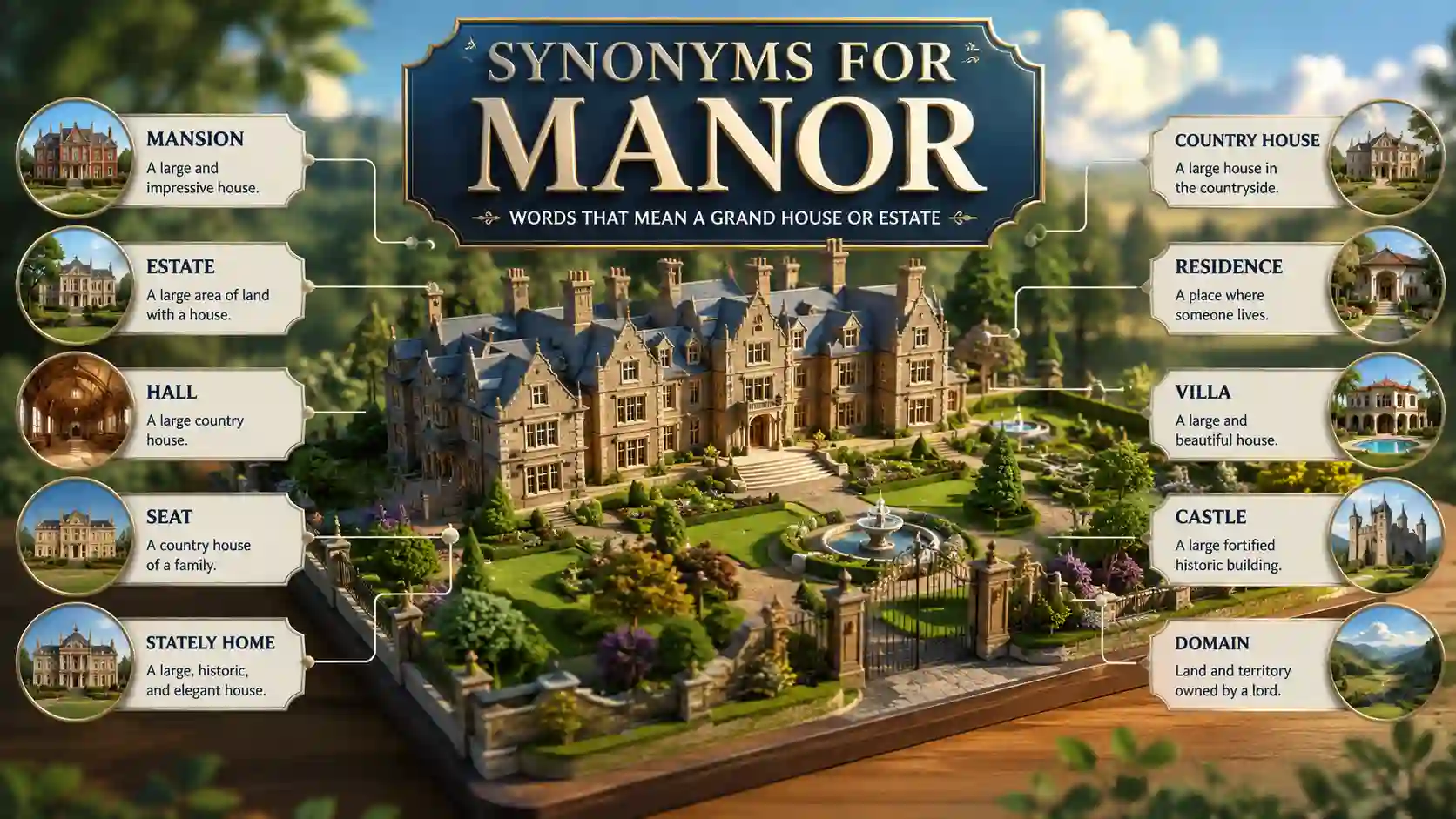
| Manor house | A large country house connected with an estate | Historical or British writing | The manor house stood beside the lake. |
| Mansion | A very large and impressive house | General writing | They bought an old mansion. |
| Estate | A large area of land, often with a house | Property or historical context | The estate covered hundreds of acres. |
| Hall | A large country house, especially in British usage | British/historical writing | The family lived in the old hall. |
| Seat | A country house belonging to a family, especially an aristocratic family | Formal or historical writing | The castle was their ancestral seat. |
| Country house | A large house in the countryside | General and British English | They visited a beautiful country house. |
| Stately home | A large, impressive historic country house | British English | The stately home attracts visitors. |
| Residence | A place where someone lives | Formal writing | The family residence was surrounded by gardens. |
| Villa | A large or elegant country or suburban house | Architecture/travel/property | The villa overlooked the valley. |
| Dwelling | A place where someone lives | Formal or academic writing | The old dwelling was carefully preserved. |
Historical and contextual alternatives
| Word | Meaning | Best Use | Example |
| Demesne | Land held by a lord for personal use | Medieval/history writing | The lord’s demesne surrounded the manor. |
| Domain | Land or territory controlled by a person or ruler | Historical/formal writing | The king expanded his domain. |
| Landed estate | A large area of privately owned land | Formal/property writing | She inherited a landed estate. |
| Homestead | A home and its surrounding property | Rural contexts | The homestead stood on the hill. |
| Property | Land or buildings owned by someone | General writing | The property included several fields. |
| Holdings | Land or property owned by a person or organization | Business/property writing | His holdings included several farms. |
| Grounds | Land surrounding a building | Descriptive writing | The manor grounds were beautifully maintained. |
| Lands | Areas of land owned or controlled by someone | Historical writing | The family protected its lands. |
| Territory | An area controlled or occupied by someone | Historical/general contexts | The lord ruled the territory. |
| Lordship | Authority or territory belonging to a lord | Medieval history | The lordship included several villages. |
Grand-house alternatives
These can describe a manor-like building, but they aren’t always exact synonyms.
| Word | Meaning | Best Use | Example |
| Castle | A fortified residence, usually associated with nobility | Medieval/fortified settings | The castle overlooked the village. |
| Château | A large French country house or castle | French architecture | They toured a beautiful château. |
| Palace | A grand residence, usually for royalty or a very powerful person | Royal/formal contexts | The palace had enormous gardens. |
| Hacienda | A large estate or plantation house, especially in Spanish-speaking regions | Cultural/historical contexts | The hacienda had extensive farmland. |
| Great house | A large principal house on an estate or plantation | Historical writing | The great house dominated the plantation. |
| Country residence | A person’s large home in the countryside | Formal writing | The family used it as a country residence. |
| Ancestral home | A home associated with a family’s earlier generations | Family/history writing | The ancestral home had been restored. |
| Ancestral seat | A family’s traditional main residence | Formal/historical writing | The estate remained their ancestral seat. |
| Grand house | An informal description of a large impressive home | General/creative writing | The grand house stood behind the trees. |
| Country residence | A residence located in the countryside | Formal/property writing | They moved to their country residence. |
Related words that are NOT exact synonyms
| Word | Why it is related | Example |
| Cottage | A country home, but normally much smaller | They rented a small cottage. |
| Farmhouse | A house connected with a farm | The farmhouse needed repairs. |
| Lodge | A smaller house connected with an estate or grounds | The hunting lodge was nearby. |
| Homestead | A home and land, often rural | Their homestead was peaceful. |
| Plantation | A large agricultural estate, not simply a manor | The plantation grew cotton. |
| Fortress | A strongly fortified place | The fortress protected the town. |
| Stronghold | A fortified or strongly defended place | The hill became a stronghold. |
| House | A general word for a building where people live | The house was built in 1800. |
| Residence | A general word for a place where someone lives | His residence was outside town. |
| Abode | A formal or literary word for home | The old abode was abandoned. |
This distinction matters. A castle is not automatically a manor, and a cottage is not normally a manor. A good synonym should match the meaning, size, setting, and tone of the original word.
⚖️ Antonyms of Manor
There isn’t one perfect opposite of manor because manor describes a type of property or residence rather than a quality with a simple opposite.
Still, some words can provide a useful contrast.
| Word | Meaning | Example |
| Hut | A very small, simple shelter | They lived in a small hut. |
| Shack | A roughly built small building | The shack stood near the river. |
| Hovel | A small, poor-quality home | The family lived in a tiny hovel. |
| Tent | A temporary fabric shelter | They slept in a tent. |
| Shelter | A place providing basic protection | The workers built a simple shelter. |
| Cabin | A small house, often in a rural area | We stayed in a wooden cabin. |
These are contrasting housing terms, rather than strict dictionary antonyms.
💬 Example Sentences With Manor
Here are natural examples showing how manor and its alternatives work in different situations.
Daily Conversation
- We drove past an old manor on our way home.
- Have you ever visited a manor house?
- That manor has beautiful gardens.
- The family still lives in the old estate.
- I saw a huge mansion near the village.
Academic English
- The manor played an important role in medieval rural life.
- Historians studied the relationship between the lord and the manor’s tenants.
- The estate changed ownership several times.
- The manor house reflects the architecture of its period.
- The property provides evidence of earlier settlement patterns.
Business and Property Writing
- The historic manor has been converted into a hotel.
- The estate includes several smaller buildings.
- The residence is surrounded by landscaped grounds.
- The property requires extensive restoration.
- The country house is now available for private events.
Formal Writing
- The manor remained in the family for several generations.
- The ancestral seat was carefully preserved.
- The estate was divided among several heirs.
- The historic residence attracts thousands of visitors.
- The great house overlooks the surrounding countryside.
Creative Writing
- Mist covered the manor as the sun disappeared.
- The old hall stood silently beyond the iron gates.
- Moonlight fell across the mansion’s empty windows.
- Beyond the gardens, the ancestral home rose above the trees.
- The manor seemed to hold a secret from another age.
📚 Difference Between Similar Words
Choosing the right alternative depends on exactly what manor means in your sentence.
| Word | Main idea | How it differs from manor |
| Manor | Large country house or historic estate | Often has a historical or country-house sense |
| Mansion | Very large, impressive house | Focuses more on size and grandeur |
| Estate | Land and property | Focuses more on the whole property |
| Hall | Large country house | Often has a British/historical feel |
| Villa | Large or elegant house | Often suggests a particular architectural or regional style |
| Castle | Fortified noble residence | Defense and fortification are central |
| Palace | Grand royal or official residence | Usually associated with royalty or great power |
| Residence | Any place where someone lives | Much broader and more neutral |
| Cottage | Small country house | Usually much smaller than a manor |
| Homestead | Home with surrounding land | More focused on family home and rural property |
Manor vs. mansion
Mansion is one of the closest everyday alternatives to manor when you’re talking about a large house. But mansion mainly emphasizes the size and grandeur of the building, while manor can carry a stronger historical or estate-related meaning.
Example:
- The old manor stood on a large estate.
- The modern mansion had twelve bedrooms.
Manor vs. estate
An estate can include land, buildings, farms, gardens, and other property. A manor may refer to the main house or the historical estate connected to it.
Example:
- The manor was the main house.
- The estate included the manor, farms, woods, and gardens.
Manor vs. castle
A castle is defined by its fortified or defensive character. A manor does not need to be fortified.
Example:
- The medieval castle had thick defensive walls.
- The country manor had gardens and farmland.
Manor vs. villa
A villa is generally a large or elegant house, often associated with a particular architectural or regional tradition. It doesn’t automatically have the historical estate meaning of manor.
🎯 Best Alternative Words for Different Situations
The best replacement depends on your purpose.
| Situation | Best Alternative |
| Simple English | Large house |
| Formal writing | Country residence |
| Historical writing | Manor house |
| British English | Hall |
| Property description | Estate |
| Describing luxury | Mansion |
| Family history | Ancestral home |
| Aristocratic context | Seat |
| Academic history | Demesne |
| French setting | Château |
| Royal setting | Palace |
| Rural setting | Country house |
| Creative writing | Grand house |
| General reference | Residence |
| Land-focused meaning | Landed estate |
Best synonyms for essays
For an essay, these choices are usually safe when the context fits:
- manor house
- country house
- estate
- residence
- mansion
- ancestral seat
- landed estate
- country residence
Avoid using a dramatic word such as palace simply because it sounds impressive. Accuracy matters more than fancy vocabulary.
✍ Grammar Tips
Manor is a countable noun.
Singular
a manor
The village has a historic manor.
Plural
manors
Several manors were built in the region.
Possessive
the manor’s
The manor’s gardens were open to visitors.
Common word combinations
Some natural combinations include:
- manor house
- old manor
- historic manor
- country manor
- manor grounds
- manor estate
- manor farm
- manor garden
- manor house
- lord of the manor
Oxford specifically records common combinations such as manor house, manor farm, and lord of the manor.
Word family
| Word | Part of Speech | Meaning |
| manor | Noun | A manor or estate |
| manors | Noun, plural | More than one manor |
| manorial | Adjective | Related to a manor or manors |
Example:
The museum contains several manorial records.
There isn’t a normal verb, adverb, or adjective form such as manorful or manorishly. Don’t invent word forms just to create a larger vocabulary list.
❌ Common Mistakes
| Wrong Approach | Better Choice | Reason |
| Calling every large house a manor | Use mansion when size is the main point | Manor has a more specific historical/country-house sense |
| Using palace for any manor | Use manor or mansion | Palace suggests royalty or exceptional grandeur |
| Treating estate and manor as identical | Check whether you mean the house or the whole property | Estate can include much more than the house |
| Calling a small cottage a manor | Use cottage | Size and type are different |
| Using castle as an automatic synonym | Use castle only when fortification fits | A manor doesn’t have to be fortified |
| Writing “manors” for one property | Write manor | Manors is plural |
| Confusing manor with manner | Use manor for the house/estate | Manner means a way of doing something |
Manor vs. manner
This is one of the most common spelling mistakes.
Manor = a large country house or estate.
The family returned to the manor.
Manner = a way of doing or behaving.
She spoke in a polite manner.
The two words are pronounced alike in many varieties of English, but their meanings and spellings are different.
💡 Pro Writing Tips
A strong writer doesn’t choose a synonym just because it appears in a thesaurus. The replacement must preserve the original meaning.
Before replacing manor, ask:
- Am I talking about the building?
- Am I talking about the land and property?
- Is the setting historical?
- Is the house large and impressive?
- Is the writing formal or casual?
- Does the word need a British English feel?
- Does the alternative change the meaning?
A useful rule
If you’re talking about the whole property, use estate.
If you’re focusing on a large impressive house, a mansion may be better.
This approach makes your writing clearer and prevents forced synonym use.
📖 Related Words
Here are useful words connected with manor:
Property words
- estate
- property
- land
- grounds
- holdings
- acreage
- domain
- residence
- homestead
- dwelling
Historical words
- lord
- lordship
- tenant
- demesne
- feudal
- manorial
- medieval
- inheritance
- estate
- ancestral
House and architecture words
- mansion
- hall
- villa
- palace
- castle
- château
- residence
- country house
- great house
- manor house
People and roles
- lord of the manor
- landowner
- tenant
- resident
- heir
- owner
- landlord
❓ Frequently Asked Questions
What is the best synonym for manor?
The best synonym depends on the meaning. Mansion is a good choice when you mean a large, impressive house. Estate works when you mean the land and property. Manor house, hall, and country house are especially useful for historical or British contexts.
What is another word for manor house?
Common alternatives for manor house include country house, mansion, hall, country residence, stately home, and ancestral seat. The best choice depends on the setting. For British historical writing, a hall or country house can sound natural, while a mansion emphasizes the size and grandeur of the building.
Is mansion a synonym for manor?
Mansion can be a synonym for manor when both words describe a large, impressive house. However, they aren’t always interchangeable. Manor can also refer to a historic estate or territorial unit, while mansion mainly refers to a large house.
What is the opposite of manor?
There is no exact dictionary opposite of manor. If you need a contrasting housing term, words such as hut, shack, hovel, cabin, or shelter can work depending on the sentence. These describe smaller or simpler forms of housing rather than true antonyms.
What is the difference between manor and mansion?
A manor often has a historical or country-estate meaning and may refer to both a house and its associated property. A mansion mainly means a very large, impressive house. Therefore, a mansion is sometimes a suitable replacement, but it doesn’t cover every meaning of manor.
What is the difference between manor and estate?
A manor may mean a large country house or a historical estate associated with a lord. An estate is broader and focuses on the land and property. An estate can contain a manor, farms, gardens, woods, and other buildings, so it isn’t always interchangeable with manor.
What is the plural of manor?
The plural of manor is manors. For example: “Several old manors can still be found in the region.” The word follows the regular English plural pattern by adding -s. The same spelling is used in both British and American English.
What is the difference between manor and manner?
Manor refers to a large country house, estate, or related historical unit. Manner means a way of doing something or behaving. For example, “They visited the manor” refers to a property, while “He spoke in a polite manner” refers to how he spoke.
🏁 Conclusion
The best synonym for manor depends on what you mean. Mansion is useful when you want to emphasize a large and impressive house, while estate is better when you’re talking about land and property. Manor house, hall, country house, residence, villa, and seat can work in specific contexts.
For historical writing, words such as demesne, landed estate, and lordship may be more precise. Remember that a synonym should preserve the original meaning—not simply look similar in a thesaurus.