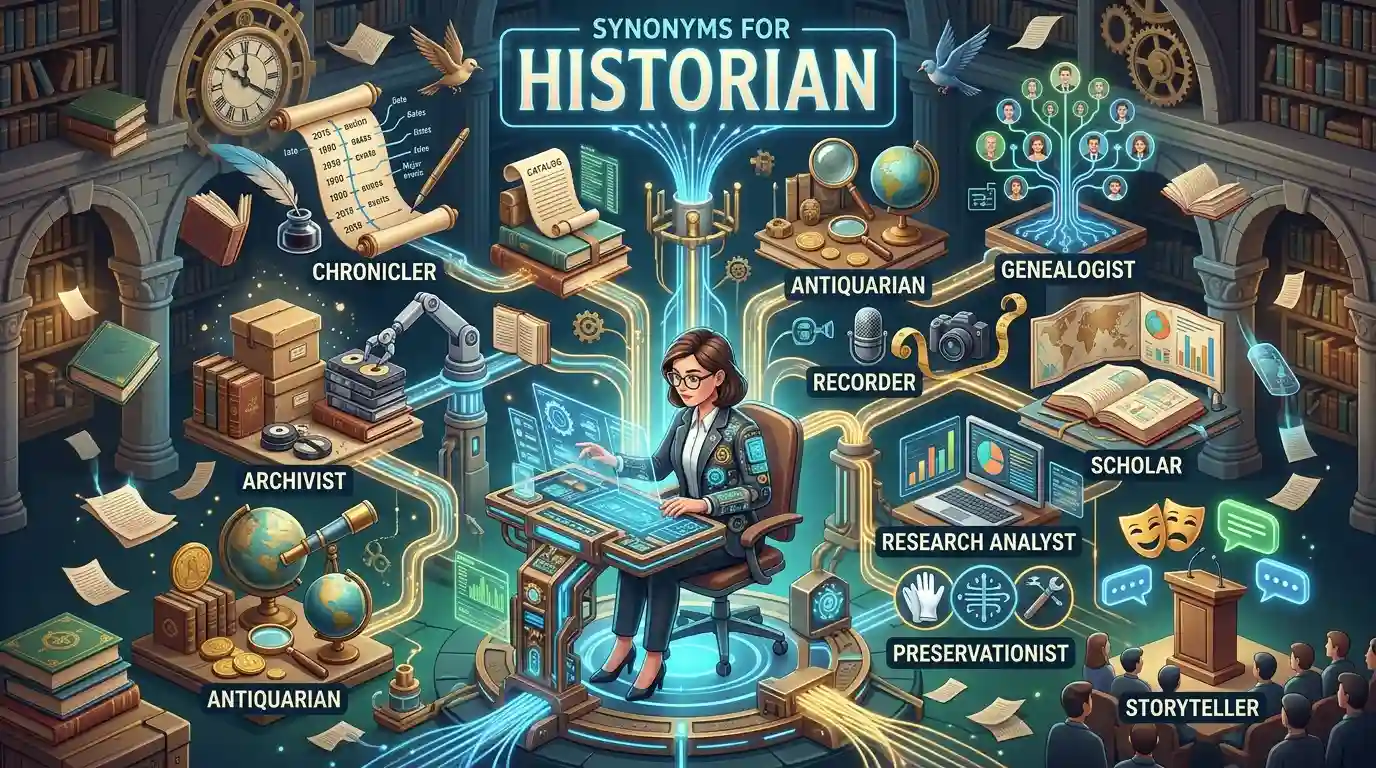
If you’re looking for synonyms for historians, you’re probably trying to find a better or more specific word for someone who studies and writes about the past. While historian is the most common term, words like chronicler, biographer, annalist, archivist, and historical scholar can work in different situations.
The right choice depends on what the person actually does. In this guide, you’ll discover useful synonyms for historians, their simple meanings, examples, and the differences between similar words. This will help you choose the best word for essays, academic writing, conversations, and everyday English.
📖 Meaning of Historian
A historian is a person who studies, researches, and writes about events from the past. Historians use books, letters, official records, photographs, interviews, and other evidence to understand what happened and why it mattered.
The word historian is a noun. It can describe someone who studies a broad period, a country, a culture, or a special subject such as war, art, politics, or social life.
Simple meaning:
A historian is someone who studies or writes about history.
Example:
The historian studied old documents to learn more about the city’s past.
A historian doesn’t simply memorize dates. Good historical work involves examining evidence, checking sources, comparing different accounts, and explaining the past clearly.
📝 Top Synonyms for Historian
There isn’t one perfect synonym for historian because related words can describe different types of historical work. Some focus on recording events, while others focus on research, documents, or people’s lives.
| Synonym | Simple Meaning | Best Used For |
| Chronicler | A person who records events | Historical events |
| Historiographer | A writer or student of history | Academic history |
| Annalist | A person who records events in time order | Chronological records |
| Historical scholar | An expert who studies history | Academic writing |
| History writer | Someone who writes about history | General writing |
| Historical researcher | Someone who researches the past | Research projects |
| Biographer | A person who writes someone’s life story | Biography |
| Archivist | A person who preserves and manages records | Archives |
| Genealogist | Someone who studies family history | Ancestry |
| Antiquarian | Someone interested in old objects and history | Antiquities |
| Diarist | A person who keeps a diary | Personal records |
| Scholar | A person with deep academic knowledge | Formal contexts |
| Researcher | Someone who investigates information | Research |
| Analyst | Someone who examines information carefully | Historical analysis |
| Recorder | Someone who records information | General records |
Quick tip
Use historian when you mean someone who studies history generally. Choose a more specific word when you want to explain the person’s particular role.
👨🏫 Famous Historians in History
Throughout history, many historians have helped people understand ancient civilizations, wars, governments, cultures, and major social changes.
Some well-known names include:
- Herodotus — Often associated with early Greek historical writing and known for The Histories.
- Thucydides — Famous for his detailed account of the Peloponnesian War.
- Ibn Khaldun — A major thinker whose work examined history, society, politics, and the rise and fall of civilizations.
- Bede — An important early English historian whose writings covered the history of the English Church and people.
- Edward Gibbon — Best known for The History of the Decline and Fall of the Roman Empire.
- Leopold von Ranke — Influential in the development of modern professional historical scholarship.
- Mary Beard — A well-known modern classicist and writer on ancient Rome.
These figures show that historians can approach the past in very different ways. Some focus on wars and politics, while others examine religion, culture, economics, or everyday life.
📚 History Synonyms and Related Words
The word history can have several meanings, so its alternatives depend on the sentence.
| Word | Meaning | Example |
| Past | Time that has already happened | We can learn from the past. |
| Chronicle | A record of events | The book is a chronicle of the kingdom. |
| Annals | Historical records arranged by years | The annals describe important events. |
| Record | Written information about events | The document is an important historical record. |
| Account | A description of an event or period | She gave an account of the battle. |
| Story | A description of events | The museum tells the story of the town. |
| Background | Earlier events that explain something | We need to understand the historical background. |
| Heritage | Traditions and things passed down from the past | The city protects its cultural heritage. |
| Antiquity | Ancient times | The building dates from antiquity. |
| Chronology | Events arranged according to time | The chronology helps students understand the sequence. |
History vs. Past
These words are related but aren’t always interchangeable.
History often refers to the study, record, or account of past events.
Past simply means an earlier time.
She studies history at university.
We should learn from the past.
✍️ Chronicler Synonyms and Alternatives
A chronicler is someone who records or describes events, usually in the order in which they happened. The word is especially useful when talking about historical records and older accounts.
If you’re looking for chronicler synonyms, consider these alternatives:
| Alternative | Meaning | Context |
| Recorder | Someone who records events | General |
| Annalist | A person who records events by year | Historical |
| Historian | A person who studies and writes history | Broad |
| Reporter | Someone who reports events | Modern news |
| Documentarian | A person who documents real events | Media |
| Archivist | Someone who preserves records | Documents |
| Memoirist | Someone who writes personal memories | Personal history |
| Diarist | Someone who keeps a diary | Personal records |
| Biographer | Someone who writes a person’s life story | Biography |
| Recorder of events | A person who documents events | Formal/general |
Example
The chronicler recorded the events of the king’s reign.
Here, recorder could work as a broad alternative, but chronicler gives the sentence a stronger historical meaning.
🏛️ Historical Synonyms and Related Terms
Historical is an adjective, so its alternatives depend heavily on what you are describing.
For example, historical evidence, historical buildings, and historical events don’t always have the same possible replacements.
| Word | Meaning | Example |
| Historic | Important or memorable in history | It was a historic agreement. |
| Past | Related to an earlier time | The museum explores past cultures. |
| Ancient | Very old, especially from early history | They studied an ancient city. |
| Old | Existing for a long time | The town has an old marketplace. |
| Traditional | Connected with established customs | The festival has traditional roots. |
| Heritage | Connected with inherited culture or history | The building is part of our heritage. |
| Chronological | Arranged by time | The book gives a chronological account. |
| Archival | Related to stored records | Researchers examined archival material. |
| Ancestral | Connected with ancestors | They returned to their ancestral home. |
| Period | Connected with a particular historical time | The painting belongs to the medieval period. |
Historical vs. Historic
This is one of the most common vocabulary questions.
Historical means connected with history.
We studied historical documents.
Historic usually means important or significant in history.
The country signed a historic agreement.
So, don’t use these two words as exact replacements in every sentence.
⏳ Chronologist Synonyms and Alternatives
A chronologist is someone who studies or works with the arrangement of events according to time. The related noun chronology refers to the order in which events happened.
Useful chronologist synonyms and related terms include:
| Word | Meaning | Best Use |
| Chronologer | A person concerned with chronology | Historical writing |
| Chronographer | A writer who records events by time | Older/formal contexts |
| Annalist | A recorder of events by year | Historical records |
| Chronicler | A person who records events | Historical accounts |
| Historian | A person who studies history | Broad history |
| Timekeeper | Someone who measures or tracks time | General use |
| Recorder | Someone who documents information | General contexts |
| Historical researcher | Someone investigating past events | Research |
| Timeline specialist | Someone focused on event sequences | Informal/modern use |
Example
The chronologist arranged the events according to their dates.
The word historian would be broader, while chronologist emphasizes the time and sequence of events.
⚖️ Difference Between Historian, Chronicler, and Chronologist
These three words are closely connected, but each has a different focus.
| Word | Main Focus | Simple Explanation |
| Historian | Studying and explaining the past | Researches and interprets history |
| Chronicler | Recording events | Documents what happened |
| Chronologist | Time and sequence | Arranges events by when they happened |
Historian
A historian asks questions about the past and studies evidence to understand events.
The historian investigated why the empire collapsed.
Chronicler
A chronicler mainly records events, often as a continuing account.
The chronicler recorded the king’s major victories.
Chronologist
A chronologist focuses on dates and the order of events.
The chronologist placed the events in the correct sequence.
Easy way to remember:
Historian = studies
Chronicler = records
Chronologist = orders by time
💡 How to Choose the Best Synonym for Historian
The best synonym depends on what the person actually does. Before replacing historians, ask yourself what part of historical work you want to highlight.
- General history: Use historian.
- Recording events: Use chronicler.
- Writing events by year: Use annalist.
- Writing someone’s life: Use a biographer.
- Managing old records: Use archivist.
- Studying family ancestry: Use genealogists.
- Working with dates: Use chronologists.
- Studying old objects: Use antiquarian.
- Academic research: Use historical scholars.
- Researching the past: Use historical research.
A simple rule
Don’t choose a synonym just because it sounds more impressive. Precision is more important than complexity.
For example:
The archivist preserved thousands of old documents.
This is more accurate than:
The historian preserved thousands of old documents.
The first sentence tells readers exactly what the person’s role was.
❓ Frequently Asked Questions
What is the best synonym for historian?
The best synonym depends on the context. A chronicler is useful for someone who records events, while a biographer describes someone who writes about a person’s life. Archivist focuses on preserving records, and historical scholar suits academic writing. For general use, historian remains the clearest choice.
What is another word for a historian?
Common alternatives include chronicler, historiographer, annalist, historical scholar, and history writer. Some related terms are more specific, such as biographer, archivist, genealogist, and antiquarian. You should choose the word based on the person’s actual work rather than simply replacing historian with any related term.
What is a synonym for history?
Depending on the sentence, alternatives for history include past, chronicle, annals, record, account, heritage, chronology, and background. These words have slightly different meanings, so they aren’t interchangeable in every situation. For example, chronology focuses on order, while heritage focuses on what is passed down.
What is a synonym for chronicler?
Possible alternatives for chronicler include recorder, annalist, historian, documentarian, diarist, and chronographer. The best option depends on the type of record being created. Chronicler is especially useful when describing someone who documents events over time, particularly in a historical or literary context.
What is another word for historical?
Possible alternatives for historical include past, ancient, archival, chronological, traditional, and heritage-related, depending on the context. Historic is related but isn’t an exact synonym. It often describes something that is important or significant in history, rather than simply something connected with the past.
What is a synonym for chronologist?
Related terms include chronologer, chronographer, annalist, chronicler, and historian. However, these words don’t have exactly the same meaning. A chronologist has a particular focus on time, dates, and the sequence of events, while a historian usually has a much broader role in studying and interpreting the past.
What is the difference between historic and historical?
Historical means connected with history or the past. Historic commonly means important or significant in history. For example, historical documents are documents connected with the past, while a historic decision is a decision considered especially important. This distinction helps make academic and professional writing more precise.
What is the opposite of a historian?
There is no exact dictionary antonym for historian because it is the name of a person who studies history. Non-historian can be used when you simply mean someone who isn’t a historian. In some contexts, ahistorical can describe an approach that ignores historical context, but it doesn’t mean “opposite of historian.”
🏁 Conclusion
The word historian is already clear and useful, but the right alternative can make your writing more precise. Chronicler, historiographer, annalist, biographer, archivist, genealogist, antiquarian, and scholar each add a slightly different meaning.
For everyday and academic writing, historians are usually the safest choice. When you need greater precision, use a specialist term such as military historian, art historian, social historian, or oral historian.