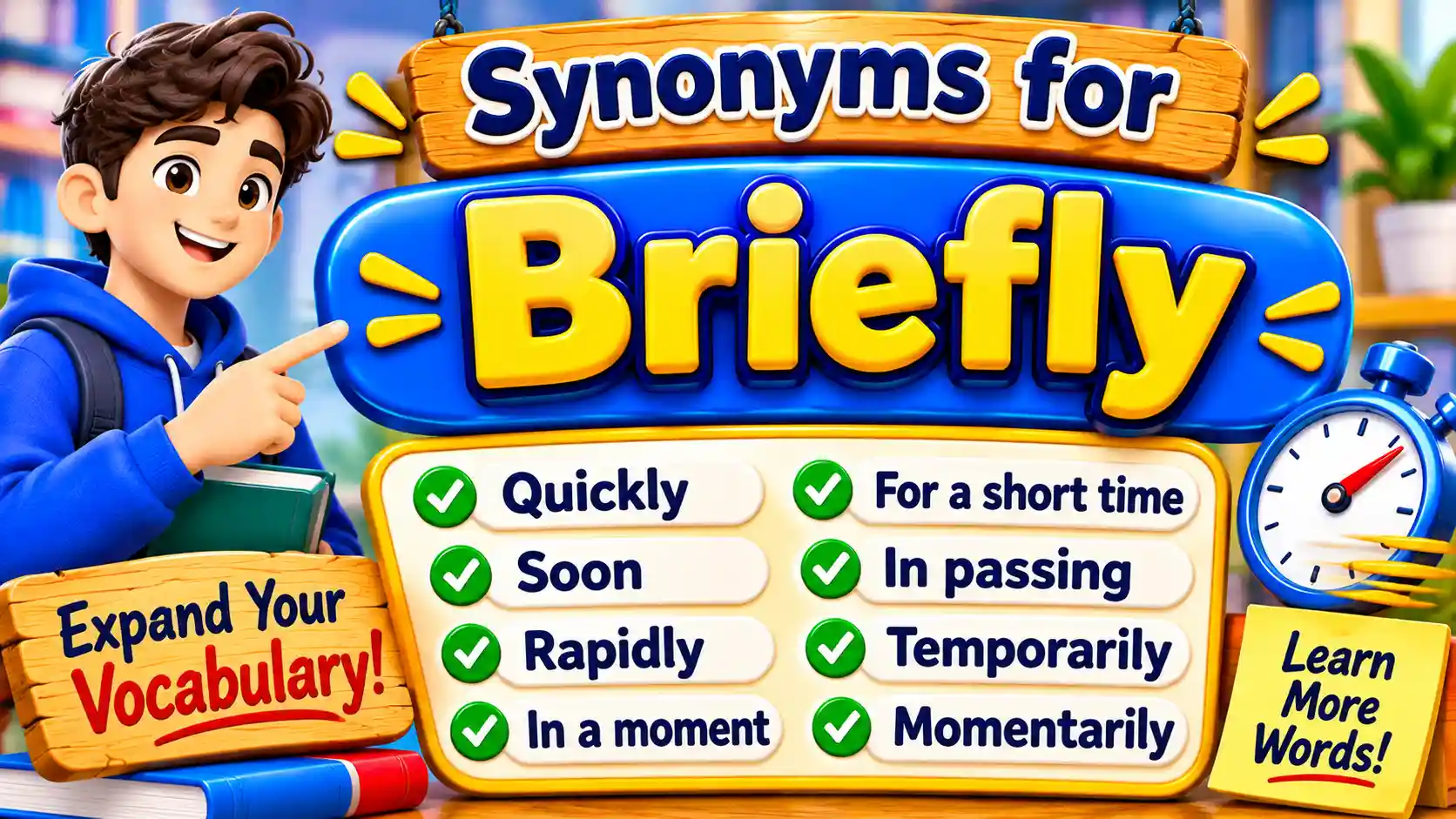
Briefly is a small word with a big job. You use it when you want to say something in a few words, or when something lasts only a short time. But is “briefly” always the best word? Not always. Sometimes “concisely” fits better, sometimes “shortly”, and sometimes “in brief”.
In this guide, you will learn 40 synonyms for briefly in four clear groups, with meanings, best uses, and real examples. You will also learn the difference between briefly and shortly, briefly and concisely, and briefly and quickly — plus grammar tips and common mistakes to avoid. By the end, you will pick the right word every time.
📖 Meaning of Briefly
Definition: Briefly means for a short time, or in a few words without a lot of detail. As an adverb, it tells you how an action happens — fast in time, or short in words.
Part of Speech: Adverb.
Pronunciation: BREEF-lee — /ˈbriːf.li/.
Origin: Briefly comes from the adjective brief plus -ly. Brief comes from Middle English bref, from Anglo-French bref, from Latin brevis, meaning “short”. The adjective brief has been in English since the 14th century (Merriam-Webster). Latin brevis is also the root of abbreviate and brevity.
Common Usage: Briefly is used in daily talk, emails, meetings, and writing. People say “Let me explain briefly” before a quick summary, and “We met briefly” after a short visit. It is a B1-level word in the Cambridge Dictionary, so most learners meet it early.
Simple Explanation: Briefly means short — short in time, or short in words. If you speak briefly, you use a few words. If you stay briefly, you do not stay long.
📝 Top Synonyms of Briefly
In Few Words (Concise Speech and Writing)
| Word | Meaning | Best Use | Example |
| concisely | Using very few words, but still clear | Formal writing and speeches | She explained the plan concisely in two minutes. |
| succinctly | Saying a lot with very few words | Essays, reports, and summaries | He summed up the book succinctly in one paragraph. |
| tersely | Short and direct, sometimes a little sharp | News, reports, and firm replies | The manager answered tersely, “No, we cannot.” |
| curtly | Short and a little rude | Firm replies and short answers | She nodded curtly and walked away. |
| pithily | Short, strong, and full of meaning | Quotes, slogans, and smart writing | He put the whole idea pithily in one line. |
| crisply | Short, clear, and neat | Business talk and clear instructions | She gave the orders crisply and left the room. |
| compactly | Packed into a small space or few words | Notes, summaries, and guides | The guide states the rules compactly on one page. |
| laconically | Using very few words, calm and quiet | Stories, dialogue, and dry humour | He replied laconically, “Fine.” |
| sparingly | Using only a little, with care | Careful speech and writing | She used praise sparingly, so it meant more. |
| economically | Using few words, with no waste | Tight writing and clear reports | He wrote economically, with no extra words. |
For a Short Time
| Word | Meaning | Best Use | Example |
| shortly | For a short time; also means “soon” | Daily talk and plans | She stayed shortly, then went home. |
| momentarily | For a very short moment | Daily talk and stories | The lights went out momentarily. |
| fleetingly | For a moment that passes fast | Stories and soft writing | Fame touched him fleetingly, then faded. |
| temporarily | For a limited time, not for good | Work, plans, and changes | She worked here temporarily last summer. |
| transiently | Lasting only a short time | Formal and academic writing | The pain passed transiently and did not return. |
| ephemerally | Lasting a very short time, like a day | Poetic and formal writing | The flowers bloomed ephemerally in spring. |
| for a moment | For one short moment | Daily talk and stories | He paused for a moment, then smiled. |
| for a while | For a short period of time | Daily talk and plans | We sat for a while and talked. |
| for an instant | For one tiny moment | Stories and strong writing | For an instant, the whole room went quiet. |
| for a second | For one very short moment | Daily talk and quick stories | She looked at him for a second, then laughed. |
In Short (Summarizing)
| Word | Meaning | Best Use | Example |
| in brief | In a few words; a short version | Meetings, emails, and summaries | In brief, we need more time and more money. |
| in short | In a few words; a quick summary | Daily talk and writing | In short, the plan worked. |
| in summary | As a short version of the whole | Reports, essays, and talks | In summary, the team met every goal. |
| in a nutshell | In very few words | Daily talk and fun summaries | In a nutshell, we won and went home happy. |
| in essence | In the most basic sense | Formal talk and essays | In essence, the story is about hope. |
| summarily | In a short, quick way | Formal and legal writing | The case was dealt with summarily. |
| in outline | In a rough, short form | Plans, talks, and first drafts | She gave the idea in outline only. |
| in a word | In one short word | Daily talk and strong points | In a word, it was perfect. |
| to sum up | To give the short version | Talks, essays, and meetings | To sum up, we need three more days. |
| in sum | In total, in a few words | Formal writing and reports | In sum, the year was a success. |
To Touch on Something Lightly
| Word | Meaning | Best Use | Example |
| in passing | While doing something else, without focus | Daily talk and stories | She mentioned the trip in passing. |
| cursorily | Quickly, without much care or detail | Formal writing and reviews | He read the report cursorily before the meeting. |
| superficially | Only on the surface, not deeply | Academic and formal writing | The book treats the topic superficially. |
| hastily | In a hurry, with little time | Daily talk and stories | He wrote the note hastily and ran out. |
| quickly | At a fast speed | Daily talk and all writing | She glanced quickly at the clock. |
| swiftly | Fast and smooth | Stories and formal writing | The news spread swiftly through the town. |
| speedily | Fast, without delay | Formal and business writing | The order was sent speedily by courier. |
| rapidly | Very fast | Reports, news, and stories | The river rose rapidly after the rain. |
| promptly | At once, without delay | Business and polite writing | She replied promptly to the email. |
| hurriedly | In a rush, with little time | Daily talk and stories | He packed hurriedly and caught the bus. |
⚖️ Antonyms of Briefly
| Word | Meaning | Example |
| at length | For a long time, or with many words | He spoke at length about his trip. |
| in detail | With all the small parts included | She explained the plan in detail. |
| thoroughly | Fully, with nothing left out | The teacher checked the work thoroughly. |
| extensively | Over a wide area or long time | They travelled extensively in Asia. |
| exhaustively | Covering every part, leaving nothing out | The book covers the topic exhaustively. |
| verbosely | Using too many words | He answered verbosely and lost the crowd. |
| wordily | With more words than needed | The letter was written wordily. |
| diffusely | Spread out, not tight or clear | She wrote diffusely about the problem. |
| lengthily | For a long time, or at great length | He talked lengthily about the past. |
| long-windedly | In a long, boring way | The speaker went on long-windedly. |
Honest note: these are situational opposites. At length is the opposite of brief speech, extensively is the opposite of a short stay, and verbosely is the opposite of few words — no single word is the exact opposite of briefly in every sense.
💬 Example Sentences
Daily Conversation:
- We chatted briefly before the movie started.
- She waved briefly and then walked away.
- He stopped by briefly to say hello.
- They met briefly at the park yesterday.
Academic English:
- The study mentions the topic briefly in the last chapter.
- The teacher explained the rule briefly before the test.
- The paper covers the history briefly in its opening lines.
- Students should state their main idea briefly in the first paragraph.
Business English:
- The manager updated the team briefly at the start of the meeting.
- Please describe the project briefly in your email.
- The report covers the results briefly on the first page.
- She introduced the new plan briefly before lunch.
Formal Writing:
- The committee discussed the matter briefly and moved on.
- The letter states the request briefly and clearly.
- The speaker addressed the issue briefly in his opening remarks.
- The law describes the rule briefly in one short paragraph.
Informal Writing:
- Let me tell you briefly — we won!
- I’ll catch you up briefly: the trip was great.
- She texted briefly: “Running late, see you soon.”
- He replied briefly, “Sounds good, thanks!”
Creative Writing:
- The sun appeared briefly between the clouds.
- Her smile flashed briefly, then faded away.
- The old house stood briefly in the morning light.
- He paused briefly, then opened the door.
📚 Difference Between Similar Words
| Word Pair | When to Use Each | Example |
| briefly vs shortly | Briefly means a short time or few words. Shortly also means “soon”. | “We spoke briefly.” vs “I’ll call you shortly.” |
| briefly vs concisely | Concisely is only about a few words. Briefly is wider — short time or few words. | “She answered concisely.” vs “She stayed briefly.” |
| briefly vs quickly | Quickly means fast speed. Briefly means short time. | “He ran quickly.” vs “He visited briefly.” |
| briefly vs temporarily | Temporarily means for a limited time, then it changes. Briefly means a very short time. | “She worked here temporarily.” vs “She stopped briefly.” |
Simple rule: If you mean “soon”, use shortly — never briefly. If you mean “few words”, use concisely. If you mean “a short time”, use briefly.
🎯 Best Alternative Words
- Professional Writing: concisely, succinctly, in brief
- Essay Writing: succinctly, in summary, in essence
- Email: briefly, in short, in summary
- Business: concisely, in brief, summarily
- Conversation: shortly, for a moment, in short
- Marketing: crisply, in a nutshell, in essence
- Creative Writing: fleetingly, momentarily, in passing
✍ Grammar Tips
- Word form: Briefly is made from the adjective brief plus -ly. Brief is the adjective, briefly is the adverb.
- Comparative and superlative: Use more briefly and most briefly — “She spoke more briefly than last time.”
- Position: Briefly usually sits before the main verb — “She briefly explained the plan.” It can also start a sentence — “Briefly, the plan is simple.” It works at the end too — “We met briefly.”
- Briefly vs brief: Use brief before a noun — “a brief meeting”. Use briefly with a verb — “We met briefly.”
- Briefly vs shortly: Shortly can mean “soon” — “I’ll be there shortly.” Briefly never means “soon”.
- Phrase “in brief”: In brief means “in short” — “In brief, we need more time.”
- No noun “brieflyness”: The noun is brevity — “the brevity of his speech”.
- Fixed phrases: “To be brief”, “briefly speaking”, and “put briefly” all introduce a short summary.
❌ Common Mistakes
| Wrong | Correct | Reason |
| I will briefly tell you about the plan. | I will speak to you briefly about the plan. | Briefly is an adverb, not a verb — it needs a verb like speak. |
| She gave a brief speech. | She gave a brief speech. | Before a noun, use the adjective brief, not the adverb briefly. |
| He will come briefly. | He will come shortly. | Briefly never means “soon” — for soon, use shortly. |
| We talked brieflyly about it. | We talked briefly about it. | Briefly already ends in -ly — never add -ly again. |
| Let me brief explain the rule. | Let me explain the rule briefly. | Brief is an adjective; the adverb is briefly. |
| He brieflyed the team. | He briefed the team. | Brief is the verb; briefly is only an adverb and has no past form. |
💡 Pro Writing Tips
- Pick the sense first: Do you mean short time or few words? The answer picks the synonym.
- Use briefly for time, concisely for words — that one choice fixes most mistakes.
- Never use briefly for “soon” — use shortly and your meaning stays clear.
- Start a summary with “Briefly,” or “In brief,” — readers know a short version is coming.
- Keep briefly near the verb it describes, so the sentence stays easy to read.
- In formal writing, prefer concisely or succinctly; in daily talk, briefly is fine.
- Watch briefly vs brief: adjective before a noun, adverb with a verb.
📖 Related Words
- Associated words: brief, brevity, concise, succinct, short
- Nearby words: abbreviate, abbreviation, summary, outline, synopsis
- Contextual words: short-lived, fleeting, momentary, temporary, transient
- Semantic variations: in brief, in short, in a nutshell, to sum up, in summary
❓ FAQs
What does briefly mean?
Briefly means for a short time or in a few words. When you speak briefly, you keep your words short and clear. When you stay somewhere briefly, you do not stay long. It is an adverb, so it describes how an action happens. Use it when time is short or when details are few.
What is the difference between briefly and shortly?
Briefly and shortly are close, but they are not the same. Briefly describes a short time or a small number of words. Shortly can also mean soon, as in “I will be there shortly.” Briefly never means soon. Use briefly for short speech or a short visit, and use shortly when something will happen soon.
What is the difference between briefly and concisely?
Concisely is only about words. It means saying a lot with very few words. Briefly is wider — it can mean a short time or few words. A speech can be brief, and a visit can be brief, but only words can be concise. Use concisely for writing and speaking, and briefly for time and words.
How do you use it briefly in a sentence?
Use briefly before or after a verb to show that something lasted a short time or used a few words. Say “She spoke briefly at the meeting” or “We met briefly before lunch.” You can also start a sentence with it: “Briefly, the plan is simple.” Always keep it near the verb it describes.
Is briefly an adjective or an adverb?
Briefly is an adverb, never an adjective. It is made from the adjective brief plus -ly. Use briefly to describe a verb, as in “He answered briefly.” Use brief before a noun, as in “a brief answer.” If you need a noun, use brevity, as in “the brevity of his speech.”
What does “to be brief” mean?
“To be brief” means to keep your words short and skip extra details. Speakers use it before a quick summary, as in “To be brief, we won the game.” Writers use it to signal a short version of a longer story. It is a polite way to say you will not talk for long.
Can it briefly mean “soon”?
No, briefly never means soon. If you say “I will be there briefly,” it means you will stay for a short time, not that you will arrive soon. For soon, use shortly — “I will be there shortly.” Mixing the two is a common mistake, so keep their meanings apart.
What is the noun form of briefly?
Briefly has no direct noun form of its own. The noun is brevity, which means shortness in time or in words. Say “the brevity of the meeting” or “the brevity of her note.” Do not write “brieflyness” — that word does not exist. Use brevity whenever you need the noun.
Conclusion
Briefly is a small word, but it does a big job — it keeps your words short and your time clear. In this guide, you learned 40 synonyms for briefly in four clear groups: words for few words like concisely and succinctly, words for a short time like shortly and momentarily, short summary phrases like in brief and in short, and light-touch words like in passing and cursorily. You also learned the key differences — briefly vs shortly, briefly vs concisely, and briefly vs quickly — plus grammar tips and common mistakes to avoid. The best synonym is always the one that fits the moment, so pick with care and write with confidence.