
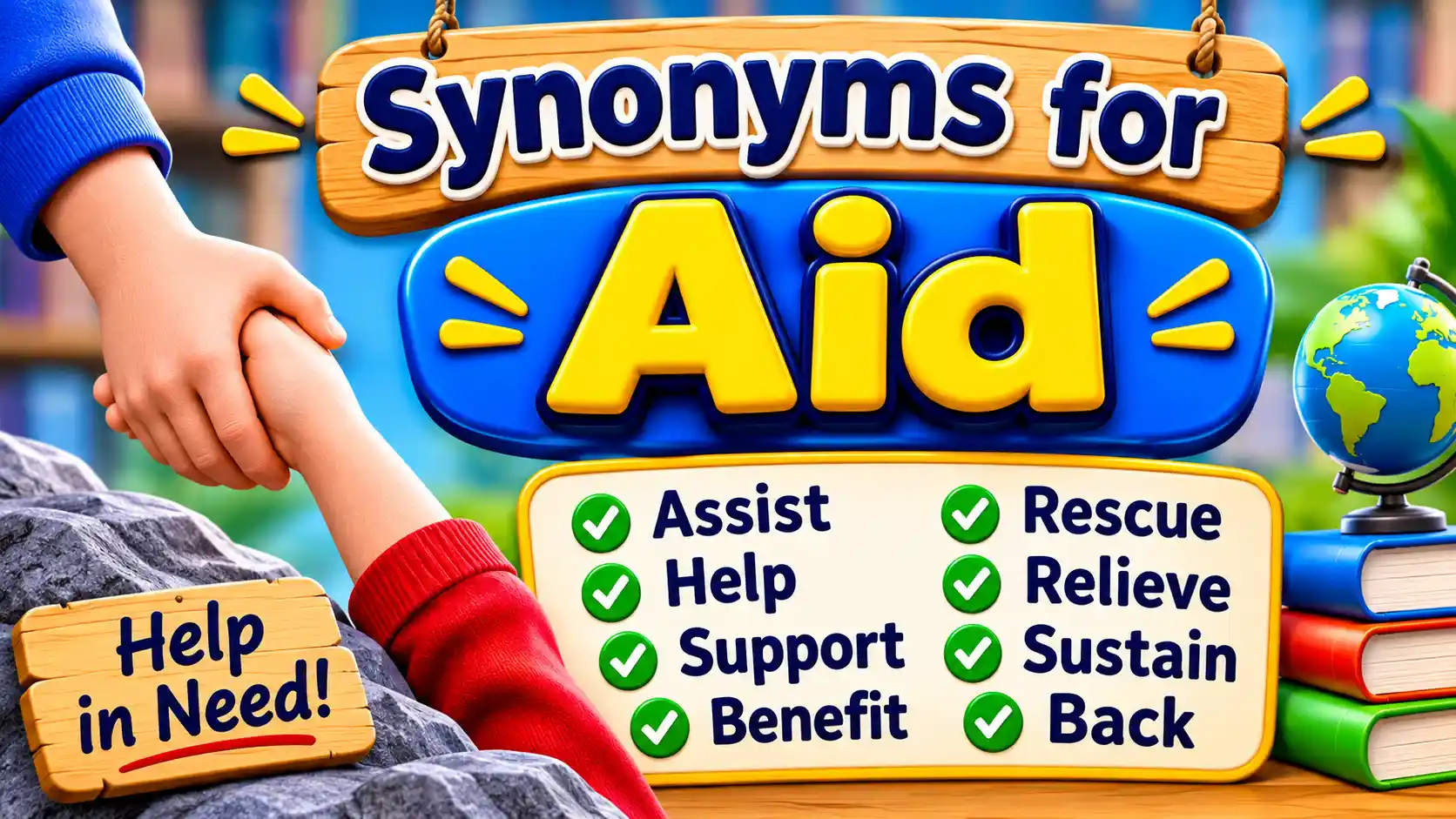
Aid is a word we see everywhere — in news about floods, in school forms about money, and in first aid kits at home. It means help, and it can be a noun or a verb. But aid is not always the best word: sometimes help fits better, sometimes assistance, and sometimes funding or relief.
In this guide, you will learn 40 synonyms for aid in four clear groups, with meanings, best uses, and real examples. You will also learn the difference between aid and help, aid and assistance, and the tricky pair aid and aide. By the end, you will pick the right word every time.
📖 Meaning of Aid
Definition: Aid is help or support given to someone in need. It can be money, food, care, or work. As a verb, aid means to help someone.
Part of Speech: Noun and verb.
Pronunciation: AID — /eɪd/ (sounds like “paid” without the p).
Origin: From Middle English eyden, from Anglo-French aider, from Latin adjutare, a frequentative of adjuvare — from ad- (“to”) + juvare (“to help”). The first known use of aid was in the 15th century (Merriam-Webster). The sense of “a thing by which help is given” — like a hearing aid — is recorded from the 1590s.
Common Usage: Aid is used for help given to people in need — foreign aid, first aid, financial aid, humanitarian aid. It is more formal than help, and it often means money, goods, or organised care.
Simple Explanation: Aid is help. When people are in trouble, aid is what you send — money, food, medicine, or a helping hand.
📝 Top Synonyms of Aid
Help and Support (General)
| Word | Meaning | Best Use | Example |
| help | The act of giving support to someone | Everyday talk and writing | Can you give me some help with this bag? |
| assistance | Help given to someone who needs it | Formal writing and emails | She asked for assistance with her homework. |
| support | Help that keeps someone strong | Emotional, financial, and team help | Friends gave support after the loss. |
| backing | Support, often from a group or leader | Business and public support | The plan has the backing of the whole team. |
| encouragement | Words that give hope and courage | Motivation and learning | His encouragement helped her keep going. |
| guidance | Advice that shows the right way | Teachers, mentors, and leaders | The teacher gave guidance to the new student. |
| cooperation | Working together to reach a goal | Teamwork and group projects | The project needs cooperation from all sides. |
| collaboration | Working with others on a shared task | Work, school, and creative projects | Our collaboration made the book better. |
| teamwork | Effort made by a group together | Sports, work, and school | Teamwork helped us finish on time. |
| reinforcement | Extra help that makes something stronger | Support for ideas, teams, and plans | The extra staff gave reinforcement to the team. |
Money and Material Help
| Word | Meaning | Best Use | Example |
| funding | Money given for a project or cause | Business, schools, and research | The school received funding for new books. |
| grant | Money given, usually by a government | Education and charity | She won a grant to study abroad. |
| donation | Money or goods given to help others | Charity and good causes | He made a donation to the food bank. |
| contribution | Something given to help a cause | Charity, teams, and projects | Her contribution helped build the library. |
| subsidy | Money given by the government to help | Farming, housing, and business | Farmers got a subsidy for their crops. |
| charity | Help given to people in need | Good causes and giving | The charity feeds homeless people daily. |
| sponsorship | Money given to support a person or event | Sports, events, and students | A bank gave sponsorship to the school team. |
| endowment | A large gift of money for the future | Universities and trusts | The endowment pays for new labs. |
| allowance | Money given regularly for a purpose | Students and children | He gets a weekly allowance from his parents. |
| loan | Money borrowed to be paid back later | Banks and students | She took a loan to pay for college. |
Medical and Emergency Help
| Word | Meaning | Best Use | Example |
| first aid | First, simple medical help | Accidents and emergencies | She learned first aid at school. |
| treatment | Medical care given to a sick person | Hospitals and doctors | The treatment helped him recover fast. |
| care | Looking after someone who is sick | Health and family | The nurse gave care to the old man. |
| therapy | Treatment that helps body or mind | Health and recovery | Therapy helped her walk again. |
| remedy | A cure or fix for a problem | Health and home care | Rest is the best remedy for a cold. |
| rescue | Saving someone from danger | Emergencies and disasters | The rescue team saved the trapped dog. |
| cure | Something that makes a sick person well | Medicine and health | Doctors found a cure for the disease. |
| medicine | A drug used to treat illness | Health and pharmacies | Take this medicine twice a day. |
| nursing | Care given by nurses to the sick | Hospitals and homes | Nursing helped the patient feel safe. |
| healing | The process of getting better | Health and recovery | Time and rest brought healing. |
To Aid (Verb Sense)
| Word | Meaning | Best Use | Example |
| assist | To help someone with a task | Formal and polite writing | Please assist the new student. |
| champion | To support and fight for a cause | Leaders and advocates | She champions free education for all. |
| promote | To help something grow or succeed | Business and marketing | We promote fair trade in our shop. |
| facilitate | To make a task easier | Business and meetings | The manager facilitated the talk. |
| boost | To lift or increase something | Energy, sales, and mood | A kind word can boost your day. |
| advance | To help something move forward | Careers, causes, and science | The grant advanced the research. |
| strengthen | To make something stronger | Teams, bodies, and ideas | Exercise strengthens your heart. |
| serve | To work for and help others | Service and community | Volunteers serve food at the shelter. |
| benefit | To be good for someone | Health, work, and learning | Reading benefits every student. |
| further | To help a plan or cause grow | Formal writing | The gift furthered the school’s work. |
⚖️ Antonyms of Aid
| Word | Meaning | Example |
| hindrance | Something that stops help or progress | Bad roads were a hindrance to the rescue. |
| harm | Damage or hurt to someone | The storm caused harm to the village. |
| obstruction | Something that blocks the way | The fallen tree was an obstruction on the road. |
| opposition | Resistance against a plan or idea | The plan faced strong opposition. |
| neglect | Lack of care for someone in need | Neglect made the garden die. |
| abandonment | Leaving someone without help | The dog suffered abandonment by its owner. |
| refusal | Saying no to a request for help | His refusal shocked the whole team. |
| denial | Refusing to give what is asked | The denial of funds hurt the school. |
| damage | Harm done to something | The flood caused damage to the house. |
| injury | Hurt to a person’s body | The injury kept him out of the game. |
Honest note: these are situational opposites. Hindrance is the opposite of help, neglect is the opposite of care, and refusal is the opposite of giving — no single word is the exact opposite of aid in every sense.
💬 Example Sentences
Daily Conversation:
- Can you aid me with this heavy bag?
- Thanks for the help — I could not do it alone.
- My neighbour gave me a hand with the shopping.
- She asked her friend for support with the move.
Academic English:
- The study shows that peer support aids student learning.
- Financial assistance helps many students pay for college.
- The research received funding from the university.
- Teachers give guidance to students who need extra aid.
Business English:
- The company gave a grant to the local school.
- Our sponsor gave funding for the new project.
- The team needs more support to meet the deadline.
- The charity sent relief to the flood area.
Formal Writing:
- The government sent aid to the people after the storm.
- The committee approved a subsidy for small farms.
- The hospital received a donation for new beds.
- The programme gives assistance to families in need.
Informal Writing:
- Give me a hand — this box is heavy!
- He always backs me up when I need help.
- My mum gave me some cash to aid me on my trip.
- Thanks for the boost — I feel better now.
Creative Writing:
- Her smile was a remedy for his tired heart.
- The old map gave guidance to the lost travellers.
- His words were a healing balm for her pain.
- The rescue came just as the storm grew worse.
📚 Difference Between Similar Words
| Word Pair | When to Use Each | Example |
| aid vs help | Help is the general, everyday word. Aid is more formal, often for groups, money, or emergencies. | “Help me carry this.” vs “The country sent aid after the earthquake.” |
| aid vs assistance | Assistance is the act of helping. Aid is the help itself, often money or goods. | “She gave assistance with the form.” vs “They sent aid to the village.” |
| aid vs support | Support is ongoing help, often emotional or financial. Aid is help given in a time of need. | “Friends gave support for a year.” vs “Aid arrived after the flood.” |
| aid vs relief | Relief is help after a disaster or pain. Aid is wider — money, care, or work in any need. | “Relief came after the storm.” vs “Foreign aid to build new schools.” |
| aid vs aide | Aid is help (noun or verb). Aide is a person who helps — a helper or assistant. | “They sent aid.” vs “The senator’s aide arranged the meeting.” |
Simple rule: If it is a person who helps, use aid. If it is the help itself, use aid.
🎯 Best Alternative Words
- Professional Writing: assistance, support, funding
- Essay Writing: support, guidance, encouragement
- Email: help, assistance, support
- Business: funding, sponsorship, grant
- Conversation: help, a hand, support
- Marketing: boost, support, promote
- Creative Writing: remedy, healing, rescue
✍ Grammar Tips
- Noun: Aid is usually uncountable for help — say “some aid”, never “an aid”. But it is countable for devices: a hearing aid, a teaching aid, and visual aids.
- Verb forms: aid, aids, aided, aiding — “She aids her friend.” / “He aided the team yesterday.”
- Adjective use: Aid works in compounds — first aid, foreign aid, financial aid, humanitarian aid.
- Aid vs aide: Aid is help. Aide is a person who helps — a teacher’s aide, an aide to a leader. The extra “e” in aid stands for employee.
- Fixed phrase: “Aid and abet” is a legal phrase meaning to help someone do something wrong.
- Phrase: “In aid of” means in support of — “a concert in aid of the flood victims.”
- No plural for help: Never write “aids” for general help. “Aids” as a noun is the disease AIDS, written in capital letters.
❌ Common Mistakes
| Wrong | Correct | Reason |
| She gave me aid yesterday. | She gave me some help yesterday. | Aid is usually uncountable for help. “An aid” means a device or tool, like a hearing aid. |
| He is my aid in class. | He is my aide in class. | Aide is the person who helps. Aid is the help itself. |
| They aid the poor every month. | They give aid to the poor every month. | Aid as a verb takes a direct object — “aid the poor”, never “aid to”. |
| First aids are important. | First aid is important. | First aid is uncountable — never add -s. |
| He paid me yesterday. | He aided me yesterday. | Past tense needs -ed — aided, not aid. |
| The charity raised aids for children. | The charity raised aid for children. | Aid is uncountable for help — never add -s. |
💡 Pro Writing Tips
- Pick the sense first: Is it money? Use funding or grants. Is it medical? Use treatment or first aid. Is it general? Use help or assistance.
- Use aid for big needs: Aid fits disasters, countries, and organised help. For small, daily needs, help sounds more natural.
- Vary your words: Don’t repeat aid in every sentence. Mix in assistance, support, and relief.
- Keep it formal in reports: In business and academic writing, assistance and funding sound more professional than help.
- Watch aid vs aide: In one sentence, “The aide gives aid to the patient as she aids the doctor” shows all three uses — aide (person), aid (help), aids (verb).
- Use strong verbs: Instead of “give aid to”, try “assist”, “support”, or “boost” for a livelier sentence.
📖 Related Words
- Associated words: help, support, relief, care, rescue, funding, grant
- Nearby words: assist, assistant, assistance, aid worker, first aid kit
- Contextual words: humanitarian, financial aid, foreign aid, mutual aid, legal aid
- Semantic variations: aid package, aid worker, aid agency, aid programme
❓ FAQs
What does aid mean?
Aid means help or support, often money, food, or care given to people in need. As a verb, aid means to help someone. You can say “The charity sent aid to the flood victims” or “She aided her friend with the move.” It is a formal word for help.
What is the difference between aid and help?
Help is the general, everyday word for giving support. Aid is more formal and often means help for a group, money, or emergency care — like foreign aid or first aid. You say “help me” in daily talk, but “send aid” for a disaster.
What is the difference between aid and assistance?
Assistance is the act of helping, while aid is the help itself, often money or goods. You give assistance with a task, and you send aid to people in need. The two words are close, but aid sounds more formal and is used for bigger needs.
How do you use aid in a sentence?
Use aid as a noun for help — “The country sent aid after the earthquake.” Use it as a verb to mean help — “Volunteers aided the rescue team.” Remember: aid as a noun is usually uncountable, so say “some aid”, never “an aid”.
Is aid a noun or a verb?
Aid is both a noun and a verb. As a noun, it means help or support — “They sent aid to the village.” As a verb, it means to help — “She aided her friend.” The verb forms are aid, aids, aided, and aiding.
What is first aid?
First aid is the first, simple medical help given to a sick or hurt person before a doctor arrives. It includes cleaning a cut, putting on a bandage, or helping someone breathe. Everyone should learn basic first aid, because quick help can save a life.
What is foreign aid?
Foreign aid is money, food, or help that one country gives to another country in need. It is often sent after a disaster, or to help with schools, health, and farming. Rich countries give foreign aid to help poor countries grow and recover.
What is the difference between aid and aid?
Aid is help or support, and it can be a noun or a verb. Aide is only a noun, and it means a person who helps — like a teacher’s aide or an aide to a leader. Remember: aid is the help, and aide is the helper.
Conclusion
Aid is a small word with a big heart — it means help, and it shows up in news, school, work, and daily life. In this guide, you learned 40 synonyms for aid in four clear groups: general help like assistance and support, money and material help like funding and grant, medical and emergency help like first aid and treatment, and the verb sense like assist and boost. You also learned the key differences — aid vs help, aid vs assistance, and the tricky pair aid vs aide — plus grammar tips and common mistakes to avoid. The best synonym is always the one that fits the moment, so pick with care and write with confidence.