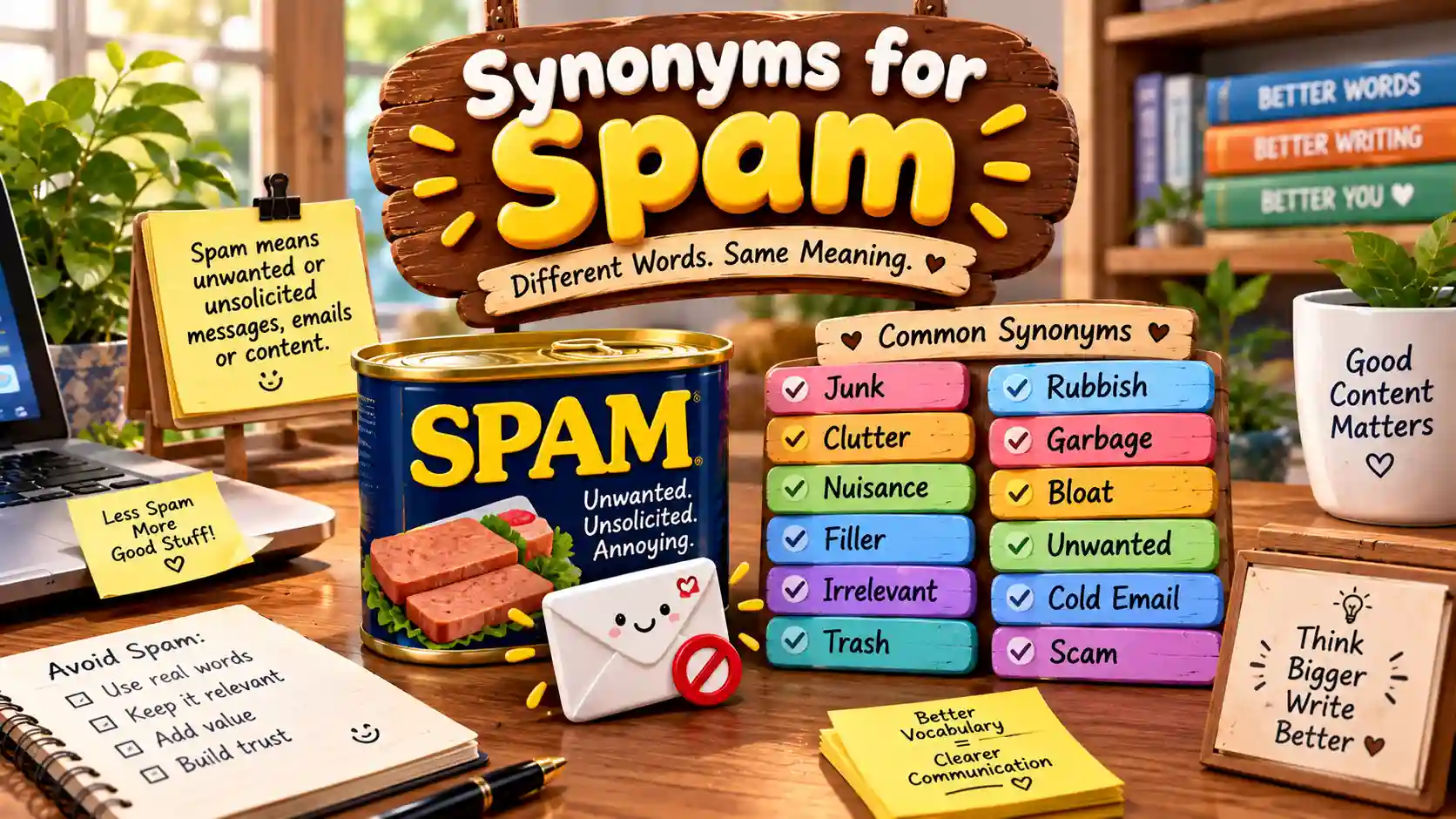
Almost everyone hates it. Spam fills inboxes, buzzes phones, and clutters comment sections every single day. But the word has a surprising double life — it started as canned meat in 1937 and became internet slang thanks to a Monty Python comedy sketch. People search for synonyms for spam because one word covers email junk, scam calls, pop-up ads, and even lunch meat.
This guide gives you 36 words grouped by meaning, so you’ll always pick the right one. You’ll also learn antonyms, grammar tips, common mistakes, and answers to the most asked questions.
📖 Meaning of “Spam”
Definition: 1) Unsolicited messages sent in bulk — usually ads, scams, or junk you never asked for. 2) A brand of canned cooked meat.
Part of Speech: Noun (uncountable for messages; countable for the food — “cans of Spam”). Also a verb: to spam, spammed, spamming.
Pronunciation: /spæm/ — rhymes with “ham.”
Origin: The food came first. Hormel introduced Spam in 1937, with the name often said to come from “spiced ham” (though the company has never confirmed one official meaning). The internet meaning arrived decades later: in a 1970 Monty Python sketch, Vikings chant “Spam, Spam, Spam!” so loudly that normal café conversation becomes impossible. In the early 1990s, internet users borrowed the joke — junk messages drown out real conversation exactly like the Vikings’ chant. The infamous 1994 Canter & Siegel green-card Usenet blast made the term famous worldwide.
Common Usage: “Check your spam folder.” “I got a spam call.” “Stop spamming the chat.”
Simple Explanation: Spam is junk you never asked for. Online, it’s unwanted bulk messages. In the kitchen, it’s canned meat with a capital S.
📝 Top Synonyms of “Spam”
Unwanted Bulk Messages
| Word | Meaning | Best Use | Example |
| Junk mail | Unwanted ads and letters | Everyday | My mailbox is full of junk mail. |
| Junk email | Unwanted emails in your inbox | I delete junk email every morning. | |
| Unsolicited messages | Messages you never asked for | Formal | She reported the unsolicited messages. |
| Bulk mail | Large batches of ads | Business | Companies send bulk mail daily. |
| Spam email | Junk email with ads or scams | That spam email promised a free prize. | |
| Robocalls | Automatic recorded phone calls | Phone | Robocalls interrupt dinner nightly. |
| Spam calls | Unwanted sales or scam calls | Phone | I block spam calls right away. |
| Cold calls | Sales calls to strangers | Business | Cold calls rarely make sales now. |
| Telemarketing calls | Calls selling products | Formal | Telemarketing calls dropped after the ban. |
| Chain messages | Forwarded texts passed along | Casual | Stop sending me chain messages! |
| Phishing emails | Fake emails stealing info (scam subtype) | Security | That phishing email copied my bank’s logo. |
| Scam messages | Texts meant to cheat you | Casual | Scam messages often ask for money. |
| Unsolicited ads | Ads pushed without permission | Marketing | Pop-ups are unsolicited ads. |
| Inbox clutter | Piled-up unwanted mail | Casual | I cleared years of inbox clutter. |
Online Annoyances
| Word | Meaning | Best Use | Example |
| Pop-ups | Ads that jump up on screen | Web | Pop-ups covered the whole page. |
| Clickbait | Shocking headlines that bait clicks | Web | That headline was pure clickbait. |
| Spam bots | Fake accounts posting junk | Social media | Spam bots flooded the comments. |
| Fake accounts | Profiles that aren’t real | Social media | He deleted ten fake accounts. |
| Trolling | Posts meant to annoy or provoke | Informal | Ignore the trolling and move on. |
| Adware | Software showing endless ads | Tech | Adware slowed his laptop. |
| Banner ads | Ads stretched across webpages | Web | Banner ads slowed the site. |
| Sponsored posts | Paid posts inside feeds | Social media | Sponsored posts filled my feed. |
| Email blasts | Mass emails sent at once | Marketing | They send email blasts weekly. |
| Mass messages | Messages fired off to crowds | General | Mass messages rarely get replies. |
The Food Sense
| Word | Meaning | Best Use | Example |
| Canned meat | Meat sealed in a tin | Food | We packed canned meat for camping. |
| Luncheon meat | Sliced cold meat for sandwiches | Food | Luncheon meat sandwiches are quick. |
| Potted meat | Ground meat in a small can | Food | Grandma loved potted meat. |
| Tinned ham | Ham preserved in a can | Food, British | Tinned ham lasts for years. |
| Processed meat | Factory-made preserved meat | Food | Doctors warn about processed meat. |
| Canned ham | Ham sealed in a can | Food | Canned ham fed troops in the war. |
Verbs: The Act of Spamming
| Word | Meaning | Best Use | Example |
| Flood | Overwhelm with messages | Informal | Bots flood my inbox daily. |
| Bombard | Hit with constant messages | Dramatic | Ads bombard every page. |
| Blast | Send to huge lists at once | Marketing | They blast emails weekly. |
| Pester | Annoy with repeats | Casual | Stop pestering me with links! |
| Stuff | Cram inboxes full of junk | Informal | Scammers stuff inboxes with junk. |
| Deluge | Drown in a flood of messages | Descriptive | Offers deluge his phone. |
⚖️ Antonyms
| Word | Meaning | Example |
| Ham | Legitimate email (the real filter term!) | Filters sort ham from spam. |
| Personal messages | Notes from real people | Personal messages matter most. |
| Solicited mail | Messages you asked for | I only open solicited mail. |
| Wanted calls | Calls you expect | Wanted calls never annoy me. |
| Legitimate email | Real, trustworthy mail | Legitimate email lands in my inbox. |
| Genuine offers | Honest, real deals | Genuine offers are rare. |
| Real news | True, verified information | I trust real news sources. |
| Personal letters | Handwritten notes | Grandma sends personal letters. |
💬 Example Sentences
Daily Conversation
- I found three spam emails this morning.
- Never click links in spam messages.
- The filter caught most of the spam.
Academic English
4. Researchers study how spam filters learn.
5. Spammers change tactics every year.
Business English
6. Our company blocks spam on the server.
7. Training cut spam complaints by half.
Formal Writing
8. This message was marked as spam.
9. Deleting spam daily keeps inboxes clean.
Informal Writing
10. Ugh, more spam in the comments!
11. My inbox is 90% spam, honestly.
Creative Writing
12. Monty Python made spam famous in 1970.
13. The Vikings sang “Spam!” until nobody could talk.
Real-World History
14. In 1994, two lawyers spammed Usenet with ads.
15. Congress passed the CAN-SPAM Act in 2003.
The Food
16. Frying Spam with eggs is a Hawaiian favorite.
17. Soldiers ate Spam throughout World War II.
18. My grandpa still loves fried Spam sandwiches.
19. South Korea gives fancy Spam sets for holidays.
Tech Talk
20. Don’t feed the trolls or the spam bots.
21. Ham is the email term for “not spam.”
22. Spam calls ruined my quiet evening.
📚 Difference Between Similar Words
These four get mixed up constantly. Here’s the breakdown:
| Spam | Phishing | Scam | Junk mail | |
| Core idea | Bulk unwanted messages | Fake messages stealing info | Any dishonest trick | Unwanted ads by post |
| Goal | Advertise or annoy | Steal passwords or money | Cheat you | Sell things |
| Channel | Email, phone, comments | Email, texts | Any channel | Your mailbox |
| Example | “Win a free cruise!” email | Fake bank login page | Fake prize call | Pizza flyers |
Here’s the simple rule. All phishing is spam, but not all spam is phishing. Spam annoys you; phishing robs you. And junk mail is spam’s paper cousin — same idea, different mailbox.
🎯 Best Alternative Words
- Professional Writing: unsolicited messages, bulk mail — precise and neutral.
- Essay Writing: junk mail, unsolicited communication — clear for readers.
- Email: junk email, inbox clutter — natural in tech writing.
- Business: cold calls, telemarketing, bulk mail — industry-standard terms.
- Conversation: spam calls, robocalls, junk — warm and human.
- Marketing: email blasts, mass messages — honest labels for campaigns.
- Creative Writing: deluge, bombard, flood — vivid and dramatic.
✍ Grammar Tips
Noun Forms
| Sense | Countable? | Example |
| Messages | No (uncountable) | “a lot of spam” — never “a spam” |
| Food | Yes (as cans) | “two cans of Spam” — never “two Spams” |
Verb Forms
| Form | Example |
| Base | spam |
| Third person singular | spams |
| Past tense | spammed |
| Present participle | spamming |
| Past participle | spammed |
Adjective Form: spammy (informal) — “a spammy subject line.”
Adverb Form: No standard adverb exists. Don’t invent one — reword the sentence instead.
Capitalization Rule: Capital-S “Spam” is Hormel’s trademarked food. Lowercase “spam” is junk messages. This distinction marks careful writers.
❌ Common Mistakes
| ❌ Wrong | ✅ Correct | 💡 Reason |
|---|---|---|
| I got a spam yesterday. | I got spam yesterday. | “Spam” is uncountable for messages — never say “a spam.” |
| She spammed me an email. | She spammed me with emails. | The verb pairs with “with,” or use it without an object. |
| The spams are annoying. | The spam is annoying. | No plural “spams” for messages, ever. |
| I love spam musubi! | I love Spam musubi! | Capital S for the Hormel food product. |
| He sent me a phishing spam. | He sent me a phishing email. | Phishing is the scam type; don’t stack it with “spam.” |
| Mark it as a spam. | Mark it as spam. | No “a” — it’s an uncountable noun. |
💡 Pro Writing Tips
- Capitalize the food. “Spam” for lunch meat, “spam” for junk mail — readers and editors notice.
- “Spam” as a verb is informal. In formal reports, write “sent unsolicited bulk messages” instead.
- Don’t call everything phishing. Phishing specifically steals information. Most junk is just spam.
- Use “ham” with confidence. In spam-filter writing, “ham” is the genuine industry term for good email.
- In headlines, go human. “Junk mail” and “robocalls” feel warmer than “spam” to casual readers.
📖 Related Words
- Spammer — a person who sends spam.
- Spamming — the act of sending it.
- Spammy — looking or feeling like spam.
- Spam folder — where filters hide junk.
- Spam filter — software that catches it.
- Ham — legitimate email, spam’s opposite.
- Phishing — fake messages that steal info.
- Spoofing — faking a sender’s identity.
- Robocall — an automated junk call.
- Cold call — an unwanted sales call.
- Bulk mail — mass-sent ads or letters.
FAQs
1. What does spam mean?
Spam has two meanings. Online, it means unwanted bulk messages — junk emails, scam calls, and annoying ads you never asked for. In the kitchen, Spam (capital S) is Hormel’s famous canned meat from 1937. The internet meaning comes from a 1970 Monty Python sketch where Vikings chant “Spam!” until no one can talk.
2. Why is junk email called spam?
The name comes from a 1970 Monty Python sketch set in a café where every dish contains Spam, and Vikings sing “Spam, Spam, Spam!” so loudly that normal talk becomes impossible. Early internet users in the 1990s borrowed the joke: junk messages drown out real conversation just like the Vikings’ chant.
3. What is a good synonym for spam?
For junk messages, use junk mail, unsolicited messages, bulk mail, or robocalls for unwanted calls. “Phishing” works only for fake emails that steal information — it’s a subtype, not a full synonym. For the food, say canned meat or luncheon meat. Always match the word to the exact meaning you need.
4. Is spam a noun or a verb?
Spam is both. As a noun, it means junk messages (“I got spam”) or canned meat (“I bought Spam”). As a verb, it means sending junk (“Stop spamming the group!”). The noun for messages is uncountable — say “a lot of spam,” never “a spam.” The verb follows regular rules: spam, spammed, spamming.
5. What’s the difference between spam and phishing?
Spam is any bulk unwanted message, usually ads or junk. Phishing is a dangerous subtype: fake messages designed to steal your passwords or money by pretending to be your bank or a trusted company. All phishing is spam, but not all spam is phishing. Never click links in either one.
6. Why is Spam capitalized sometimes?
Capital-S “Spam” is Hormel’s trademarked canned meat, on sale since 1937. Lowercase “spam” means junk messages — the internet slang from Monty Python. This distinction matters in writing: “I fried Spam for breakfast” (food) versus “I deleted the spam” (junk mail). When in doubt, food gets the capital.
7. How do you use spam in a sentence?
For messages: “My spam folder is full again.” As a verb: “Please don’t spam the chat with links.” For food: “We ate Spam and rice for dinner.” Remember the patterns: spam is uncountable for messages (no “a spam”), and the verb works with or without an object — “he spams daily” or “they spammed our inbox.”
8. What is the opposite of spam?
In email filtering, the opposite of spam is “ham” — the real industry term for legitimate email. More generally, opposites include personal messages, solicited mail, and wanted calls. While spam is bulk junk you never asked for, ham is wanted mail from real people. Filters learn to sort one from the other.
Conclusion
Spam wears two hats — the junk in your inbox and the meat in the can — and now you have 36 words to describe both. Remember the golden rules: capital S for the food, no plural for the messages, and phishing is spam’s dangerous cousin, not its twin. Keep this guide bookmarked, and explore more vocabulary on Synonymfy.com to make every sentence sharper.