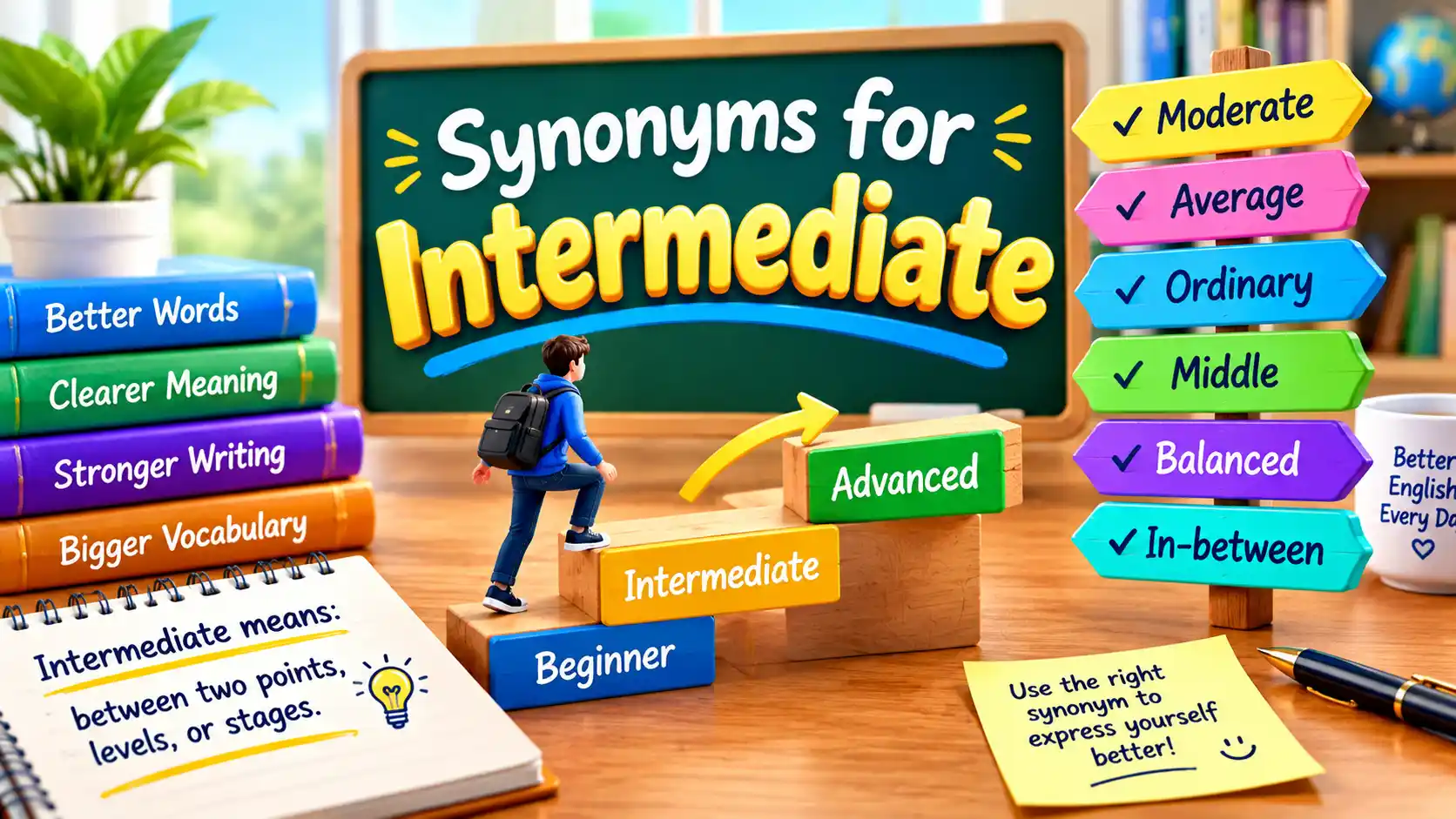
Looking for the best synonyms for intermediate? You’ve found them! Intermediate means “in the middle” — not a beginner anymore, but not yet an expert. Think of an English learner who can hold a conversation but still makes mistakes, or a skier who handles blue runs but not black ones.
In this guide, you’ll learn 40 great alternatives grouped by meaning: middle-level words like middle, medium, and moderate, learning words like developing and competent, go-between words like mediator and liaison, and everyday words like decent and middling. You’ll also learn how intermediate differs from beginner and advanced, plus grammar tips and easy examples. Let’s find your level!
📖 Meaning of “Intermediate”
Definition: Between two levels, stages, or extremes; neither beginning nor advanced. Also, a person at that middle level (e.g., “an intermediate skier”).
Part of Speech: Adjective (main use). Also a noun (“an intermediate”). A verb form exists but is rare (“to intermediate” = to act as a go-between).
Pronunciation: “in-ter-MEE-dee-it” (/ˌɪntərˈmiːdiət/).
Origin: From Latin intermedius — inter (between) + medius (middle). That’s why medium, median, and mediate are its word cousins.
Common Usage: “Intermediate English.” “An intermediate level.” “Intermediate results.”
Simple Explanation: Intermediate = the middle step. You’ve passed the start, but you haven’t reached the top yet.
📝 Top Synonyms of “Intermediate”
Middle-Level Words
| Word | Meaning | Best Use | Example |
| Middle | In the center, between two ends | General | She is at a middle level of Spanish. |
| Medium | Neither large nor small; neither high nor low | Size, level | Choose a medium difficulty puzzle. |
| Moderate | Not extreme; reasonable and middle | Skill, difficulty | A moderate workout suits most people. |
| Mid-level | At the middle stage of a scale | Work, courses | This is a mid-level management job. |
| In-between | Between two things or stages | Everyday | I’m in-between beginner and expert. |
| Halfway | At the middle point of a journey or course | Progress | We’re halfway through the course. |
| Average | Typical; neither very good nor very bad | General | His score was average for the class. |
| Standard | The usual, normal level | Exams, quality | A standard room, not a luxury one. |
| Transitional | Moving from one stage to another | Change, growth | This is a transitional phase of learning. |
| Bridging | Connecting two stages, like a bridge | Learning, gaps | A bridging course fills the gap. |
Learning and Skill Levels
| Word | Meaning | Best Use | Example |
| Developing | Growing in skill, not yet finished | Learners | Her English is improving fast. |
| Progressing | Moving forward step by step | Students | He’s a progressing piano player. |
| Advancing | Moving toward a higher level | Courses | An advancing skier tries harder slopes. |
| Competent | Good enough to do something well | Work, skills | She’s a competent driver now. |
| Semi-skilled | Partly trained, with some skills | Jobs | The factory needs semi-skilled workers. |
| Semi-pro | Almost professional, but not quite | Sports, arts | He plays at a semi-pro level. |
| Second-stage | At the second level of learning | Courses | This is a second-stage French class. |
| Mid-course | In the middle of a course | Study | The mid-course test was fair. |
| Post-beginner | Just past the beginner stage | Language learning | Post-beginner lessons are more fun. |
| Pre-advanced | Just before the advanced stage | Language learning | Pre-advanced students read novels. |
Go-Between and Connecting Words
| Word | Meaning | Best Use | Example |
| Intermediary | A person or thing acting between two sides | Business, formal | The bank acted as an intermediary. |
| Mediator | Someone who helps two sides agree | Conflict, talks | A mediator settled the dispute. |
| Middleman | A person between a maker and a buyer | Trade | The middleman takes a small fee. |
| Go-between | A person who carries messages between others | Everyday | She was our go-between with the team. |
| Liaison | A person who keeps two groups connected | Work, official | Our liaison handles the partner company. |
| Intervening | Coming between two things in time or space | Formal | In the intervening years, much changed. |
| Connecting | Joining two things together | General | A connecting road links the towns. |
| Middle-ground | A position between two extremes | Opinions | Let’s find a middle-ground solution. |
| Midway | At the middle point between two places | Travel, progress | We stopped midway through the hike. |
| Buffer | Something that sits between two things to protect | Zones, safety | A buffer zone separates the countries. |
Everyday Alternatives
| Word | Meaning | Best Use | Example |
| Fair | Reasonably good; not great, not bad | Everyday | Her French is fair — she manages fine. |
| Decent | Acceptable and quite good | Conversation | He has a decent level of German. |
| Ordinary | Normal, not special | General | An ordinary bike, nothing fancy. |
| Passable | Good enough to pass or get by | Tests, skills | His passable Italian helped on holiday. |
| So-so | Neither good nor bad (informal) | Casual talk | My cooking is so-so, honestly. |
| Middling | Middle in quality; average | Reviews | The film got middling reviews. |
| Run-of-the-mill | Ordinary, nothing special | Everyday | A run-of-the-mill hotel room. |
| Middle-of-the-road | Neither extreme; moderate | Opinions, style | A middle-of-the-road political view. |
| Median | The middle value in a set | Math, statistics | The median score was 72. |
| Middle-ranking | In the middle of a ranking | Sports, jobs | A middle-ranking team in the league. |
⚖️ Antonyms
Intermediate sits in the middle — so its opposites live at the two ends:
| Word | Meaning | Example |
| Beginner | Someone just starting | He’s a beginner at chess. |
| Elementary | The most basic level | Elementary English for new learners. |
| Novice | A person with very little experience | A novice cook burned the soup. |
| Advanced | At a high, near-expert level | An advanced course in physics. |
| Expert | Someone with top-level skill | She’s an expert in the field. |
| Extreme | Far from the middle; at an end | Extreme heat or extreme cold. |
| Highest | At the very top of a scale | The highest level of the game. |
| Final | The last stage, not a middle one | The final exam, not a practice one. |
💬 Example Sentences
Daily Conversation
- My English is intermediate — I can chat, but I still make mistakes.
- This puzzle is medium difficulty, not too hard.
- Her cooking is so-so, but her baking is amazing.
- We’re halfway through the road trip already.
Academic English
- Intermediate learners benefit from reading short stories.
- The study compared beginner, intermediate, and advanced groups.
- A transitional phase often follows rapid growth.
- The median score of the class was 68.
Business English
- This role needs a mid-level manager with five years’ experience.
- Our liaison handles all contact with the client.
- The report proposes a middle-ground solution.
- Semi-skilled workers receive extra training this month.
Formal Writing
- The committee appointed an intermediary to lead the talks.
- The intervening years brought major changes to the town.
- A bridging course prepares students for university.
- The results were middling, neither strong nor weak.
Informal Writing
- I’m in-between levels — too good for beginners, too slow for experts, lol.
- His German is decent; he ordered food without any drama.
- The hotel was run-of-the-mill, but the breakfast saved it.
- Post-beginner yoga is where the fun really starts.
Creative Writing
- She stood midway on the bridge, between two worlds.
- The buffer of trees softened the noise from the road.
- His advancing skill surprised even his teacher.
- A middle-ranking knight dreamed of the final tournament.
📚 Difference Between Similar Words
| Word | What It Means | When to Use It |
| Intermediate | A level between beginner and advanced | “Intermediate English; an intermediate skier.” |
| Beginner | Just starting; little or no skill | “A beginner’s guide; a beginner class.” |
| Advanced | High skill, close to expert | “Advanced physics; an advanced learner.” |
| Medium | Middle in size or amount (not a learning level) | “A medium coffee; medium heat.” |
| Average | Typical or normal; a math mean | “An average score; the average student.” |
Simple rule: For learning levels, use beginner → intermediate → advanced. For sizes and amounts, use medium. For “typical,” use average — it doesn’t mean “in the middle of a course.”
🎯 Best Alternative Words
- Professional Writing: intermediate, mid-level, competent — clear and respected.
- Essay Writing: transitional, intermediary, intervening — formal and precise.
- Email: mid-level, in-between, decent — friendly and simple.
- Business: mid-level, liaison, middle-ground — perfect for roles and negotiations.
- Conversation: fair, so-so, halfway — natural and everyday.
- Marketing: developing, advancing, progressing — positive and forward-looking.
- Creative Writing: midway, buffer, bridging — visual and poetic.
✍ Grammar Tips
| Form | Word | Example |
| Adjective | intermediate | An intermediate course. |
| Noun | intermediate / intermediates | She’s an intermediate in this class. |
| Verb (rare) | intermediate | He intermediated between the two sides. |
| Adverb (rare) | intermediately | Rarely used — prefer “at an intermediate level.” |
| Comparative | more intermediate | This class is more intermediate than the last. |
- No “-er” form: Never write “intermediater.” Use more intermediate.
- Adjective before nouns: “Intermediate students” — not “intermediates students.”
- Add “level” when needed: “I am at an intermediate level of English” — not “an intermediate level of English.”
- In language learning: Intermediate usually means B1 on the CEFR scale; upper-intermediate means B2. That’s the standard schools use worldwide.
❌ Common Mistakes
| ❌ Wrong | ✅ Correct | 💡 Reason |
| She is a intermediater student. | She is an intermediate student. | No “-er” form exists; also use “an” before a vowel sound. |
| This course is for intermediate students. | This course is for intermediate students. | Use the adjective form before a noun, not the plural noun. |
| He is more intermediater than me. | He is more intermediate than me. | Comparatives of long adjectives use “more.” |
| I am at an intermediate level of English. | I am at an intermediate level of English. | “Intermediate” needs “level” to describe a stage of learning. |
| My English is intermediate. | My English is at an intermediate level. | The adverb “intermediately” is almost never used in real English. |
| The middle of the book was boring. | The middle of the book was boring. | For parts of things, use “middle,” not “intermediate.” |
💡 Pro Writing Tips
- For levels, name the scale. “Intermediate (B1)” tells a reader exactly where you stand — vague “middle” doesn’t.
- Match the word to the field. Mid-level fits jobs, post-beginner fits language classes, mediator fits negotiations.
- Don’t confuse medium and intermediate. A “medium shirt” is a size; an “intermediate course” is a level. Mixing them is a common learner error.
- Use “developing” for encouragement. In feedback, “developing” sounds kinder than “average” — it promises growth.
- Keep “intermediary” for people and roles. For skill levels, stick with intermediate or mid-level — “intermediary English” sounds wrong.
📖 Related Words
- Associated words: middle, medium, median, mediate, mediator
- Nearby words: level, stage, phase, standard, grade
- Contextual words: beginner, advanced, expert, CEFR, B1, B2
- Semantic variations: mid-level, in-between, halfway, middle-of-the-road
FAQs
1. What does intermediate mean?
Intermediate means in the middle — between a beginning level and an advanced one. An intermediate English learner can hold everyday conversations but still make grammar mistakes. An intermediate skier handles gentle slopes but not steep black runs. The word comes from Latin intermedius, meaning “in the middle,” and it’s the standard middle step in most learning scales.
2. What is a synonym for intermediate?
The best synonyms for intermediate are middle, medium, mid-level, moderate, and in-between. For learning, use developing or competent; for jobs, mid-level; for people who connect two sides, mediator or liaison. The right word depends on your sentence — a level, a job, or a go-between role all take different words.
3. What is the difference between beginner and intermediate?
A beginner is just starting and knows only the basics — a few words, simple rules, easy tasks. An intermediate learner has passed that stage: they can use the language or skill in real situations, though not perfectly. In English learning, beginner is roughly A1–A2 on the CEFR scale, while intermediate is B1 — a clear, big step forward.
4. What level is intermediate in English?
In English learning, intermediate usually means B1 on the CEFR scale, the international standard. A B1 learner can handle travel, work, and everyday topics, and can describe experiences and dreams. Upper-intermediate is the next step, B2, where learners discuss complex ideas fluently. Schools and exams worldwide use these levels consistently.
5. Is intermediate higher than beginner?
Yes — intermediate is one full step above beginner. The standard order is beginner → intermediate → advanced → expert. A beginner learns the alphabet and simple phrases; an intermediate learner holds conversations and writes short texts. If you can already use a skill in real life, even imperfectly, you’ve reached intermediate.
6. What is the opposite of intermediate?
Intermediate has two opposites, one at each end: beginner (or elementary, novice) at the low end, and advanced (or expert) at the high end. Which opposite you need depends on the direction — “lower than intermediate” means beginner, while “higher than intermediate” means advanced. Both are correct, just in opposite directions.
7. Is intermediate an adjective or a noun?
Intermediate is mainly an adjective: “an intermediate course,” “intermediate English.” But it can also be a noun for a person at that level: “She’s an intermediate in this ski school.” The plural noun is intermediates. A rare verb form also exists — “to intermediate” means to act as a go-between — but you’ll almost never need it.
8. What comes after intermediate level?
After intermediate comes advanced, then expert (or proficient in language learning). In CEFR terms, intermediate is B1, upper-intermediate is B2, advanced is C1, and proficiency is C2. In sports and hobbies, the same ladder applies: intermediate skiers move to advanced slopes, and intermediate players join advanced leagues as their skills grow.
Conclusion
Now you’ve got 40 great synonyms for intermediate — from everyday words like middle, fair, and halfway to precise ones like mid-level, developing, and mediator. Remember the learning ladder: beginner → intermediate → advanced, and for English, intermediate means B1. Choose the word that fits your sentence — a level, a job, or a go-between — and watch out for the classic traps (no “intermediater,” and add “level” when you talk about learning). Keep practicing with the example sentences, and explore more vocabulary guides on Synonymfy.com to climb your English ladder every day!