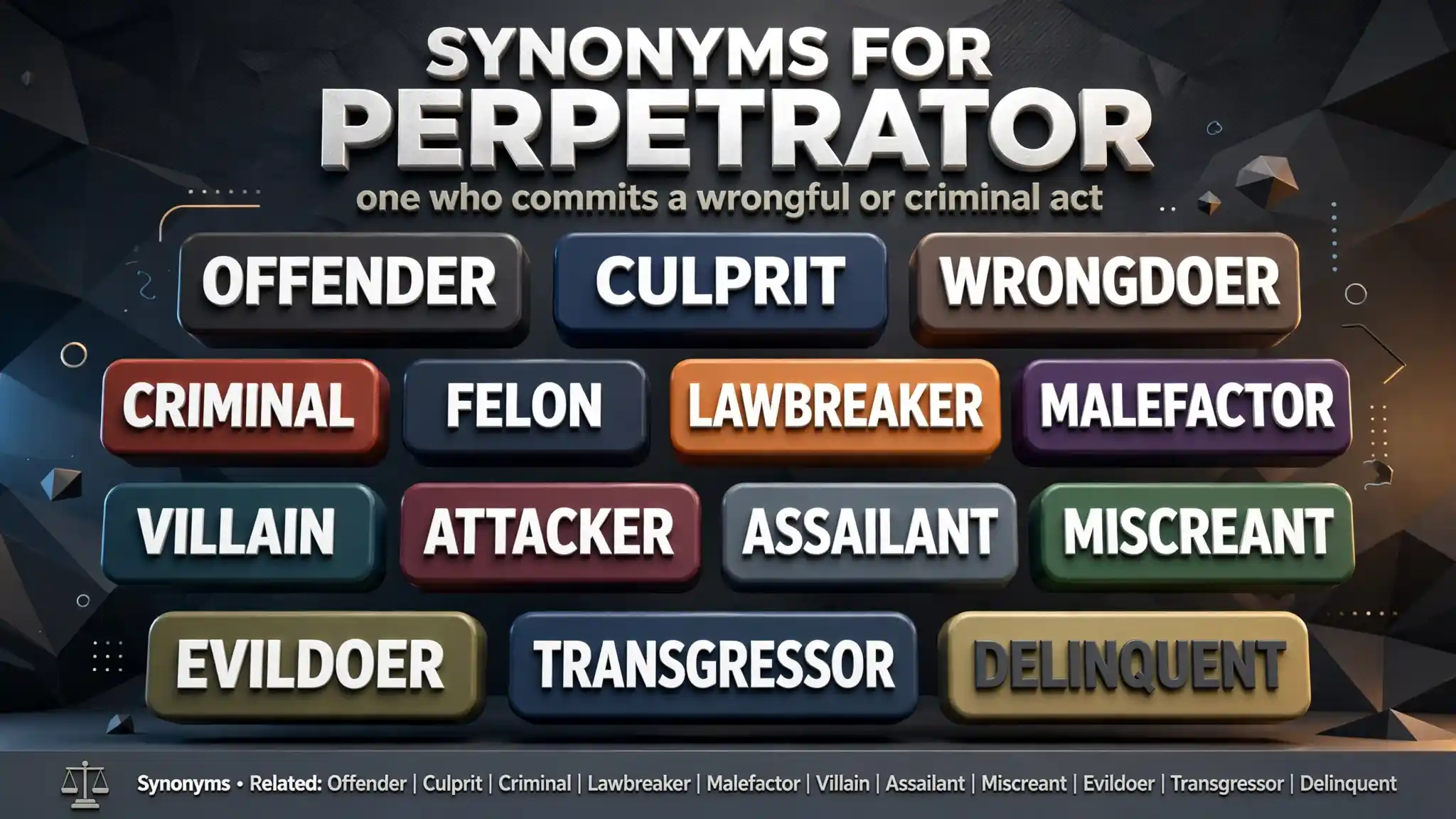
What does perpetrator mean? A perpetrator is the person who commits a crime or a harmful act. People search for synonyms for perpetrators when they write essays, news reports, or stories and want a fresh word.
But be careful — not every similar word fits every situation. Culprit sounds light, felon sounds legal, and villain belongs in stories. This guide gives you 40 accurate synonyms for perpetrator, grouped by meaning, with simple definitions and real examples. You’ll also learn antonyms, grammar tips, and common mistakes. Let’s build your vocabulary the right way.
📖 Meaning of “Perpetrator”
- Definition: A perpetrator is a person who commits a crime or does something harmful. (Cambridge Dictionary, Merriam-Webster)
- Part of Speech: Noun
- Pronunciation: PUR-puh-tray-ter
- Origin: From the Latin perpetrare, meaning “to carry out” or “to commit.”
- Common Usage: Used in news, legal writing, and formal discussions about crime.
- Simple Explanation: The perpetrator is the one who did it — the doer of the harmful act.
📝 Top Synonyms of “Perpetrator”
General Words for Someone Who Does Wrong
| Word | Meaning | Best Use | Example |
| culprit | the person responsible for something bad | everyday talk and news | The culprit broke the window and ran away. |
| offender | someone who breaks a law or rule | formal and legal writing | The offender was fined for speeding. |
| criminal | someone who commits crimes | news and formal writing | The criminal was caught by the police last night. |
| wrongdoer | someone who does something morally wrong | essays and moral discussions | Every wrongdoer must face the results of their actions. |
| evildoer | someone who does evil or cruel things | stories and dramatic writing | The evildoer planned to harm the whole village. |
| miscreant | someone who behaves badly or breaks rules | formal or literary writing | The miscreant was removed from the school event. |
| sinner | someone who does wrong in a religious sense | religious contexts | The preacher said every sinner can seek forgiveness. |
| transgressor | someone who breaks a law or moral rule | formal writing | The transgressor ignored every warning sign. |
| malefactor | someone who commits a crime (formal) | legal and formal writing | The malefactor was sentenced to five years in prison. |
| reprobate | a very bad person with no morals | literary writing | The reprobate showed no regret for his crimes. |
| scoundrel | a dishonest or bad person | informal writing and stories | The scoundrel tricked the old man out of his money. |
| rogue | a dishonest person, sometimes charming | stories and informal talk | The rogue smiled as he told another lie. |
| villain | an evil character, often in stories | fiction and movies | The villain planned to steal the crown jewels. |
| delinquent | a young person who breaks laws | legal and news contexts | The delinquent was sent to a youth center. |
Words for a Violent Attacker
| Word | Meaning | Best Use | Example |
| assailant | someone who attacks violently | news reports | The assailant was arrested near the park. |
| attacker | someone who attacks | everyday and news language | The attacker ran off before help arrived. |
| aggressor | someone who starts a fight or attack | formal discussions | The aggressor started the fight without warning. |
| assaulter | someone who commits assault | legal contexts | The assaulter faced charges in court. |
| mugger | someone who robs people by force in the street | news and safety warnings | The mugger stole her purse and fled. |
| thug | a violent and cruel person | informal and news | The thugs threatened the shopkeeper for money. |
Legal and Formal Terms
| Word | Meaning | Best Use | Example |
| felon | someone guilty of a serious crime | legal writing (US) | The felon lost the right to vote. |
| convict | someone found guilty and punished | legal and news | The convict is serving ten years in prison. |
| lawbreaker | someone who breaks the law | formal writing | Every lawbreaker must answer in court. |
| misdemeanant | someone guilty of a minor crime | legal writing (US) | The misdemeanant paid a small fine. |
| recidivist | someone who commits crimes again and again | legal and academic | The recidivist returned to prison within a year. |
| outlaw | someone who lives outside the law | historical and literary | The outlaw hid in the mountains for years. |
Narrower Terms — Specific Crimes
Note: These name the doer of one specific crime. They’re useful, but they don’t cover every crime like “perpetrator” does.
| Word | Meaning | Best Use | Example |
| murderer | someone who kills on purpose | serious crime reports | The murderer was caught within two days. |
| killer | someone who causes death | news and stories | The killer left no clues behind. |
| thief | someone who steals | everyday talk | The thief took her bike from the yard. |
| robber | someone who steals using force or threats | news reports | The robber demanded money from the bank clerk. |
| burglar | someone who breaks into buildings to steal | news and warnings | The burglar entered through the back window. |
| fraudster | someone who cheats people for money | business and news | The fraudster faked invoices to steal funds. |
| vandal | someone who damages property on purpose | news and school contexts | The vandal sprayed paint on the school wall. |
| arsonist | someone who sets fires on purpose | news reports | The arsonist burned down the empty warehouse. |
Old-Fashioned and Literary Terms
| Word | Meaning | Best Use | Example |
| blackguard | a rude, dishonest man (old use) | classic literature | The blackguard cheated at cards all evening. |
| knave | a dishonest man (old use) | classic literature | The knave plotted against the king. |
| varlet | a dishonest servant or man (old use) | historical fiction | The varlet stole bread from the kitchen. |
| caitiff | a cowardly villain (old use) | old poetry | The caitiff begged for mercy at last. |
| dastard | a sneaky, cowardly villain (old use) | classic stories | The dastard attacked from behind. |
| rapscallion | a mischievous troublemaker (old use) | playful old writing | The young rapscallion skipped school again. |
⚖️ Antonyms
| Word | Meaning | Example |
| victim | the person harmed by the act | The victim told the police what happened. |
| injured party | the person hurt (formal) | The injured party asked for compensation. |
| sufferer | someone who suffers | The sufferer needed medical help. |
| hero | someone who does brave, good deeds | The hero saved the child from the fire. |
| savior | someone who rescues others | The savior arrived just in time. |
| rescuer | someone who saves people from danger | The rescuer pulled them from the car. |
| protector | someone who keeps others safe | The protector guarded the door all night. |
| law-abiding citizen | someone who follows the law | Every law-abiding citizen deserves safety. |
💬 Example Sentences
Daily Conversation
- Police are still looking for the perpetrator of last night’s robbery.
- Who’s the culprit who finished all the cookies?
- The offender apologized and paid for the damage.
- They never found the thief who took my bag.
Academic English
- Researchers studied how perpetrators choose their targets.
- The essay compared the motives of the offender and the victim.
- Recidivist behavior rises when support systems fail.
- Scholars debate whether a young delinquent can fully reform.
Business English
- The fraudster behind the fake invoices has been identified.
- Our firm helps victims take legal action against offenders.
- The company fired the wrongdoer the same day.
- Auditors traced the loss to a single perpetrator inside the firm.
Formal Writing
- The perpetrator of this crime will face full legal consequences.
- Every malefactor must answer for their actions in court.
- The transgressor violated three separate regulations.
- Lawbreakers damage the trust a community depends on.
Informal Writing
- That scoundrel never returned my book!
- The villain in this movie is actually pretty funny.
- Some rogue hacked my game account yesterday.
- The mugger took his wallet near the station.
Creative Writing
- The evildoer laughed as the castle gates slammed shut.
- A lone outlaw rode into town at midnight.
- The dastard waited in the shadows with a dagger.
- No one suspected the quiet knave in the corner.
📚 Difference Between Similar Words
| Word | Meaning | When to Use | Example |
| perpetrator | the one who committed the act | serious, factual, legal | Police are hunting the perpetrator. |
| culprit | the one responsible | everyday, lighter tone | The culprit ate all the cookies. |
| criminal | one who commits crimes | implies a pattern of crime | The criminal had three past convictions. |
| offender | one who breaks rules or laws | legal and formal | First-time offenders may get a warning. |
| suspect | one believed to have done it | guilt not yet proven | The suspect was released yesterday. |
🎯 Best Alternative Words
- Professional Writing: offender, perpetrator, lawbreaker
- Essay Writing: wrongdoer, culprit, transgressor
- Email (formal): offender, the responsible party
- Business: fraudster (for fraud), offender, wrongdoer
- Conversation: culprit, thief (for stealing)
- Marketing: avoid — negative words hurt brands; use “issue” or “challenge” instead
- Creative Writing: villain, malefactor, evildoer, scoundrel
✍ Grammar Tips
- Noun: perpetrator (the person) — The perpetrator fled the scene.
- Verb: perpetrate (to commit) — He perpetrated a fraud.
- Noun (act): perpetration — The perpetration of the crime shocked everyone.
- Plural: perpetrators — Two perpetrators were arrested.
- Adjective: none direct — use “criminal” as the adjective (criminal behavior).
- Adverb: none — rephrase instead (He acted criminally).
- Common Mistakes: spelling it “perpetrater”; mixing it up with “suspect”; using it for accidents instead of deliberate acts.
❌ Common Mistakes
| Wrong | Correct | Reason |
| The suspect is the perpetrator. | The suspect may be the perpetrator. | A suspect is only accused; a perpetrator actually did it. |
| perpetrater | perpetrator | Correct spelling ends in -trator. |
| He is the perpetrator of the car accident. | He caused the car accident. | Perpetrator fits deliberate crimes, not accidents. |
| The victim was the perpetrator. | The victim suffered; the perpetrator caused it. | The victim and perpetrator are opposites. |
| A perpetrator commits the crime. | A perpetrator commits the crime. | A singular subject needs the -s verb form. |
💡 Pro Writing Tips
- Match severity: culprit for small wrongs, felon for serious crimes.
- Protect yourself legally: in journalism, write “alleged perpetrator” or “suspect” until a court convicts.
- Know your audience: villain for stories, offender for reports, culprit for chat.
- Be precise: if the crime is theft, “thief” beats the vague “perpetrator.”
- Avoid repetition: rotate culprit, offender, and wrongdoer in long articles.
📖 Related Words
- Associated: perpetrate, perpetration, crime, offense, felony, misdemeanor
- Nearby: victim, accomplice (helper), accessory (helper after the fact), guilt, punishment
- Contextual: justice, trial, sentence, conviction, arrest, investigation
- Semantic: wrongdoing, misconduct, violation, breach, atrocity
❓ FAQs
1. What is the best synonym for perpetrator?
“Culprit” is the best everyday synonym for perpetrator. It’s simple, neutral, and fits news, essays, and conversation. For legal writing, use “offender.” For stories, “villain” works well. Choose based on your audience: culprit for general use, felon for serious crimes, and malefactor for formal reports.
2. What is the difference between perpetrator and culprit?
A perpetrator is the person who committed a crime or harmful act, often used in serious or legal contexts. A culprit is simply the one responsible, and it can sound lighter — even funny. You’d call a thief a perpetrator in court but the cookie thief at home a culprit.
3. Is criminal a synonym for perpetrator?
Yes, but with a difference. A perpetrator did one specific act, while “criminal” suggests someone who commits crimes as a pattern. Every criminal is a perpetrator of their crimes, but a first-time perpetrator isn’t always called a criminal. Use “criminal” when the person has a record of offenses.
4. What is the opposite of perpetrator?
The direct opposite is “victim” — the person harmed by the act. Other antonyms include “injured party” (formal), “sufferer,” and positive opposites like “hero,” “savior,” “rescuer,” and “protector.” In legal contexts, “law-abiding citizen” also works as an opposite. Choose the one that fits your sentence best.
5. Can I use perpetrator in everyday conversation?
You can, but it sounds formal. In casual talk, “culprit” feels more natural: “Who’s the culprit who ate my lunch?” Save “perpetrator” for serious topics like news, reports, or discussions about crime. Using it for small everyday things can sound overly dramatic or funny.
6. What is the verb form of perpetrator?
The verb is “perpetrate,” meaning to commit a crime or harmful act: “He perpetrated a fraud.” The noun for the act itself is “perpetration.” So the family is: perpetrate (verb), perpetration (noun), perpetrator (person). Remember the spelling: per-pe-tra-tor, not “perpetrater.”
7. Is suspect a synonym for perpetrator?
No, and this is a common mistake. A suspect is someone believed to have committed a crime but not yet proven guilty. A perpetrator is the person who actually did it. News outlets say “alleged perpetrator” or “suspect” until a court decides. Never call someone a perpetrator before proof.
8. What are formal synonyms for perpetrator?
For formal and legal writing, use “offender,” “felon” (serious crimes in the US), “convict” (found guilty), “lawbreaker,” “malefactor,” or “transgressor.” In court documents, “the accused” refers to someone on trial. Match the word to the situation: felon for serious crimes, misdemeanant for minor ones.
Conclusion
You now know 40 accurate synonyms for perpetrator — from everyday words like culprit and offender to legal terms like felon and convict, plus story-ready picks like villain and scoundrel. Remember the golden rules: match the word to the crime’s severity, know your audience, and never confuse a suspect with a perpetrator.