
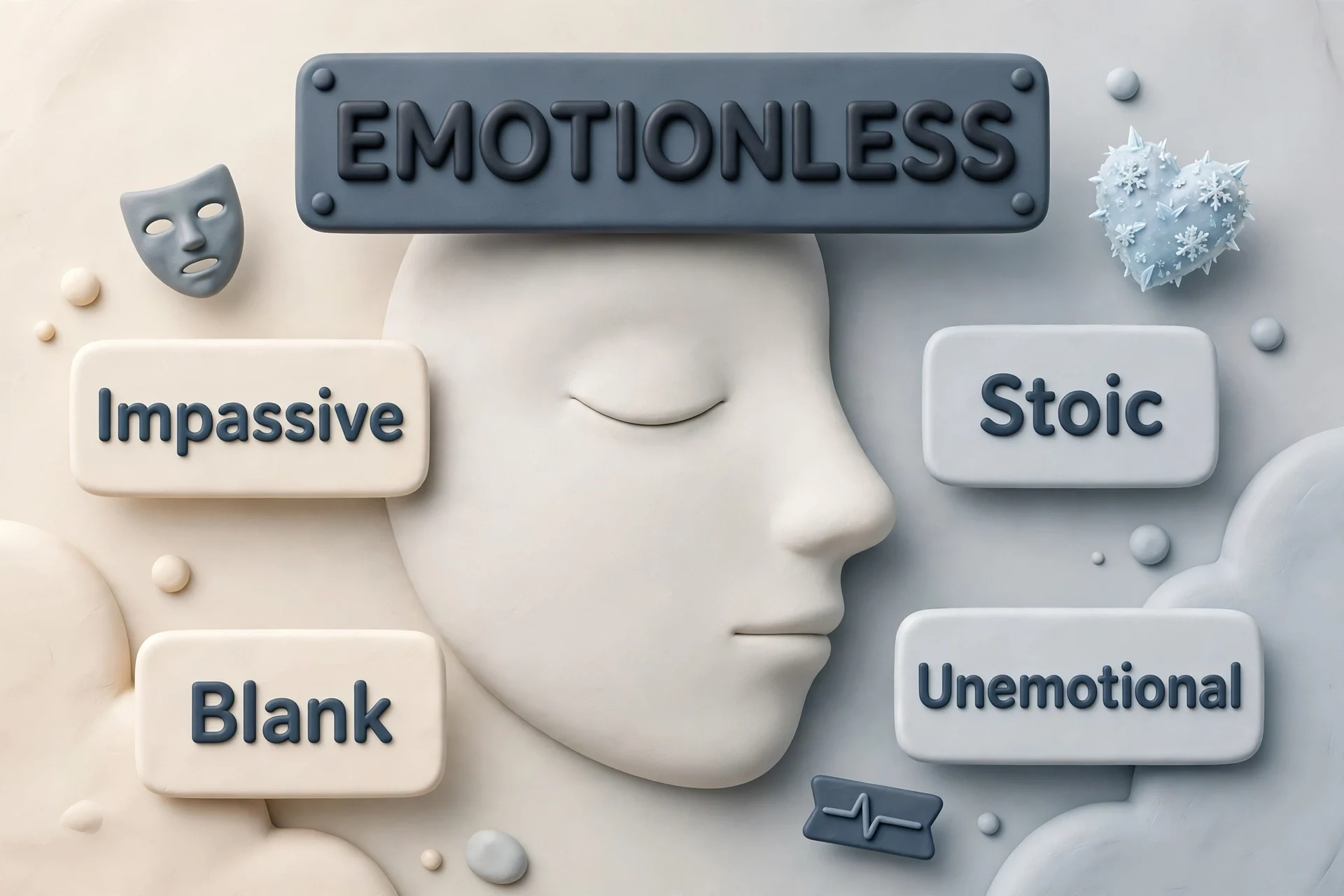
Some faces tell you nothing — no smile, no frown, no sign of what the person feels inside. “Emotionless” is the word for that still, unreadable look, and it comes from a surprising root: “emotion” once meant a public stir or uprising, not a feeling at all.
In this guide, you will find 40 synonyms for emotionless, sorted into four clear groups, with meanings, best uses, and real examples. You will also learn the difference between emotionless, unemotional, apathetic, and stoic, plus grammar tips and common mistakes. By the end, you will know exactly which word fits your sentence — and your writing will feel sharper, clearer, and more precise.
📖 Meaning of Emotionless
Definition: “Emotionless” is an adjective. Merriam-Webster defines it as “showing, having, or expressing no emotion” — for example, “an emotionless stare”. Oxford Learner’s Dictionaries defines it simply as “not showing any emotion”, as in “an emotionless voice”. In simple words, something emotionless shows no feeling at all — a face, a voice, or a reply that gives nothing away.
Part of Speech: Adjective
Pronunciation: ih-MOH-shun-lus /ɪˈmoʊʃənləs/
Origin: “Emotionless” is built from “emotion” plus “-less”, meaning “without emotion”. “Emotion” itself comes from French émotion, from Old French emouvoir, “stir up”, from Latin emovēre, “to remove, displace”, from e-, “out”, plus movēre, “to move”. In the 1570s, “emotion” meant a public moving or agitation — a riot in the streets — and only by the 1650s did it mean a strong feeling, then any feeling by 1808. Merriam-Webster records the first known use of “emotion” in 1579, and of “emotionless” in 1843.
Common Usage: People use “emotionless” for faces, voices, stares, replies, and masks — “an emotionless face”, “an emotionless voice”, “an emotionless stare”. It often sounds cold or distant, but it can also be neutral, as in a calm professional reply.
Simple Explanation: If someone is emotionless, their face and voice show no feeling — you cannot tell if they are happy, sad, or angry.
📝 Top Synonyms for Emotionless
Showing No Feeling
| Word | Meaning | Best Use | Example |
| Impassive | Showing no sign of feeling | Formal writing | An impassive face. |
| Unemotional | Not easily moved by feeling | Daily speech and writing | An unemotional man. |
| Expressionless | With no expression on the face | Faces and looks | An expressionless stare. |
| Blank | Empty of expression | Faces and voices | A blank look. |
| Deadpan | Deliberately showing no feeling | Humour and acting | A deadpan joke. |
| Wooden | Stiff and without feeling | Acting and speech | A wooden performance. |
| Stony | Cold and hard, like stone | Faces and silence | A stony silence. |
| Frozen | Fixed and unable to move | Faces and looks | A frozen smile. |
| Flat | Without feeling or energy | Voices and tones | A flat voice. |
| Vacant | Empty, showing no thought | Faces and eyes | Vacant eyes. |
Cold, Detached
| Word | Meaning | Best Use | Example |
| Cold | Without warmth or feeling | People and replies | A cold reply. |
| Detached | Emotionally distant | Formal writing | A detached manner. |
| Distant | Far away in feeling | People and behaviour | A distant father. |
| Aloof | Cool and not friendly | People and manners | An aloof stranger. |
| Reserved | Quiet and not showing feelings | People and character | A reserved man. |
| Withdrawn | Pulled back from others | People and behaviour | A withdrawn child. |
| Uncaring | Not caring about others | People and actions | An uncaring boss. |
| Unfeeling | Without sympathy or feeling | People and actions | An unfeeling remark. |
| Heartless | Cruel, without pity | People and actions | A heartless decision. |
| Callous | Hardened, without feeling | People and actions | A callous remark. |
Calm, Controlled
| Word | Meaning | Best Use | Example |
| Stoic | Enduring pain without showing feeling | Formal and literary writing | A stoic soldier. |
| Composed | Calm and in control | People and situations | A composed speaker. |
| Calm | Peaceful and not excited | Daily speech | A calm voice. |
| Cool | Calm under pressure | Daily speech | He stayed cool. |
| Collected | Calm and in control | Formal writing | A collected manner. |
| Poised | Calm and confident | People and behaviour | A poised young woman. |
| Serene | Peaceful and untroubled | People and places | A serene face. |
| Tranquil | Calm and quiet | Places and moods | A tranquil morning. |
| Steady | Firm and not shaking | Voices and nerves | A steady voice. |
| Unmoved | Not affected by feeling | Formal writing | He was unmoved by the news. |
Uninterested, Not Caring
| Word | Meaning | Best Use | Example |
| Apathetic | Showing no interest or concern | Formal writing | An apathetic crowd. |
| Bored | Tired of something, not interested | Daily speech | A bored student. |
| Uninterested | Not interested at all | Daily speech | An uninterested look. |
| Unconcerned | Not worried or caring | Formal writing | An unconcerned shrug. |
| Blasé | Unimpressed by things that once excited | Formal writing | A blasé traveller. |
| Jaded | Tired and bored from too much | Formal writing | A jaded critic. |
| Weary | Tired, with no energy left | People and moods | A weary sigh. |
| Numb | Unable to feel, physically or emotionally | Feelings and moods | A numb heart. |
| Empty | Feeling nothing inside | Feelings and moods | An empty feeling. |
| Listless | Lacking energy or interest | People and moods | A listless afternoon. |
⚖️ Antonyms of Emotionless
| Word | Meaning | Example |
| Emotional | Full of strong feeling | An emotional speech. |
| Expressive | Showing feelings clearly | An expressive face. |
| Passionate | Full of strong feeling | A passionate singer. |
| Sensitive | Easily moved by feeling | A sensitive child. |
| Warm | Kind and friendly | A warm smile. |
| Lively | Full of life and energy | A lively party. |
| Enthusiastic | Full of excitement | An enthusiastic crowd. |
| Empathetic | Understanding others’ feelings | An empathetic friend. |
| Caring | Kind and thoughtful | A caring nurse. |
| Animated | Full of life and movement | An animated talk. |
💬 Example Sentences
Daily Conversation
- His face was emotionless when he heard the news.
- She gave an emotionless reply and walked away.
- The guard stood emotionless at the door.
- He watched the game with an emotionless face.
Academic English
- The study found that emotionless faces are harder to read.
- Researchers studied how an emotionless voice affects trust.
- The article explains why some people seem emotionless under stress.
- A flat, emotionless tone can make a speech feel cold.
Business English
- The manager kept an emotionless face during the meeting.
- A calm, emotionless reply can help in a tough talk.
- The letter was short, cold, and emotionless.
- Stay emotionless when you hear bad news at work.
Formal Writing
- The judge listened with an emotionless face.
- The report described the witness as calm and emotionless.
- Her emotionless voice hid her true feelings.
- The ceremony ended in emotionless silence.
Informal Writing
- He read my message and gave an emotionless “ok”.
- Her text was so emotionless, I could not tell if she was happy.
- I tried to stay emotionless, but my hands shook.
- That movie was so boring, it left me emotionless.
Creative Writing
- The statue stared back, cold and emotionless.
- An emotionless wind moved through the empty streets.
- Her eyes were emotionless, like glass in winter.
- The robot spoke in an emotionless voice, soft and flat.
📚 Difference Between Similar Words
| Word | Meaning | When to Use It | Example |
| Emotionless | Shows no emotion at all, often cold | For a face, voice, or reply with no feeling | His face was emotionless. |
| Unemotional | Not easily moved, calm by nature | For a person who rarely shows feeling | An unemotional man. |
| Apathetic | No interest or concern, does not care | For someone who does not care at all | An apathetic crowd. |
| Stoic | Endures pain without showing feeling | For quiet strength in hard times | A stoic soldier. |
Simple rule: Use emotionless for no feeling shown, unemotional for a calm nature, apathetic for no care at all, and stoic for quiet strength under pressure.
🎯 Best Alternative Words
- Professional Writing: Use “unemotional” or “impassive” for formal writing, as in “an unemotional reply” or “an impassive face”.
- Essay Writing: Use “stoic” or “impassive” for a strong vocabulary, as in “a stoic hero” or “an impassive judge”.
- Email: Use “calm” or “composed” for a polite tone, as in “a calm reply” or “a composed message”.
- Business: Use “composed” or “calm” for meetings and talks, as in “a composed speaker” or “a calm voice”.
- Conversation: Use “blank”, “flat”, or “cold” — they sound natural, as in “a blank look” or “a cold reply”.
- Marketing: Use “calm” or “composed” to sound steady, as in “a calm, composed brand voice”.
- Creative Writing: Use “stony”, “impassive”, or “vacant” to paint a cold scene, as in “a stony silence” or “vacant eyes”.
✍ Grammar Tips
- Word family: emotion (noun), emotional (adjective), emotionless (adjective), emotionlessly (adverb), emotionlessness (noun).
- “Emotionless” is an adjective: It describes a noun — “an emotionless face”, “an emotionless voice”. It never stands alone as a noun.
- Comparative: Use “more” and “most” — “more emotionless”, “most emotionless”. Never say “emotionlesser” or “emotionlessest”.
- “An”, not “a”: “Emotionless” starts with a vowel sound, so say “an emotionless face”, never “an emotionless face”.
- Adverb form: Add “-ly” — “emotionlessly”. “She spoke emotionlessly.”
- Noun form: Add “-ness” — “emotionlessness”. “His emotionlessness surprised me.”
- One word, not two: “Emotionless” is a single word. Never write “emotion less”.
❌ Common Mistakes
| Wrong | Correct | Reason |
| He is emotionlesser than me. | He is more emotionless than me. | Long adjectives use “more”, not “-er”. |
| She spoke emotionlessly. | She spoke emotionlessly. | After a verb we need the adverb “emotionlessly”. |
| His face was emotionless. | His face was emotionless. | “Emotionless” is one word, not two. |
| He showed an emotionless face. | He showed an emotionless face. | “Emotionless” starts with a vowel sound, so use “an”. |
| She is unemotionless. | She is unemotional. | “Emotionless” already means “without emotion”; do not add “un-“. |
| His emotionlessness surprised me. | His emotionlessness surprised me. | The noun form is “emotionlessness”, not “emotionless”. |
💡 Pro Writing Tips
- Pick by meaning, not by habit: If no feeling is shown, use “emotionless”. If the person is calm by nature, use “unemotional”. If they do not care, use “apathetic”. If they endure quietly, use “stoic”.
- Match the tone: “Emotionless” often sounds cold. For a positive tone, use “calm” or “composed”. For a neutral tone, use “unemotional” or “impassive”.
- Show the face: Instead of saying “He was emotionless”, show it — “His face did not move. His eyes stayed flat.”
- Use it sparingly: One “emotionless” per paragraph is plenty. If you use it in every sentence, your writing sounds flat.
- Watch the article: It is “an emotionless face”, not “an emotionless face” — the vowel sound needs “an”.
- Pair it with a noun: “Emotionless” works best before a noun — “an emotionless face”, “an emotionless voice”, “an emotionless stare”.
📖 Related Words
- Emotion — noun; a strong feeling, such as joy, anger, or fear
- Emotional — adjective; full of strong feeling
- Emotionlessly — adverb; in an emotionless way
- Emotionlessness — noun; the state of showing no emotion
- Apathy — noun; lack of interest or concern
- Apathetic — adjective; showing no interest or concern
- Stoic — adjective; enduring pain without showing feeling
- Stoicism — noun; the quality of enduring without complaint
- Impassive — adjective; showing no sign of feeling
- Unemotional — adjective; not easily moved by feeling
- Feeling — noun; an emotion or a sense
- Sentiment — noun; a feeling or an opinion
- Passion — noun; a very strong feeling
- Indifference — noun; lack of interest or concern
❓ FAQs
What is the best synonym for emotionless?
“Impassive” is the best all-round synonym for emotionless, because it fits faces, voices, and people. “Unemotional” is best for a calm nature, “stoic” is best for quiet strength, and “blank” is best for a face with no expression. Pick the word that matches the exact idea you mean.
What is the difference between emotionless and unemotional?
“Emotionless” means showing no emotion at all, often cold or distant — a face with no feeling. “Unemotional” means not easily moved by feeling, calm by nature — a person who rarely shows emotion. “Emotionless” describes a moment, while “unemotional” describes a character. Use “emotionless” for a look and “unemotional” for a person.
Is emotionless an adjective?
Yes, “emotionless” is an adjective. It describes a noun, as in “an emotionless face” or “an emotionless voice”. Its adverb form is “emotionlessly”, as in “She spoke emotionlessly”, and its noun form is “emotionlessness”, as in “His emotionlessness surprised me”.
How do I use emotionless in a sentence?
Put “emotionless” before the noun it describes, as in “His face was emotionless when he heard the news” or “She gave an emotionless reply.” You can also use it after a linking verb, as in “The guard stood emotionless at the door.” Never use it as a noun — say “emotionlessness”, not “emotionless”.
What is the opposite of emotionless?
The opposite of “emotionless” is “emotional”. Other antonyms are “expressive”, “passionate”, “sensitive”, and “warm”. For example, “an emotional speech” is the opposite of “an emotionless speech”. The best antonym depends on the sense — “expressive” fits a face, and “passionate” fits a person.
Is emotionless a negative word?
Often, yes. “Emotionless” usually sounds cold, distant, or uncaring, as in “an emotionless reply”. But it can be neutral too — a calm, professional reply in a tough meeting may simply be “emotionless”. For a positive tone, use “calm” or “composed” instead, and save “emotionless” for a truly blank look.
What is the difference between emotionless and apathetic?
“Apathetic” means showing no interest or concern — the person does not care. “Emotionless” means showing no feeling — the person may still care deeply inside, but their face and voice give nothing away. A student can be apathetic about homework, while a soldier can be emotionless under fire and still care very much.
What is an emotionless face?
An emotionless face is a face with no expression — the eyes stay flat, the mouth stays still, and nothing shows. It is also called a “blank face” or a “deadpan look”. An emotionless face is hard to read, because you cannot tell what the person thinks or feels from their face alone.
Conclusion
“Emotionless” is a small word with a cold job — it names a look, a tone, or a reply that shows no feeling at all. Now you know 40 words that can do the same job more clearly: “impassive” for no sign of feeling, “unemotional” for a calm nature, “apathetic” for no care at all, and “stoic” for quiet strength. Keep the grammar simple: “emotionless” is an adjective, so it describes a noun, and its comparative is “more emotionless”. Pick the word that fits your exact meaning, and your writing will sound sharper, clearer, and more precise.


