
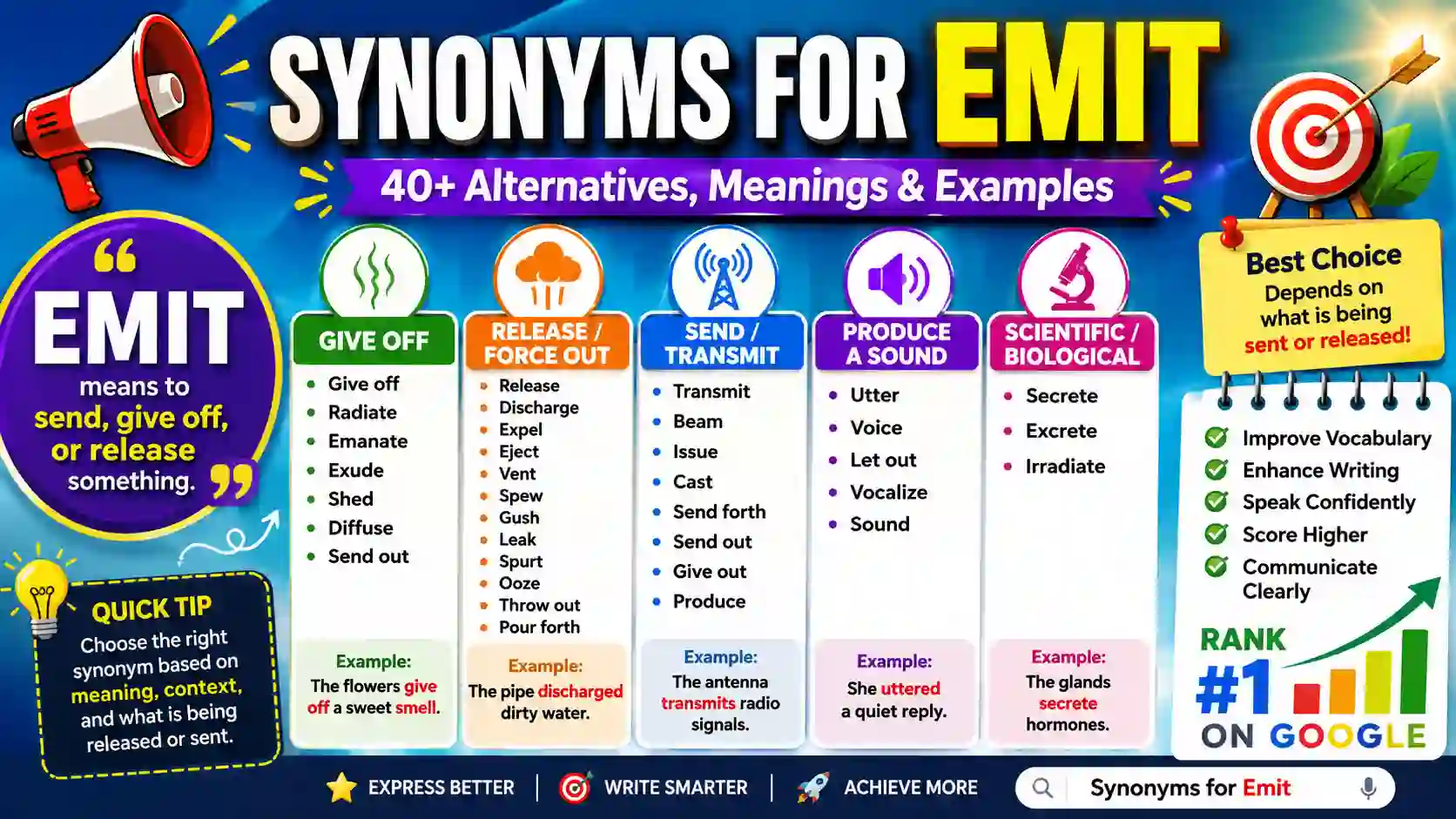
Looking for the best synonyms for emit? The word emit means to send, give off, or release something such as light, heat, sound, gas, or a smell. However, the best alternative depends on the context. Words like release, radiate, give off, exude, discharge, emanate, and produce can make your writing clearer and more natural.
In this guide, you’ll discover the most useful synonyms for emit, their meanings, differences, and simple examples. Whether you’re an English learner, student, teacher, writer, or professional, this guide will help you choose the right word for every situation.
📖 Meaning of Synonyms for Emit
The verb emit means to send, give, or let something out. It is commonly used for light, heat, sound, gas, smoke, smells, radiation, and sometimes words or other sounds. For example, The lamp emits a soft light means the lamp gives off light.
Emit is a verb. Its pronunciation is /ɪˈmɪt/, or roughly “ih-MIT.” It has two syllables.
The word comes from the Latin emittere, meaning to send out or let go.
In everyday English, the best synonym depends on what is being sent out:
- Light: radiate, shine, give off
- Heat: release, radiate, give off
- Gas or smoke: release, discharge, vent, expel
- A smell: give off, exude, release
- Sound: utter, produce, voice, let out
- Radiation: radiate, release, give off
- A message or statement: issue, express, voice
This difference matters because not every synonym works naturally in every sentence. Major thesauruses groups emit around meanings such as give off/send forth and produce a sound, which is why context is important.
📝 Top Synonyms of Emit
There isn’t one perfect replacement for emit in every situation. The best synonym depends on what is being sent, produced, or released. For example, release works well for gases and energy, radiate is useful for heat and light, while utter is better for sounds or spoken words.
💡 Synonyms for Emit Meaning “Give Off”
| Word | Meaning | Best Use | Example |
|---|---|---|---|
| Give off | Send out naturally | Light, heat, smell, gas | The flowers give off a sweet smell. |
| Release | Let something out | Gas, heat, energy | The machine releases heat. |
| Radiate | Send energy outward | Heat, light, energy | The sun radiates heat. |
| Emanate | Come or spread from a source | Light, smell, sound | A pleasant smell emanated from the kitchen. |
| Exude | Slowly give off something | Smell, liquid, quality | The flowers exude a strong fragrance. |
| Shed | Give off or spread | Light, heat | The candle sheds a warm glow. |
| Send out | Send something outward | Signals, light, smells | The device sends out a signal. |
| Give out | Produce or release | Light, sound, heat | The old radio gave out a strange noise. |
| Send forth | Send or spread outward | Formal writing | The flower sends forth a pleasant scent. |
| Diffuse | Spread through an area | Light, smell, gas | The perfume diffused through the room. |
🌫️ Synonyms for Emit Meaning “Release or Force Out”
| Word | Meaning | Best Use | Example |
|---|---|---|---|
| Discharge | Release or let out | Liquid, gas, electricity | The pipe discharged dirty water. |
| Expel | Force something out | Gas, air, matter | The engine expels hot gases. |
| Eject | Force something out | Objects, ash, matter | The volcano ejected ash. |
| Vent | Allow gas or pressure to escape | Gas, steam, pressure | The tank vents excess gas. |
| Spew | Send out forcefully | Smoke, liquid, lava | The volcano spewed ash into the air. |
| Spout | Send out in a stream | Water, liquid | The fountain spouted water. |
| Gush | Flow out strongly | Liquid | Water gushed from the pipe. |
| Spurt | Come out suddenly and forcefully | Liquid, gas | Oil spurted from the damaged line. |
| Ooze | Flow out slowly | Liquid | Mud oozed from the crack. |
| Leak | Escape through a hole or opening | Gas, liquid | Gas leaked from the pipe. |
| Throw out | Send outward or release | Smoke, waste | The chimney throws out thick smoke. |
| Pour forth | Flow or come out in a large amount | Water, emotion | Water poured forth from the broken pipe. |
📡 Synonyms for Emit Meaning “Send”
| Word | Meaning | Best Use | Example |
|---|---|---|---|
| Transmit | Send from one place to another | Signals, information | The antenna transmits radio signals. |
| Beam | Send a signal or ray in a particular direction | Light, signals | The device beams a laser signal. |
| Issue | Officially send or produce | Statements, notices | The company issued a formal statement. |
| Cast | Send or spread outward | Light, rays | The lamp cast a soft light. |
| Produce | Make or create something | Sounds, effects | The speaker produced a loud tone. |
🗣️ Synonyms for Emit Meaning “Produce a Sound”
When emit refers to making a sound, different words are more natural than synonyms used for light, heat, or gas.
| Word | Meaning | Best Use | Example |
|---|---|---|---|
| Utter | Produce a spoken sound | Words, cries | She uttered a quiet reply. |
| Voice | Express something through speech | Opinions, concerns | He voiced his concerns. |
| Let out | Make or release a sound | Cries, laughs, screams | She let out a scream. |
| Vocalize | Produce a vocal sound | Technical or formal writing | The bird vocalized several calls. |
| Sound | Produce a noise or signal | Alarms, bells | The alarm sounded loudly. |
🧬 Related Scientific Words
Some words are related to emit in specific scientific contexts, but they aren’t always direct synonyms. Use them only when their precise meaning fits the sentence.
| Word | Meaning | Best Use | Example |
|---|---|---|---|
| Secrete | Produce and release a substance from cells or glands | Biology | The glands secrete hormones. |
| Excrete | Remove waste from a living organism | Biology | The kidneys excrete waste products. |
| Irradiate | Expose something to radiation | Science | Scientists irradiated the material. |
🎯 Quick Guide: Which Synonym Should You Use?
| If You Mean… | Best Synonyms |
|---|---|
| Give off naturally | Give off, release, exude |
| Send out heat or light | Radiate, give off, shed |
| Release gas or liquid | Release, discharge, vent |
| Force something out | Expel, eject |
| Spread from a source | Emanate, diffuse |
| Send a signal | Transmit, beam, send out |
| Produce a sound | Utter, produce, vocalize |
| Express an opinion | Voice, express |
| Produce something | Produce, issue |
| Release a substance biologically | Secrete, excrete |
⚖️ Antonyms
An antonym of emit generally describes taking something in, keeping it, or stopping it from being released.
| Antonym | Meaning | Example |
| Absorb | Take something in | Dark surfaces absorb heat. |
| Receive | Take something sent | The receiver receives the signal. |
| Retain | Keep something | The material retains heat. |
| Withhold | Keep back | The company withheld the information. |
| Contain | Keep something inside | The tank contains the gas. |
| Suppress | Stop or hold back | The system suppresses noise. |
| Inhale | Breathe in | We inhale oxygen. |
| Take in | Receive or absorb | Plants take in carbon dioxide. |
| Conceal | Keep hidden | She concealed the information. |
| Repress | Hold back | He repressed his emotions. |
💬 Example Sentences
Here are practical examples showing how emit and its alternatives work in different types of English.
Daily Conversation
- The candle emits a soft light.
- This soap gives off a fresh smell.
- The old car emits too much smoke.
- The alarm let out a loud beep.
- The heater gives off plenty of warmth.
Academic English
- The sun radiates energy across space.
- Some materials absorb rather than emit light.
- The experiment measured the heat released by the reaction.
- The device transmits signals over a long distance.
- Certain plants exude natural chemicals.
Business English
- The factory emits carbon dioxide.
- The company issued a formal statement.
- The printer produces a high-pitched sound.
- The machine releases excess heat.
- The manager voiced concerns about the plan.
Formal Writing
- The system discharges wastewater into a treatment facility.
- The device radiates low levels of energy.
- The laboratory released its findings.
- The engine expels hot gases.
- The speaker uttered only a few words.
Informal Writing
- The engine gave off a weird smell.
- She let out a little laugh.
- The speaker made a strange noise.
- The pipe leaked gas.
- The old fan gave out a buzzing sound.
Creative Writing
- Moonlight shed a silver glow across the lake.
- A sweet scent emanated from the garden.
- The fireplace radiated comforting warmth.
- A soft whisper escaped her lips.
- The forest seemed to exude a quiet mystery.
📚 Difference Between Similar Words
Choosing the right alternative makes your writing more precise.
| Word | Main Idea | Example |
| Emit | Send or give something out | The machine emits heat. |
| Release | Let something go | The valve releases pressure. |
| Radiate | Send energy outward | The sun radiates heat. |
| Emanate | Spread from a source | Music emanated from the room. |
| Exude | Slowly give off | The plant exudes a strong smell. |
| Discharge | Let something out, often formally | The pipe discharges water. |
| Expel | Force something out | The engine expels gas. |
| Utter | Produce a spoken sound | He uttered a cry. |
| Transmit | Send something across a distance | The tower transmits signals. |
| Vent | Allow gas or pressure to escape | The container vents steam. |
Emit vs. Release
Emit often describes something that naturally sends out light, heat, sound, gas, or radiation.
The star emits light.
Release focuses more on allowing something to leave or become free.
The valve releases gas.
Emit vs. Radiate
Radiate is more specific. It often describes energy, heat, light, or something spreading outward.
The sun radiates heat.
You could say:
The sun emits heat.
But radiation gives a stronger picture of energy spreading outward.
Emit vs. Emanate
Emanate often suggests that something comes or spreads from a source.
A strange smell emanated from the room.
It can also describe qualities such as confidence or warmth.
Emit vs. Utter
Use utter mainly for speech or sounds.
She uttered a short cry.
Don’t normally replace emit with utter when talking about smoke, heat, or light.
🎯 Best Alternative Words
The best synonym depends on your writing situation.
| Situation | Best Alternative | Example |
| Professional writing | Release | The process releases heat. |
| Science writing | Radiate | The object radiates energy. |
| Essay writing | Produce | The reaction produces gas. |
| Business email | Issue | The company issued a statement. |
| Everyday conversation | Give off | The paint gives off a strong smell. |
| Technical writing | Discharge | The system discharges excess water. |
| Environmental writing | Release | Vehicles release harmful gases. |
| Creative writing | Emanate | A warm glow emanated from the window. |
| Speech | Utter | He uttered a few words. |
| Biology | Secrete | The glands secrete hormones. |
| Signals | Transmit | The antenna transmits signals. |
| Gas or pressure | Vent | The tank vents excess pressure. |
A useful rule is simple: don’t choose a synonym just because it looks similar in a thesaurus. Choose it because it fits the object, action, and tone of your sentence.
✍ Grammar Tips
Emit is a regular verb.
| Form | Word | Example |
| Base form | emit | Machines emit heat. |
| Third-person singular | emits | The lamp emits light. |
| Past tense | emitted | The engine emitted smoke. |
| Past participle | emitted | The factory has emitted pollutants. |
| Present participle | emitting | The car is emitting fumes. |
Common Word Forms
- emit — verb
- emits — present-tense verb
- emitted — past tense/past participle
- emitting — present participle
- emission — noun
- emissions — plural noun
- emitter — something that emits
Important spelling rule
When adding -ed or -ing, the final t remains:
- emit → emitted
- emit → emitting
The spelling has a doubled t in these forms.
❌ Common Mistakes
| Wrong | Correct | Reason |
|---|---|---|
| The sun emit heat. | The sun emits heat. | A singular subject such as the sun takes emits in the present tense. |
| The car emit smoke yesterday. | The car emitted smoke yesterday. | Use the past-tense form emitted with a past-time expression such as yesterday. |
| The machine is emit heat. | The machine is emitting heat. | After is, use the present participle (-ing form). |
| She emitted a sentence. | She uttered a sentence. | Utter is more natural when someone says or produces spoken words. |
| The sun uttered heat. | The sun emitted heat. | Utter is normally used for spoken words or sounds, while emit can describe giving off heat. |
| The lamp emits brightly. | The lamp emits bright light. | Emit normally needs an object or noun phrase that identifies what is being given off. |
| The factory emitted gases yesterday. | The factory emitted gas yesterday. | Gas is often used as an uncountable noun when referring generally to a substance released into the air. Gases is also correct when referring to multiple types of gases. |
💡 Pro Writing Tips
Professional writers don’t replace every occurrence of a word with a synonym just to avoid repetition. Instead, they choose a word that matches the exact meaning, context, and tone of the sentence. With emit, the right alternative depends on what is being sent, produced, or released.
Use these practical tips:
- Choose give off for simple, everyday English when talking about light, heat, smells, or gases.
- Choose release when something is allowed to leave or is sent out, especially gas, heat, energy, or chemicals.
- Choose radiate for energy, heat, light, or radiation spreading outward from a source.
- Choose exude when a smell, liquid, or quality comes out gradually or naturally.
- Choose expel when something is forced or pushed out, such as gas, air, or smoke.
- Choose discharge in technical or formal contexts, especially for liquids, gases, electricity, or waste.
- Choose utter when someone produces a spoken word, sound, cry, or expression.
- Choose transmit when a signal, message, or form of energy is sent from one place to another.
- Choose vent when gas, steam, or pressure is deliberately allowed to escape through an opening.
- Choose emanate when a smell, sound, light, or quality seems to come or spread from a particular source.
- Choose produce when you simply mean to make or create a sound, effect, or result.
- Use emit when you need a neutral and flexible verb for sending or giving something out.
🎯 Quick Tip
Don’t choose a synonym simply because it appears in a thesaurus. Ask yourself what is being emitted and how it leaves the source. For example, a lamp emits light, the sun radiates heat, a valve releases gas, and a person utters a sound. Choosing the precise word makes your writing clearer and more natural.
📖 Related Words
Here are useful words connected with emit:
Word Family
- emit
- emits
- emitted
- emitting
- emission
- emissions
- emitter
Science and Environment
- radiation
- heat
- energy
- light
- gas
- smoke
- fumes
- carbon dioxide
- pollution
- signal
Sound and Speech
- sound
- voice
- utter
- speak
- pronounce
- shout
- whisper
- cry
- noise
- signal
Common Collocations
Some common combinations include:
- emit light
- emit heat
- emit radiation
- emit sound
- emit smoke
- emit gas
- emit fumes
- emit a signal
- emit energy
- emit a smell
- emit carbon dioxide
❓ FAQs
What is the best synonym for emit?
The best synonym depends on the context. Give off is a simple everyday alternative, while release works well in many situations. Radiate is better for heat and light, discharge for liquids or gases, and utter for sounds or spoken expressions. There is no single synonym that fits every sentence.
What is another word for emit?
Common alternatives for emit include give off, release, radiate, emanate, discharge, exude, issue, expel, transmit, vent, shed, and send out. For sounds, useful alternatives include utter, voice, produce, and let out. The correct choice depends on what is being emitted and the style of your sentence.
What is a simple word for emit?
A simple alternative to emit is give off. For example, instead of saying, “The candle emits heat,” you can say, “The candle gives off heat.” Give off is especially useful in everyday English because it is easy to understand and works naturally with light, heat, smells, and gases.
Is release a synonym for emit?
Yes, release can be a synonym for emit in many contexts, especially when something is allowed to leave. For example, “The factory emits gas” and “The factory releases gas” are similar. However, release can also mean setting something free, so it has a wider meaning than emit.
Is radiate a synonym for emit?
Yes, radiate can replace emit when talking about energy, heat, light, or radiation spreading outward. For example, “The sun emits heat” can become “The sun radiates heat.” However, radiate is more specific and may sound less natural when discussing ordinary gases, liquids, or spoken sounds.
What is the opposite of emit?
Common opposites of emit include absorb, receive, retain, withhold, contain, and take in. The best opposite depends on the situation. For example, a surface can absorb heat instead of emitting it, while a person can withhold information instead of releasing or communicating it.
What is the difference between emit and exude?
Emit is a broad word meaning to send or give something out. Exude usually suggests that something comes out gradually, especially a smell, liquid, or quality. For example, “The machine emits heat” is neutral, while “The flowers exude a sweet fragrance” suggests a natural, gradual release.
What is the difference between emit and emanate?
Emit means to send or give something out from a source. Emanate often focuses on something spreading or coming from a particular source. For example, “The lamp emits light” is natural, while “A pleasant smell emanated from the kitchen” emphasizes where the smell came from.
📝 Conclusion
Emit is a useful verb with a broad meaning: to send, give, or let something out. Depending on your sentence, you can replace it with give off, release, radiate, emanate, discharge, exude, expel, transmit, issue, vent, or utter.
The key is to choose a synonym based on meaning and context, not simply because it appears in a thesaurus. Use give off for simple everyday English, radiate for energy or heat, discharge for technical situations, transmit for signals, and utter for sounds.