Finding the right synonym for spoil can make your English clearer and more natural. The word spoil has several meanings—it can mean to ruin something, damage an experience, make food go bad, or treat someone too generously. That’s why one synonym doesn’t always fit every sentence.
In this guide, you’ll discover the best synonyms for spoil, along with simple meanings, examples, and usage tips. Whether you’re a student, writer, teacher, or English learner, you’ll learn how to choose the right alternative to spoil with confidence.
📖 Meaning of Spoil
The word spoil is a versatile English verb with several meanings. Most often, it means to damage something, make it less enjoyable, or cause it to lose its good quality. For example, The rain spoiled our picnic.
But spoil can also mean to treat someone too generously, especially a child, or to become bad or rotten when talking about food. Cambridge lists these major uses, including damaging enjoyment, food becoming unfit to eat, and treating someone too well.
Pronunciation: /spɔɪl/
Part of speech: Verb
Past forms: spoiled or spoilt
-ing form: spoiling
Simple examples
- The bad weather spoiled our trip.
- Don’t spoil the movie by telling me the ending.
- The hot weather spoiled the food spoil.
- Her grandparents spoil her with gifts.
The exact synonym depends on which meaning of spoil you intend. That’s important because ruin, pamper, and rot aren’t interchangeable in every sentence.
📝 Top Synonyms for Spoil
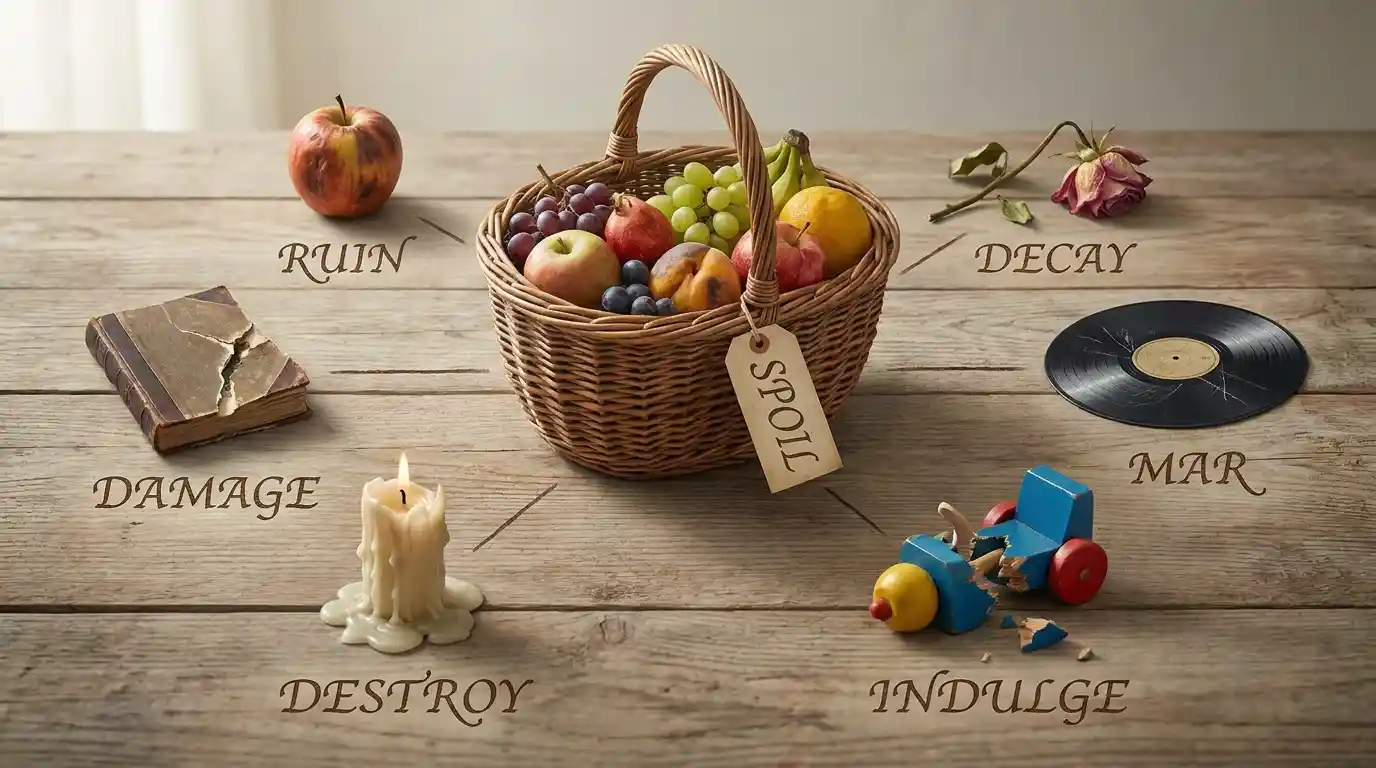
The word spoil has several meanings, so the best synonym depends on the context. Some alternatives mean ruin or damage, while others describe food going bad or treating someone too generously.
🔹 Synonyms for Spoil Meaning “Ruin or Damage”
These words are useful when spoil means to make something worse, unsuccessful, unpleasant, or damaged.
| Word | Meaning | Best Use | Example |
|---|---|---|---|
| Ruin | Make something unsuccessful or unpleasant | General | The rain ruined our picnic. |
| Damage | Harm something | Objects, plans, reputation | The storm damaged the building. |
| Destroy | Completely damage or end something | Strong meaning | Fire destroyed the house. |
| Wreck | Seriously damage something | Informal/general | The accident wrecked the car. |
| Harm | Cause damage or injury | General/formal | Stress can harm productivity. |
| Mar | Harm beauty or quality | Formal writing | The mistake marred the performance. |
| Impair | Reduce quality or ability | Academic/formal | Poor lighting impaired visibility. |
| Disfigure | Damage someone’s or something’s appearance | Appearance | The fire disfigured the building. |
| Deface | Damage the surface or appearance | Buildings/art | Someone defaced the wall. |
| Blight | Damage or ruin an area or situation | Places/society | Pollution blighted the area. |
🔹 Synonyms for Spoil Meaning “Hurt Quality or Reputation”
These alternatives work well when something reduces quality, value, trust, beauty, or reputation.
| Word | Meaning | Best Use | Example |
|---|---|---|---|
| Tarnish | Damage reputation or appearance | Reputation/metal | The scandal tarnished his reputation. |
| Diminish | Make something less strong or valuable | Formal writing | The error diminished her argument. |
| Undermine | Weaken gradually | Trust, plans, authority | His actions undermined public trust. |
| Compromise | Weaken quality or effectiveness | Business/formal | Cost-cutting compromised quality. |
| Degrade | Reduce quality or condition | Technical/formal | Chemicals degraded the material. |
| Taint | Make something impure or less acceptable | Food/reputation | The mistake tainted the results. |
🔹 Synonyms for Spoil Meaning “Interrupt or Affect an Experience”
Use these words when something prevents an event, activity, or experience from being enjoyable or successful.
| Word | Meaning | Best Use | Example |
|---|---|---|---|
| Disrupt | Interrupt normal progress | Events/plans | The strike disrupted travel. |
| Disturb | Interrupt peace or enjoyment | Situations | The noise disturbed our dinner. |
| Disappoint | Fail to meet expectations | Experiences | The ending disappointed viewers. |
| Sour | Make a situation unpleasant | Relationships/situations | The argument soured their friendship. |
| Poison | Seriously damage a relationship or situation | Relations | The dispute poisoned their relationship. |
🔹 Informal Synonyms for Spoil
These expressions are common in everyday conversation and informal writing.
| Word/Phrase | Meaning | Best Use | Example |
|---|---|---|---|
| Mess up | Do badly or cause a problem | Informal | I don’t want to mess up the plan. |
| Foul up | Make something go wrong | Informal | A small error fouled up the schedule. |
| Botch | Do something badly | Tasks/work | He botched the repair. |
| Bungle | Handle something poorly | Work/tasks | They bungled the investigation. |
🔹 Synonyms for Spoil Meaning “Become Bad”
When spoil refers to food or another organic substance becoming bad, these words are more appropriate.
| Word | Meaning | Best Use | Example |
|---|---|---|---|
| Deteriorate | Become worse in quality or condition | Food/conditions | The food deteriorated quickly. |
| Decay | Gradually become rotten or weak | Food/materials | The fruit began to decay. |
| Rot | Become spoiled and unusable | Food/organic matter | The apples started to rot. |
| Go bad | Become no longer good to eat | Everyday speech | The milk has gone bad. |
| Decompose | Break down naturally | Scientific writing | Organic waste decomposes over time. |
| Putrefy | Rot and decay | Scientific/formal | The organic matter began to putrefy. |
| Turn sour | Become sour or unpleasant | Food | The milk turned sour. |
🔹 Synonyms for Spoil Meaning “Treat Someone Too Well”
In this meaning, spoil doesn’t mean damage. It means giving someone too much attention, comfort, freedom, or material things.
| Word | Meaning | Best Use | Example |
|---|---|---|---|
| Indulge | Give someone special treatment | People | She indulges her grandchildren. |
| Overindulge | Give someone too much | Children/people | Parents may overindulge their children. |
| Pamper | Treat someone with extra care | People | The hotel pampered its guests. |
| Coddle | Protect or treat someone too gently | People | Don’t coddle your child. |
| Baby | Treat someone too gently | Informal | His parents still baby him. |
| Humor | Give someone what they want | People | She humored the child. |
| Overgratify | Give excessive satisfaction | Formal | The policy may overgratify consumers. |
🎯 How to Choose the Right Synonym for Spoil
Don’t choose a synonym just because it appears in a thesaurus. First, identify what spoil means in your sentence.
- Make something bad: use ruin or damage
- Completely destroy: use destroy
- Reduce effectiveness: use impair
- Hurt a reputation: use tarnish
- Weaken trust: use undermine
- Interrupt an event: use disrupt
- Make a relationship unpleasant: use sour
- Make food bad: use rot, decay, or go bad
- Treat someone too generously: use pamper, indulge, or overindulge
⚖️ Antonyms of Spoil
The opposite of spoil changes according to its meaning.
| Antonym | Meaning | Example |
| Preserve | Keep something in good condition | Salt helps preserve food. |
| Protect | Keep something safe from harm | Trees protect the soil. |
| Maintain | Keep something in good condition | We maintain the equipment. |
| Improve | Make something better | Practice improves your skills. |
| Enhance | Increase quality or value | Good lighting enhances the room. |
| Repair | Fix something damaged | They repaired the roof. |
| Restore | Return something to a former condition | Experts restored the painting. |
| Save | Prevent loss or damage | Quick action saved the project. |
| Care for | Look after properly | She cares for the plants. |
| Discipline | Guide behavior appropriately | Parents should discipline children fairly. |
💬 Example Sentences With Spoil
The best synonym depends on the context. Here are examples across different types of English:
Daily Conversation
- Don’t let one bad moment spoil your day.
- The loud music spoiled our dinner.
- Please don’t spoil the surprise.
- The heat spoiled the food spoil.
- I don’t want to spoil your fun.
Academic English
- Poor planning can undermine an otherwise strong project.
- Excessive noise can impair students’ concentration.
- The error diminished the strength of the argument.
- Incorrect data can compromise the results.
- Pollution can degrade natural habitats.
Business English
- Delays may disrupt the supply chain.
- Poor service can damage a company’s reputation.
- High costs could undermine profitability.
- A careless decision may tarnish the brand.
- Technical problems disrupted the meeting.
Formal Writing
- The scandal tarnished his public image.
- The conflict poisoned relations between the two groups.
- The policy undermined public confidence.
- The damage impaired the building’s usefulness.
- Several factors diminished the project’s value.
Informal English
- I totally messed up the schedule.
- That mistake fouled up our plans.
- Don’t screw up the surprise.
- He botched the job.
- They bungled the whole thing.
Creative Writing
- A cold wind spoiled the peaceful evening.
- The dark clouds marred the bright horizon.
- Years of conflict soured their friendship.
- The abandoned house slowly decayed.
- A single careless word poisoned the conversation.
📚 Difference Between Similar Words
Many words can replace spoil, but they don’t have exactly the same strength or meaning.
| Word | Main Difference | Example |
| Spoil | Make something less enjoyable or good | The noise spoiled the evening. |
| Ruin | Damage something badly or completely | The flood ruined the house. |
| Damage | Cause physical or functional harm | The storm damaged the roof. |
| Destroy | Completely eliminate or severely damage | Fire destroyed the building. |
| Mar | Reduce beauty or quality | One mistake marred the event. |
| Impair | Reduce ability or effectiveness | Poor lighting impaired vision. |
| Disrupt | Interrupt normal activity | The strike disrupted transport. |
| Tarnish | Harm reputation or appearance | The scandal tarnished his name. |
| Sour | Make a relationship or situation unpleasant | The argument soured their friendship. |
| Pamper | Treat someone especially well | They pampered their guests. |
| Decay | Become rotten or gradually break down | The fruit decayed. |
Spoil vs. Ruin
Spoil can mean making something less enjoyable without completely destroying it.
Ruin is often stronger.
- The rain spoiled our picnic.
- The fire ruined the entire building.
Spoil vs. Damage
Damage usually focuses on physical harm, reduced function, or loss.
- The storm damaged the roof.
- The loud noise spoiled the party.
Spoil vs. Pamper
These are completely different meanings.
- Grandparents sometimes spoil their grandchildren. = Give them too much.
- The hotel pampered its guests. = Treated them especially well.
Spoil vs. Rot
Use rot when food or organic material becomes rotten.
- The heat spoiled the meat.
- The meat rotted in the heat.
🎯 Best Alternative Words for Different Situations
| Situation | Best Alternative | Example |
| Professional writing | Undermine | The error undermined confidence. |
| Academic essay | Impair | The conditions impaired performance. |
| Business email | Disrupt | The delay disrupted our schedule. |
| Casual conversation | Ruin | You ruined the surprise! |
| Formal writing | Diminish | The error diminished the result. |
| Reputation | Tarnish | The scandal tarnished the brand. |
| Relationships | Sour | The disagreement soured their friendship. |
| Food | Decay / Rot | The fruit began to rot. |
| Children | Overindulge / Pamper | They pamper their children. |
| Creative writing | Mar | The clouds marred the view. |
| Informal speech | Mess up | Don’t mess up the plan. |
| Strong damage | Destroy / Wreck | The storm wrecked the building. |
✍ Grammar Tips for Spoil
Spoil is mainly used as a verb and can be transitive or intransitive, depending on the meaning.
| Form | Example |
| Base verb | Don’t spoil the surprise. |
| Third person | She spoils her children. |
| Past | The rain spoiled our plans. |
| Past participle | The food has spoiled. |
| -ing form | The weather is spoiling our trip. |
Spoiled or Spoilt?
Both forms are correct.
- Spoiled is especially common in American English.
- Spoilt is common in British English.
- Both can function as past forms of spoil.
Word forms
- Spoil — verb
- Spoiled / spoilt — past form
- Spoiling — present participle
- Spoilage — noun
- Spoiled / spoilt — adjective
❌ Common Mistakes
| Wrong | Correct | Reason |
| The food spoiled me. | The food spoiled. | Food becomes bad; it doesn’t receive treatment. |
| He ruined his child with gifts. | He spoiled his child with gifts. | Spoil fits excessive generosity toward a child. |
| Don’t spoil the ending. | Don’t spoil the ending for me. | The natural phrase is to spoil something for someone. |
| The milk was damaged. | The milk spoiled. | Spoil is natural for food becoming unfit to use. |
| She pampered the movie. | She spoiled the movie. | Pamper is normally used for people, not movies. |
💡 Pro Writing Tips
Don’t replace spoil with a synonym simply because a thesaurus gives you one.
First ask:
What exactly happened?
- Something became less enjoyable → spoil
- Something was badly damaged → ruin
- Something was physically harmed → damage
- Something was completely destroyed → destroy
- Beauty or quality was reduced → mar
- Effectiveness was reduced → impair
- A relationship became unpleasant → sour
- A reputation was harmed → tarnish
- Food became bad → rot / decay
- Someone received excessive attention → pamper / overindulge
This approach makes your writing more precise and natural.
📖 Related Words
Here are useful words connected with spoil:
Damage and quality
- ruin
- damage
- destroy
- impair
- harm
- mar
- blemish
- degrade
- deteriorate
- compromise
Food and decay
- rotten
- decay
- rot
- spoilage
- stale
- sour
- taint
- decompose
- mold
- deterioration
People and treatment
- pamper
- indulge
- overindulge
- coddle
- baby
- humor
- generosity
- excessive
- spoiled
- spoilt
Relationships and situations
- sour
- poison
- undermine
- disrupt
- disturb
- disappoint
- weaken
- damage
- tarnish
- compromise
❓ Frequently Asked Questions
1. What is the best synonym for spoil?
The best general synonym for spoil is ruin when you mean making something bad or less enjoyable. However, the right alternative depends on context. Damage, mar, impair, and destroy can work for harm, while pamper and overindulge fit the meaning of treating someone too generously.
2. What is another word for spoil?
Another word for spoil can be ruin, damage, harm, mar, impair, destroy, disrupt, tarnish, or mess up. If you are talking about food, rot, decay, or go bad may be better. If you’re talking about a person receiving too much attention, use pamper or overindulge.
3. What is a synonym for spoiling a surprise?
Useful alternatives include ruin the surprise, give away the surprise, or reveal the surprise. In everyday English, ruin the surprise sounds natural. You can also say, “Don’t tell me what happens,” when talking about a movie, book, or event that you don’t want revealed.
4. What is a synonym for spoiled food?
For food, useful alternatives include go bad, rot, decay, deteriorate, turn sour, and become spoiled. The best choice depends on the food and situation. For everyday conversation, going bad is very common. For scientific or formal writing, decay or decomposition may be more suitable.
5. What is the synonym of spoil for a child?
When spoil means giving a child too much or allowing too much behavior, useful alternatives include overindulge, pamper, coddle, baby, and overgratify. Overindulge is especially useful when you want to show that someone gives a child too much attention, freedom, or material things.
6. Is ruin a synonym for spoil?
Yes, ruin is one of the closest synonyms for spoil when the meaning is to make something unsuccessful, unpleasant, or much worse. However, the two words aren’t always interchangeable. Spoil can also mean pampering someone or becoming bad as food, meanings that ruin doesn’t normally express.
7. What is the opposite of spoil?
The opposite of spoil depends on the context. Preserve, protect, maintain, improve, enhance, repair, and restore can be antonyms. For food, preserve is especially useful. For something damaged, repair or restore may be the better opposite.
8. What is a formal synonym for spoil?
Formal alternatives include impair, diminish, undermine, compromise, deteriorate, degrade, and tarnish. Choose according to the meaning. For example, impairment works well for reduced ability, while tarnish is commonly used for reputation. These words can make formal or academic writing more precise.
🎯 Conclusion
Spoil is a useful word, but it has several meanings, so the best synonym depends on the sentence. Use ruin for general damage to enjoyment, damage for harm, destruction for severe damage, mar for beauty or quality, impair for reduced ability, rot for food, and pamper or overindulge when talking about excessive treatment of a person.