Finding the right words can make your English clearer and more natural. The word “along” is commonly used to describe movement beside or following something, such as a road, river, or path. It can also appear in phrases like “along with” and “come along,” giving it different meanings in different situations.
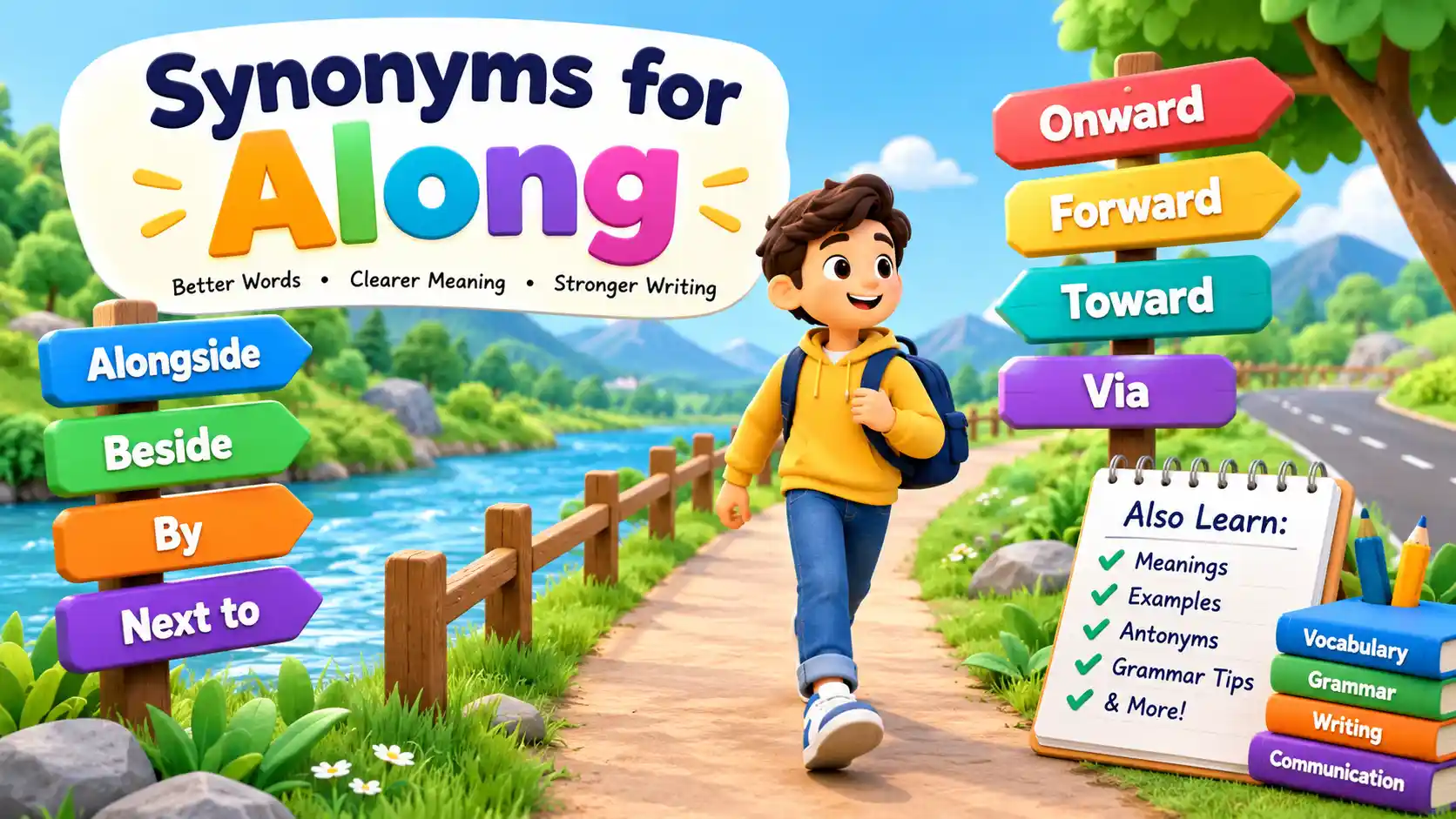
If you’re looking for synonyms for along, this guide will help you choose the right alternative without changing the meaning of your sentence. You’ll discover useful words such as alongside, beside, by, onward, forward, toward, and via, along with simple examples, differences, and grammar tips. Whether you’re a student, writer, teacher, or English learner, you’ll learn how to use these alternatives confidently.
📖 Meaning of “Along”
Along is a common English word that can have different meanings depending on the sentence. It is mainly used as a preposition or adverb.
As a preposition, along often means following the length or direction of something, such as a road, river, path, or beach.
We walked along the river.
Here, along means that the people walked beside and followed the direction of the river.
It can also describe movement:
She walked along the narrow path.
As an adverb, along can mean forward, onward, or with someone.
Come along with us.
Because along has several meanings, there isn’t one perfect synonym for every situation. Words such as beside, beside the length of, by, onward, forward, with, through, and alongside may work depending on the context.
Pronunciation: /əˈlɒŋ/ or /əˈlɔːŋ/
Part of speech: Preposition, adverb
📝 Top Synonyms for “Along”
The best alternative depends on what along means in your sentence. Some words below are close synonyms, while others are useful context-based alternatives.
| Word | Meaning | Best Use | Example |
| Alongside | Beside or next to | Places, people, objects | We walked alongside the river. |
| Beside | Next to | Location | She sat beside the window. |
| By | Near or beside | Everyday English | We stopped by the road. |
| Near | Close to something | Location | A café stands near the beach. |
| Next to | Immediately beside | Daily conversation | He walked next to his friend. |
| Alongside of | Beside | Informal usage | The car moved alongside the truck. |
| On | Following or situated on | Roads, paths, surfaces | Shops are located on the road. |
| Down | Along a route in a direction | Streets and roads | They walked down the street. |
| Up | Along a route toward a higher point | Roads, rivers, directions | We walked up the path. |
| Through | From one side to another | Places and routes | We traveled through the valley. |
| Across | From one side to another | Areas and surfaces | We walked across the field. |
| Forward | Toward the front | Movement | The group moved forward. |
| Onward | Continuing forward | Formal/literary writing | They continued onward. |
| Ahead | In front or farther forward | Movement | The hikers moved ahead. |
| Forth | Forward | Formal/literary English | The travelers went forth. |
| With | In the company of | People | Come with us. |
| Together with | In company with | Formal writing | She traveled together with her team. |
| In company with | Together with someone | Formal English | He arrived at the company with his colleagues. |
| Following | Moving beside or behind a route | Directions | We drove following the river. |
| Beside the | At the side of | Location | They walked beside the road. |
| By the side of | Next to | Descriptive writing | He waited by the side of the road. |
| Near to | Close to | Formal/general English | The hotel is near the station. |
| Adjacent to | Directly next to | Formal writing | The building is adjacent to the park. |
| Parallel to | Moving in the same direction | Roads, lines, movement | The path runs parallel to the river. |
| In the direction of | Toward a particular direction | Precise writing | They walked in the direction of the village. |
| Toward | In the direction of | Movement | She walked toward the station. |
| Towards | In the direction of | British English/general use | They moved towards the exit. |
| Past | Beyond a particular point | Movement | We walked past the school. |
| Beyond | Farther than a point | Description | The road continues beyond the village. |
| Via | By way of | Travel/formal writing | We traveled via the coastal road. |
| By way of | Using a route or method | Formal writing | We went by way of the old town. |
| Throughout | In every part of | Areas/time | Flowers grew throughout the garden. |
| Over | Across or covering an area | Movement | Birds flew over the fields. |
| Around | In or near an area | Movement/location | We walked around the lake. |
| Onward from | Continuing from a point | Formal writing | The journey continued onward from the village. |
Important Note
Not all of these are exact synonyms of along. For example, beside usually describes position, while onward describes continuing movement. Choosing the right alternative depends on the meaning of the original sentence.
⚖️ Antonyms of “Along”
Because along has several meanings, its opposite also changes with context.
| Antonym or Contrast | Meaning | Example |
| Against | In the opposite direction | They walked against the flow of traffic. |
| Away | Moving farther from something | She walked away from the river. |
| Backward | Toward the rear | He took a step backward. |
| Behind | At the back | The group stayed behind. |
| Apart | Separately | The friends moved apart. |
| Opposite | Facing another direction or side | The shop is opposite the station. |
| Back | Returning toward an earlier point | They went back home. |
| Still | Not moving | The boat remained still. |
💬 Example Sentences With “Along”
Here are 20 examples showing how along works in different types of English.
Daily Conversation
- We walked along the beach after dinner.
- Come along with us to the market.
- She drove along the quiet road.
- I saw several shops along the street.
- They walked along the river.
Academic English
- The researchers collected samples along the coastline.
- Trees were planted along the edge of the field.
- Several settlements developed along the river.
- The study examined changes along the migration route.
Business English
- Several offices are located along the main road.
- The company opened new stores along the highway.
- We met several clients along the way.
- The team worked along with its international partners.
Formal Writing
- Houses were built along the narrow valley.
- The railway extends along the eastern border.
- Several communities developed along the coast.
Informal English
- Why don’t you come along?
- I’ll bring my brother along.
- We picked up some friends along the way.
Creative Writing
- A soft wind moved along the empty road.
📚 Difference Between Similar Words
Some alternatives look similar to along, but they aren’t interchangeable in every sentence.
| Word | Main Meaning | Example |
| Along | Following the length or direction of something | We walked along the river. |
| Alongside | Beside something or someone | We walked alongside the river. |
| Beside | At the side of something | She stood beside the door. |
| Through | From one side or part to another | We walked through the forest. |
| Across | From one side to the other | We walked across the bridge. |
| Toward | In the direction of something | We walked toward the station. |
| Past | Moving beyond something | We walked past the station. |
| Onward | Continuing forward | The travelers moved onward. |
| Around | Moving around something | We walked around the lake. |
Along vs. Alongside
Along emphasizes following the length or direction of something.
We walked along the beach.
Alongside emphasizes being beside something.
We walked alongside the beach.
In many location sentences, both may sound natural, but the focus is slightly different.
Along vs. Through
Use along when you follow the length or edge of something.
They walked along the river.
Use it when you move from one part of something to another.
They walked through the forest.
Along vs. Toward
Along describes movement following a route or line.
We walked along the road.
Toward describes the direction of movement.
We walked toward the village.
🎯 Best Alternative Words for Different Situations
The best synonym isn’t always the most complicated word. Choose the word that matches your meaning.
| Situation | Best Alternative |
| Everyday conversation | Beside |
| Walking beside something | Alongside |
| Describing a road | Down |
| Formal writing | Alongside / Adjacent to |
| Continuing a journey | Onward |
| Moving forward | Forward |
| Moving toward something | Toward / Towards |
| Moving beyond something | Past |
| Traveling by a route | Via |
| Traveling with someone | With |
| Describing parallel movement | Parallel to |
| Academic geography | Alongside / Parallel to |
| Creative writing | Alongside / Onward |
✍️ Grammar Tips for “Along”
1. “Along” as a preposition
When along comes before a noun, it commonly acts as a preposition.
We walked along the river.
Shops appeared along the road.
2. “Along” as an adverb
It can also describe movement or continuation without directly introducing a noun.
Come along.
The work is coming along nicely.
3. “Along with”
Along with means together with or in addition to.
Sarah came along with her brother.
The package includes a charger along with the manual.
4. “All along”
All along means from the beginning or throughout a period.
I knew the answer all along.
This expression has a different meaning from simply using along for movement.
❌ Common Mistakes
| Wrong | Correct | Reason |
| We walked along the river. | We walked along the river. | Don’t normally add off after long. |
| She walked along to the station. | She walked along the road to the station. | Add the route when needed for clarity. |
| He came along with me. | He came along with me. | Don’t use ” after” here. |
| They walked through the road. | They walked along the road. | Use along for movement following a road. |
| She walked along the forest. | She walked through the forest. | Use through when moving inside the forest. |
💡 Pro Writing Tips
When replacing along, don’t simply choose the first synonym you see in a thesaurus. First ask what you want to say.
If you mean “beside”
Use:
- alongside
- beside
- by
- next to
If you mean “continuing”
Use:
- onward
- forward
- ahead
If you mean “in a direction”
Use:
- toward
- towards
- in the direction of
If you mean “using a route”
Use:
- via
- by way of
- following
Good writing is about precision. A simple word that fits the sentence is usually better than a difficult word that changes the meaning.
📖 Related Words
Here are some words and phrases connected with along:
- Alongside
- Along with
- All along
- Come along
- Move along
- Go along
- Get along
- Along the way
- Along the road
- Along the path
- Along the river
- Along the coast
- Beside
- Nearby
- Forward
- Onward
- Toward
- Through
- Across
- Beyond
These related expressions are useful when learning vocabulary because they show how along works in real English.
❓ Frequently Asked Questions
What is a synonym for “along”?
A common synonym for along is alongside when you mean “beside” or “next to.” Other alternatives include beside, by, next to, down, onward, forward, and via, but the best choice depends on the sentence. Not every alternative has exactly the same meaning as along.
What is another word for “along” in English?
Another word for along can be alongside, beside, or by when talking about location. For movement, down, forward, onward, or toward may work better. Always check the meaning before replacing along, because this small word has several different uses.
What is the synonym of “along the road”?
Depending on the sentence, alternatives include down the road, on the road, beside the road, or following the road. For example, “We walked along the road” can become “We walked down the road.” The best option depends on whether you’re describing movement, location, or direction.
Is “alongside” a synonym for “along”?
Alongside can be a synonym for along in some sentences, especially when the meaning is “beside.” For example, “They walked along the river” and “They walked alongside the river” can have similar meanings. However, alongside focuses more strongly on being beside something.
What is the opposite of “along”?
There isn’t one universal opposite of alone. Depending on its meaning, possible contrasts include away, backward, against, behind, apart, or back. For example, if along describes forward movement, backward may express the opposite direction. Context determines the best opposite.
What does “along with” mean?
Along with means together with or in addition to. For example, “Tom came along with his sister” means Tom came together with his sister. In another sentence, “The book comes along with a workbook,” the phrase means the workbook is included with the book.
Is “beside” the same as “along”?
Beside and along can sometimes have similar meanings, but they’re not always interchangeable. Beside usually means “at the side of” something, while along often describes following the length or direction of something. For example, “walk along the road” and “stand beside the road” express different ideas.
Can “along” be used for people?
Yes. Along can be used with people, especially in phrases such as come along, bring someone along, and along with. For example, “Can I bring my friend along?” means “Can I bring my friend with me?” These expressions are common in everyday English.
📝 Conclusion
Along is a small but flexible English word. It can describe movement beside a road or river, continuing forward, or being together with someone.
The most useful alternatives include alongside, beside, by, next to, onward, forward, toward, through, and via. But remember: these words don’t all mean exactly the same thing.