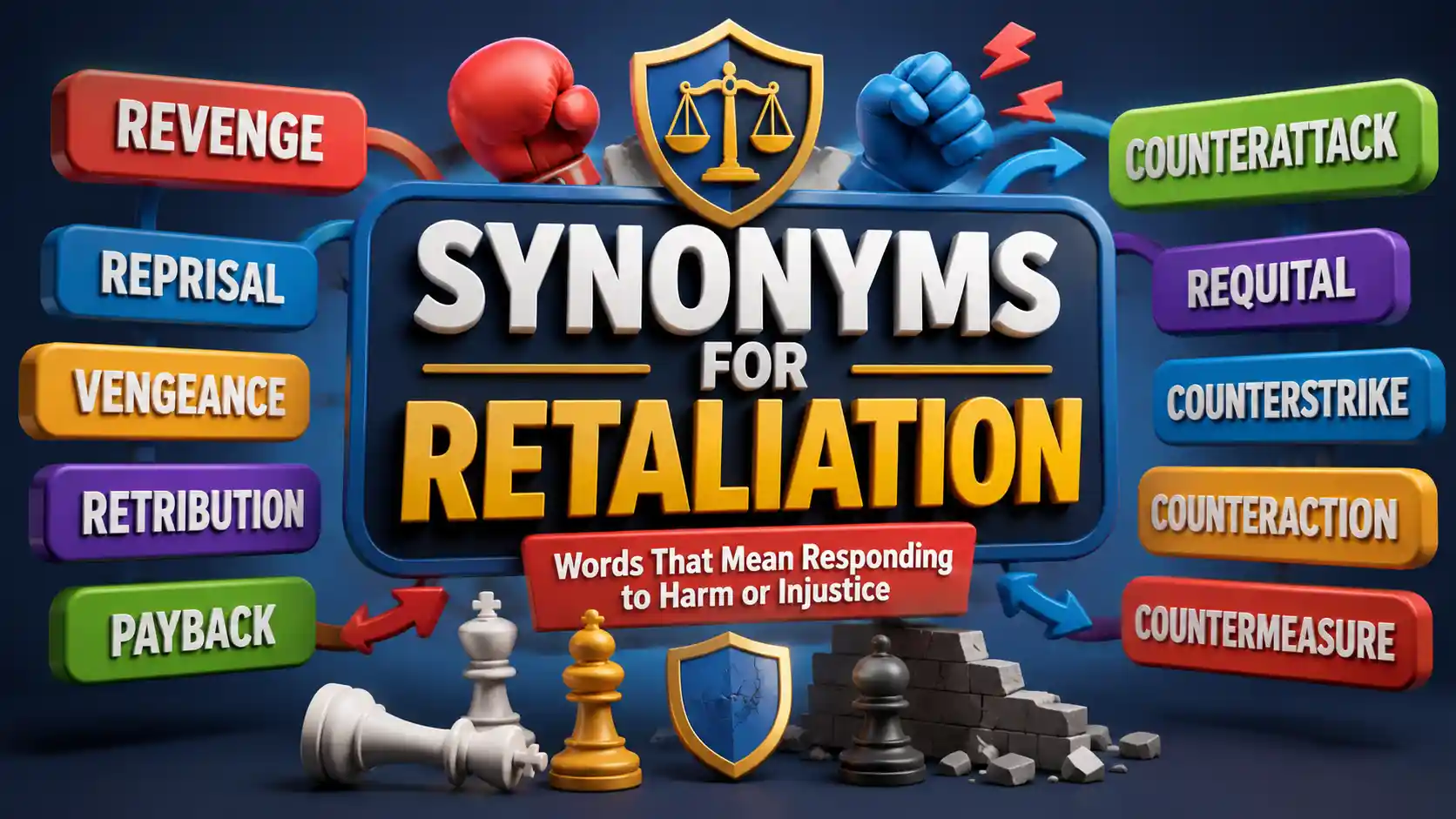
Looking for the best synonyms for retaliation? The word retaliation means responding to harm, an attack, or unfair treatment by taking action against the person or group responsible. Common alternatives include revenge, reprisal, vengeance, retribution, payback, and counterattack, but each word has a slightly different meaning and tone.
In this guide, you’ll learn the closest synonyms for retaliation, their simple meanings, example sentences, and when to use each one. Whether you’re writing an essay, email, article, or everyday conversation, this guide will help you choose the right word for the right context.
📖 Meaning of Synonyms for Retaliation
Retaliation is a noun that means taking harmful action against someone because they have already caused harm, trouble, or injury. Cambridge defines it as an act of hurting someone or doing something harmful because that person has done something harmful to you.
Pronunciation: retaliation — /rɪˌtæl.iˈeɪ.ʃən/
Part of speech: Noun
The word is usually uncountable, especially when it describes the general act of responding to harm. Common phrases include fear of retaliation, in retaliation, and retaliation against someone.
In simple English, retaliation means “hurting or punishing someone back because they hurt you first.”
For example:
The company feared retaliation after reporting the problem.
The word often appears in discussions about conflict, politics, business, law, war, personal disputes, and workplace behavior. It can describe physical, financial, legal, social, or political responses.
The strongest synonyms to remember
If you only need a few natural alternatives, choose:
- Reprisal — best for formal, military, or political contexts
- Revenge — best for personal situations
- Vengeance — stronger and more emotional
- Retribution — formal and focused on punishment
- Payback — informal
- Counterattack — best when an attack is answered by another attack
- Pushback — best for resistance or criticism
- Backlash — best for a strong negative reaction
Collins specifically gives revenge, repayment, vengeance, and reprisal as synonyms associated with retaliation.
📝 Top Synonyms of Retaliation
| Word | Meaning | Best Use | Example |
|---|---|---|---|
| Reprisal | An act of retaliation in response to harm or an attack | Formal, military, political | The attack was seen as a reprisal. |
| Revenge | Action taken to hurt or punish someone for a wrong | Personal, general | He wanted revenge for the insult. |
| Vengeance | Punishment or harm inflicted in response to a wrong | Formal, emotional, literary | She sought vengeance for the betrayal. |
| Retribution | Punishment for a wrongdoing, often seen as deserved | Formal, legal, moral | The criminal feared retribution. |
| Payback | Informal action taken to get even | Informal, conversational | He saw the decision as payback. |
| Requital | A return or response to an action, especially a harmful one | Formal, literary | The attack was viewed as requital. |
| Counterattack | An attack made in response to an earlier attack | Military, conflict, strategy | The army launched a counterattack. |
| Counterstrike | A strike made in response to an earlier strike or attack | Military, strategic | The country threatened a counterstrike. |
| Counteraction | An action taken to oppose or respond to another action | Formal, business, political | The firm planned counteraction. |
| Countermeasure | An action taken to deal with or oppose a threat | Business, security, government | New countermeasures were introduced. |
| Counterblow | A forceful response to an attack or harmful action | Formal, conflict | The group feared a counterblow. |
| Counterstroke | A strong action taken in response to an opposing action | Formal, military | The force prepared a counterstroke. |
| Retaliatory action | An action taken in response to harm or an attack | Formal, professional | Officials warned against retaliatory action. |
| Retaliatory response | A response intended as retaliation | Formal, political | The country threatened a retaliatory response. |
| Revenge attack | An attack carried out to avenge a previous harm | Conflict, journalism | The incident was described as a revenge attack. |
🔹 Related Words — Not Exact Synonyms
These words can be useful in related contexts, but I would not present them as direct synonyms for “retaliation.”
| Word/Phrase | Meaning | Best Use | Example |
|---|---|---|---|
| Response | An action or reaction to something | General | The decision was a response to the threat. |
| Reaction | A response caused by an event | General | The policy caused a strong reaction. |
| Backlash | A strong negative reaction from people or a group | Social, political, business | The decision caused a public backlash. |
| Pushback | Resistance or criticism in response to something | Business, politics, informal | The plan received public pushback. |
| Resistance | Opposition to something | Political, social | The group organized resistance. |
| Opposition | Action or position against something | Formal | The proposal met strong opposition. |
| Defiance | Open refusal to obey or accept something | Formal | His action was an act of defiance. |
| Countermove | A move made in response to another move | Strategy, business, games | The company made a countermove. |
| Retort | A sharp or clever verbal reply | Conversation, writing | Her retort ended the argument. |
| Comeback | A quick or effective reply | Informal, conversation | He had a clever comeback. |
| Getting even | Trying to repay a wrong or settle a score | Informal | He was accused of getting even. |
| Settling the score | Taking revenge for a perceived wrong | Informal | He wanted to settle the score. |
| Tit for tat | A pattern of responding to an action with a similar action | Informal, conflict | The dispute became a tit-for-tat exchange. |
| Eye for an eye | The idea of responding to harm with similar harm | Idiomatic, moral discussion | His plan followed an eye-for-an-eye approach. |
❌ Remove These From the Synonym List
I recommend removing these from your article’s main synonym table:
- Answer — too broad; not a synonym for retaliation.
- Punishment — related, but retaliation and punishment are not the same.
- Penalty — specifically a consequence for breaking a rule or law.
- Payback action — unnatural phrase; use payback.
- Revenge response — not a standard dictionary synonym.
- Retributive action — a descriptive phrase, not a direct synonym.
- Aggressive response — related but much broader.
- Hostile response — related but not equivalent.
- Restorative response — not a synonym; it can suggest repair or reconciliation, which is almost the opposite direction of retaliation.
- Duplicate Counterattack — it appears twice in your original table.
⚖️ Antonyms of Retaliation
There isn’t always one perfect opposite of retaliation because the opposite depends on the situation. However, these words describe choosing peace, forgiveness, or non-aggression instead of returning harm.
| Antonym | Meaning | Example |
| Forgiveness | Choosing not to punish someone for a wrong | She chose forgiveness instead of revenge. |
| Pardon | Official or personal decision not to punish | The president granted a pardon. |
| Mercy | Kindness shown instead of punishment | The judge showed mercy. |
| Peace | A state without conflict | Both sides wanted peace. |
| Reconciliation | Restoring a friendly relationship | They worked toward reconciliation. |
| Cooperation | Working together rather than fighting | The countries chose cooperation. |
| Restraint | Controlling an urge to act | The leader showed restraint. |
| Nonviolence | Refusing to use violence | The group followed nonviolence. |
| Acceptance | Willingness to accept a situation | He responded with acceptance. |
| Compromise | Agreement reached by both sides giving something up | They reached a compromise. |
💬 Example Sentences Using Retaliation and Its Alternatives
Daily Conversation
- She was afraid of retaliation after speaking up.
- He didn’t want to seek revenge.
- They chose forgiveness instead of payback.
- The argument led to a cycle of revenge.
- His response looked like retaliation.
- She decided not to get even.
- Nobody wanted another round of conflict.
- He showed restraint instead of fighting back.
Academic English
- Retaliation can increase tension between opposing groups.
- The study examines the causes of retaliatory behavior.
- Revenge and retaliation are often discussed in conflict studies.
- The policy was designed to reduce the risk of retaliation.
- Researchers distinguish retaliation from ordinary disagreement.
- Retribution may involve a desire for deserved punishment.
- Reprisal is commonly associated with formal or military conflict.
- The author argues that retaliation can create a cycle of harm.
Business English
- The employee feared retaliation after reporting misconduct.
- The company denied taking retaliatory action.
- The new policy protects workers from retaliation.
- Competitors may respond with countermeasures.
- The firm avoided an aggressive response.
- The decision caused significant customer pushback.
- Management wanted to prevent further conflict.
- The company chose negotiation rather than payback.
Formal Writing
- The government warned against further retaliation.
- Officials feared a retaliatory response.
- The decision could trigger economic countermeasures.
- The attack was described as a reprisal.
- The organization called for restraint.
- The two sides agreed to avoid further escalation.
Creative Writing
- His heart burned with a desire for vengeance.
- She resisted the urge to seek revenge.
- The silence was stronger than any retaliatory act.
- He walked away instead of settling the score.
📚 Difference Between Similar Words
Several words are close to retaliation, but they don’t always mean exactly the same thing.
| Word | Key Difference | Example |
| Retaliation | Harmful response to previous harm | The attack was retaliation. |
| Revenge | Personal desire to hurt or punish someone for a wrong | He wanted revenge. |
| Reprisal | Formal response to an attack or harmful act | The strike was a reprisal. |
| Vengeance | Strong, often emotional desire for punishment | She sought vengeance. |
| Retribution | Punishment viewed as deserved | He believed justice required retribution. |
| Payback | Informal way to describe getting even | It was pure payback. |
| Counterattack | A specific attack made in response to an attack | The army launched a counterattack. |
| Backlash | Strong negative reaction from people or a group | The policy caused a backlash. |
| Pushback | Resistance, criticism, or opposition | The plan received pushback. |
| Punishment | Penalty imposed for wrongdoing | The court ordered punishment. |
Retaliation vs. Revenge
Retaliation is broader. It describes harmful action taken in response to harm.
Revenge often carries a stronger personal or emotional meaning.
- The company feared retaliation from a competitor.
- He wanted revenge after the betrayal.
Retaliation vs. Reprisal
Reprisal is more formal and is often used in military, political, or international contexts.
- The attack was an act of retaliation.
- The military response was described as a reprisal.
Collins notes that reprisal is especially associated with retaliation in warfare, while retribution suggests punishment that is deserved.
Retaliation vs. Retribution
Retribution focuses more on punishment for wrongdoing. It can sound legal, moral, or formal.
- The criminal feared retribution.
- The company feared retaliation after taking action against a competitor.
Collins defines retribution as punishment for wrongdoing and lists retaliation and reprisal among its synonyms.
Retaliation vs. Backlash
A backlash is a strong negative reaction, but it doesn’t necessarily involve deliberately harming the person who caused the original problem.
- The policy caused a backlash.
- The threat of retaliation delayed the decision.
🎯 Best Alternative Words for Different Situations
Choosing a synonym depends on your audience and the type of writing.
| Situation | Best Word | Why |
| Professional writing | Retaliation | Clear and neutral |
| Academic essay | Retribution | Formal and precise when punishment is meant |
| Business email | Retaliation | Professional and direct |
| Military writing | Reprisal | Fits formal conflict contexts |
| Personal conflict | Revenge | Natural and familiar |
| Emotional writing | Vengeance | Strong emotional tone |
| Informal conversation | Payback | Casual expression |
| Politics | Reprisal / retaliation | Formal and precise |
| Security | Countermeasure | Focuses on opposing a threat |
| Military strategy | Counterattack | Specific to answering an attack |
| Social media | Backlash / pushback | Natural for public reaction |
| Creative writing | Vengeance / revenge | Stronger emotional effect |
| Neutral reporting | Retaliation | Less emotionally loaded |
| Workplace context | Retaliation | Common in discussions of harmful responses |
| Conflict resolution | Restraint | Focuses on avoiding escalation |
✍️ Grammar Tips
1. Retaliation is a noun
Correct:
The workers feared retaliation.
Incorrect:
The workers feared retaliate.
The verb is retaliate.
The workers feared that the company might retaliate.
2. Retaliate is a verb
Common patterns include:
- retaliate against someone
- retaliate for something
- retaliate by doing something
- retaliate with something
Examples:
The country retaliated against the attack.
The company retaliated by changing its policy.
Cambridge and Collins both show these common structures for retaliate.
3. Retaliatory is the adjective
Retaliatory describes something intended as retaliation.
Examples:
- retaliatory action
- retaliatory measures
- retaliatory strike
- retaliatory attack
- retaliatory response
Cambridge defines retaliatory as describing an action intended to harm someone who has harmed you.
4. Retaliation is normally uncountable
Natural:
They feared retaliation.
Less natural in ordinary usage:
They feared many retaliations.
When discussing separate acts, you can say:
The attacks were acts of retaliation.
❌ Common Mistakes
| Wrong | Correct | Reason |
| He retaliated. | He retaliated. | Retaliate is a verb. |
| They feared retaliation. | They feared retaliation. | Retaliation is the noun. |
| She retaliated against him. | She retaliated against him. | The sentence needs a verb. |
| It was a revenge action. | It was an act of revenge. | More natural English. |
| He wanted to retaliate. | He wanted revenge. | Retaliatory is an adjective. |
| The company retaliated. | The company retaliated. | Use the verb for an action. |
| They retaliated. | They retaliated against him. | Retaliate against is the normal structure. |
| He sought a retaliation. | He sought retaliation. | Retaliation is normally uncountable. |
One important meaning mistake
Don’t automatically replace retaliation with revenge in every sentence.
For example:
The government feared retaliation.
This sounds neutral and formal.
The government feared revenge.
This can sound more personal or emotional.
The best synonym depends on the context.
💡 Pro Writing Tips
A good writer doesn’t replace every repeated word with a random thesaurus entry. The goal is to choose a word that keeps the same meaning, tone, and grammatical role.
Use these rules:
- Choose retaliation for neutral or professional writing.
- Choose revenge for personal conflict.
- Choose reprisal for formal conflict or military contexts.
- Choose vengeance when the tone is emotional or dramatic.
- Choosing retribution when deserved punishment is the main idea.
- Choose payback in informal conversation.
- Choose counterattack when an actual attack is being answered.
- Choose pushback when the response is resistance or criticism.
- Choose backlash when a group or public reacts negatively.
Also check the grammar around the word. A noun should not be replaced with a verb or adjective simply because the words are related.
For example:
The company feared retaliation.
You can write:
The company feared reprisal.
But you can’t naturally write:
The company feared retaliation.
The second sentence needs a noun after the adjective, such as retaliatory action.
📖 Related Words
Understanding related vocabulary can help you use retaliation more accurately.
Words related to retaliation
- retaliate
- retaliated
- retaliating
- retaliatory
- retaliation
- retaliator
- revenge
- vengeance
- reprisal
- retribution
- payback
- counterattack
- counterstrike
- countermeasure
- punishment
- resistance
- backlash
- pushback
- conflict
- aggression
- hostility
- harm
- injury
- response
- reaction
- escalation
- restraint
- forgiveness
- reconciliation
- negotiation
Useful phrases
- fear of retaliation
- in retaliation
- retaliation against
- retaliation for
- act of retaliation
- threat of retaliation
- risk of retaliation
- retaliatory action
- retaliatory measures
- retaliatory strike
- retaliatory attack
- retaliatory response
❓ Frequently Asked Questions
What is the best synonym for retaliation?
The best synonym depends on context. Reprisal, revenge, vengeance, retribution, and payback are among the closest alternatives. Reprisal works well in formal or military contexts, while revenge is common in personal situations. Payback is more informal, and retribution emphasizes punishment.
What is another word for retaliation?
Another word for retaliation can be revenge, reprisal, vengeance, retribution, payback, or requital. The best choice depends on the sentence. For formal writing, reprisal or retribution may work better. For everyday English, revenge and payback are usually easier and more natural.
What is the opposite of retaliation?
Possible opposites include forgiveness, mercy, restraint, reconciliation, peace, and nonviolence. There isn’t one perfect antonym for every situation. If retaliation means returning harm with harm, then choosing restraint or forgiveness represents a very different response.
What is the difference between retaliation and retribution?
Retaliation means harmful action taken in response to previous harm. Retribution emphasizes punishment for wrongdoing and often has a more formal or moral tone. For example, a company may fear retaliation after taking action, while a person may believe a criminal deserves retribution.
What is the difference between retaliation and reprisal?
Both words describe a response to harm, but reprisal is more formal and is strongly associated with conflict, military action, and political situations. Retaliation is broader and can describe personal, workplace, business, political, or military responses.
What is the adjective form of retaliation?
The adjective form is retaliatory. It describes an action intended as retaliation. Common phrases include retaliatory action, retaliatory measures, retaliatory strike, and retaliatory attack. Cambridge and Collins both use retaliation for actions intended to harm someone who previously caused harm.
What is the verb form of retaliation?
The verb form is retaliate. It means to respond to harm by doing something harmful in return. Common patterns include retaliate against someone, retaliate for something, and retaliate by doing something. The related forms include retaliated and retaliating.
What is a simple word for retaliation?
A simple word for retaliation is revenge or, in informal English, payback. However, these aren’t perfect replacements in every sentence. Retaliation is often more neutral and can be used in professional, political, workplace, and academic writing without the strong emotional tone that revenge may carry.
🏁 Conclusion
The best synonyms for retaliation include revenge, reprisal, vengeance, retribution, payback, and requital, but each word carries a slightly different meaning or tone.
For formal writing, reprisal and retribution can be strong choices. For personal situations, revenge is usually more natural. Vengeance creates a stronger emotional tone, while payback is informal. When the response involves another attack, counterattack or counterstrike may be more precise.