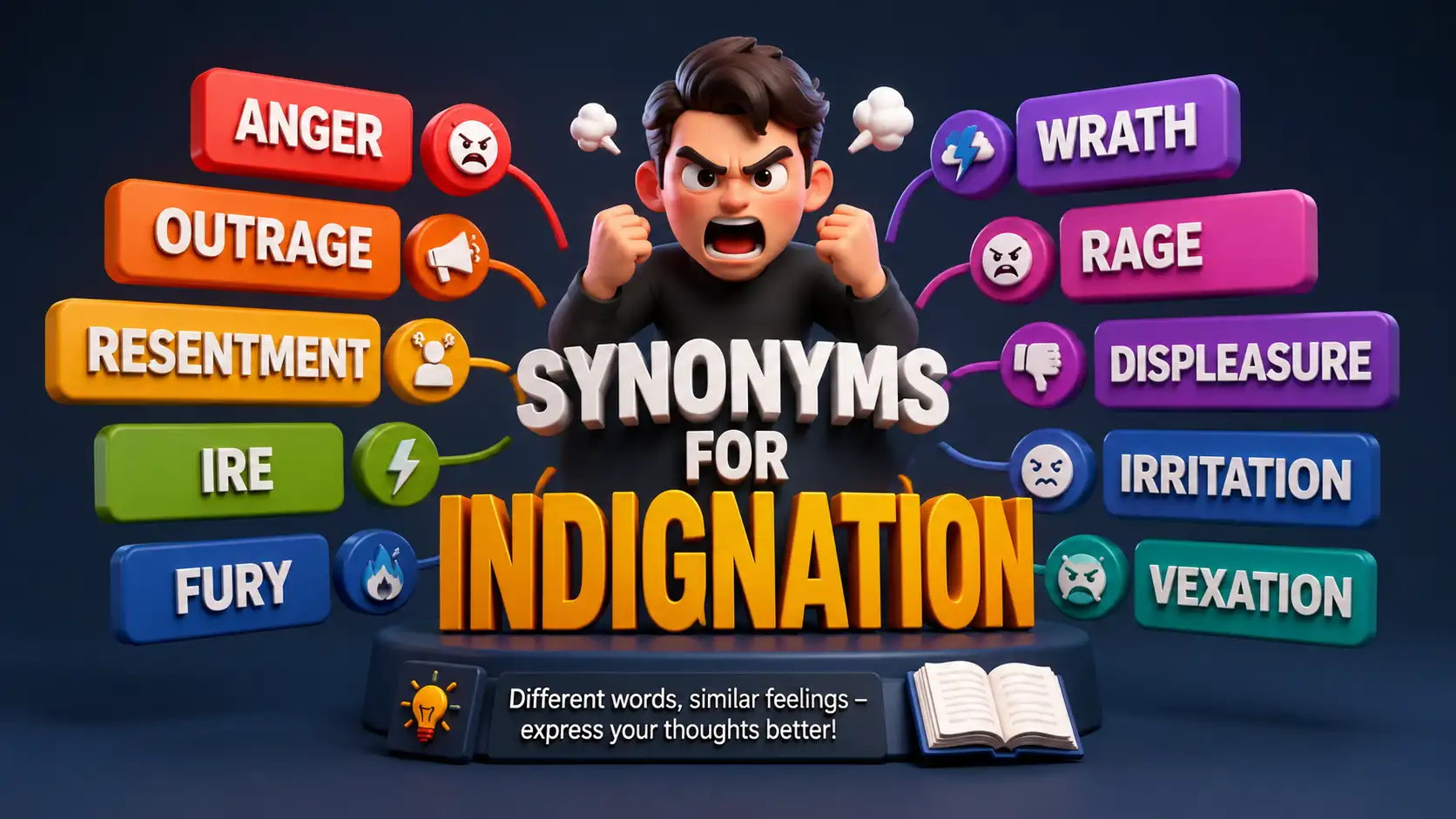
Looking for the best synonyms for indignation? You’re in the right place. Indignation means strong anger caused by something unfair, wrong, or offensive. Depending on your sentence, words such as anger, outrage, resentment, fury, ire, wrath, displeasure, and irritation can express similar ideas, but each has a slightly different meaning.
In this guide, you’ll discover the most accurate synonyms for indignation, their simple meanings, example sentences, antonyms, and useful alternatives for academic, professional, and everyday English. Whether you’re a student, writer, teacher, or content creator, this guide will help you choose the right word with confidence.
📖 Meaning of Synonyms for Indignation
Indignation is a noun that means strong anger caused by something you believe is unfair, unreasonable, wrong, mean, or shameful. It often carries the idea that the anger is justified or morally right.
For example:
The unfair decision caused public indignation.
In simple English, indignation means angry feelings about something you think is wrong or unfair.
The pronunciation is /ˌɪndɪɡˈneɪʃn/, with the main stress on the third syllable. Oxford lists indignation as an uncountable noun and gives the common patterns indignation at/about/over something.
The word comes from Latin indignatio, related to indignari, meaning to regard something as unworthy. Merriam-Webster records the first known use of indignation in the 14th century.
Simple definition
Indignation = strong anger caused by something considered unfair, wrong, or offensive.
📝 Top Synonyms of Indignation
Not every word below is a perfect one-to-one replacement. Anger, outrage, resentment, ire, fury, rage, wrath, and displeasure are among the strongest alternatives, but each has its own shade of meaning. Cambridge lists related terms such as resentment, displeasure, righteous anger, annoyance, vexation, irritation, pique, umbrage, ire, rage, wrath, and fury.
| Word | Meaning | Best Use | Example |
| Anger | Strong displeasure | General writing | His decision caused anger. |
| Outrage | Strong anger about something shocking or wrong | News and formal writing | The decision caused public outrage. |
| Resentment | Bitter anger from unfair treatment | Personal or social contexts | She felt resentment toward her employer. |
| Righteous anger | Anger believed to be morally justified | Formal and ethical contexts | The injustice caused righteous anger. |
| Ire | Strong anger, often literary | Formal or literary writing | The decision drew the mayor’s ire. |
| Fury | Extremely strong anger | Emotional writing | The announcement caused fury. |
| Rage | Very intense anger, sometimes uncontrolled | Strong emotional contexts | He struggled to control his rage. |
| Wrath | Powerful anger, often suggesting punishment | Formal, literary, religious contexts | The leader faced public wrath. |
| Displeasure | Mild to strong unhappiness or disapproval | Professional writing | The manager expressed displeasure. |
| Annoyance | Mild anger or irritation | Everyday English | His delay caused annoyance. |
| Irritation | Feeling annoyed or bothered | Daily conversation | The repeated noise caused irritation. |
| Vexation | Annoyance or frustration | Formal writing | The mistake was a source of vexation. |
| Exasperation | Strong annoyance after repeated problems | Everyday and professional English | She sighed in exasperation. |
| Pique | Hurt pride or offended feeling | Formal/literary writing | He left in a fit of pique. |
| Umbrage | Offense or annoyance at an action or remark | Formal English | She took umbrage at his comment. |
| Choler | Anger, especially an old-fashioned form | Literary writing | His choler was obvious. |
| Huff | Short period of anger or annoyance | Informal English | She walked away in a huff. |
| Animus | Strong hostility toward someone | Formal writing | He showed animus toward his rival. |
| Hostility | Unfriendly or aggressive feeling | Business and social contexts | The proposal met with hostility. |
| Bitterness | Angry and resentful feeling | Personal writing | Years of bitterness remained. |
| Animosity | Strong dislike or hostility | Formal writing | The dispute created animosity. |
| Acrimony | Angry and bitter disagreement | Formal writing | The debate ended in acrimony. |
| Rancor | Long-lasting bitterness or resentment | Formal writing | The conflict left deep rancor. |
| Discontent | Lack of satisfaction | Social and business contexts | Public discontent was growing. |
| Dissatisfaction | Feeling that something is not good enough | Professional writing | Customers expressed dissatisfaction. |
| Aggravation | Annoyance caused by a problem | Informal English | The delay was an aggravation. |
| Irritation | Mild anger caused by something bothersome | Daily English | His constant questions caused irritation. |
| Disapproval | Negative judgment of something | Formal and professional writing | The plan received public disapproval. |
| Offense | Feeling hurt or insulted | Social contexts | His words caused offense. |
| Grievance | Formal complaint about unfair treatment | Workplace/legal contexts | She filed a grievance. |
| Frustration | Annoyance caused by difficulty or failure | Everyday English | The delay caused frustration. |
| Temper | A tendency toward anger | Everyday English | He has a quick temper. |
| Spite | Desire to hurt or annoy someone | Negative personal behavior | He acted out of spite. |
| Malice | Intention to cause harm | Formal writing | The act was done with malice. |
| Antipathy | Strong dislike | Formal writing | She felt antipathy toward the policy. |
| Contempt | Feeling that someone or something is beneath respect | Formal contexts | He spoke with contempt. |
| Disdain | Strong lack of respect | Formal/literary writing | She showed disdain for the proposal. |
| Furore | Public excitement, anger, or protest | British English | The decision caused a political furore. |
| Uproar | Noisy public expression of anger or disagreement | News writing | The announcement caused an uproar. |
| Protest | Public expression of disagreement | Social and political writing | The policy triggered widespread protest. |
⚖️ Antonyms of Indignation
| Antonym | Meaning | Example |
| Calm | Peaceful state without anger | She remained calm during the argument. |
| Composure | Ability to stay calm | He maintained his composure. |
| Serenity | Deep peace and calm | The room had an air of serenity. |
| Patience | Ability to wait without becoming angry | She showed great patience. |
| Forbearance | Self-control when dealing with others | His forbearance prevented an argument. |
| Pleasure | Feeling of enjoyment or satisfaction | The news brought pleasure. |
| Delight | Strong happiness | The result filled them with delight. |
| Approval | Positive opinion or acceptance | The proposal received approval. |
| Complacency | Excessive satisfaction with oneself or a situation | His complacency worried the team. |
💬 Example Sentences With Indignation and Its Synonyms
Daily Conversation
- She spoke with indignation after hearing the unfair accusation.
- His rude comment caused irritation.
- I could hear anger in her voice.
- He reacted with annoyance to the delay.
- She left the room in a huff.
Academic English
- The unfair treatment generated public indignation.
- The study examines social resentment.
- The policy created widespread dissatisfaction.
- Students expressed disapproval of the decision.
- The issue became a source of public outrage.
Business English
- Customers expressed displeasure with the service.
- The manager responded to the complaint calmly.
- The policy caused frustration among employees.
- Several workers filed a formal grievance.
- The announcement was met with strong disapproval.
Formal Writing
- The decision provoked widespread outrage.
- The speech was delivered with moral indignation.
- The policy generated considerable resentment.
- The minister faced public wrath.
- The controversy was followed by considerable acrimony.
Creative Writing
- Her indignation burned behind a quiet smile.
- Fury rose in his chest.
- His face showed unmistakable anger.
- A wave of resentment swept through the crowd.
- Their outrage filled the streets.
📚 Difference Between Similar Words
The biggest mistake when replacing indignation is assuming that every anger-related word has exactly the same meaning.
| Word | Main Idea | Difference From Indignation |
| Anger | General strong displeasure | Broader than indignation |
| Outrage | Extreme anger about something wrong | Usually stronger and more public |
| Resentment | Bitter feeling about unfair treatment | Often lasts longer |
| Rage | Extreme, uncontrolled anger | Focuses more on intensity |
| Fury | Very intense anger | Strong emotional force |
| Wrath | Powerful anger with punishment implied | More formal or literary |
| Ire | Intense anger | More literary/formal |
| Annoyance | Mild anger | Much weaker than indignation |
| Irritation | Being bothered | Usually less intense |
| Displeasure | Lack of satisfaction | Can be much milder |
| Frustration | Anger caused by difficulty | Cause is often failure or obstacles |
| Umbrage | Feeling offended | Focuses on taking offense |
| Pique | Offended pride | Often connected with wounded pride |
🎯 Best Alternative Words for Different Situations
| Situation | Best Alternative |
| Professional email | displeasure |
| Academic essay | indignation / resentment |
| News article | outrage |
| Formal report | disapproval / resentment |
| Business complaint | dissatisfaction |
| Casual conversation | anger / annoyance |
| Strong emotional writing | fury / rage |
| Literary writing | ire / wrath |
| Public reaction | outrage / uproar |
| Unfair treatment | resentment |
| Moral injustice | righteous anger |
| Offended reaction | umbrage |
| Wounded pride | pique |
| Long-term bitterness | rancor / bitterness |
The safest replacement
If you’re unsure which word to choose, anger is usually the safest general alternative. If the sentence involves a perceived injustice or moral wrong, indignation or outrage may communicate the idea more accurately.
✍ Grammar Tips
Indignation is a noun and is normally used as an uncountable noun.
Common patterns
- indignation at something
- indignation about something
- indignation over something
- full of indignation
- filled with indignation
- express indignation
- provoke indignation
- arouse indignation
Oxford gives examples such as indignation at/about/over something and notes common combinations including public indignation and righteous indignation.
Related word forms
| Word | Part of Speech | Example |
| indignation | Noun | Her indignation was obvious. |
| indignant | Adjective | She was indignant about the decision. |
| indignantly | Adverb | He replied indignantly. |
| indignity | Noun | They suffered an indignity. |
Don’t confuse indignation with indignity. Indignation is the angry feeling; indignity is an insult, humiliation, or loss of dignity.
❌ Common Mistakes
| Wrong | Correct | Reason |
| He was indignant. | He was indignant. | Indignant is the adjective. |
| She felt an indignation. | She felt indignation. | Indignation is normally uncountable. |
| His indignation about the unfair rule. | His indignation over the unfair rule. | Both can work; over is a natural pattern. |
| She spoke of indignation. | She spoke indignantly. | The adverb describes how she spoke. |
| Indignation means any small annoyance. | Indignation usually involves a sense of unfairness or wrongdoing. | The word has a stronger moral meaning. |
💡 Pro Writing Tips
A strong writer doesn’t replace every repeated word with the first synonym found in a thesaurus.
Ask three questions first:
- How strong is the emotion?
- Why is the person angry?
- Is the writing formal or informal?
For example:
The customer felt angry.
This is simple and neutral.
The customer felt indignation.
This suggests that the customer believed something was unfair or wrong.
The customer expressed outrage.
This suggests a stronger and often more public reaction.
That small difference can make your writing more precise.
📖 Related Words
Useful vocabulary around indignation includes:
- indignant
- indignantly
- indignity
- anger
- outrage
- resentment
- injustice
- unfairness
- offense
- disapproval
- protest
- grievance
- hostility
- bitterness
- fury
- rage
- wrath
- ire
- irritation
- frustration
- displeasure
- contempt
- disdain
- animosity
- acrimony
FAQs
What is the best synonym for indignation?
The best general synonym for indignation is anger, but outrage can be better when the reaction is very strong or public. Resentment works when the anger comes from unfair treatment. The right choice depends on the sentence, intensity, and reason for the emotional response.
Is outrage a synonym for indignation?
Yes, outrage can be a synonym for indignation, especially when anger is caused by something shocking, unfair, or morally wrong. However, outrage often sounds stronger and can describe a public reaction. Indignation can also describe a personal feeling of justified anger.
What is the opposite of indignation?
Common opposites of indignation include calm, composure, serenity, pleasure, approval, and patience. The best antonym depends on the context. If the sentence focuses on emotional control, composure or calm works well. If it focuses on a positive response, approval or pleasure may fit.
Is resentment the same as indignation?
No. Resentment and indignation are closely related, but they are not identical. Resentment usually describes bitter or lasting anger caused by unfair treatment. Indignation emphasizes anger about something considered wrong, unfair, mean, or shameful. A person can feel both at the same time.
What is a formal synonym for indignation?
Formal alternatives include ire, displeasure, resentment, outrage, umbrage, and righteous anger. For professional writing, displeasure or resentment may sound appropriate. For literary writing, ire and wrath are stronger stylistic choices. Always check the exact meaning before replacing the original word.
Is indignation a noun or adjective?
Indignation is a noun. The related adjective is indignant, as in “She was indignant about the decision.” The adverb is indignantly, as in “He replied indignantly.” Keeping these forms separate helps prevent common grammar errors in essays and professional writing.
What is the difference between indignation and rage?
Indignation focuses on why someone is angry, especially when they believe something is unfair or wrong. Rage focuses more on extreme intensity and possible loss of emotional control. Therefore, someone can feel indignation without becoming enraged, while rage does not necessarily involve a sense of justice.
What are the most common synonyms for indignation?
Common synonyms include anger, outrage, resentment, fury, rage, wrath, ire, displeasure, annoyance, irritation, vexation, pique, umbrage, and righteous anger. Trusted thesauruses list many of these words, but they aren’t interchangeable in every sentence because each carries a slightly different emotional meaning.
🏁 Conclusion
The best synonym for indignation depends on the exact meaning you want. Anger is the broadest choice, while outrage suggests strong or public anger. Resentment highlights lasting bitterness from unfair treatment, ire is more literary, and fury or rage emphasize extreme emotional intensity.
The key is not to replace indignation with a random thesaurus word. Choose the alternative that matches the cause, strength, tone, and context of your sentence. That approach makes your English clearer, more natural, and more precise.