Finding the right synonyms for forcing can make your writing clearer and more precise. Depending on the situation, forcing can mean making someone do something, putting pressure on them, using physical power, or making an event happen.
The best alternative depends on your meaning. For example, compelling often suggests strong pressure, while coercing suggests using threats or pressure. Pressuring is more common in everyday English, while compelling and coercing are often better choices in formal writing. Cambridge also lists expressions such as arm-twisting, browbeating, coercion, duress, and putting the heat on someone in the broader group of language used for causing someone to act.
In this guide, you’ll learn useful alternatives, their meanings, examples, antonyms, grammar tips, and how to choose the right word.
📖 Meaning of Forcing
Forcing is the present participle of the verb “force.”
Simple definition
Forcing means making someone do something or making something happen when there may be little or no choice.
For example:
The manager was forcing the team to work late.
Here, forcing means making the team work late even if they didn’t want to.
The word can also describe physical action:
He was forcing the door open.
In this case, forcing means using physical effort to make the door open. Cambridge distinguishes these two major uses: making someone do something without offering a choice and using physical strength to move or open something.
Part of speech
- Word: Forcing
- Base verb: Force
- Part of speech: Verb form / present participle
- Pronunciation: /ˈfɔːr.sɪŋ/
- Base verb: force
- Past form: forced
- -ing form: forcing
Common uses
- forcing someone to agree
- forcing someone to leave
- forcing a decision
- forcing an issue
- forcing a door open
- forcing a change
- forcing yourself to do something
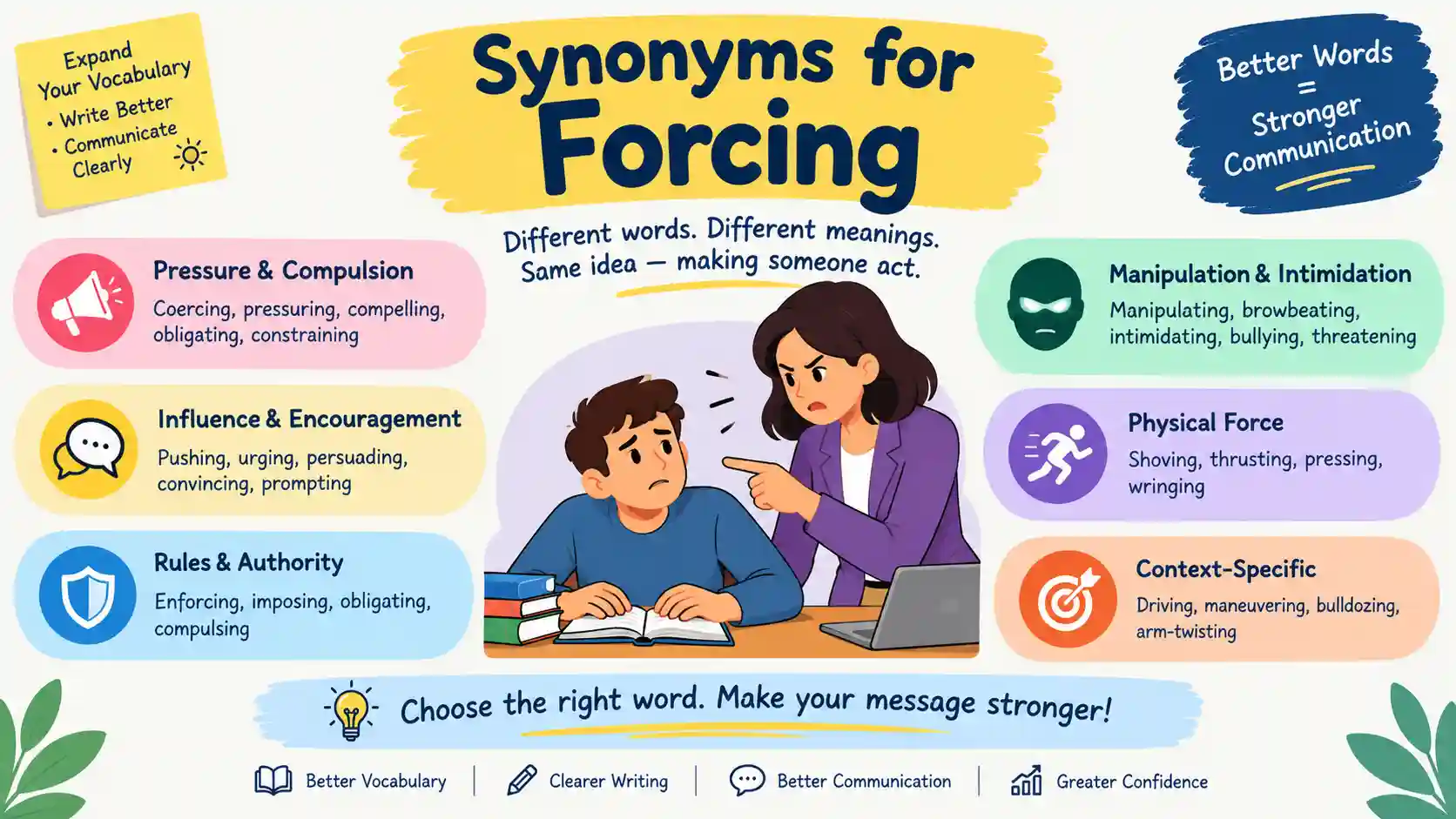
📝 Top Synonyms for Forcing
Forcing can describe making someone act, applying pressure, influencing a decision, or using physical strength. The best alternative depends on the exact meaning and situation.
💪 Words for Strong Pressure or Compulsion
| Word | Meaning | Best Use | Example |
| Compelling | Making someone act because of strong pressure or reason | Formal writing | The evidence was compelling him to respond. |
| Coercing | Making someone act through threats or serious pressure | Formal/serious | They were accused of coercing workers. |
| Pressuring | Trying strongly to make someone act | Everyday/business | She was pressuring him to decide. |
| Constraining | Limiting someone’s freedom or choices | Academic/formal | The policy was constraining their options. |
| Obliging | Making someone do something because it is necessary | Formal | The rules were obliging them to report it. |
| Obligating | Creating a duty or requirement | Legal/formal | The contract was obligating them to pay. |
| Compulsing | Forcing someone to comply | Rare/formal | The policy focused on compulsing compliance. |
🗣️ Words for Encouraging or Influencing Action
| Word | Meaning | Best Use | Example |
| Pushing | Encouraging or pressuring someone to act | Everyday English | She kept pushing him to apply. |
| Urging | Strongly encouraging someone | Neutral | His teacher was urging him to practice. |
| Insisting | Firmly saying that something must happen | Conversation | She was insisting on an explanation. |
| Demanding | Asking for something firmly | Business/formal | The client was demanding changes. |
| Influencing | Affecting someone’s decision or behavior | Neutral | Advertising can influence buyers. |
| Persuading | Getting someone to agree through reasons | Positive/neutral | She was persuading him to stay. |
| Convincing | Causing someone to accept an idea or opinion | General | He was convincing them to try again. |
| Prompting | Causing someone to take action | Neutral | The warning prompted him to leave. |
| Inducing | Causing someone to do something | Formal | The situation was inducing people to act. |
| Driving | Causing an action or change | Figurative | High costs were driving the change. |
🎭 Words for Unfair or Manipulative Pressure
| Word | Meaning | Best Use | Example |
| Manipulating | Influencing someone unfairly | Negative contexts | He was manipulating her into agreeing. |
| Browbeating | Pressuring someone through intimidation | Negative contexts | They were browbeating employees into silence. |
| Intimidating | Making someone act through fear | Serious contexts | The group was intimidating witnesses. |
| Bullying | Using repeated pressure, fear, or threats | Negative contexts | He was bullying others into joining. |
| Threatening | Warning someone of harm or punishment | Strong/negative | They were threatening him with dismissal. |
| Badgering | Repeatedly asking or pressuring someone | Informal | Stop badgering me for an answer. |
| Hounding | Repeatedly pursuing or pressuring someone | Informal | Reporters were hounding him for comments. |
| Harassing | Repeatedly troubling or disturbing someone | Serious | She said she was being harassed at work. |
| Strong-arming | Using heavy pressure or force | Informal | They were strong-arming suppliers into agreement. |
📋 Words for Forcing Rules, Decisions, or Outcomes
| Word | Meaning | Best Use | Example |
| Enforcing | Making people obey a rule or law | Rules/law | Officers were enforcing the new rules. |
| Imposing | Making something apply to others, often without choice | Formal | The company was imposing new restrictions. |
| Maneuvering | Using careful actions to influence an outcome | Formal | They were maneuvering him into accepting the deal. |
| Bulldozing | Pushing something through despite opposition | Informal | The group was bulldozing the proposal through. |
| Arm-twisting | Using strong pressure to get agreement | Informal | The deal required some arm-twisting. |
🏃 Words for Physical Force or Movement
| Word | Meaning | Best Use | Example |
| Shoving | Pushing something or someone with force | Physical action | He was shoving the door open. |
| Thrusting | Pushing something suddenly or strongly | Physical action | He was thrusting the object forward. |
| Pressing | Applying physical pressure | Physical action | She was pressing the button firmly. |
| Wringing | Forcing something out of something or someone | Specific contexts | He was wringing information from them. |
🎯 Context-Specific Alternatives
Some words are related to forcing but shouldn’t be treated as exact synonyms in every sentence.
| Word/Phrase | Meaning | When to Use | Example |
| Pushing toward | Moving or encouraging someone toward an action | Decisions/actions | The evidence was pushing him toward a decision. |
| Forcing compliance | Making someone obey or follow a requirement | Rules/policies | The system was designed to force compliance. |
| Putting pressure on | Trying to make someone act or decide | Everyday/business | They were putting pressure on him to respond. |
| Forcing the issue | Making a matter receive immediate attention | Idiomatic/formal | The report forced the issue into public discussion. |
| Forcing someone’s hand | Making someone take an action before they want to | Idiomatic | The deadline forced the manager’s hand. |
⚖️ Antonyms of Forcing
If forcing means making someone act without a free choice, its opposite often involves choice, freedom, or voluntary action.
| Antonym | Meaning | Example |
| Allowing | Giving permission or freedom | They allowed him to choose. |
| Permitting | Giving official permission | The school permitted students to leave. |
| Encouraging | Giving support without requiring action | She encouraged him to apply. |
| Persuading | Changing someone’s mind through reasons | He persuaded her to join. |
| Requesting | Asking for something politely | She requested more time. |
| Inviting | Asking someone willingly to participate | They invited him to speak. |
| Freeing | Removing restrictions | The decision freed them from the rule. |
| Releasing | Letting someone or something go | They released the prisoner. |
| Choosing | Deciding freely | She chose to stay. |
| Volunteering | Offering to do something willingly | He volunteered to help. |
| Accepting | Agreeing willingly | They accepted the offer. |
| Cooperating | Working together willingly | Everyone cooperated with the plan. |
💬 Example Sentences for Forcing
Daily Conversation
- Stop forcing me to choose right now.
- She was forcing herself to smile.
- Don’t keep forcing him to talk.
- They were forcing us to wait outside.
- I don’t like forcing people to agree with me.
Academic English
- The new conditions are forcing students to adapt.
- Economic changes are forcing schools to reconsider their plans.
- The evidence is forcing researchers to examine the theory again.
- Limited resources are forcing the team to change its method.
- The situation is forcing students to think more carefully.
Business English
- Rising costs are forcing the company to reduce spending.
- The market is forcing businesses to improve their services.
- The deadline is forcing the team to work faster.
- Competition is forcing the company to innovate.
- The contract is forcing the supplier to meet strict requirements.
Formal Writing
- The circumstances were forcing the organization to reconsider its strategy.
- Financial pressure was forcing several changes.
- The evidence was forcing officials to review the decision.
- New regulations were forcing businesses to adapt.
- The growing demand was forcing the industry to change.
📚 Difference Between Similar Words
Forcing vs. Pressuring
| Word | Main idea | Example |
| Forcing | Leaving someone with little or no choice | They were forcing him to leave. |
| Pressuring | Trying strongly to make someone act | They were pressuring him to leave. |
Pressure doesn’t always mean that the person has no choice. Forcing usually suggests a stronger lack of choice.
Forcing vs. Compelling
Compelling is often a more formal alternative to forcing.
- The evidence forced the company to respond.
- The evidence compelled the company to respond.
Compelling can sound more polished in academic and professional writing.
Forcing vs. Coercing
Coercing is stronger and usually suggests pressure, threats, or intimidation.
- They were forcing him to sign.
- They were coercing him into signing.
Use coercing when the idea of improper pressure is important.
Forcing vs. Persuading
These words aren’t interchangeable.
Persuading means convincing someone through reasons or encouragement.
Forcing means making someone act without genuine freedom of choice.
She persuaded him to join the team.
She forced him to join the team.
The first sentence suggests choice. The second suggests a lack of choice.
Forcing vs. Encouraging
Encouraging is usually supportive.
Forcing is much stronger.
The teacher encouraged students to participate.
The teacher forced students to participate.
The first gives support; the second removes or limits choice.
🎯 Best Alternative Words for Different Situations
Professional Writing
Use:
- compelling
- pressuring
- constraining
- obligating
- compelling
- enforcing
Example:
“New regulations are forcing businesses to adapt.”
More formal:
“New regulations are compelling businesses to adapt.”
Essay Writing
Good choices include:
- compelling
- constraining
- obligating
- pressuring
- inducing
For a polite tone, avoid unnecessarily strong words such as coercing or bullying.
Try:
- requesting
- urging
- encouraging
- asking
- pressing
Business
Useful alternatives include:
- compelling
- pressuring
- obligating
- enforcing
- driving
- pushing
Conversation
Natural choices include:
- pushing
- pressuring
- making
- insisting
- forcing
Marketing
Depending on the meaning:
- encouraging
- persuading
- prompting
- influencing
- driving
Creative Writing
For stronger emotional language:
- compelling
- pressuring
- intimidating
- coercing
- pushing
- driving
- overpowering
✍️ Grammar Tips
1. Force + object + to + verb
This is one of the most common patterns.
Structure:
force + someone + to + verb
Example:
The coach forced the players to practice.
2. Forcing + object + to + verb
When using the -ing form:
The coach was forcing the players to practice.
3. Force someone into something
Use into when describing movement toward a situation or position.
They forced him into an uncomfortable situation.
4. Force something open
For physical action:
He forced the door open.
5. Force yourself to do something
This means making yourself do something that you don’t naturally want to do.
I forced myself to finish the assignment.
Word forms
| Form | Example |
| Force | They force him to work. |
| Forces | The rule forces change. |
| Forced | She was forced to leave. |
| Forcing | They are forcing a decision. |
| Forceful | He gave a forceful response. |
| Forcefully | She argued forcefully. |
❌ Common Mistakes
| Wrong / Less Suitable | Better | Reason |
| She forced him agree. | She forced him to agree. | Use to + verb after force. |
| He forced me agreeing. | He forced me to agree. | Don’t use the -ing form after this pattern. |
| She persuaded him to leave by force. | She forced him to leave. | Choose the word that matches the meaning. |
| They coerced the students to study. | They forced the students to study. | Coerce usually suggests improper pressure or threats. |
| He forced the door to open. | He forced the door open. | Physical use commonly follows the object + adjective pattern. |
💡 Pro Writing Tips
A good writer doesn’t replace forcing with the first synonym they find.
Instead, ask what kind of pressure is involved.
- Use pressuring for strong influence.
- Use compelling for formal writing.
- Use coercing when threats or improper pressure are involved.
- Use persuading when someone is convinced through reasons.
- Use encouraging when support is offered.
- Use enforcing when a rule or law must be obeyed.
- Use intimidating when fear is used.
- Use obligating when a duty or requirement is created.
- Use pushing for casual or figurative pressure.
- Use forcing when the lack of choice is the key idea.
This makes your writing more precise and prevents different ideas from being treated as exact synonyms.
📖 Related Words
Here are some useful words connected with forcing:
Pressure-related words
- pressure
- persuasion
- influence
- insistence
- demand
- compulsion
- coercion
- intimidation
- obligation
- constraint
Action-related words
- push
- shove
- drive
- thrust
- press
- impose
- compel
- induce
Useful phrases
- force someone to do something
- force something on someone
- force the issue
- force someone’s hand
- force something open
- force your way through
- put pressure on someone
- push someone toward something
Cambridge specifically identifies expressions such as force someone’s hand, push someone toward something, put the heat on someone, and put/tighten the screws on someone within this wider vocabulary area.
❓ Frequently Asked Questions
1. What is the best synonym for forcing?
The best synonym depends on the sentence. Compelling, pressuring, and coercing are common alternatives, but they don’t have exactly the same meaning. Compelling often sounds formal, pressuring suggests strong influence, and coercing usually suggests improper pressure or threats. Choose the word that matches the situation.
2. What is another word for forcing someone?
Common alternatives include pressuring, compelling, coercing, intimidating, pushing, obligating, and persuading. However, these words have different strengths. Persuading usually allows a person to make a choice, while forcing suggests little or no choice. Coercing can suggest threats or serious pressure.
3. Is compelling a synonym for forcing?
Compelling can be a synonym for forcing in many contexts, especially formal writing. Both can describe making someone do something. However, compelling can sound less physical and more formal. For example, “The evidence compelled him to respond” means the evidence created a strong reason or pressure to respond.
4. What is the difference between forcing and pressuring?
Forcing usually suggests that someone has little or no choice, while pressuring means trying strongly to influence someone’s decision. A person can be pressured and still refuse. If someone is forced, the situation normally suggests that their freedom to choose has been greatly reduced.
5. What is a formal word for forcing?
Some formal alternatives include compelling, coercing, constraining, obligating, and enforcing. The right word depends on the context. Compelling works well when something creates a strong need to act. Constraining focuses on limited choices, while enforcing is useful when rules or requirements are involved.
6. What is a polite alternative to forcing?
Depending on the situation, encouraging, requesting, urging, or persuading can sound more polite than forcing. These words are useful when someone is being asked or encouraged rather than denied a choice. For example, “The teacher encouraged students to participate” sounds much softer than “The teacher forced students to participate.”
7. Is persuading the same as forcing?
No. Persuading and forcing are different. Persuasion usually involves giving reasons, encouragement, or information so another person chooses to act. Forcing means making someone act with little or no choice. A persuasive request can be rejected, while forcing generally suggests that refusal isn’t realistically available.
8. What is the opposite of forcing?
Depending on the context, opposites include allowing, permitting, encouraging, requesting, inviting, choosing, and volunteering. These words generally involve greater freedom of choice. For example, forcing someone to participate removes choice, while inviting someone to participate gives them the opportunity to decide.
🎯 Conclusion
Finding the right synonyms for forcing depends on the meaning and tone of your sentence. Words such as compelling, pressuring, coercing, pushing, urging, and obligating can describe different types of pressure or influence. For physical action, words like shoving, thrusting, and pressing may be more suitable.
Remember, related words aren’t always exact synonyms. Persuading suggests using reasons, while coercing suggests serious pressure or threats. Enforcing is mainly used for rules and laws, while compelling works well in formal and academic writing.
Choosing the right alternative can make your English more precise, natural, and effective. Whether you’re writing an essay, email, business document, or everyday sentence, always choose the word that best matches your intended meaning.