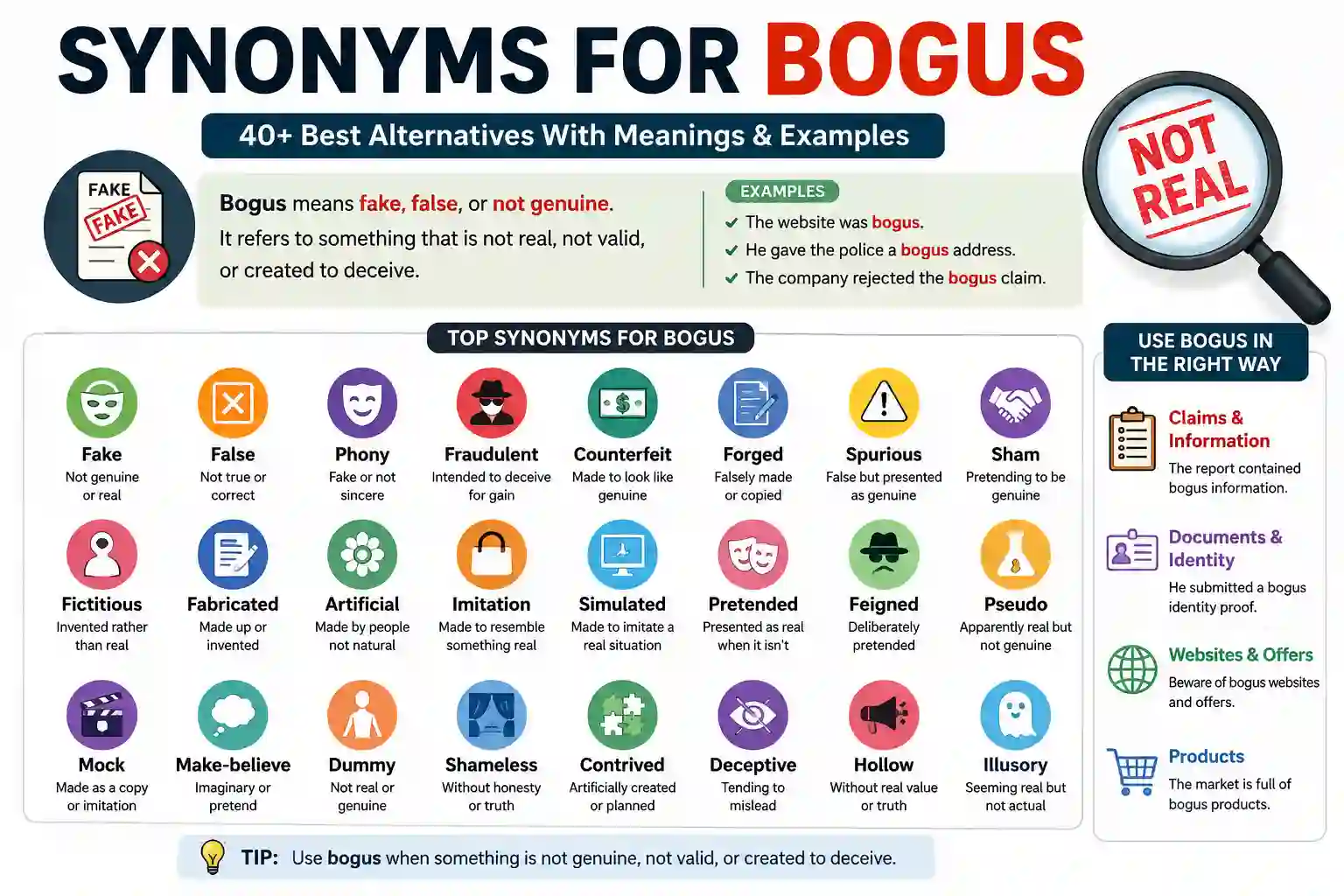
Looking for the best synonyms for bogus? The word bogus means fake, false, or not genuine, and it can describe everything from a bogus claim or document to a fake product or website. But not every alternative has the same meaning or tone.
In this guide, you’ll discover useful synonyms such as fake, false, phony, fraudulent, counterfeit, forged, spurious, and sham, along with simple meanings and examples. Whether you’re a student, writer, teacher, or professional, you’ll learn how to choose the right word for your sentence and make your English clearer and more precise.
📖 Meaning of Synonyms for Bogus
The word bogus means false, not real, or not genuine. It can describe something that looks real but isn’t, or something created to deceive people. It is an adjective and is commonly used with words such as claim, document, website, account, identity, product, and information.
Pronunciation: /ˈboʊ.ɡəs/ in American English and /ˈbəʊ.ɡəs/ in British English.
Simple meaning:
If something is bogus, you can’t trust it because it isn’t genuine or what it claims to be.
For example:
- The website was bogus.
- He gave the police a bogus address.
- The company rejected the bogus claim.
Cambridge Dictionary lists fake and phoney/phony among the closest alternatives.
Where is “bogus” commonly used?
You may see bogus in:
- Everyday conversation
- News reports
- Business writing
- Online safety discussions
- Legal and administrative contexts
- Discussions about false claims
- Academic and professional writing
📝 Top Synonyms of Bogus
Not every synonym has exactly the same meaning. Some focus on something being fake, while others suggest fraud, deception, imitation, or lack of truth.
| Synonym | Meaning | Best Use | Example |
| Fake | Not genuine or real | General use | The watch was fake. |
| False | Not true or correct | Claims and information | The report contained false information. |
| Phony | Fake or not sincere | People, claims, documents | He gave a phony excuse. |
| Forged | Falsely made or copied | Documents and signatures | She submitted a forged certificate. |
| Sham | Something pretending to be genuine | Situations, agreements, institutions | The deal was a sham. |
| Fictitious | Invented rather than real | Names, people, stories | The author used a fictitious name. |
| Fabricated | Made up or invented | Stories, evidence, information | The accusation was fabricated. |
| Artificial | Made by people rather than natural | Objects and materials | The flowers were artificial. |
| Imitation | Made to resemble something genuine | Products and objects | She bought an imitation handbag. |
| Simulated | Made to resemble a real situation | Training and testing | The students practiced in a simulated environment. |
| Pretended | Presented as real when it isn’t | Actions and feelings | His concern seemed pretended. |
| Feigned | Deliberately pretended | Formal writing | He feigned surprise. |
| Pseudo | Apparently real but not genuinely so | Experts, science, systems | It was presented as pseudo-science. |
| Mock | Made as a copy or imitation | Tests, objects, events | They held a mock interview. |
| Make-believe | Imaginary or pretend | Children’s activities | The children created a make-believe world. |
| Dummy | A model or imitation used instead of the real thing | Objects and training | The store used a dummy camera. |
| Contrived | Artificially planned rather than natural | Stories and situations | The ending felt contrived. |
| Invented | Created rather than discovered or true | Stories and excuses | He invented an excuse. |
| Concocted | Carefully invented or put together | Stories and schemes | They concocted a false story. |
| Deceptive | Likely to mislead | Appearance and information | The advertisement was deceptive. |
| Misleading | Giving a wrong impression | Information and statements | The headline was misleading. |
| Dishonest | Not truthful or fair | People and behavior | His answer was dishonest. |
| Untrue | Not true | Statements and claims | The rumor was untrue. |
| Unreal | Not real | General conversation | The offer sounded unreal. |
| Inauthentic | Not genuine or authentic | Art, behavior, experiences | The review felt inauthentic. |
| Illegitimate | Not lawful, valid, or genuine | Claims and authority | The document was considered illegitimate. |
| Invalid | Not legally or logically acceptable | Documents, arguments, results | The permit was invalid. |
| Unfounded | Without a good basis or evidence | Claims and accusations | The allegation was unfounded. |
| Baseless | Without reasonable support | Claims and accusations | The rumor was baseless. |
| Groundless | Without a valid reason or basis | Arguments and fears | His concern was groundless. |
| Spurious | Apparently valid but actually false | Arguments and evidence | The researcher rejected the spurious claim. |
| Deceitful | Intentionally misleading | People and actions | His deceitful behavior damaged trust. |
| Fraudulent | Involving fraud or deception | Financial/legal matters | The company reported a fraudulent claim. |
| Counterfeit | An unauthorized imitation of something genuine | Products and currency | The shop sold counterfeit goods. |
| Unreliable | Not dependable or trustworthy | Sources and information | The website was unreliable. |
| Dubious | Not likely to be true or trustworthy | Claims and evidence | The source made a dubious claim. |
| Questionable | Doubtful or open to suspicion | Decisions and claims | The report used questionable data. |
The closest everyday choices are usually fake, false, phony, sham, fraudulent, counterfeit, forged, and spurious, but the correct choice depends on context. Cambridge’s thesaurus also groups words such as counterfeit, fraudulent, spurious, forged, pseudo, imitation, and phony with bogus.
⚖️ Antonyms of Bogus
An antonym expresses the opposite idea: something real, genuine, truthful, or legitimate.
| Antonym | Meaning | Example |
| Genuine | Truly what it claims to be | The document is genuine. |
| Real | Actually existing | The threat was real. |
| Authentic | Original and genuine | The painting is authentic. |
| Legitimate | Lawful or valid | It is a legitimate business. |
| True | In accordance with fact | The statement is true. |
| Valid | Acceptable or well-founded | The argument is valid. |
| Actual | Existing in fact | These are the actual figures. |
| Bona fide | Genuine or sincere | He is a bona fide expert. |
| Honest | Truthful and sincere | She gave an honest answer. |
| Reliable | Worthy of trust | This is a reliable source. |
Cambridge’s thesaurus identifies genuine, real, authentic, legitimate, true, bona fide, and actual as antonyms associated with bogus.
💬 Example Sentences With Bogus and Its Synonyms
Here are natural examples showing how these words work in different situations:
- The police discovered a bogus identity card.
- The website was bogus, so customers avoided it.
- He made a false claim about his experience.
- She bought a fake designer bag.
- The salesman gave the customer a phony address.
- The company investigated a fraudulent payment.
- Officials found several counterfeit banknotes.
- The signature on the document was forged.
- The argument was based on spurious evidence.
- The agreement turned out to be a sham.
- The character in the story has a fictitious name.
- The report contained fabricated information.
- The flowers were artificial, not natural.
- He purchased an imitation product.
- The emergency exercise used a simulated situation.
- Her apology sounded feigned rather than sincere.
- The advertisement was misleading.
- The accusation was completely unfounded.
- The rumor was baseless.
- The source seemed unreliable.
🔎 Fake vs. Bogus: What’s the Difference?
Fake and bogus are close synonyms because both can describe something that isn’t real or genuine. However, they aren’t always interchangeable.
Fake is the most common and direct word in everyday English. It can describe a fake product, fake money, fake identity, or fake story. Bogus often emphasizes that something is false, invalid, or presented as genuine when it isn’t.
| Word | Meaning | Best Use | Example |
| Fake | Not real or genuine | Everyday English | He bought a fake watch. |
| Bogus | False, fake, or not valid | Claims, information, documents, offers | The website was bogus. |
Is “fake” a synonym for “bogus”?
Yes. Fake is one of the closest synonyms for bogus. Both words can describe something that is not genuine.
- The document was bogus.
- The document was fake.
Both sentences communicate a similar idea.
However, bogus can sometimes suggest that something is false or invalid rather than simply an imitation. For example, a bogus claim may be completely untrue, while a fake watch usually means an imitation of a genuine watch.
Quick Rule
Use fake when you want a simple, common word for something that isn’t real. Use bogus when you want to emphasize that something is false, invalid, or misleading.
Examples:
- Fake product → an imitation of a real product
- Bogus claim → a false or unsupported claim
- Fake money → counterfeit currency
- Bogus offer → an offer that isn’t genuine or trustworthy
📚 Difference Between Similar Words
Several words can replace bogus, but they don’t always mean exactly the same thing.
| Word | Main Idea | Best Context |
| Bogus | False or not genuine | General situations |
| Fake | Made to look real | Products, objects, people |
| False | Not true | Claims, facts, statements |
| Phony | Fake or insincere | People, excuses, claims |
| Fraudulent | Involving deliberate deception | Money and business |
| Counterfeit | Unauthorized copy of a genuine product | Currency and branded goods |
| Forged | Falsely created or altered | Signatures and documents |
| Spurious | False but apparently valid | Evidence, reasoning, claims |
| Sham | Something pretending to be genuine | Agreements and institutions |
| Fictitious | Invented rather than real | Names, people, stories |
Bogus vs. Fake
Fake is usually the easiest general synonym for bogus. Cambridge also lists fake directly as a synonym of bogus.
- Bogus: The website was bogus.
- Fake: The website was fake.
Both work well in everyday English.
Bogus vs. Fraudulent
Fraudulent is more specific. It often describes deliberate deception, especially when money, documents, or transactions are involved.
- The claim was bogus.
- The insurance claim was fraudulent.
Bogus vs. Counterfeit
Counterfeit usually refers to an unauthorized imitation of something valuable or protected, such as money, branded products, or official documents.
- The website was bogus.
- The bank discovered counterfeit notes.
Bogus vs. Spurious
Spurious is more formal and is useful when discussing claims, evidence, arguments, or reasoning.
- The claim was bogus.
- The researcher rejected the spurious argument.
🎯 Best Alternative Words for Different Situations
Choosing the right synonym depends on what you’re describing.
| Situation | Best Alternative | Example |
| Everyday conversation | Fake | That’s a fake product. |
| Professional writing | False | The report contains false information. |
| Business | Fraudulent | The transaction appeared fraudulent. |
| Legal documents | Forged | The signature was forged. |
| Branded products | Counterfeit | The store sold counterfeit goods. |
| Academic writing | Spurious | The paper rejected a spurious claim. |
| Informal speech | Phony | That’s a phony excuse. |
| Creative writing | Fictitious | The story uses a fictitious character. |
| Formal criticism | Inauthentic | The response seemed inauthentic. |
| Unsupported claims | Unfounded | The accusation was unfounded. |
✍️ Grammar Tips
Is “bogus” an adjective?
Yes. Bogus is an adjective. It describes a noun.
- a bogus claim
- a bogus website
- a bogus document
- a bogus identity
Does “bogus” have a verb form?
No common standard verb form comes directly from bogus. Don’t write bogused as though it were a normal verb.
Instead, use words such as:
- faked
- forged
- fabricated
- falsified
- counterfeited
Does “bogus” have an adverb form?
There is no commonly used standard adverb such as bogusly. Rewrite the sentence with a natural expression.
Instead of:
He acted bogusly.
Use:
He acted deceptively.
Can “bogus” describe a person?
Yes, but it can sound informal or critical. For a person, phony, fake, or dishonest may sometimes communicate the intended meaning more naturally.
❌ Common Mistakes
| Wrong or Weak Usage | Better Usage | Reason |
| He bogus the document. | He forged the document. | Bogus is normally an adjective. |
| She gave a bogusly answer. | She gave a false answer. | Bogusly isn’t natural standard English. |
| The money was forged. | The money was counterfeit. | Forged is more commonly used for documents/signatures. |
| The fake claim was counterfeit. | The claim was false. | Counterfeit usually describes an imitation of something genuine. |
| The fake signature was bogus. | The signature was forged. | Forged gives the more precise meaning. |
Quick rule
Don’t automatically replace bogus with the first synonym you find. Ask:
What exactly is false?
- Product → fake/counterfeit
- Document → forged
- Claim → false/unfounded
- Transaction → fraudulent
- Argument → spurious
- Person/behavior → phony/fake
- Story/name → fictitious
💡 Pro Writing Tips
A good synonym should preserve both the meaning and tone of the original sentence.
For example, fake is simple and conversational, while fraudulent sounds more professional. Spurious is useful in formal or academic writing, whereas phony is informal and can sound critical.
Before choosing an alternative, consider:
- Audience: Who will read it?
- Context: What is being described?
- Tone: Is the writing formal or casual?
- Precision: Does the synonym add a more exact meaning?
- Grammar: Does the replacement fit the sentence?
- Connotation: Does the word sound too harsh or informal?
The best synonym isn’t always the most complicated one. In many cases, fake or false is clearer than a more advanced word.
📖 Related Words
Words connected with bogus include:
- fake
- false
- phony
- fraud
- fraudulence
- deception
- deceit
- counterfeit
- forgery
- imitation
- sham
- fabrication
- falsification
- deception
- dishonesty
- fictitious
- spurious
- pseudo
- simulated
- misleading
- deceptive
- inauthentic
- illegitimate
- dubious
- questionable
- unreliable
- genuine
- authentic
- legitimate
- real
- truthful
These words belong to related semantic areas such as deception, authenticity, truth, imitation, fraud, and credibility.
Frequently Asked Questions
What’s another word for bogus?
Another word for bogus is fake, false, phony, fraudulent, counterfeit, forged, spurious, sham, fictitious, or inauthentic. The best synonym depends on context. For everyday English, fake is usually the simplest choice.
How do you say bogus professionally?
In professional writing, you can replace bogus with more precise words such as false, fraudulent, invalid, unfounded, spurious, fabricated, deceptive, or inauthentic. For example, instead of “a bogus claim,” you could write “a false or unfounded claim.”
What does “bogus” mean in slang?
In informal or slang English, bogus means fake, false, dishonest, or not genuine. It can also describe something that seems unfair, unreasonable, or unacceptable. For example, “That excuse is bogus” means the excuse isn’t believable or genuine.
Is phony a synonym for bogus?
Yes. Phony, also spelled phony in American English and phoney in British English, can mean fake, insincere, or not genuine. It can describe a person, excuse, address, claim, or other thing. Because it is informal and often disapproving, it may not be the best choice for formal writing.
What is the opposite of bogus?
The opposite of bogus is usually genuine, real, authentic, legitimate, or true. The best antonym depends on context. For example, a bogus document is the opposite of a genuine document, while a bogus business claim may be the opposite of a legitimate claim.
What is the difference between bogus and fraudulent?
Bogus broadly means false, fake, or not genuine. Fraudulent is more specific and normally suggests intentional deception, often for an unfair or dishonest purpose. You can describe a claim as bogus, but calling a transaction fraudulent strongly suggests that deception or fraud was involved.
What is the difference between bogus and counterfeit?
Bogus is a broad word for something false or not genuine. Counterfeit specifically describes something made as an unauthorized imitation of a genuine item, especially money, branded products, or official materials. Therefore, a counterfeit product can be bogus, but not everything described as bogus is counterfeit.
🎯 Conclusion
The word bogus means false, fake, or not genuine, but the best synonym depends on the situation. Fake is the easiest everyday alternative, while fraudulent works well for dishonest transactions, counterfeit for copied products or currency, forged for documents and signatures, and spurious for questionable claims or reasoning.
Looking for the best synonyms for bogus? The word bogus means fake, false, or not genuine, and it can describe everything from a bogus claim or document to a fake product or website. But not every alternative has the same meaning or tone. In this guide, you’ll discover useful synonyms such as fake, false, phony, fraudulent, counterfeit, forged, spurious, and sham, along with simple meanings and examples. Whether you’re a student, writer, teacher, or professional, you’ll learn how to choose the right word for your sentence and make your English clearer and more precise.
📖 Meaning of Synonyms for Bogus
The word bogus means false, not real, or not genuine. It can describe something that looks real but isn’t, or something created to deceive people. It is an adjective and is commonly used with words such as claim, document, website, account, identity, product, and information.
Pronunciation: /ˈboʊ.ɡəs/ in American English and /ˈbəʊ.ɡəs/ in British English.
Simple meaning:
If something is bogus, you can’t trust it because it isn’t genuine or what it claims to be.
For example:
- The website was bogus.
- He gave the police a bogus address.
- The company rejected the bogus claim.
Cambridge Dictionary lists fake and phoney/phony among the closest alternatives.
Where is “bogus” commonly used?
You may see bogus in:
- Everyday conversation
- News reports
- Business writing
- Online safety discussions
- Legal and administrative contexts
- Discussions about false claims
- Academic and professional writing
📝 Top Synonyms of Bogus
Not every synonym has exactly the same meaning. Some focus on something being fake, while others suggest fraud, deception, imitation, or lack of truth.
| Synonym | Meaning | Best Use | Example |
| Fake | Not genuine or real | General use | The watch was fake. |
| False | Not true or correct | Claims and information | The report contained false information. |
| Phony | Fake or not sincere | People, claims, documents | He gave a phony excuse. |
| Forged | Falsely made or copied | Documents and signatures | She submitted a forged certificate. |
| Sham | Something pretending to be genuine | Situations, agreements, institutions | The deal was a sham. |
| Fictitious | Invented rather than real | Names, people, stories | The author used a fictitious name. |
| Fabricated | Made up or invented | Stories, evidence, information | The accusation was fabricated. |
| Artificial | Made by people rather than natural | Objects and materials | The flowers were artificial. |
| Imitation | Made to resemble something genuine | Products and objects | She bought an imitation handbag. |
| Simulated | Made to resemble a real situation | Training and testing | The students practiced in a simulated environment. |
| Pretended | Presented as real when it isn’t | Actions and feelings | His concern seemed pretended. |
| Feigned | Deliberately pretended | Formal writing | He feigned surprise. |
| Pseudo | Apparently real but not genuinely so | Experts, science, systems | It was presented as pseudo-science. |
| Mock | Made as a copy or imitation | Tests, objects, events | They held a mock interview. |
| Make-believe | Imaginary or pretend | Children’s activities | The children created a make-believe world. |
| Dummy | A model or imitation used instead of the real thing | Objects and training | The store used a dummy camera. |
| Contrived | Artificially planned rather than natural | Stories and situations | The ending felt contrived. |
| Invented | Created rather than discovered or true | Stories and excuses | He invented an excuse. |
| Concocted | Carefully invented or put together | Stories and schemes | They concocted a false story. |
| Deceptive | Likely to mislead | Appearance and information | The advertisement was deceptive. |
| Misleading | Giving a wrong impression | Information and statements | The headline was misleading. |
| Dishonest | Not truthful or fair | People and behavior | His answer was dishonest. |
| Untrue | Not true | Statements and claims | The rumor was untrue. |
| Unreal | Not real | General conversation | The offer sounded unreal. |
| Inauthentic | Not genuine or authentic | Art, behavior, experiences | The review felt inauthentic. |
| Illegitimate | Not lawful, valid, or genuine | Claims and authority | The document was considered illegitimate. |
| Invalid | Not legally or logically acceptable | Documents, arguments, results | The permit was invalid. |
| Unfounded | Without a good basis or evidence | Claims and accusations | The allegation was unfounded. |
| Baseless | Without reasonable support | Claims and accusations | The rumor was baseless. |
| Groundless | Without a valid reason or basis | Arguments and fears | His concern was groundless. |
| Spurious | Apparently valid but actually false | Arguments and evidence | The researcher rejected the spurious claim. |
| Deceitful | Intentionally misleading | People and actions | His deceitful behavior damaged trust. |
| Fraudulent | Involving fraud or deception | Financial/legal matters | The company reported a fraudulent claim. |
| Counterfeit | An unauthorized imitation of something genuine | Products and currency | The shop sold counterfeit goods. |
| Unreliable | Not dependable or trustworthy | Sources and information | The website was unreliable. |
| Dubious | Not likely to be true or trustworthy | Claims and evidence | The source made a dubious claim. |
| Questionable | Doubtful or open to suspicion | Decisions and claims | The report used questionable data. |
The closest everyday choices are usually fake, false, phony, sham, fraudulent, counterfeit, forged, and spurious, but the correct choice depends on context. Cambridge’s thesaurus also groups words such as counterfeit, fraudulent, spurious, forged, pseudo, imitation, and phony with bogus.
⚖️ Antonyms of Bogus
An antonym expresses the opposite idea: something real, genuine, truthful, or legitimate.
| Antonym | Meaning | Example |
| Genuine | Truly what it claims to be | The document is genuine. |
| Real | Actually existing | The threat was real. |
| Authentic | Original and genuine | The painting is authentic. |
| Legitimate | Lawful or valid | It is a legitimate business. |
| True | In accordance with fact | The statement is true. |
| Valid | Acceptable or well-founded | The argument is valid. |
| Actual | Existing in fact | These are the actual figures. |
| Bona fide | Genuine or sincere | He is a bona fide expert. |
| Honest | Truthful and sincere | She gave an honest answer. |
| Reliable | Worthy of trust | This is a reliable source. |
Cambridge’s thesaurus identifies genuine, real, authentic, legitimate, true, bona fide, and actual as antonyms associated with bogus.
💬 Example Sentences With Bogus and Its Synonyms
Here are natural examples showing how these words work in different situations:
- The police discovered a bogus identity card.
- The website was bogus, so customers avoided it.
- He made a false claim about his experience.
- She bought a fake designer bag.
- The salesman gave the customer a phony address.
- The company investigated a fraudulent payment.
- Officials found several counterfeit banknotes.
- The signature on the document was forged.
- The argument was based on spurious evidence.
- The agreement turned out to be a sham.
- The character in the story has a fictitious name.
- The report contained fabricated information.
- The flowers were artificial, not natural.
- He purchased an imitation product.
- The emergency exercise used a simulated situation.
- Her apology sounded feigned rather than sincere.
- The advertisement was misleading.
- The accusation was completely unfounded.
- The rumor was baseless.
- The source seemed unreliable.
🔎 Fake vs. Bogus: What’s the Difference?
Fake and bogus are close synonyms because both can describe something that isn’t real or genuine. However, they aren’t always interchangeable.
Fake is the most common and direct word in everyday English. It can describe a fake product, fake money, fake identity, or fake story. Bogus often emphasizes that something is false, invalid, or presented as genuine when it isn’t.
| Word | Meaning | Best Use | Example |
| Fake | Not real or genuine | Everyday English | He bought a fake watch. |
| Bogus | False, fake, or not valid | Claims, information, documents, offers | The website was bogus. |
Is “fake” a synonym for “bogus”?
Yes. Fake is one of the closest synonyms for bogus. Both words can describe something that is not genuine.
- The document was bogus.
- The document was fake.
Both sentences communicate a similar idea.
However, bogus can sometimes suggest that something is false or invalid rather than simply an imitation. For example, a bogus claim may be completely untrue, while a fake watch usually means an imitation of a genuine watch.
Quick Rule
Use fake when you want a simple, common word for something that isn’t real. Use bogus when you want to emphasize that something is false, invalid, or misleading.
Examples:
- Fake product → an imitation of a real product
- Bogus claim → a false or unsupported claim
- Fake money → counterfeit currency
- Bogus offer → an offer that isn’t genuine or trustworthy
📚 Difference Between Similar Words
Several words can replace bogus, but they don’t always mean exactly the same thing.
| Word | Main Idea | Best Context |
| Bogus | False or not genuine | General situations |
| Fake | Made to look real | Products, objects, people |
| False | Not true | Claims, facts, statements |
| Phony | Fake or insincere | People, excuses, claims |
| Fraudulent | Involving deliberate deception | Money and business |
| Counterfeit | Unauthorized copy of a genuine product | Currency and branded goods |
| Forged | Falsely created or altered | Signatures and documents |
| Spurious | False but apparently valid | Evidence, reasoning, claims |
| Sham | Something pretending to be genuine | Agreements and institutions |
| Fictitious | Invented rather than real | Names, people, stories |
Bogus vs. Fake
Fake is usually the easiest general synonym for bogus. Cambridge also lists fake directly as a synonym of bogus.
- Bogus: The website was bogus.
- Fake: The website was fake.
Both work well in everyday English.
Bogus vs. Fraudulent
Fraudulent is more specific. It often describes deliberate deception, especially when money, documents, or transactions are involved.
- The claim was bogus.
- The insurance claim was fraudulent.
Bogus vs. Counterfeit
Counterfeit usually refers to an unauthorized imitation of something valuable or protected, such as money, branded products, or official documents.
- The website was bogus.
- The bank discovered counterfeit notes.
Bogus vs. Spurious
Spurious is more formal and is useful when discussing claims, evidence, arguments, or reasoning.
- The claim was bogus.
- The researcher rejected the spurious argument.
🎯 Best Alternative Words for Different Situations
Choosing the right synonym depends on what you’re describing.
| Situation | Best Alternative | Example |
| Everyday conversation | Fake | That’s a fake product. |
| Professional writing | False | The report contains false information. |
| Business | Fraudulent | The transaction appeared fraudulent. |
| Legal documents | Forged | The signature was forged. |
| Branded products | Counterfeit | The store sold counterfeit goods. |
| Academic writing | Spurious | The paper rejected a spurious claim. |
| Informal speech | Phony | That’s a phony excuse. |
| Creative writing | Fictitious | The story uses a fictitious character. |
| Formal criticism | Inauthentic | The response seemed inauthentic. |
| Unsupported claims | Unfounded | The accusation was unfounded. |
✍️ Grammar Tips
Is “bogus” an adjective?
Yes. Bogus is an adjective. It describes a noun.
- a bogus claim
- a bogus website
- a bogus document
- a bogus identity
Does “bogus” have a verb form?
No common standard verb form comes directly from bogus. Don’t write bogused as though it were a normal verb.
Instead, use words such as:
- faked
- forged
- fabricated
- falsified
- counterfeited
Does “bogus” have an adverb form?
There is no commonly used standard adverb such as bogusly. Rewrite the sentence with a natural expression.
Instead of:
He acted bogusly.
Use:
He acted deceptively.
Can “bogus” describe a person?
Yes, but it can sound informal or critical. For a person, phony, fake, or dishonest may sometimes communicate the intended meaning more naturally.
❌ Common Mistakes
| Wrong or Weak Usage | Better Usage | Reason |
| He bogus the document. | He forged the document. | Bogus is normally an adjective. |
| She gave a bogusly answer. | She gave a false answer. | Bogusly isn’t natural standard English. |
| The money was forged. | The money was counterfeit. | Forged is more commonly used for documents/signatures. |
| The fake claim was counterfeit. | The claim was false. | Counterfeit usually describes an imitation of something genuine. |
| The fake signature was bogus. | The signature was forged. | Forged gives the more precise meaning. |
Quick rule
Don’t automatically replace bogus with the first synonym you find. Ask:
What exactly is false?
- Product → fake/counterfeit
- Document → forged
- Claim → false/unfounded
- Transaction → fraudulent
- Argument → spurious
- Person/behavior → phony/fake
- Story/name → fictitious
💡 Pro Writing Tips
A good synonym should preserve both the meaning and tone of the original sentence.
For example, fake is simple and conversational, while fraudulent sounds more professional. Spurious is useful in formal or academic writing, whereas phony is informal and can sound critical.
Before choosing an alternative, consider:
- Audience: Who will read it?
- Context: What is being described?
- Tone: Is the writing formal or casual?
- Precision: Does the synonym add a more exact meaning?
- Grammar: Does the replacement fit the sentence?
- Connotation: Does the word sound too harsh or informal?
The best synonym isn’t always the most complicated one. In many cases, fake or false is clearer than a more advanced word.
📖 Related Words
Words connected with bogus include:
- fake
- false
- phony
- fraud
- fraudulence
- deception
- deceit
- counterfeit
- forgery
- imitation
- sham
- fabrication
- falsification
- deception
- dishonesty
- fictitious
- spurious
- pseudo
- simulated
- misleading
- deceptive
- inauthentic
- illegitimate
- dubious
- questionable
- unreliable
- genuine
- authentic
- legitimate
- real
- truthful
These words belong to related semantic areas such as deception, authenticity, truth, imitation, fraud, and credibility.
Frequently Asked Questions
What’s another word for bogus?
Another word for bogus is fake, false, phony, fraudulent, counterfeit, forged, spurious, sham, fictitious, or inauthentic. The best synonym depends on context. For everyday English, fake is usually the simplest choice.
How do you say bogus professionally?
In professional writing, you can replace bogus with more precise words such as false, fraudulent, invalid, unfounded, spurious, fabricated, deceptive, or inauthentic. For example, instead of “a bogus claim,” you could write “a false or unfounded claim.”
What does “bogus” mean in slang?
In informal or slang English, bogus means fake, false, dishonest, or not genuine. It can also describe something that seems unfair, unreasonable, or unacceptable. For example, “That excuse is bogus” means the excuse isn’t believable or genuine.
Is phony a synonym for bogus?
Yes. Phony, also spelled phony in American English and phoney in British English, can mean fake, insincere, or not genuine. It can describe a person, excuse, address, claim, or other thing. Because it is informal and often disapproving, it may not be the best choice for formal writing.
What is the opposite of bogus?
The opposite of bogus is usually genuine, real, authentic, legitimate, or true. The best antonym depends on context. For example, a bogus document is the opposite of a genuine document, while a bogus business claim may be the opposite of a legitimate claim.
What is the difference between bogus and fraudulent?
Bogus broadly means false, fake, or not genuine. Fraudulent is more specific and normally suggests intentional deception, often for an unfair or dishonest purpose. You can describe a claim as bogus, but calling a transaction fraudulent strongly suggests that deception or fraud was involved.
What is the difference between bogus and counterfeit?
Bogus is a broad word for something false or not genuine. Counterfeit specifically describes something made as an unauthorized imitation of a genuine item, especially money, branded products, or official materials. Therefore, a counterfeit product can be bogus, but not everything described as bogus is counterfeit.
🎯 Conclusion
The word bogus means false, fake, or not genuine, but the best synonym depends on the situation. Fake is the easiest everyday alternative, while fraudulent works well for dishonest transactions, counterfeit for copied products or currency, forged for documents and signatures, and spurious for questionable claims or reasoning.