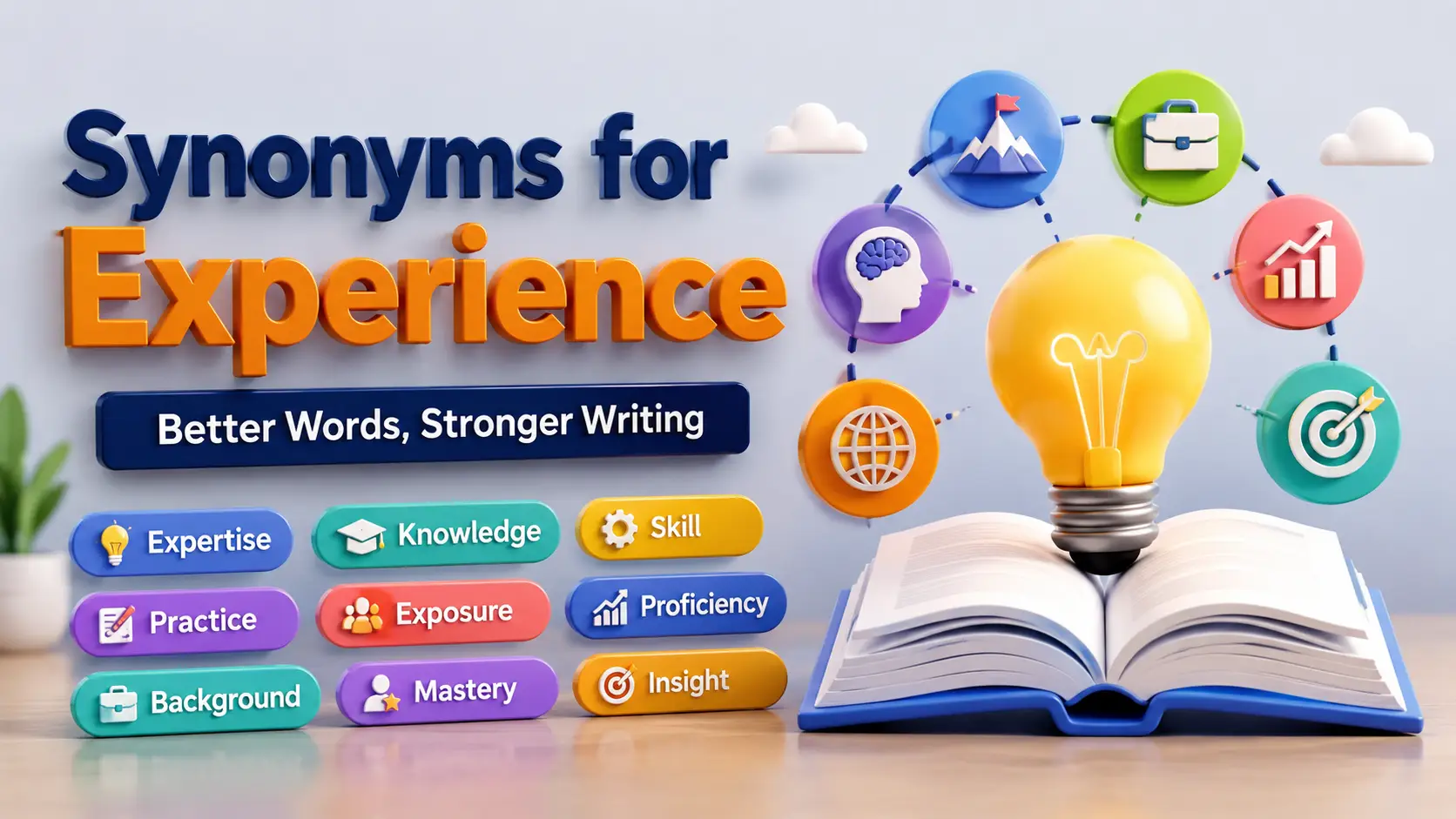
Looking for the right synonyms for experience can make your English clearer, stronger, and more natural. The word experience can describe knowledge gained through practice, professional skills, or something that happens in your life. Depending on the context, you might use words like expertise, knowledge, skill, practice, exposure, background, adventure, or encounter.
In this guide, you’ll discover useful alternatives to experience with simple meanings and examples. Whether you’re writing a resume, essay, email, business document, or everyday conversation, you’ll learn how to choose the best synonym without changing the original meaning.
📖 Meaning of Synonyms for Experience
The correct spelling is experience, not experince. The word experience can be a noun or a verb.
As a noun, experience can mean knowledge or skill gained by doing, seeing, or feeling something. It can also mean an event that happens to you. As a verb, experience means to go through something or have something happen to you.
Pronunciation: /ɪkˈspɪə.ri.əns/ (UK), /ɪkˈspɪr.i.əns/ (US)
Simple examples:
- She has five years of experience in teaching.
- The trip was an unforgettable experience.
- We experienced several problems during the project.
The best synonym depends on the meaning. For example, expertise works well when you mean professional knowledge, while adventure works when you mean an exciting event. Merriam-Webster and Cambridge both group synonyms for experience according to different meanings rather than treating every related word as an exact replacement.
📝 Top Synonyms of Experience
There isn’t one perfect synonym for experience in every sentence. The best alternative depends on whether you mean knowledge gained through practice, a particular event, or going through something. Here are accurate alternatives with their specific uses:
| Word | Meaning | Best Use | Example |
|---|---|---|---|
| Expertise | Specialized knowledge or skill | Professional | Her expertise in marketing is valuable. |
| Knowledge | Understanding gained through learning or experience | Academic | He has extensive knowledge of finance. |
| Skill | Ability gained through practice | Work | She has excellent computer skills. |
| Proficiency | A high level of skill or ability | Formal | His proficiency in English is impressive. |
| Familiarity | Knowledge gained through contact or use | General | She has familiarity with the software. |
| Practice | Repeated activity that develops ability | Education | Regular practice improves writing skills. |
| Training | Instruction that develops skills | Professional | His training prepared him for the job. |
| Background | Previous education, work, or knowledge | Resume/Business | She has a strong background in science. |
| Know-how | Practical knowledge of how to do something | Informal/Business | He has the know-how to fix the system. |
| Mastery | Very high or complete skill | Academic/Formal | She achieved mastery of the language. |
| Acquaintance | Basic knowledge of or familiarity with something | Formal | He has some acquaintance with classical literature. |
| Exposure | Contact with something that increases knowledge | Academic/Business | Students need exposure to different ideas. |
| Seasoning | Skill gained through long experience | Literary/Formal | Years of work gave him valuable seasoning. |
| Involvement | Participation in an activity or situation | Business/General | Her involvement in the project was valuable. |
| Hands-on knowledge | Knowledge gained through practical activity | Professional | The course provides hands-on knowledge. |
| Firsthand knowledge | Knowledge gained directly from personal experience | Formal/Academic | She has firsthand knowledge of the issue. |
| Personal knowledge | Knowledge gained directly from one’s own experience | General | He has personal knowledge of the situation. |
| Practical knowledge | Knowledge gained by doing something | Professional | The job gave her practical knowledge. |
| Adventure | An exciting or unusual experience | Travel/Creative | The trip was a memorable adventure. |
| Event | Something that happens | General | The event changed his perspective. |
| Episode | A particular event or period | Storytelling | It was an important episode in her career. |
| Incident | A specific event, often unusual | News/Formal | The incident taught us an important lesson. |
| Encounter | An unexpected meeting or experience | General/Formal | The encounter was memorable. |
| Occurrence | Something that happens | Formal | The occurrence was unusual. |
| Happening | Something that takes place | Informal | The strange happening surprised everyone. |
| Expedition | An organized journey, especially for exploration | Travel/Science | The expedition reached the mountain. |
| Journey | A trip or a process of personal development | Travel/Creative | The journey taught him patience. |
| Trial | A difficult experience or test | Formal | The difficult period was a trial for everyone. |
| Ordeal | A very difficult or painful experience | Serious/Formal | The accident was a terrible ordeal. |
| Venture | A new activity involving some risk | Business | Starting the company was a bold venture. |
| Undertaking | A task, project, or activity | Formal/Business | The project was a major undertaking. |
Many of these alternatives are contextual synonyms, not interchangeable words. Cambridge lists terms such as personal knowledge, firsthand knowledge, practice, training, familiarity, and exposure for the knowledge meaning, while words such as event, episode, incident, adventure, and encounter relate to the event meaning.
⚖️ Antonyms
The opposite of experience depends on the sense you’re using.
| Word | Meaning | Example |
| Inexperience | Lack of experience | His inexperience caused a few mistakes. |
| Ignorance | Lack of knowledge | Ignorance of the rules can cause problems. |
| Unfamiliarity | Lack of knowledge or contact | Her unfamiliarity with the system was clear. |
| Inexpertise | Lack of expert skill | His inexpertise made the task difficult. |
| Incompetence | Lack of ability to do something properly | The error showed serious incompetence. |
| Inactivity | Lack of action or activity | Long inactivity can reduce practical skills. |
| Avoidance | Staying away from something | Avoidance prevented him from learning. |
For the noun meaning related to knowledge or skill, inexperience is the clearest antonym. Cambridge also lists theory as an opposite in a particular contrast with practical experience.
💬 Example Sentences
Here are natural examples showing how experience and its alternatives work in different situations.
Daily Conversation
- I had a great experience at the concert.
- She has plenty of experience with children.
- That trip was a wonderful adventure.
- I’ve never had an experience like that before.
- We went through a difficult experience together.
- His knowledge helped us solve the problem.
Academic English
- Students gain practical experience through projects.
- The course provides valuable training.
- Her knowledge of history is impressive.
- Research gave the students firsthand exposure to the topic.
- Regular practice improves language skills.
Business English
- We need someone with relevant experience.
- She has extensive expertise in digital marketing.
- His professional background makes him suitable for the role.
- The company values practical knowledge.
- Her proficiency in data analysis helped the team.
Formal Writing
- The event was a significant episode in his career.
- The team encountered several challenges.
- The expedition became a valuable learning experience.
- Years of practice developed her mastery.
- The difficult period was an important trial.
Creative Writing
- The journey became an unforgettable adventure.
- Their unexpected encounter changed everything.
- The strange incident stayed in his memory.
- The trip was an experience he would never forget.
- The difficult ordeal made her stronger.
📚 Difference Between Similar Words
Choosing the right synonym isn’t just about finding a word with a similar dictionary meaning. The word must also fit the context.
| Word | Main Meaning | Use It When |
| Experience | Knowledge gained or something that happens | You want a broad, natural word |
| Expertise | Special knowledge or skill | Talking about professional ability |
| Knowledge | Facts or understanding | Talking about what someone knows |
| Skill | Ability to do something | Talking about practical ability |
| Practice | Repeated activity | Talking about learning through repetition |
| Training | Organized learning | Talking about preparation for a job or task |
| Background | Previous study or work | Talking about someone’s career or education |
| Familiarity | Knowledge from repeated contact | Talking about knowing something reasonably well |
| Exposure | Contact with something | Talking about gaining awareness or experience |
| Adventure | Exciting experience | Talking about travel or unusual events |
| Incident | A particular event | Talking about one specific occurrence |
| Ordeal | Very difficult experience | Talking about hardship |
| Encounter | Meeting or coming across something | Talking about an unexpected event or meeting |
Experience vs. Expertise
Experience is broader. It can mean time spent doing something, while expertise suggests a high level of specialized knowledge or skill.
- She has ten years of experience in teaching.
- She has considerable expertise in language education.
Experience vs. Knowledge
Knowledge is what you know. Experience often describes knowledge gained through doing, seeing, or feeling something.
- He has extensive knowledge of computers.
- He gained practical experience by repairing computers.
Experience vs. Adventure
An adventure is a type of experience, usually one that is exciting, unusual, or memorable.
- The training course was a useful experience.
- The mountain trip was an exciting adventure.
🎯 Best Alternative Words
Different situations call for different alternatives.
| Situation | Best Alternatives |
| Professional writing | Expertise, proficiency, background |
| Resume | Experience, skills, background, training |
| Essay writing | Knowledge, practice, exposure, firsthand knowledge |
| Business email | Experience, expertise, background |
| Job interview | Experience, skills, expertise |
| Academic writing | Knowledge, practice, exposure, observation |
| Daily conversation | Experience, adventure, event, encounter |
| Marketing | Customer experience, journey, interaction |
| Creative writing | Adventure, episode, encounter, journey |
| Formal writing | Expertise, proficiency, occurrence, ordeal |
For a resume, don’t replace experience with adventure or episode. The meaning changes completely. Likewise, expertise can sound stronger than experience because it focuses on specialized knowledge or skill.
✍ Grammar Tips
Experience has several useful forms.
| Form | Word | Example |
| Noun | experience | She has valuable experience. |
| Plural noun | experiences | His experiences shaped his career. |
| Verb | experience | We experience change every day. |
| Past tense | experienced | She experienced many challenges. |
| Present participle | experiencing | They are experiencing rapid growth. |
| Adjective | experienced | She is an experienced teacher. |
| Adjective | inexperienced | He is an inexperienced worker. |
Experience as an Uncountable Noun
When experience means general knowledge or skill, it is usually uncountable:
- She has five years of experience.
- He has experience in marketing.
Don’t normally say:
- ❌ She has five years of experiences.
Experience as a Countable Noun
When you mean separate events, experiences can be plural:
- Traveling gave her many new experiences.
- His childhood experiences influenced his writing.
❌ Common Mistakes
| Wrong | Correct | Reason |
| She has many years of experience. | She has many years of experience. | General work knowledge is usually uncountable. |
| He has an expertise in sales. | He has expertise in sales. | Expertise is normally uncountable. |
| I have experience in marketing. | I have experience in marketing. | Use experience in an area of work. |
| She is experienced. | She is experienced. | Experienced is the adjective. |
| He experienced an adventure. | He had an adventure. | Experience as a verb is less natural with many event nouns. |
| His experiences are useful. | His experiences are useful. | Use the plural when referring to separate events. |
| I am experienced with software. | I am experienced with software. | Use experience after “am.” |
💡 Pro Writing Tips
A good writer doesn’t replace every occurrence of experience with a synonym. Instead, choose a word that gives the reader a more exact meaning.
Use expertise for specialist knowledge
Her expertise in SEO helped the company grow.
Use skills for abilities
His communication skills are excellent.
Use background for career history
She has a strong background in education.
Use familiarity for basic or moderate knowledge
The job requires familiarity with spreadsheet software.
Use adventure for exciting events
Their trip became an unforgettable adventure.
Use ordeal for a painful or difficult experience
The accident was a terrible ordeal.
Use encounter for an unexpected meeting or event
His encounter with the author inspired him.
The goal isn’t to use the fanciest word. The goal is precision. A simple word that fits the sentence is usually better than an unusual synonym that changes the meaning.
📖 Related Words
Here are useful words connected with experience:
- Knowledge
- Skill
- Expertise
- Proficiency
- Practice
- Training
- Familiarity
- Exposure
- Background
- Mastery
- Acquaintance
- Learning
- Education
- Development
- Growth
- Participation
- Involvement
- Observation
- Adventure
- Journey
- Encounter
- Event
- Episode
- Incident
- Occurrence
- Ordeal
- Trial
- Venture
- Undertaking
- Challenge
Useful phrases with Experience
- work experience
- professional experience
- practical experience
- relevant experience
- previous experience
- hands-on experience
- firsthand experience
- personal experience
- life experience
- customer experience
- learning experience
- valuable experience
- extensive experience
- limited experience
- gain experience
- get experience
- have experience
- learn from experience
- from personal experience
- in my experience
❓ FAQs
What is another word for experience?
Another word for experience depends on the meaning. Expertise, knowledge, skill, proficiency, familiarity, practice, and background work when you mean knowledge or ability. For an event, alternatives include adventure, episode, incident, encounter, and occurrence. There isn’t one synonym that works perfectly in every sentence.
What is a professional synonym for experience?
Expertise, proficiency, background, and professional knowledge are useful professional alternatives to experience. However, experience is often the most natural word on a resume or in a business setting. Use expertise when you want to emphasize specialized knowledge or a high level of skill rather than simply time spent doing a job.
What is a synonym for work experience?
Useful alternatives for work experience include professional background, practical experience, professional experience, hands-on experience, and industry experience. The best choice depends on your sentence. On a resume, professional experience or work experience is usually clearer than replacing the phrase with an uncommon synonym.
What is the opposite of experience?
The clearest opposite of experience when it means knowledge or skill is inexperience. Other context-dependent opposites include ignorance, unfamiliarity, and inexpertise. Cambridge’s thesaurus specifically lists inexperience and, in a particular contrast, theory as antonyms related to the noun experience.
Is expertise the same as experience?
No. Experience means knowledge or skill gained through doing, seeing, or feeling things, while expertise means specialized knowledge or skill. A person can have many years of experience without being an expert. Expertise is therefore a narrower and often stronger word than experience in professional writing.
Is experience a noun or a verb?
Experience can be both a noun and a verb. As a noun, it can mean knowledge gained through activity or an event that happens to someone. As a verb, it means to have something happen to you or to feel something. For example, “She has experience” and “She experienced difficulty” are both correct.
What is a synonym for experience in a resume?
For a resume, useful related terms include professional experience, work history, professional background, practical experience, expertise, and skills. However, these aren’t identical. Work history focuses on previous jobs, while expertise emphasizes specialized ability. In most resumes, the heading Professional Experience remains clear and standard.
How can I avoid repeating the word experience?
Use a context-specific alternative instead of changing every occurrence. Try expertise for specialist knowledge, skills for abilities, background for career history, knowledge for understanding, and adventure or encounter for memorable events. Sometimes the best solution is simply to rewrite the sentence rather than force in a synonym.
📌 Conclusion
The word experience is flexible, so the best synonym depends on what you mean. For professional knowledge, choose words such as expertise, proficiency, skill, or background. Learning, practice, training, exposure, and knowledge can work well. For memorable events, consider adventure, encounter, episode, incident, or journey.