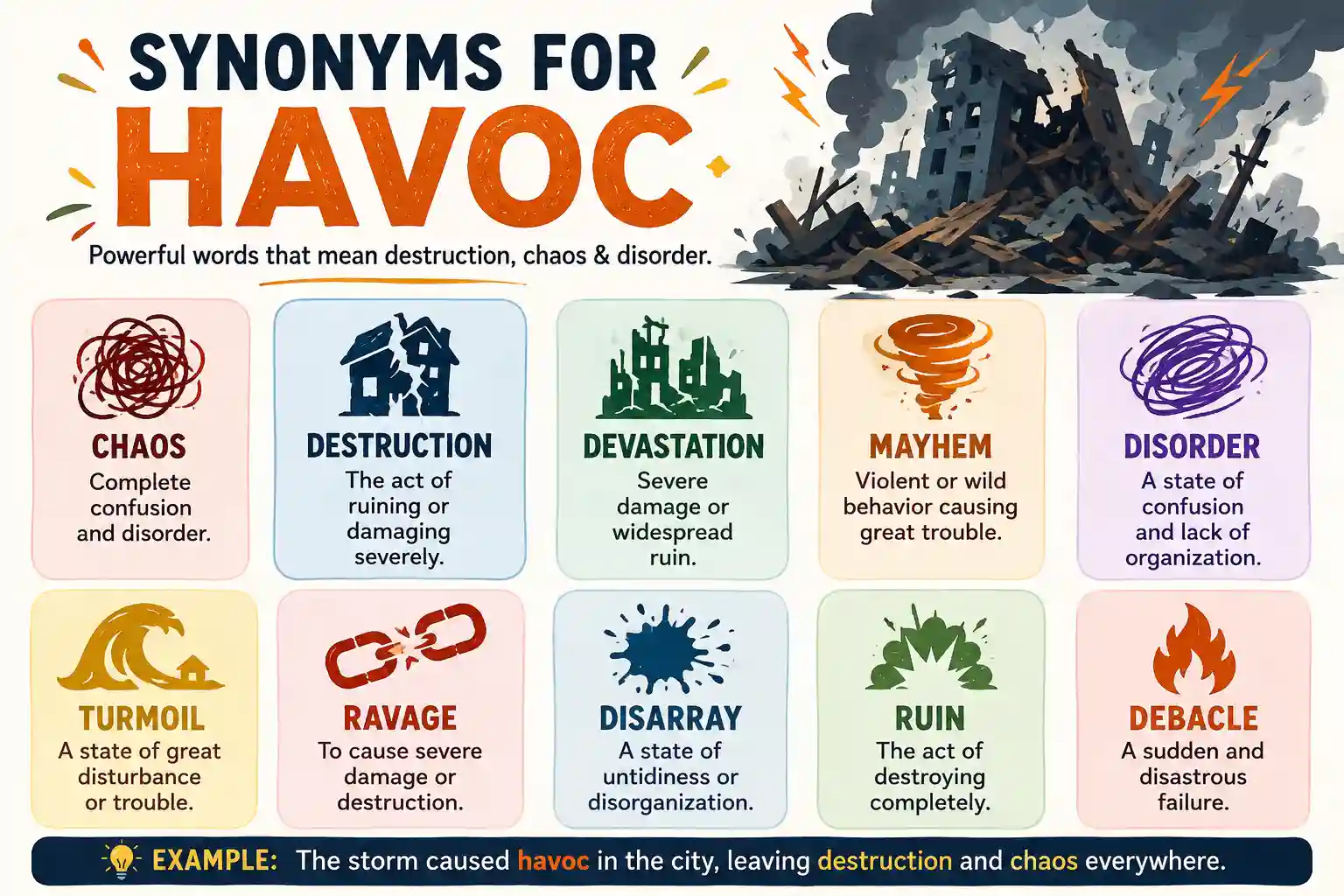
Looking for the best synonyms for havoc? The word havoc describes serious damage, destruction, confusion, or disorder, but the right alternative depends on the context. Words like chaos, destruction, devastation, disorder, mayhem, turmoil, and disarray can express different shades of meaning.
In this guide, you’ll discover the most useful synonyms for havoc, their simple meanings, differences, and real-life examples. Whether you’re writing an essay, email, article, or everyday conversation, you’ll learn how to choose the right word and make your English clearer and more natural.
📖 Meaning of Havoc
Havoc is a noun that describes serious damage, destruction, confusion, or disorder. It is commonly used when an event, person, or situation causes widespread trouble.
For example:
- The storm caused havoc in the city.
- The computer virus created havoc across the network.
- Heavy traffic played havoc with our travel plans.
Cambridge defines havoc as confusion and lack of order, especially when it causes damage or trouble. Merriam-Webster gives two main senses: widespread destruction and great confusion or disorder.
Pronunciation: /ˈhæv.ək/
Part of speech: Noun; it can also be used as a verb in less common usage.
Simple meaning:
Havoc means a situation where serious damage, confusion, or disorder has been caused.
Oxford also lists havoc as an uncountable noun and notes common combinations such as cause havoc, create havoc, play havoc with, and wreak havoc.
Word Origin
The word havoc comes from Middle English and Anglo-Norman French. Oxford explains that it was originally connected with the phrase “cry havoc,” an order associated with plundering after a military victory.
📝 Top Synonyms of Havoc
Not every synonym for havoc has exactly the same meaning. Some focus on damage, while others describe confusion, disorder, or disruption. Choose the word that best matches your context.
| Synonym | Meaning | Best Use | Example |
| Chaos | A state of complete confusion or disorder | General situations | The storm left the city in chaos. |
| Destruction | Severe damage that ruins or destroys something | Physical damage | The fire caused widespread destruction. |
| Devastation | Very severe damage, loss, or destruction | Disasters | The earthquake caused widespread devastation. |
| Disorder | A lack of order or organization | Formal writing | The conflict caused disorder in the region. |
| Disarray | A state of confusion or poor organization | Work and organization | The office was left in disarray. |
| Mayhem | Extreme confusion, disorder, or violence | Dramatic situations | The accident caused mayhem on the highway. |
| Turmoil | A state of great confusion, uncertainty, or unrest | Social, political, and business contexts | The company was in turmoil after the merger. |
| Upheaval | A major change that causes disruption | Social and business changes | The reform caused economic upheaval. |
| Confusion | A lack of clarity, understanding, or order | General situations | The sudden change created confusion. |
| Damage | Physical harm or loss caused to something | Accidents and disasters | The storm caused serious damage. |
| Ruin | A state of severe damage or destruction | Places, buildings, and situations | The flood left the old building in ruin. |
| Disruption | An interruption that prevents something from continuing normally | Business, travel, and systems | The outage caused major disruption. |
| Disturbance | Something that interrupts peace, order, or normal activity | Formal and general use | The protest caused a disturbance. |
| Commotion | Noisy confusion or excited activity | Everyday situations | The announcement caused a commotion. |
| Pandemonium | Wild and noisy confusion | Crowds and dramatic events | Pandemonium broke out after the announcement. |
| Uproar | A loud reaction caused by anger, excitement, or disagreement | Public reactions | The decision caused an uproar. |
| Tumult | Loud, confused, and disorderly activity | Formal or literary writing | The streets were filled with tumult. |
| Anarchy | A complete lack of government, order, or control | Political and social contexts | The collapse of the government led to anarchy. |
| Catastrophe | A disastrous event causing serious damage or suffering | Major disasters | The flood became a national catastrophe. |
| Calamity | A serious event that causes great trouble or suffering | Formal and literary writing | The drought was a terrible calamity. |
| Disaster | A sudden event causing great damage, loss, or suffering | General and formal writing | The storm was a major disaster. |
⭐ Most Direct Synonyms for Havoc
For the closest and most useful alternatives, focus on these words:
- Chaos
- Destruction
- Devastation
- Disorder
- Disarray
- Mayhem
- Turmoil
- Upheaval
- Confusion
- Disruption
🎯 Choose the Right Synonym
- Chaos → when the main idea is complete disorder
- Destruction → when something is seriously damaged or destroyed
- Devastation → when destruction is severe and widespread
- Disorder → when there is a lack of order or control
- Disarray → when things are poorly organized
- Mayhem → when there is extreme disorder or violence
- Turmoil → when people, organizations, or societies face serious instability
- Upheaval → when major change causes disruption
- Confusion → when people don’t understand what is happening
- Disruption → when normal activities are interrupted
🔥 Wreak Havoc Synonyms
Wreak havoc means to cause widespread damage, destruction, confusion, or disruption. The best alternative depends on what kind of harm or trouble you’re describing.
| Alternative | Meaning | Best Use | Example |
| Cause damage | Make something suffer physical or other harm | General use | The storm caused serious damage to the buildings. |
| Cause destruction | Lead to severe physical damage or ruin | Disasters and conflict | The fire caused widespread destruction. |
| Cause devastation | Cause severe and widespread damage or loss | Natural disasters | The earthquake caused widespread devastation. |
| Create chaos | Cause extreme confusion or disorder | Crowds, systems, and situations | The sudden outage created chaos at the airport. |
| Cause disruption | Interrupt normal activities or services | Business and daily life | The strike caused major disruption to public transport. |
| Create disorder | Cause a lack of order or control | Formal and social contexts | The conflict created disorder in the region. |
| Cause havoc | Cause serious trouble, damage, or disorder | General use | The storm caused havoc across the city. |
| Cause mayhem | Create extreme confusion or disorder | Dramatic situations | The accident caused mayhem on the highway. |
| Cause turmoil | Create serious confusion, instability, or unrest | Social and business contexts | The scandal caused turmoil within the company. |
| Disrupt | Prevent something from continuing normally | Systems, services, and plans | The storm disrupted air travel. |
| Damage | Harm or impair something | General and physical harm | The flood damaged hundreds of homes. |
| Devastate | Destroy or severely damage something | Very serious damage | The hurricane devastated coastal communities. |
Best Alternatives by Context
- Wreak havoc on buildings → cause serious damage
- Wreak havoc on a city → cause widespread destruction
- Wreak havoc on traffic → cause major disruption
- Wreak havoc on a computer system → disrupt the system
- Wreak havoc on plans → disrupt or seriously affect plans
- Wreak havoc in a crowd → create chaos or cause mayhem
- Wreak havoc on a business → cause serious disruption or damage
- Wreak havoc on an ecosystem → cause widespread damage or devastation
Examples of Wreak Havoc Synonyms
- The hurricane wreaked havoc on the coast.
- The hurricane caused widespread damage to the coast.
- The cyberattack wreaked havoc on the company’s network.
- The cyberattack disrupted the company’s network.
- The heavy snowfall wreaked havoc with travel plans.
- The heavy snowfall caused major disruption to travel.
- The sudden announcement created chaos among employees.
- The earthquake caused widespread devastation across the region.
Quick Tip
Don’t replace wreak havoc with the same synonym in every sentence. Choose the alternative according to the meaning:
Damage → cause damage
Destruction → cause destruction
Severe loss → cause devastation
Confusion → create chaos
Interruption → cause disruption
Disorder → create disorder
Extreme disorder → cause mayhem
Instability → cause turmoil
⚖️ Antonyms of Havoc
The opposite of havoc depends on which meaning you’re using. If havoc means confusion or disorder, words such as order and organization work well. If it means destruction, preservation and protection can be better opposites.
| Antonym | Meaning | Example |
| Order | A well-organized state | The room was restored to order. |
| Peace | A calm, nonviolent state | The town returned to peace. |
| Calm | A quiet and peaceful condition | The sea became calm again. |
| Stability | A steady condition | The economy regained stability. |
| Organization | Proper arrangement | Better organization improved the office. |
| Harmony | Agreement and balance | The team worked in harmony. |
| Control | Power to manage something | The manager regained control. |
| Discipline | Orderly behavior | Discipline restored order. |
| Preservation | Protection from damage | Preservation saved the historic building. |
| Protection | Keeping something safe | The new system provides protection. |
💬 Example Sentences With Havoc
Here are natural examples showing how havoc works in different situations.
Daily Conversation
- The rain caused havoc on the roads.
- The kids created havoc in the living room.
- The broken elevator caused havoc in the building.
- A power cut created havoc during the evening.
- The traffic accident caused havoc downtown.
Academic English
- Climate change can cause havoc in vulnerable ecosystems.
- Poor planning may create havoc in public services.
- The disease caused widespread havoc in the region.
- Economic instability can wreak havoc on families.
- The study examines how disasters create social upheaval.
Business English
- The software failure caused havoc across the company.
- The sudden resignation created confusion among employees.
- Supply problems caused serious disruption.
- The delay played havoc with the production schedule.
- Poor communication can create organizational disorder.
Formal Writing
- The severe storm caused widespread destruction.
- The conflict resulted in considerable devastation.
- The policy created economic turmoil.
- The flood left the region in disarray.
- The unexpected decision caused considerable upheaval.
Creative Writing
- The wildfire swept across the valley, leaving devastation behind.
- By morning, the once-busy street lay in ruins.
- Pandemonium spread through the crowd.
- The storm turned the peaceful harbor into chaos.
- The battle left nothing but wreckage behind.
📚 Difference Between Similar Words
The most common mistake is assuming that every synonym of havoc has exactly the same meaning. They don’t.
| Word | Main Idea | Strength | Example |
| Havoc | Damage + disorder | Strong | The storm caused havoc. |
| Chaos | Complete lack of order | Strong | The office descended into chaos. |
| Destruction | Physical or total damage | Very strong | The fire caused destruction. |
| Devastation | Severe destruction and loss | Very strong | The earthquake caused devastation. |
| Disorder | Lack of order | Moderate | The room was in disorder. |
| Mayhem | Extreme confusion, often with violence | Strong | The accident caused mayhem. |
| Turmoil | Serious emotional/social confusion | Strong | The company was in turmoil. |
| Upheaval | Major disruptive change | Strong | The industry faced upheaval. |
| Commotion | Noisy disturbance | Mild–moderate | The announcement caused a commotion. |
| Disarray | Poor organization | Moderate | The files were in disarray. |
Havoc vs. Chaos
Havoc often suggests that confusion or disorder has caused damage or trouble. Chaos focuses more directly on a complete lack of order.
- The storm caused havoc in the village.
- The office was in chaos after the move.
Havoc vs. Destruction
Destruction specifically emphasizes things being damaged or destroyed. Havoc can include destruction but may also refer to confusion and disruption.
- The fire caused destruction.
- The fire caused havoc throughout the neighborhood.
Havoc vs. Mayhem
Mayhem often suggests extreme confusion, disorder, and sometimes violence. It’s more dramatic than ordinary havoc.
Havoc vs. Turmoil
Turmoil is especially useful for emotional, political, social, or business situations.
- The country was in political turmoil.
- The earthquake caused widespread havoc.
🎯 Best Alternative Words for Different Situations
| Situation | Best Alternative | Why |
| Professional writing | Disruption | Clear and neutral |
| Academic essay | Disorder | Formal and precise |
| Natural conversation | Chaos | Common and easy |
| Disaster report | Devastation | Shows severe destruction |
| Business report | Upheaval | Good for major changes |
| News writing | Destruction | Direct and clear |
| Dramatic writing | Mayhem | Strong emotional effect |
| Social issues | Turmoil | Fits instability |
| Formal writing | Disarray | Precise and polished |
| Creative writing | Ruin | Strong visual effect |
| Traffic problems | Chaos | Natural everyday choice |
| Physical damage | Destruction | Most precise |
| Economic problems | Turmoil | Natural for instability |
| Crowds/events | Pandemonium | Highlights noise and confusion |
🧩 Havoc Synonym Figgerits
If you’re solving a Figgerits puzzle and need a synonym for havoc, the answer usually depends on the number of letters available. Havoc means serious confusion, disorder, damage, or destruction, so several words can fit different clues.
Common Havoc Synonyms for Figgerits
| Synonym | Meaning | Letters |
| Chaos | Complete confusion or disorder | 5 |
| Mayhem | Extreme disorder or confusion | 6 |
| Disorder | Lack of order or control | 8 |
| Damage | Physical or other harm | 6 |
| Ruin | Severe damage or destruction | 4 |
| Turmoil | Serious confusion or unrest | 7 |
| Disarray | A state of disorder or poor organization | 8 |
| Devastation | Severe and widespread destruction | 11 |
| Destruction | Severe damage or the act of destroying | 11 |
Best Figgerits Answer for “Havoc”
If the clue simply asks for a 5-letter synonym for havoc, CHAOS is the strongest common answer.
Havoc → CHAOS
If the puzzle requires:
- 4 letters: RUIN
- 5 letters: CHAOS
- 6 letters: MAYHEM / DAMAGE
- 7 letters: TURMOIL
- 8 letters: DISORDER / DISARRAY
- 11 letters: DEVASTATION / DESTRUCTION
Quick Tip
For Figgerits and other word puzzles, always check the number of letters and crossing letters before choosing an answer. Several synonyms can describe havoc, but CHAOS is usually the most natural short answer.
✍️ Grammar Tips
Is Havoc a Noun?
Yes. Havoc is mainly an uncountable noun.
Say:
- The storm caused havoc.
- The storm caused a lot of havoc.
Avoid:
- The storm caused havoc.
Because havoc is normally uncountable, don’t usually put a/an before it. Oxford specifically identifies it as an uncountable noun.
Common Expressions With Havoc
The most useful collocations include:
Wreak havoc
- The storm wreaked havoc on the coast.
Cause havoc
- The delay caused havoc with our plans.
Create havoc
- The computer problem created havoc in the office.
Play havoc with
- The bad weather played havoc with the schedule.
These patterns are widely recognized in dictionary usage guidance.
Is Havoc a Verb?
Yes, havoc can also function as a verb, although this use is much less common than the noun.
Merriam-Webster records the verb havoc, with forms such as havocked and havocking, meaning to lay waste or destroy.
For everyday English, however, the noun is much more useful.
❌ Common Mistakes With Havoc
| Wrong | Correct | Reason |
| The storm caused havoc in the city. | The storm caused havoc in the city. | Havoc is normally an uncountable noun, so don’t use a/an before it. |
| The storm wreaked havoc in the village. | The storm caused havoc in the village. | Cause havoc is a standard and natural English collocation. |
| The hurricane did havoc along the coast. | The hurricane wreaked havoc along the coast. | Wreak havoc is the established expression for causing widespread damage or disruption. |
| The flood wreaked damage across the region. | The flood caused damage across the region. | We normally say cause damage but wreak havoc. |
| The company was in havoc after the system failure. | The company was in chaos after the system failure. | In chaos is natural English; in havoc is not a standard expression. |
| The room was in mayhem after the party. | The room was in chaos after the party. | Mayhem is normally used as a noun for extreme disorder; in chaos is the natural phrase. |
| The country was in destruction after the war. | The country was in turmoil after the war. | Turmoil describes serious confusion or instability; destruction describes damage itself. |
| The accident caused many havocs on the highway. | The accident caused a lot of havoc on the highway. | Havoc is normally uncountable and doesn’t usually take a plural -s. |
| The bad weather created havoc with our plans. | The bad weather created havoc with our plans. | Don’t use a before uncountable havoc. |
| The virus played havoc with the computer system. | The virus played havoc with the computer system. | The standard expression is play havoc with something. |
| The storm wreaked havoc with several buildings. | The storm wreaked havoc on several buildings. | Wreak havoc on something is the more natural construction when referring to damage. |
| The delay caused a lot of damage to our schedule. | The delay caused a lot of disruption to our schedule. | Damage is normally uncountable when referring to harm; disruption is more precise for schedules and plans. |
Quick Rule
Remember these common patterns:
- cause havoc
- create havoc
- wreak havoc
- play havoc with something
- havoc is normally uncountable
Correct: The storm caused havoc.
Incorrect: The storm caused havoc.
💡 Pro Writing Tips
A good synonym shouldn’t simply replace a word. It should preserve the meaning and tone of the sentence.
Use chaos when the main idea is confusion.
Use destruction when something has been physically damaged or destroyed.
Quick Rule
Ask yourself:
“Am I describing damage, confusion, or major change?”
- Damage → destruction / devastation
- Confusion → chaos / disorder
- Extreme disorder → mayhem / pandemonium
- Instability → turmoil
- Major change → upheaval
- Poor organization → disarray
This simple test can help you choose a more accurate synonym instead of forcing a word into a sentence.
📖 Related Words
Here are useful words that commonly appear around havoc:
Words Related to Damage
- Damage
- Destruction
- Devastation
- Ruin
- Wreckage
- Ruination
- Desolation
- Annihilation
- Loss
- Harm
Related to Disorder
- Chaos
- Confusion
- Disorder
- Disarray
- Mayhem
- Pandemonium
- Commotion
- Tumult
- Uproar
- Anarchy
Words Related to Disruption
- Disturbance
- Upheaval
- Turmoil
- Disruption
- Instability
- Crisis
- Trouble
- Complication
- Interruption
- Unrest
❓ FAQs
What is a synonym for the word “havoc”?
A common synonym for havoc is chaos. Other alternatives include destruction, devastation, disorder, mayhem, turmoil, and disarray, depending on the context.
What are 5 strong synonyms?
Five strong synonyms for havoc are chaos, destruction, devastation, mayhem, and turmoil. Use destruction for serious damage, chaos for confusion, and turmoil for serious instability or unrest.
What is a fancy word for chaos?
A fancy or more formal word for chaos is pandemonium, disarray, tumult, or turmoil. Pandemonium suggests wild confusion, while disarray is useful for a poorly organized situation.
What is havoc in simple words?
Havoc means a lot of damage, trouble, confusion, or disorder caused by a person, event, or situation. For example, “The storm caused havoc” means the storm created serious problems or damage.
What is the opposite of havoc?
Possible opposites of havoc include order, peace, calm, stability, organization, harmony, control, and discipline. The best antonym depends on context. If havoc means physical destruction, preservation or protection may be a more accurate opposite.
What is the difference between havoc and destruction?
Havoc can mean both serious damage and disorder, while destruction focuses specifically on things being damaged or destroyed. For example, a storm can cause havoc with traffic and schedules, while destruction usually refers to physical or total damage.
What is a strong word for havoc?
Strong alternatives include devastation, destruction, mayhem, catastrophe, cataclysm, and ruination. The right choice depends on context. Devastation emphasizes severe damage, mayhem emphasizes extreme disorder, and catastrophe describes a major disaster or disastrous event.
🔎 Quick Synonym Finder
If you’re looking for a synonym for havoc, use this quick guide:
- Chaos → confusion
- Disorder → lack of order
- Disarray → poor organization
- Mayhem → extreme disorder
- Destruction → severe damage
- Devastation → widespread severe damage
- Turmoil → instability
- Upheaval → major disruptive change
- Commotion → noisy disturbance
- Pandemonium → wild confusion
- Ruin → severe damage or loss
- Catastrophe → major disaster
🏆 Final Takeaway
There isn’t one perfect synonym for havoc in every sentence. The strongest choice depends on the exact meaning you want.
If you’re talking about confusion, choose chaos or disorder. For serious damage, choose destruction or devastation. For instability, turmoil is often better, while upheaval works well for major disruptive change.
Learning these differences will make your writing more precise and natural. Instead of replacing havoc with the first synonym you find, think about the exact idea you want to express.